

People everywhere are struggling with the fatal impacts of worsening extreme heat, which is also damaging economies, widening inequalities and undermining green development, U.N. Secretary-General António Guterres said on Thursday.
Calling for global action to limit the devastating consequences, the head of the United Nations said “billions of people are facing an extreme heat epidemic – wilting under increasingly deadly heatwaves”.
Extreme-heat events have been getting more frequent, intense and longer-lasting in recent decades as a result of human-made climate change.
Guterres’ appeal comes as the record for the world’s hottest day was set twice on consecutive days this week, according to Europe’s Copernicus Climate Change Service. Monday beat Sunday, with the global average surface air temperature reaching 17.15 Celsius, as parts of the world sweltered through fierce heatwaves from the Mediterranean to Russia and Canada.
Guterres said the UN had just received preliminary data indicating that Tuesday “was in the same range”, which would make a third hottest straight day on record, if confirmed.
In a speech, he noted that heat – driven by “fossil fuel-charged, human-induced climate change” – is estimated to kill almost half a million people a year, about 30 times more than tropical cyclones.

United Nations Secretary-General Antonio Guterres speaks during the United Nations Climate Change Conference (COP28) in Dubai, December 1, 2023. COP28/Christophe Viseux/Handout via REUTERS
This year alone, extreme heat struck highly vulnerable communities across the Sahel region, killed at least 1,300 pilgrims in Mecca during Hajj and shut down schools across Asia and Africa affecting more than 80 million children.
“And we know it’s going to get worse. Extreme heat is the new abnormal,” Guterres added in his speech to journalists at UN headquarters in New York.
The Secretary-General’s “call for action” brings together ten specialised UN agencies for the first time in an urgent and concerted push to strengthen international cooperation in addressing extreme heat.
Focus on most vulnerable
Guterres listed four areas where greater efforts could be made to keep people, societies and economies safer from the negative consequences of rising global temperatures.
He emphasised the importance of “caring for the most vulnerable” – with those at greatest risk including poor people in urban areas, pregnant women, people with disabilities, the elderly, children, those who are sick and people who are displaced from their homes.
Households living in poverty often live in substandard homes without access to cooling, he added, appealing for a boost in access to low-carbon cooling and expanded use of natural measures – which include planting trees for shade – and better urban design, alongside a ramp-up of heat warning systems.

Graphic from Lancet Countdown on Health and Climate Change
Workers also need more protection, he said, as a new report from the International Labour Organization warned that over 70 percent of the global workforce – 2.4 billion people – are now at high risk of extreme heat, especially in Asia-Pacific, Africa and the Arab States.
The UN is calling on governments to urgently review laws and regulations on occupational safety and health to integrate provisions for extreme heat, including the right to refuse working in extreme hot weather.
Energy transition and adaptation
A third area targeted by the UN for action is making economies and societies better able to withstand heat, through stronger infrastructure, more resilient crops, and efforts to ease the pressure on health systems and water supplies.
“Countries, cities, and sectors need comprehensive, tailored Heat Action Plans, based on the best science and data,” Guterres said.
Lastly, the UN chief urged stepped-up action to “fight the disease”, by phasing out fossil fuels “fast and fairly” including no new coal projects, with the aim of limiting global warming to 1.5C – a goal nearly 200 governments signed up to in the 2015 Paris Agreement.
“I must call out the flood of fossil fuel expansion we are seeing in some of the world’s wealthiest countries,” he emphasised. “In signing such a surge of new oil and gas licenses, they are signing away our future.”
The United States, Canada, Australia, Norway and the UK have issued two-thirds of the global number of oil and gas licences since 2020, according to research published by the International Institute for Sustainable Development this week.
‘Still time to act’
Commenting on the UN’s call to action, Alan Dangour, director of climate and health at Wellcome, a UK-based science foundation, noted that people working outside in physical jobs and those who cannot afford to adapt to rising heat are particularly exposed – but the effects are far broader.
“The levels of heat we now routinely see around the world put every part of society under extreme pressure, directly harming our health while also affecting food and water security and much of our vital infrastructures,” he said in a statement.
Speaking to journalists on Thursday, scientists convened by Wellcome said there are positive measures that can be taken to combat the problem of extreme heat, which can also bring wider social benefits.
UAE’s ALTÉRRA invests in fund backing fossil gas despite “climate solutions” pledge
For example, they explained that using community facilities as cooling centres can offer older people a place to chat or play cards, tackling social isolation and heat stress at the same time. Or adding shades with solar panels to market stalls can help women traders keep working on hot days while also providing free electricity for their businesses.
“There is still time for concerted action to save lives from the impacts of climate change, but we can no longer afford to delay,” Dangour said.
The UN’s call for action points out that existing tools to reduce the devastating consequences of extreme heat could be deployed with large and far-reaching effects. Guterres said the good news is that “there are solutions… that we can save lives and limit its impact”.
For example, a global scale-up of heat health warning systems could save more than 98,000 lives every year, according to the World Health Organization. And the rollout of occupational safety and health measures could avoid $361 billion a year in medical and other costs, the ILO has estimated.
The UN chief urged a “huge acceleration of all the dimensions of climate action” as global warming is currently outpacing efforts to fight it. That could start to change, he added, as heatwaves, impacts on public health and disasters such as Canada’s wildfires are now hitting the richest countries as well as poorer ones.
“The heat is being felt by those that have decision-making capacity – and that is my hope,” he said.
(Reporting and editing by Matteo Civillini and Megan Rowling)
The post UN chief appeals for global action to tackle deadly extreme heat appeared first on Climate Home News.
UN chief appeals for global action to tackle deadly extreme heat

For the first time, new-energy vehicles (NEVs) made up 67% of new car sales in China in September, according to the latest data from the China Passenger Car Association (CPCA).
The figures show that NEVs, which include battery electric cars and plug-in hybrids, captured a record share of sales, even though fewer were sold than last year.
This is because sales of combustion-engine cars are falling steeply, a trend that the CPCA has attributed to rising petrol prices following the start of the Hormuz crisis.
Indeed, sales of fuel-only cars were down 31% year-on-year in the first nine months of 2026, with plug-in hybrid sales down 26% – whereas battery EV sales were only down 4%.
One analyst tells Carbon Brief that China’s rapidly growing EV fleet has offset demand for 143m barrels of oil since the start of the Hormuz crisis.
Another says that the crisis is “reinforcing China’s electrification of road transport”.
Meanwhile, amid slowing domestic sales, Chinese carmakers’ exports of NEVs more than doubled [in 2026 to date / in September] from a year earlier.
NEV record
A record two out of every three cars sold in September in China were NEVs, according to CPCA data, as shown in the figure below.
(NEVs predominantly include battery electric vehicles – BEVs – and plug-in hybrids – PHEVs. BEVs only run on electricity, whereas PHEVs also have a combustion engine.)
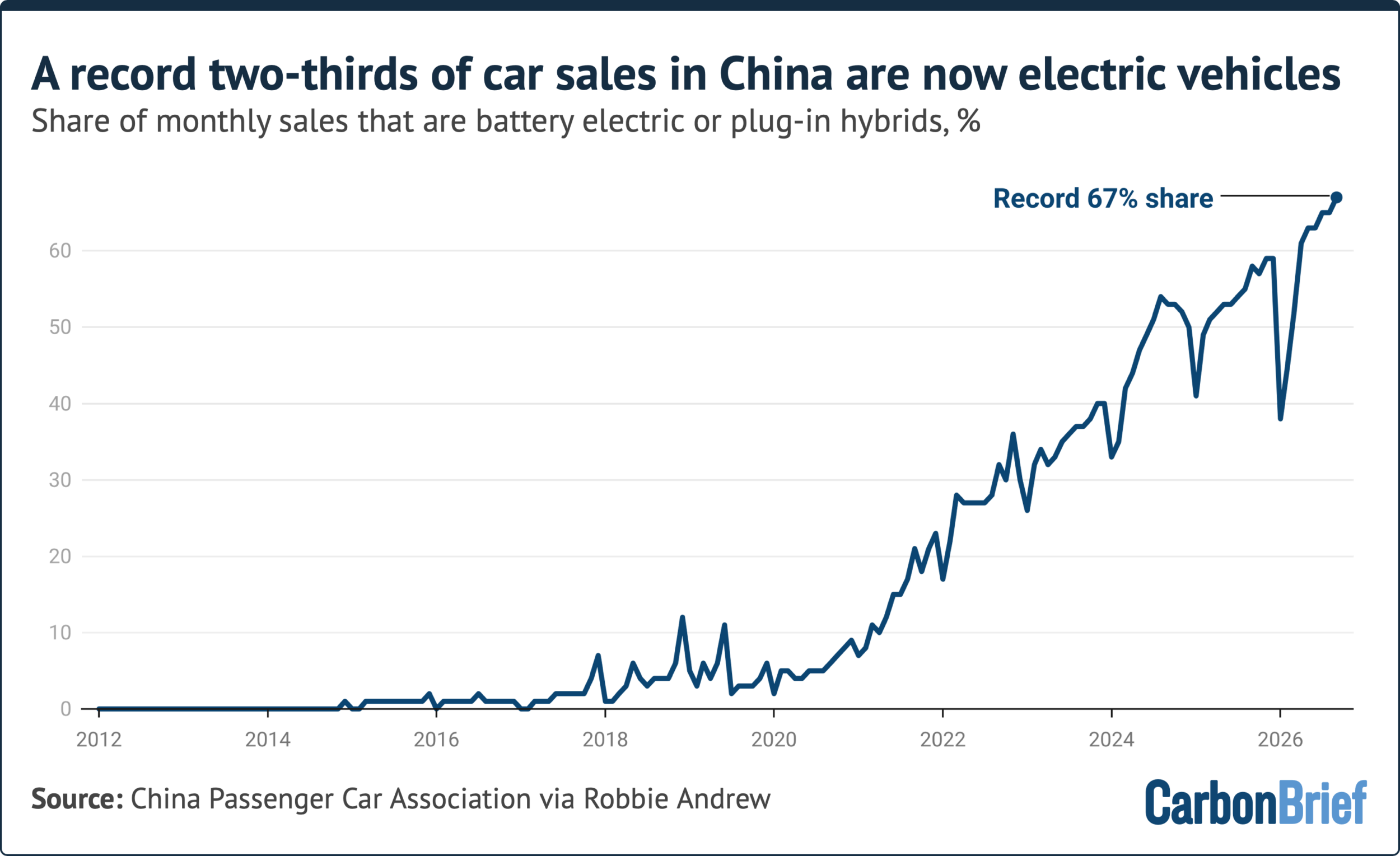
This marks a rapid rise for NEVs from just 6% of new car sales in 2020 up to 58% in 2026 to date – and a record 67% in the month of September.
This year, NEVs’ share of sales has also bounced back from a low of 39% in January, after the full purchase tax exemption that had been in place for more than a decade came to an end in December 2025.
The gain in NEV share in 2026 has come amid a slowdown across the wider domestic passenger-car market, which has hit sales of combustion-engine vehicles particularly hard.
This September, passenger-car retail sales across all categories declined, with overall sales volumes falling 28% year-on-year.
The contraction was led by combustion-engine vehicles, which saw sales fall 43% year-on-year in September and 31% in 2026 to date.
However, sales of PHEVs also fell by 36% year-on-year in September and by 26% in 2026 to date. By comparison, BEVs performed better, although sales still declined 8.5% from a year earlier in September and 4% in 2026 to date.
As a result, NEV sales overall fell by 17% in September and 13% in 2026 to date.
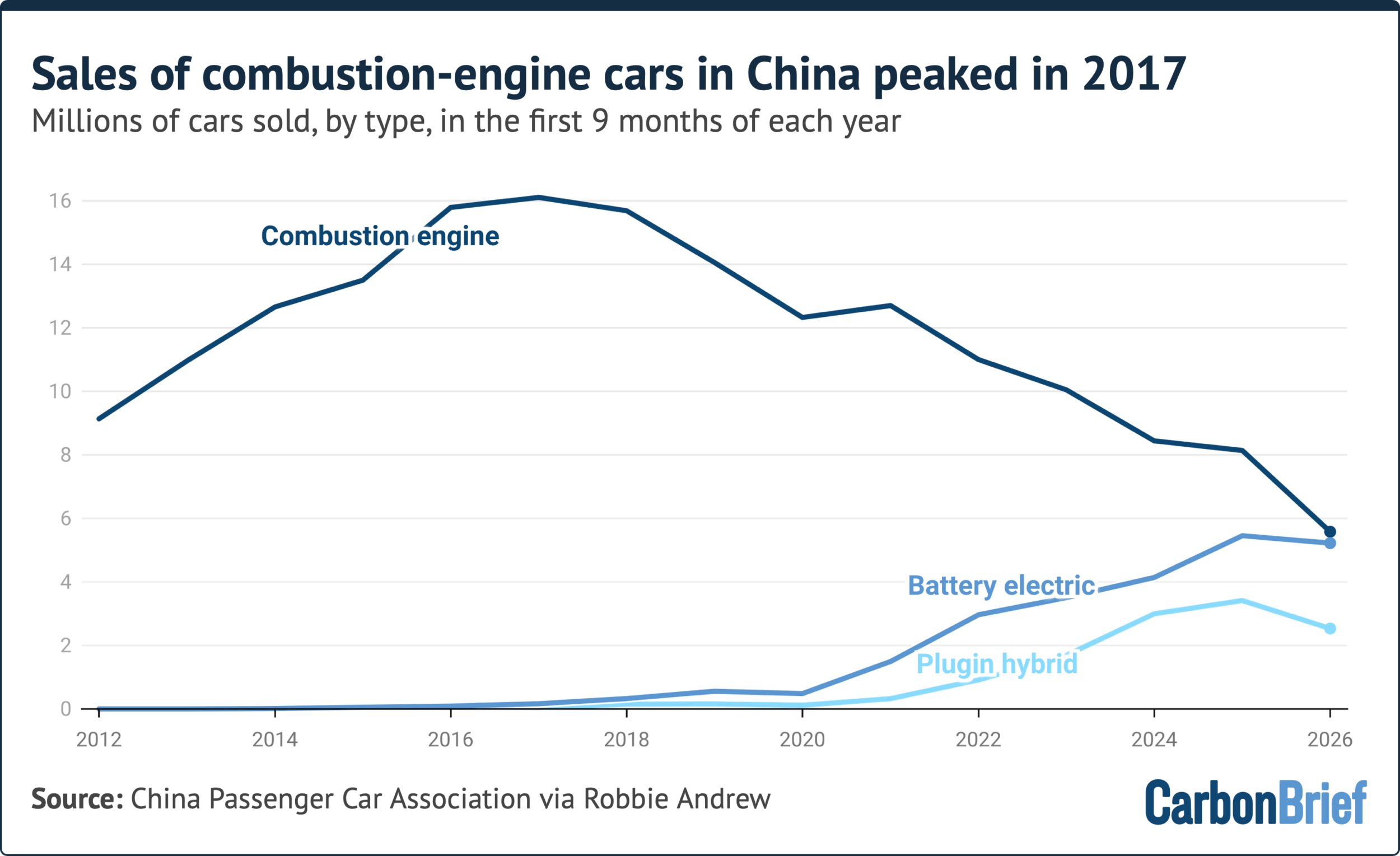
While the market changes in 2026 to date were particularly dramatic, they reflect a broad continuation of trends seen over the past decade.
Indeed, sales of combustion-engine cars in China peaked in 2017 and they have been declining ever since, shown in the figure below.
Impact of Hormuz
Part of the reason for the advance of NEVs in 2026, said Chinese technology news outlet OFweek, was petrol cars “giving up market share” as they were outperformed by electric alternatives.
Cui Dongshu, secretary-general of the CPCA, cited higher petrol prices as an explanation for September’s weak combustion-car sales, in comments to financial news outlet National Business Daily.
Imports of oil into China in January-September have fallen 15% compared to 2025, equivalent to 470m barrels, as ongoing conflict tightened supply and drove up prices.
China’s passenger-car NEV fleet has displaced 143m barrels of oil so far during the strait of Hormuz crisis, Euan Graham, senior energy analyst at thinktank Ember, tells Carbon Brief.
EVs “accounted for 12% of the decrease in China’s oil use post-Hormuz”, according to an estimate provided to thinktank the Brookings Institute by an unnamed analyst.
Erica Downs, a senior research scholar at Columbia University’s Center on Global Energy Policy, tells Carbon Brief that the strait of Hormuz crisis and higher oil prices are “reinforcing China’s electrification of road transport”.
She says the “world’s largest oil supply disruption” vindicates China’s early bet on EVs, which was partly driven by concerns about oil-supply security.
NEV demand down
Nevertheless, NEV sales have fallen year-on-year, albeit at a slower rate than overall car sales. The growth in NEV market share has also been decelerating.
Zhang Yichao, a partner at consulting firm AlixPartners, tells Carbon Brief that NEVs benefit from government trade-in policies and a “strong pipeline” of new models, particularly those involving innovation.
He says these factors help explain why NEVs sales have fallen at a slower rate to their combustion-car counterparts.
Cui told the state-run China National Radio that the fall for NEVs and for cars overall in September 2026, is also due to a high baseline of sales from the same month in 2025, as well as changes to trade-in policies and disruptions from the holiday period.
Other factors, says consulting firm Wood Mackenzie, are the weakened demand due to “demand pull-forward” in 2025 caused by the end of subsidies, as well as “tighter financing conditions”.
Zhang tells Carbon Brief he does not “see much more room ahead” for further growth in NEVs’ market share.
He adds that, in his view, their share in China is unlikely to exceed 80%, as some premium-market segments and specific use cases will continue to require combustion-engine vehicles.
Exports surge
Meanwhile, while domestic NEV retail sales fell 17% in September 2026, exports more than doubled, increasing 164% year-on-year, according to the CPCA.
This extends the decline in domestic sales and very strong growth in exports seen across 2026 to date, as shown in the figure below.
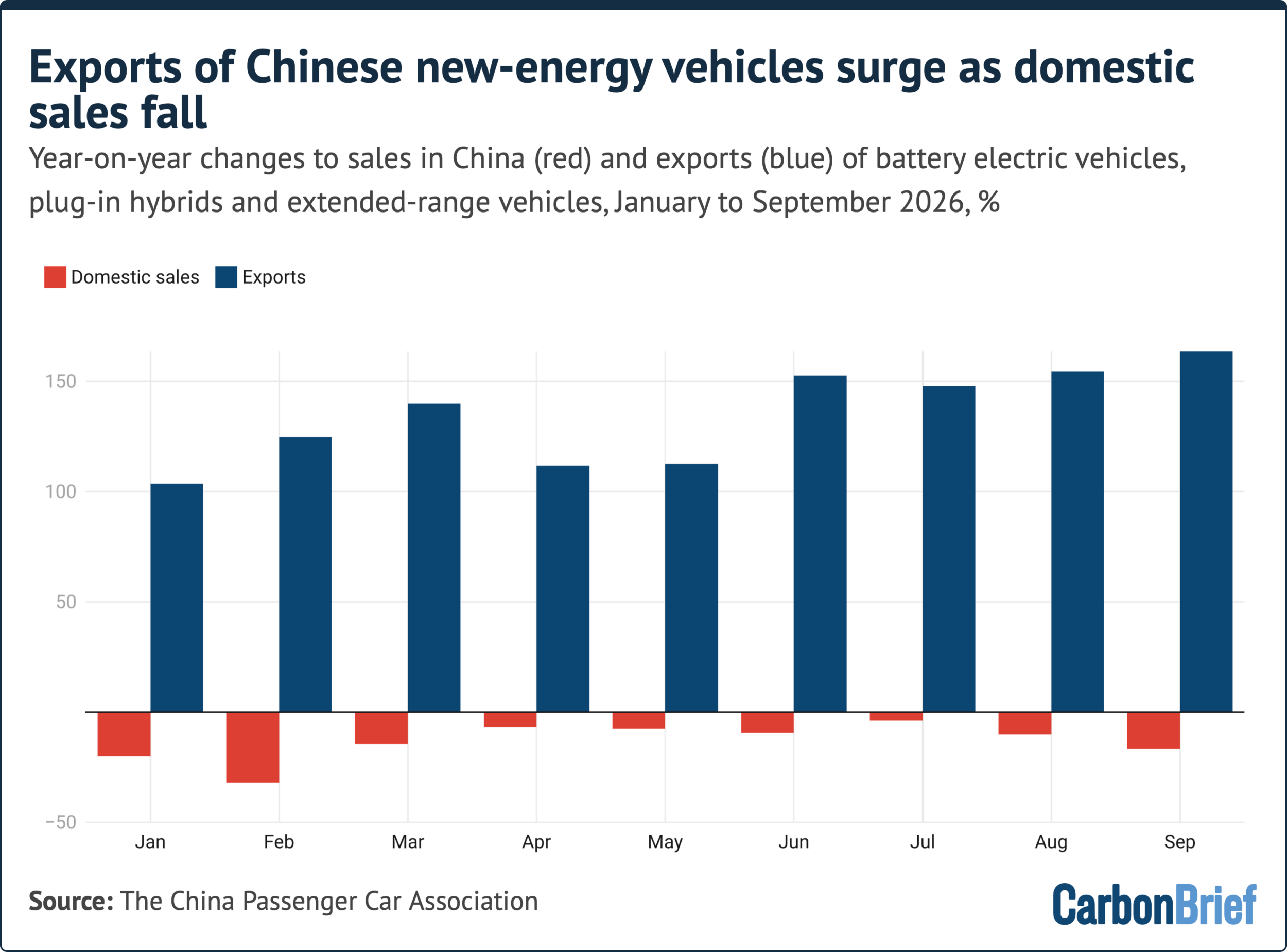
In September, 1,084,000 NEVs were sold domestically in China, while 558,000 NEVs were exported.
Exports are becoming increasingly important to Chinese carmakers, in the face of weaker domestic demand and cut-throat industrial competition.
The CPCA says exports have become “a core priority” for some carmakers.
However, the surge in exports from China has created concern in the EU, which has placed tariff