


The UK government recently released its Fusion Energy Strategy 2026, where it has laid out a bold plan to turn fusion into a commercial, clean power source while building a strong domestic industry.
The key vision is a £2.5 billion investment over five years. The goal is clear: make the UK the first country with a real pathway to commercial fusion energy. At the same time, the strategy connects clean power goals with economic growth, job creation, and long-term energy security.
A Clear Push Toward Energy Independence
The UK’s strategy comes at a time when global energy markets remain volatile. Fossil fuel dependence continues to create risks. As a result, the government sees fusion as a long-term solution for energy sovereignty.
Fusion offers several advantages. It is clean, abundant, and reliable. Unlike solar or wind, it can provide constant power. Because of this, it could play a major role in meeting future electricity demand, especially as industries and AI systems consume more energy.
The government believes that reducing reliance on fossil fuels is the only way to secure long-term stability. Fusion, therefore, is not just a research goal—it is a strategic priority.
Investing Across the Fusion Ecosystem
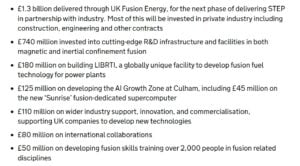
Together, these investments aim to strengthen the entire value chain—from early research to final deployment.
At the same time, the UK is working closely with the private sector. More than 500 companies are already involved in the fusion space. This number is expected to grow as global competition increases.
The potential market is massive. Estimates suggest that fusion could become a £3 trillion to £12 trillion global industry. Therefore, countries are racing to secure leadership positions early.
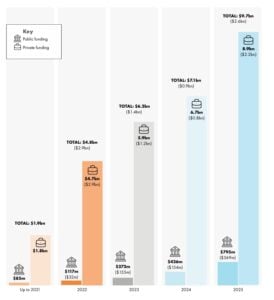
Five-Year Fusion Trends: Total Funding Till 2025
STEP Program: Building the First Fusion Power Plant
A major part of the funding—£1.3 billion—will go to the Spherical Tokamak for Energy Production (STEP) program. This initiative aims to design and build the UK’s first prototype fusion power plant.
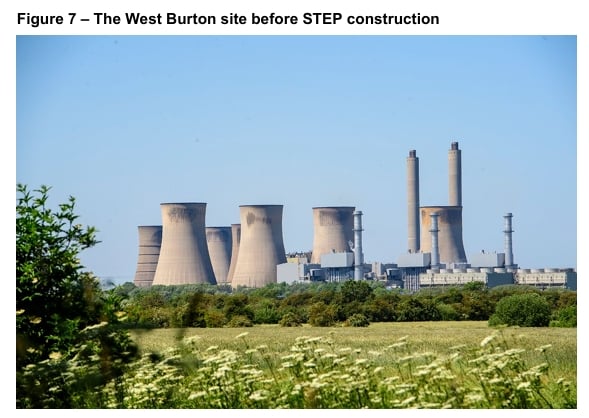
The plant will be located at a former coal site in Nottinghamshire. Construction is expected to begin in 2030, with completion targeted for 2040. The mission is ambitious: generate net energy from fusion and prove that the technology can work at a commercial scale.
To deliver this, the UK has partnered with a consortium called ILIOS. This group, led by Kier and Nuvia, will handle construction, engineering, and supply chain management. Their role covers everything from design integration to infrastructure development.
Importantly, STEP is meant to act as a catalyst. By building this prototype, the UK hopes to stimulate a broader fusion ecosystem, including suppliers, engineers, and technology firms.
UK Fusion Energy
A key part of this shift is the creation of UK Fusion Energy, a subsidiary responsible for delivering the STEP program. This organization will act as a systems integrator. It will bring together multiple technologies and partners to build a complete fusion power plant.
In summary, the three main goals for UK Fusion Energy are:
- Make future fusion power plants safer and more reliable
- Build strong UK industries and supply chains
- Bring lasting economic benefits and energy security to the UK
UKAEA Group: The Backbone of the UK’s Fusion Ambition
The backbone of the UK’s fusion strategy is the UK Atomic Energy Authority (UKAEA Group). It acts as the country’s main public body driving fusion research, innovation, and delivery.
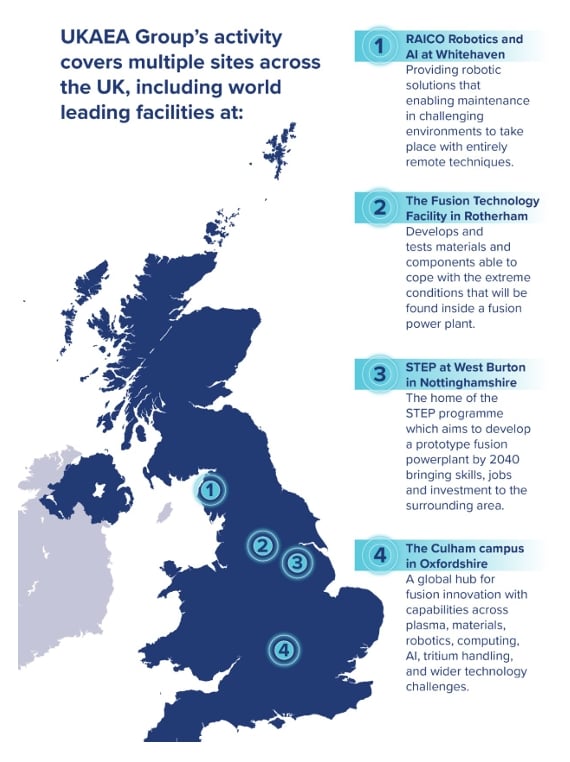
The UKAEA operates the National Fusion Laboratory based in Culham, Oxfordshire. This facility leads advanced research in plasma science, robotics, materials, tritium systems, and high-performance computing. Over time, it has built a strong global reputation for technical excellence.
However, the UKAEA’s role is now expanding. Other than research, it is actively helping to turn scientific progress into commercial outcomes.
- Neutral beam systems are used for plasma heating
- Robotics for remote maintenance in extreme environments
- Advanced diagnostics and sensor technologies
- Fusion fuel cycle systems and materials
This approach ensures that public research does not remain in the lab. Instead, it flows into real-world applications, supporting both fusion and other industries.
- ALSO SEE: France Shocks Energy Sector and Rewrites Energy Future: New Law Boosts Nuclear, Cuts Renewables
Building a Strong Industrial Base
The UK’s strategy goes beyond technology. It focuses heavily on building a full industrial ecosystem.
The plan supports companies of all sizes—from startups to multinational firms. It also aims to develop strong supply chains within the country. By doing so, the UK wants to become a top destination for fusion investment.
Key areas of opportunity include:
- High-temperature superconducting magnets
- Advanced materials
- Robotics and remote maintenance
- Plasma systems and lasers
- AI-driven control systems
These technologies are not limited to fusion. They also have applications in sectors like aerospace, automotive, healthcare, and telecommunications. As a result, fusion investment could drive innovation across multiple industries.
For example, UK-based companies are already exploring how fusion-related technologies can be used in power grids and advanced manufacturing. This creates near-term economic benefits, even before fusion becomes fully commercial.
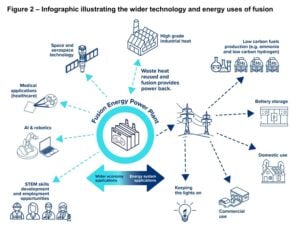
AI Meets Fusion: A Game-Changing Combination
One of the most forward-looking parts of the strategy is its focus on artificial intelligence. The government sees AI as a key tool for unlocking fusion energy.
Fusion systems are highly complex. They involve extreme temperatures, fast reactions, and dynamic plasma behavior. Managing these systems requires advanced data analysis and real-time decision-making. This is where AI becomes critical.
Revealing an AI supercomputer: Sunrise
The UK plans to invest £45 million in a dedicated AI supercomputer called Sunrise. This system will support fusion research by accelerating simulations, improving designs, and optimizing operations.
In addition, the UKAEA’s Culham campus will become an AI Growth Zone. This hub will bring together scientists, engineers, and AI experts. The goal is to create a collaborative environment where innovation can thrive.
The government’s broader AI strategy supports this effort. It focuses on building strong data systems, expanding computing power, and encouraging multidisciplinary research. Fusion stands out as one of the priority sectors where AI can deliver rapid breakthroughs.
Interestingly, the relationship works both ways. While AI helps make fusion possible, fusion could eventually power energy-intensive AI data centers. This creates a strong link between future clean energy and digital growth.
DESNZ Sets Clear Rules for Fusion Development
Investors and developers need clear rules to plan fusion projects with confidence. This includes understanding safety, environmental, and planning approvals, as well as which UK organizations must be involved.
To provide clarity, DESNZ (Department for Energy Security and Net Zero) will release a roadmap for the UK fusion regulatory process by Summer 2026. This will guide developers on how to get approvals and engage with regulators early.
The plan also aims to help regulators understand fusion technologies better and support early collaboration, reducing risks in plant design. Fusion regulators are already working with industry and will continue reviewing processes as the sector grows.
The post UK Fusion £2.5B Strategy Links AI Growth with Clean Energy Breakthroughs appeared first on Carbon Credits.


Carbon credit providers vs marketplaces is the first comparison many buyers try to make. In this comparison, a carbon credit provider is the project developer: the company that originates credits from its own projects and sells them directly. A carbon credit marketplace is a platform that lists credits from many projects at published prices.

Carbon Footprint
Democrats who call climate change an emergency should not defend a permitting system too slow to build the clean energy that would address it.”
Democrats, Take The Deal. New York Times editorial, Nov. 12.
Insetting program design starts with your supplier map. The carbon claim comes much later.
Consider a coffee procurement team that funds a farm intervention before checking its sourcing data. The supplier aggregates coffee lots from several regions. The buyer lacks farm-level traceability. Another purchaser expects to report the same outcome. A more attractive project brochure solves none of these problems.
If the distinction between a value-chain intervention and a purchased credit is still open, read CCC’s Insetting vs Offsetting guide before you set the brief.
Insetting program design begins with the purchasing relationship and works outward. You need to decide 1) where an intervention belongs, 2) what business problem it addresses, 3) who pays for it, 4) how results will be measured, and 5) what the evidence will let you say about them. This five-step playbook turns that sequence into a procurement plan.
Step 1: Insetting program design starts with supplier mapping
Start with the commodities that matter most to your Scope 3 inventory and sourcing continuity. Ask finance for spend by supplier, sustainability for the emissions baseline, and category managers for origin and volume records. Then identify which suppliers can trace material to a jurisdiction, sourcing region, producer group, or individual land-management unit.
The level of traceability affects what you can account for. Under the GHG Protocol Land Sector and Removals Standard, the spatial boundary for purchased land-based products depends on the traceability associated with each volume. Farm-specific factors or removals require physical traceability through an acceptable chain-of-custody model. A contract with a tier-one trader, by itself, does not establish a link to the farms behind its deliveries.[1]
Build a first-pass table with five columns: commodity and annual volume; supplier and origin; current traceability level; land-use and production risks; and the business owner who can change the purchasing terms. Mark missing data plainly. A blank cell is cheaper to fix before a program starts than after a claim is drafted.
If your company sets an SBTi Forest, Land and Agriculture target (FLAG), keep its land-related target boundary separate from energy and industry emissions. The current FLAG guidance also requires relevant companies to assess primary deforestation-linked commodities in their value chains.[2]
Step 2: Choose a commodity and jurisdiction for a pilot
Select one supply corridor where the sourcing connection can be established and procurement has a reason to stay. A useful pilot has repeat purchases, suppliers willing to share records, an intervention matched to a diagnosed problem, and a defined plan to measure the result. Carbon potential alone is a poor selection rule if the supplier cannot deliver the crop your business needs.
Compare candidate regions on land-use risk, supplier concentration, local rights and tenure, the availability of baseline data, and exposure to drought, erosion, or forest conversion. Check the relevant legal requirements separately. A nature project does not satisfy a due-diligence obligation merely because it has a carbon method attached.
Consider a coffee buyer sourcing from two districts. In the first, producer-group records identify the farms, while recent dry seasons have increased rejected green coffee lots. In the second, deliveries pass through several intermediaries and farm origins are unknown. Pilot shade management in the first district, with local agronomic advice and quality checks built into the plan. The buyer can trace purchases there and test the intervention against a defined sourcing problem.
Use a short decision memo to record why the selected corridor beats the alternatives, what remains uncertain, and what would stop the pilot. That memo is the first control against a project drifting toward whatever happens to photograph well.
Step 3: Design the supplier engagement and commercial model
The intervention needs an owner on each side of the contract. Decide who supplies planting material or training, who maintains the practice, who bears the cost if a harvest disappoints, and how long the buyer expects to purchase from participating suppliers. Where smallholders participate, budget cash flow and technical support for practices that offer a later return.
Put these terms in a supplier agreement or pilot addendum. It should cover eligible farms and volumes, consent to data collection, access for monitoring, any land or carbon rights that matter, benefit sharing, and what happens if the purchasing relationship ends. Ask local counsel and producer representatives to review the arrangement. The Accountability Framework is a useful reference for supply-chain work involving forests, ecosystems, and human rights.[3]
Avoid assigning an automatic carbon benefit to the buyer. The contract should say which party has the right to report each outcome, how overlapping claims will be checked, and how any issued credits will be handled. A reduction reported in a buyer’s inventory cannot simply be sold for someone else’s offset claim without an accounting review. SBTi FLAG guidance excludes purchased credits used as offsets from near-term FLAG target achievement.[2]
Set commercial measures beside environmental ones: delivered volume, rejection rate, supplier retention, and procurement cost. They tell you whether the program works as a supply-chain investment, even if carbon accounting takes longer to resolve.
Step 4: Build monitoring, reporting, and verification before rollout
Agree on the baseline and data flow before paying for a full rollout. Identify the land units or sourcing regions in scope, the practices that change, the records suppliers already keep, and the additional measurements the program requires. Decide which data can come from field visits, transaction records, or remote sensing, and who checks each source.
For carbon, separate three questions. Did the practice happen? Did emissions or removals change under an applicable method? Can the buyer attribute a defensible share to its purchased goods without double counting? The GHG Protocol’s 2026 guidance includes dedicated chapters on spatial boundaries, data and methods, evaluating actions, credited outcomes, and assurance.[1] These are distinct jobs. A photograph of a planted tree answers only part of the first.
CCC’s MRV and Additionality article explains the separate evidence questions a project reviewer will ask.
Create an evidence file for every reporting period: dated supplier and farm records, purchase volumes, methods and emission factors, uncertainty, quality checks, and changes from the baseline. Specify who can challenge the data and how corrections are recorded. If a project also seeks credit certification, keep project accounting and corporate inventory accounting separate. The GHG Protocol says its land standard focuses on entity-level inventories and does not set the rules for credit certification.[4]
Start with the minimum viable measurement design that can survive review. Add complexity when the pilot tells you which data actually changes a decision.
Step 5: Decide what can be reported and claimed
Insetting program design needs reporting rules before the marketing copy. Procurement, sustainability, finance, and legal should agree on four distinct outputs: operational performance; observed land or nature outcomes; inventory effects, if the accounting criteria are met; and any separately issued credits. One dashboard can display them, but they should not share a single unqualified headline.
SBTi FLAG guidance allows certain land-based removals within a company’s operations or supply chain to contribute to FLAG pathways, subject to criteria including permanence, traceability, data quality, and allocation. It does not allow purchased offsets to meet near-term FLAG targets.[2] Eligibility therefore depends on evidence and the applicable target rules, not on calling an activity “insetting.”
Draft a claims register. For each proposed sentence, record the period, boundary, data owner, calculation method, reviewer, and whether the result is measured, estimated, or still a goal. If the evidence supports only “we funded a pilot with 200 farms,” say that. Do not turn a funding fact into a verified emissions reduction.
What good looks like by year three
Treat year three as a review point, not a promised payback date. A mature pilot should have mapped participating supply volumes, a stable supplier agreement, a repeatable data collection process, and a comparison of commercial and environmental results against the baseline. It should also have a documented answer for outcomes that cannot be included in the buyer’s inventory.
Scale only where the pilot improves a sourcing decision and the evidence can follow the product. If neither condition holds, redesign the intervention or change the corridor. A disciplined program can conclude that a site is unsuitable. That is useful procurement intelligence.
Discuss your insetting program with CCC
Carbon Credit Capital designs nature-based supply chain investments around sourcing needs and measurable sustainability outcomes. Schedule a consultation with our carbon and sustainability experts to map your tier-one supplier network, FLAG exposure, and first pilot decision.
Sources
[1] GHG Protocol, Land Sector and Removals Standard, version 1.1, and companion Guidance, June 2026: https://ghgprotocol.org/land-sector-and-removals-standard ; https://ghgprotocol.org/land-sector-and-removals-guidance
[2] Science Based Targets initiative, Forest, Land and Agriculture Science-Based Target-Setting Guidance, version 1.2, March 2026, especially pp. 16–17, 37, and 41: https://sciencebasedtargets.org/resources/files/SBTiFLAGGuidance.pdf
[3] Accountability Framework initiative, Accountability Framework and guidance for companies: https://accountability-framework.org/
[4] GHG Protocol, Frequently Asked Questions: Land Sector and Removals Standard, questions 10 and 18: https://ghgprotocol.org/blog/frequently-asked-questions-land-sector-and-removals-lsr-standard

‘COP-out’: COP31 fails to deliver the ambition needed to phase out fossil fuels and address climate breakdown
COP31 Bulletin Day 13: New draft retains electrification goal but delays adaptation finance and science decisions
