

- Formal negotiations
- Turkish and Australian leadership
- Cover decision
- COP reform
- Adaptation
- Finance
- Just transition work programme
- Loss and damage
- Gender
- Article 6
- Agriculture and food security
- Mitigation work programme
- Response measures
- Action for climate empowerment
- Trade
- Second global stocktake
- Long-term goal review
- Around the COP
- Fossil fuels
- Action agenda
- Global leaders
- Electrification
- China at COP31
- Ocean
- Deforestation
- Methane
- New climate science
- Food and water
- NDCs
- Protests and access
- Road to COP32 and beyond

A recent ruling by the UK’s top court will make it harder for new fossil fuel production projects to get approval across Europe and beyond, with the judgment already influencing a separate court case over a new coal mine in England this week, climate campaigners and legal experts told Climate Home.
On June 20, the Supreme Court in London ruled that, in deciding whether to approve a new oil well in Horse Hill in southern England, the authorities must consider the greenhouse gas emissions from burning the oil, not just the much smaller volume of emissions from getting the oil out of the ground.
Announcing what has been called the “Finch ruling”, Judge George Leggatt said: “The emissions that will occur on combustion of the oil produced are ‘effects of the project’ because it is known with certainty that, if the project goes ahead, all the oil extracted from the ground will inevitably be burnt, thereby releasing greenhouse gases into the Earth’s atmosphere in a quantity which can readily be estimated.”
The ruling has already helped campaigners challenge a planned coal mine in Cumbria in the north of England, set to provide fuel for steel-making. The UK’s new Labour government said last week that the previous Conservative government had made an “error in law” when approving the mine and withdrew support for the mine’s developer in a separate court case being heard this week.

Campaigners against the Cumbria coal mine oppose bringing “zombie” coal back from the dead on July 16, 2024 (Photo: Friends of the Earth)
Speaking during a break in that case, Friends of the Earth lawyer Katie de Kauwe said the Finch ruling had strengthened the green group’s legal argument against the coal mine. The mine’s developer – which is still defending the case – did not assess the emissions from burning the coal and, in the wake of the Finch ruling, “it’s very clear that was unlawful”, she told Climate Home.
The ruling is likely to resonate beyond the UK, she added, because it concerns regulations that are derived from European Union (EU) law. Although the UK has left the EU, many of its laws remain similar.
Greenpeace Norway campaigner Halvard Raavand said his colleagues had “a small celebration” in their Oslo offices when the Finch ruling was handed down, popping bottles of alcohol-free champagne. “It’s highly positive,” he said. “We’re very, very relieved – it shows it’s possible to take on fossil fuels and win.”
Like the UK, Norway is not an EU member but bases much of its law on that of the bloc. Greenpeace Norway is challenging in court its government’s approval of three new oil and gas fields, arguing that they failed to properly consider the climate impact from burning the fuels – known as scope 3 emissions.
Raavand said that, while Norway and the UK’s national courts are not related, Norwegian judges are likely to consider the UK’s judgement as a precedent. “Other courts across Europe might look to each other too,” he said.

Gina Gylver, head of Natur og Ungdom (Young Friends of the Earth Norway), and Frode Pleym, head of Greenpeace in Norway in Oslo District Court on November 28, 2023 (Photo: Rasmus Berg/Greenpeace)
Over in Amsterdam, Dutch Friends of the Earth campaigner Sjoukje van Oosterhout also celebrated the Finch ruling. “This verdict sets an important precedent,” she told Climate Home. “Judges worldwide will be looking at this.” She said it could boost campaigners’ legal challenge to Dutch company One Dyas’ plans to drill oil in the Wadden Sea, part of the North Sea.
Climate law professor Harro van Asselt said the UK ruling was “important” and “may well have implications for EU member states considering licensing fossil fuel projects”. He added that judges had made similar rulings in Australia and Norway in the last few years – although the Norwegian case, which influenced the Finch ruling, is under appeal.
While its ripple effects will be strongest in the EU and countries with similar laws, van Asselt said he would not exclude the possibility of the Finch ruling influencing court judgements elsewhere, in particular in common-law countries like Australia. Common law is a legal system that evolves based on judges’ rulings, generally found in former British colonies like the US, Canada and New Zealand.
De Kauwe of Friends of the Earth added that the Finch ruling could influence environmental impact assessments across the world.

Most of the oil and gas being extracted in Europe (red) or discovered, or under development (blue), is in the North Sea (Picture: Global Energy Monitor/Screenshot)
The recent change in government in the UK is also likely to hamper new fossil fuel production projects in the country. Keir Starmer’s Labour Party was elected on a manifesto promising to ban the method of gas extraction known as fracking and not to issue new licenses to explore new oil and gas fields or grant new coal mining licenses.
Gareth Redmond-King is the international lead at the Energy and Climate Intelligence Unit advocacy group. He told Climate Home that, at last year’s COP28 climate summit, British politicians heard from Global South government negotiators that politicians in their countries had cited the UK’s decision to issue new North Sea oil and gas licences as justification for pursuing their own fossil fuel exploration. That excuse has now been taken away, he said.
“Leadership works both ways,” he added. “The precedent set by this [Labour] decision makes it harder for fossil fuel companies to justify drilling in other countries. The UK is now the first G7 country to have pledged to put a moratorium on new exploration. That’s a big step.”
(Reporting by Joe Lo; editing by Megan Rowling)
The post UK court ruling provides ammo for anti-fossil fuel lawyers worldwide appeared first on Climate Home News.
UK court ruling provides ammo for anti-fossil fuel lawyers worldwide
Continue Reading
The COP31 climate talks in Antalya, Turkey, have failed to reach agreement on a “pact” that lacked clear references to curbing fossil fuels or scaling up climate finance.
The “Antalya pact”, proposed by the joint Turkish-Australian presidency, was rejected in the final hours by the EU, the UK and several climate-vulnerable nations.
Meanwhile, many developing countries criticised the lack of progress on climate finance and indecision on a proposed $120bn target for funding climate adaptation.
With stark divisions preventing agreement on the presidency-led pact, UNFCCC chief Simon Stiell expressed “deep disappointment”, speaking of “scope to improve, modernise and reform” the UN climate process.
Despite a chaotic endgame that saw the overrunning COP become the longest in history, it did not end in complete failure, with many items adopted in the closing plenary.
These included fairly limited or procedural outcomes on a new “mechanism” for global “just transitions”, plus support for countries struck by climate disasters.
There was some progress beyond the negotiations, though, with growing coalitions of nations championing “roadmaps” for “transitioning away” from fossil fuels.
With the presidency promoting “electrification” as a key theme, around 80 nations also signed up to a global target of securing 35% of final energy consumption from electricity by 2035.
Here, Carbon Brief provides in-depth analysis of all the key outcomes from Antalya, both inside and outside the COP31 negotiations.
(See Carbon Brief’s coverage of COP30, COP29, COP28, COP27, COP26, COP25, COP24, COP23, COP22, COP21 and COP20.)
- Formal negotiations
- Turkish and Australian leadership
- Cover decision
- COP reform
- Adaptation
- Finance
- Just transition work programme
- Loss and damage
- Gender
- Article 6
- Agriculture and food security
- Mitigation work programme
- Response measures
- Action for climate empowerment
- Trade
- Second global stocktake
- Long-term goal review
- Guidance on NDCs
- Rio synergies
- Around the COP
- Road to COP32 and beyond
Formal negotiations
Turkish and Australian leadership
Turkey and Australia presided over the longest COP in history – and failed to find consensus on their proposed “cover decision”, exposing deep fractures between countries on key issues such as fossil fuels and the need for developed nations to meet climate-finance pledges.
Experts told Carbon Brief that, strictly, the talks did not “collapse” as several negotiated items were still adopted.
Rather, the rejection of the cover decision represented, for the first time, “those who want a higher level of ambition actively reject[ing] the lowest common denominator on offer”, said one veteran observer.
Dispute over who would host COP31 – representing the “western Europe and other states” region – had gone on for three years.
In the end, the two main rivals, Turkey and Australia, agreed to a deal last year at COP30 that the summit would take place in Antalya, Turkey, with Australia acting as “president of negotiations”.
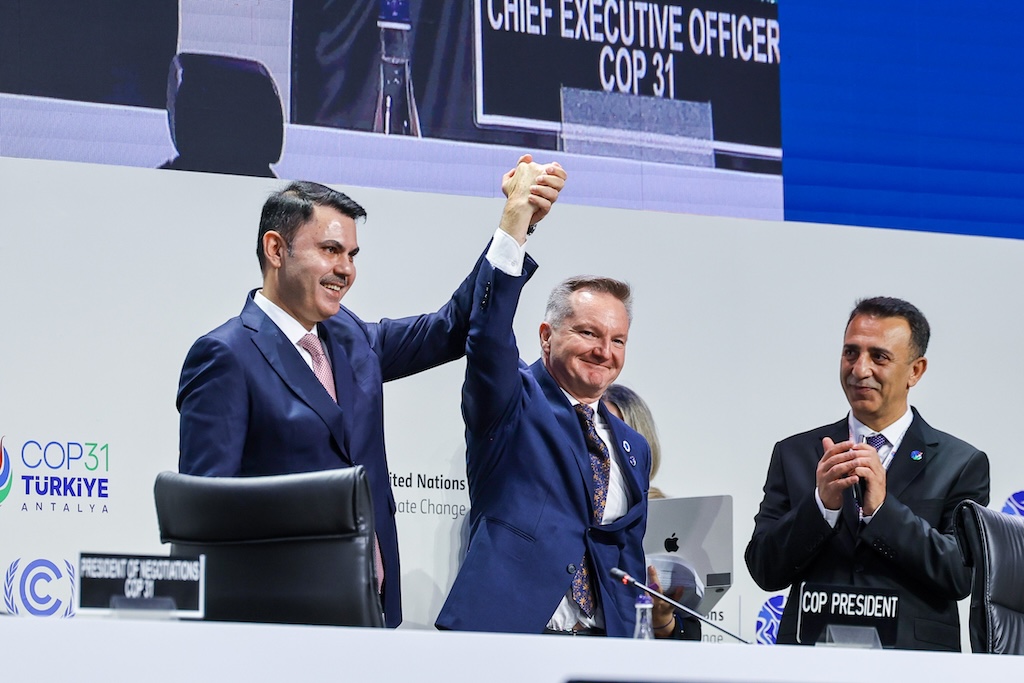
Critics questioned whether either country was well-placed to host, given their ongoing fossil-fuel expansion.
Turkey faced criticism for announcing the discovery of two new oil fields on the eve of the summit, while recent Carbon Brief analysis found that Australia is the third-largest CO2 exporter in history because of its fossil-fuel production.
Ahead of the summit, the presidency released four official letters outlining a vision for COP31.
The first letter, written by COP31 president Murat Kurum in April 2026, confirmed the appointment of Australian climate minister Chris Bowen as “president of the negotiations” and announced that a pre-COP would be held in Fiji in October.
The second letter, authored by both Kurum and Bowen from the Copenhagen climate ministerial in May, said that “COP31 presents a vital opportunity to further accelerate…in the areas of clean energy, electrification and resilient infrastructure”.
The third letter, published in August 2026, gave more details on the presidency’s plans for the “action agenda” – the part of the UN process that mobilises coalitions of nations and non-state actors to push climate action further.
This letter also introduced a key aim from the presidency to get countries to agree to increase electricity’s share of final energy consumption to 35% by 2035 (often referred to as “35 by 35”). (See: Electrification.)
The final letter, published in October ahead of the pre-COP in Fiji, said that the presidency would centre on “delivering a COP focused on accelerating implementation, electrification and resilience in an uncertain world”.
It added that “many parties have emphasised the importance of reviewing and continuously improving UNFCCC processes, to ensure it remains fit for purpose, sustainable and focused as negotiations evolve over time”, adding:
“At COP31, we will hold presidency consultations to hear parties’ views on how to strengthen UNFCCC processes, to ensure growing demands are met and to effectively deploy resources.”
The pre-COP in Fiji was held from 5-8 October and was attended by 3,000 people.
In this somewhat intimate setting, Bowen announced that Turkey and Australia had agreed to negotiate a “presidency-led” cover decision at COP31.
He added that revealing this before COP was part of the presidency’s “upfront, transparent and consultative approach”.
Later that month, the presidency named the five ministerial pairs from developed and developing countries that would take key negotiation issues forward at COP31. These issues were mitigation, adaptation, finance, just transition and oceans.
COP31 kicked off on 9 November, with climate negotiations scholar (and Carbon Brief contributing editor) Dr Joanna Depledge noting that it was clear from the summit’s opening ceremony that “Australia [was] the junior partner” in the presidency.
COP’s opening day ran late into the night as the presidency worked to avert a fight over proposed changes to the summit’s negotiations agenda.
Agenda adopted! Moments ago in Antalya, Turkey, COP31 president Murat Kurum outlined how an “agenda fight” has been averted, despite various proposals for additions to proceedings. This came after a short delay, while a series of huddles took place on…
 Simon Evans
COP31: Agenda adopted!

The next day, in plenary, Kurum announced that a resolution had been found.
He said that calls for new agenda items on adaptation finance and trade were rejected, whereas an item on a new climate finance “work programme” had been added. (The EU expressed “deep concern” about the addition.)
Kurum added that two extra proposed items on mountains and climate change – made more poignant by recent catastrophic floods in Nepal – were also not added to the agenda. However, he said that the presidency would instead hold consultations on the topic.
Though an early scrap over the agenda was avoided, the summit’s opening days were plagued with logistical problems.
Attendees were forced to spend hours navigating traffic and queues just to get into the venue – sparking serious access concerns.
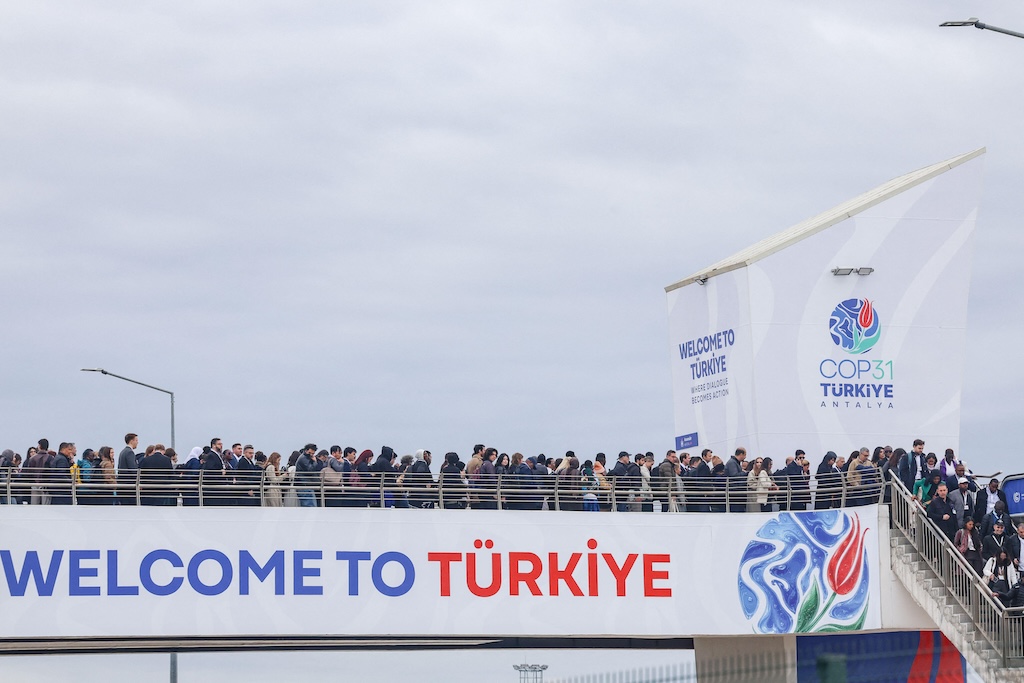
The problems persisted into the first day of the world leaders’ summit on 11 November, when delegates were informed that they should travel between the hours of 5-7am to secure access to the venue. Ire only grew when security staff still let people in after this time.
On Friday morning, the presidency released a “reflections” text from its consultations with countries on what they would like to see in a cover decision. This was an “informal note” with a bullet-pointed list of topics that might be included.
On Saturday evening, Kurum told a press conference that “around 30 countries” had indicated support for the 35 by 35 pledge.
However, he had little to share on progress in the negotiations and eluded questions on how he planned to include “fossil fuels” in the cover decision.
In the small hours of Sunday morning, half-way through the summit, Kurum announced presidency and ministerial consultations on “outstanding political issues”.
He also invited ministers to a “divan” – a group meeting, not a daybed – to discuss cross-cutting issues.
On Monday afternoon, the presidency dropped an 18-page first draft of its proposed cover decision – along with a short “