

After cyclone Freddy ravaged Malawi at the start of the year, mother-of-nine Elube Sandram was left staring at a trail of devastation.
Flood water had destroyed all her corn crops, an essential lifeline to feed her family and earn a modest income. The spiralling costs of seeds and fertilisers put replanting beyond her reach.
“The cyclone left me completely with nothing”, she told Climate Home News.
As Sandram searched for help, she said no relief was available aside from the limited support she could obtain from family members.

Elube Sandram was among the beneficiaries of the UK-funded programme in Malawi’s Chikwawa district. Photo: Raphael Mweninguwe
Her problems could have been prevented. In 2018, she registered for a £52 million ($63m) UK aid programme which helped vulnerable Malawians better cope with climate-driven floods and droughts.
But during the Covid-19 pandemic in 2020, the UK government cut back its aid spending, ending support for Sandram and many others in Malawi and around the world.
Let down
The programme that Sandram was involved with was run by UN agencies and NGOs and helped farmers by providing them with tools, training on things like pig farming and financial assistance like weather-related insurance or cash transfers.
The idea was that it’s not quite so disastrous if a flood or a drought destroys a farmers’ crops if they have livestock or an insurance payout to keep putting food on the table.
But following the UK’s cutbacks, several parts of the scheme have been reduced or axed altogether.
The activities run by a group of NGOs were wound down in 2021, two and a half years before their scheduled end. Concern Worldwide and Goal Malawi, the main implementing partners, closed their local offices. Only a series of projects with a more limited scope operated by UN agencies are still running.
Aubrey Kabudula, a farmer from Kwataine Village in Chikwawa, told Climate Home: “We were told that one of the objectives is to help people to be climate-resilient.”
“With its abrupt closure we do not think that has been achieved,” he said.
World Bank to initially host loss and damage fund under draft deal
It is an assessment shared by the Independent Commission for Aid Impact (ICAI), the UK body tasked with scrutinising how foreign aid is spent.
In June, they said that the project had been “highly effective and coherent” but had been “undermined” by cutbacks to aid and the downsizing or removal of components.

A rice field in Malawi’s Karonga region affected by drought in early 2023. Credit: Eldson Chagara
Issues are only likely to get worse. Malawi is increasingly struggling with more frequent and intense cycles of flooding and droughts. The passage of Cyclone Freddy in March killed more than 600 people and displaced at least 650,000 more, while also dismantling infrastructures and livelihoods.
Climate shocks have exacerbated poverty levels, especially for rural farmers. The World Bank estimates that over half of the country’s 19.1 million people live in poverty with women being the most affected. Low agriculture production because of droughts and floods is cited as one of the main causes.
Rishi Sunak’s rollbacks
Countries like Malawi cannot afford to address these problems alone.
Unsustainable levels of existing public debt rule out borrowing at expensive rates as an option. Most of Malawi’s climate plans are funded through grant-based international public finance provided by rich countries like the United Kingdom.
At the United National General Assembly in 2019 the then-prime minister Boris Johnson made a big, and unexpected, announcement.
He promised the UK would double its international climate finance to reach a target of £11.6 billion ($14.2bn) in 2026.
Only a few months later the global Covid-19 pandemic upended daily lives and economic orders, prompting an abrupt rethink of spending priorities.
International aid was one of the casualties. Then finance minister Rishi Sunak cut its foreign aid target from 0.7% of gross national income to 0.5%.
With Sunak now prime minister, this “temporary measure” has yet to be reversed.
Since then, the competition for a shrinking pool of money has intensified as aid funding has been diverted to support Afghan and Ukrainian refugees hosted in the UK.
Australia to accept migrants from climate-hit Tuvalu in security pact
An internal government document reported on by the Guardian suggested the £11.6bn goal could be dropped as general aid cut-backs make it a “huge challenge”.
Not just Malawi
The cuts have hit climate projects around the world. UK-funded climate resilience projects have been cut or delayed in India, Pakistan, Nepal, Kenya and small-island states.
Government figures show that the number of people whose climate resilience was improved by UK aid flatlined for the first time since records began in the last financial year.
In India, a foreign office report found that budget cuts meant that activities to help rural communities cope with climate impacts had been “reduced, slowed down and stopped in some instances”.
In Pakistan, a foreign office report found that a £38 million ($46m) climate resilience plan had been paused for 18 months because of “uncertainty… following significant and unanticipated costs incurred to support the people of Ukraine and Afghanistan in finding refuge in the UK.
A large-scale project aiming to help a series of African countries build resilience to climate change suffered a significant “scale back from its original ambition”, as its annual summary said.
The programme envisaged a £250 million ($306m) budget in its business case, but this has now been reduced to “up to £100 million” ($122m).
Targets have been scaled back too. One original target was to improve the resilience of four million people through an early-warning system. That’s been reduced to three million.
In Chikwawa the climate project has still left a mark in the minds of many people despite the cutbacks.
The beneficiaries now hope that the country, a former British colony, will not be entirely forgotten.
“I am still optimistic that the assistance that we were receiving from the donor [UK government], will not be gone forever,” said Sandram. “And if I were to be asked whether that funding should resume or not, I will say it should resume because climate change is here to stay.”
The post UK aid cuts leave Malawi vulnerable to droughts and cyclones appeared first on Climate Home News.
UK aid cuts leave Malawi vulnerable to droughts and cyclones

For the first time, new-energy vehicles (NEVs) made up 67% of new car sales in China in September, according to the latest data from the China Passenger Car Association (CPCA).
The figures show that NEVs, which include battery electric cars and plug-in hybrids, captured a record share of sales, even though fewer were sold than last year.
This is because sales of combustion-engine cars are falling steeply, a trend that the CPCA has attributed to rising petrol prices following the start of the Hormuz crisis.
Indeed, sales of fuel-only cars were down 31% year-on-year in the first nine months of 2026, with plug-in hybrid sales down 26% – whereas battery EV sales were only down 4%.
One analyst tells Carbon Brief that China’s rapidly growing EV fleet has offset demand for 143m barrels of oil since the start of the Hormuz crisis.
Another says that the crisis is “reinforcing China’s electrification of road transport”.
Meanwhile, amid slowing domestic sales, Chinese carmakers’ exports of NEVs more than doubled [in 2026 to date / in September] from a year earlier.
NEV record
A record two out of every three cars sold in September in China were NEVs, according to CPCA data, as shown in the figure below.
(NEVs predominantly include battery electric vehicles – BEVs – and plug-in hybrids – PHEVs. BEVs only run on electricity, whereas PHEVs also have a combustion engine.)
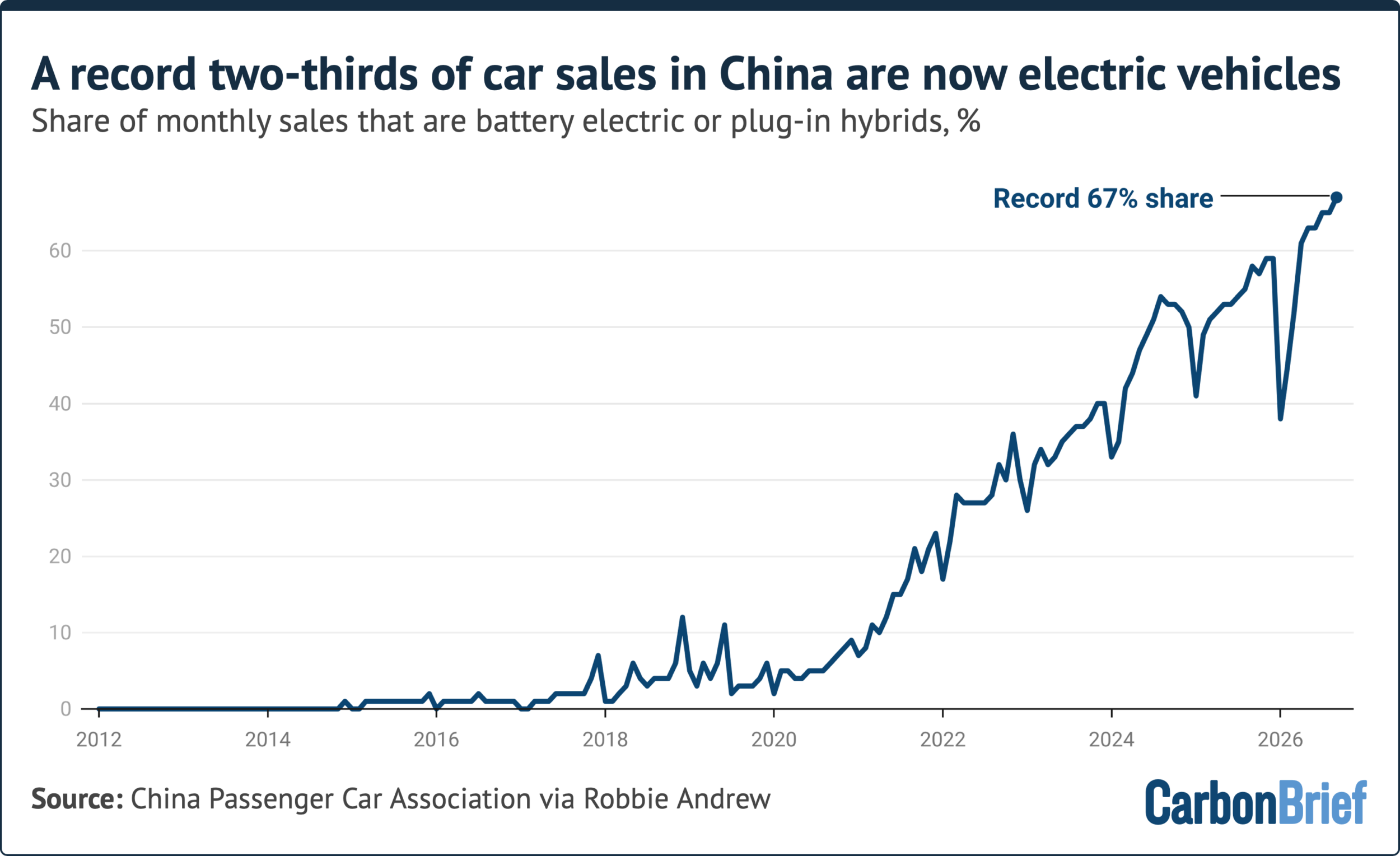
This marks a rapid rise for NEVs from just 6% of new car sales in 2020 up to 58% in 2026 to date – and a record 67% in the month of September.
This year, NEVs’ share of sales has also bounced back from a low of 39% in January, after the full purchase tax exemption that had been in place for more than a decade came to an end in December 2025.
The gain in NEV share in 2026 has come amid a slowdown across the wider domestic passenger-car market, which has hit sales of combustion-engine vehicles particularly hard.
This September, passenger-car retail sales across all categories declined, with overall sales volumes falling 28% year-on-year.
The contraction was led by combustion-engine vehicles, which saw sales fall 43% year-on-year in September and 31% in 2026 to date.
However, sales of PHEVs also fell by 36% year-on-year in September and by 26% in 2026 to date. By comparison, BEVs performed better, although sales still declined 8.5% from a year earlier in September and 4% in 2026 to date.
As a result, NEV sales overall fell by 17% in September and 13% in 2026 to date.
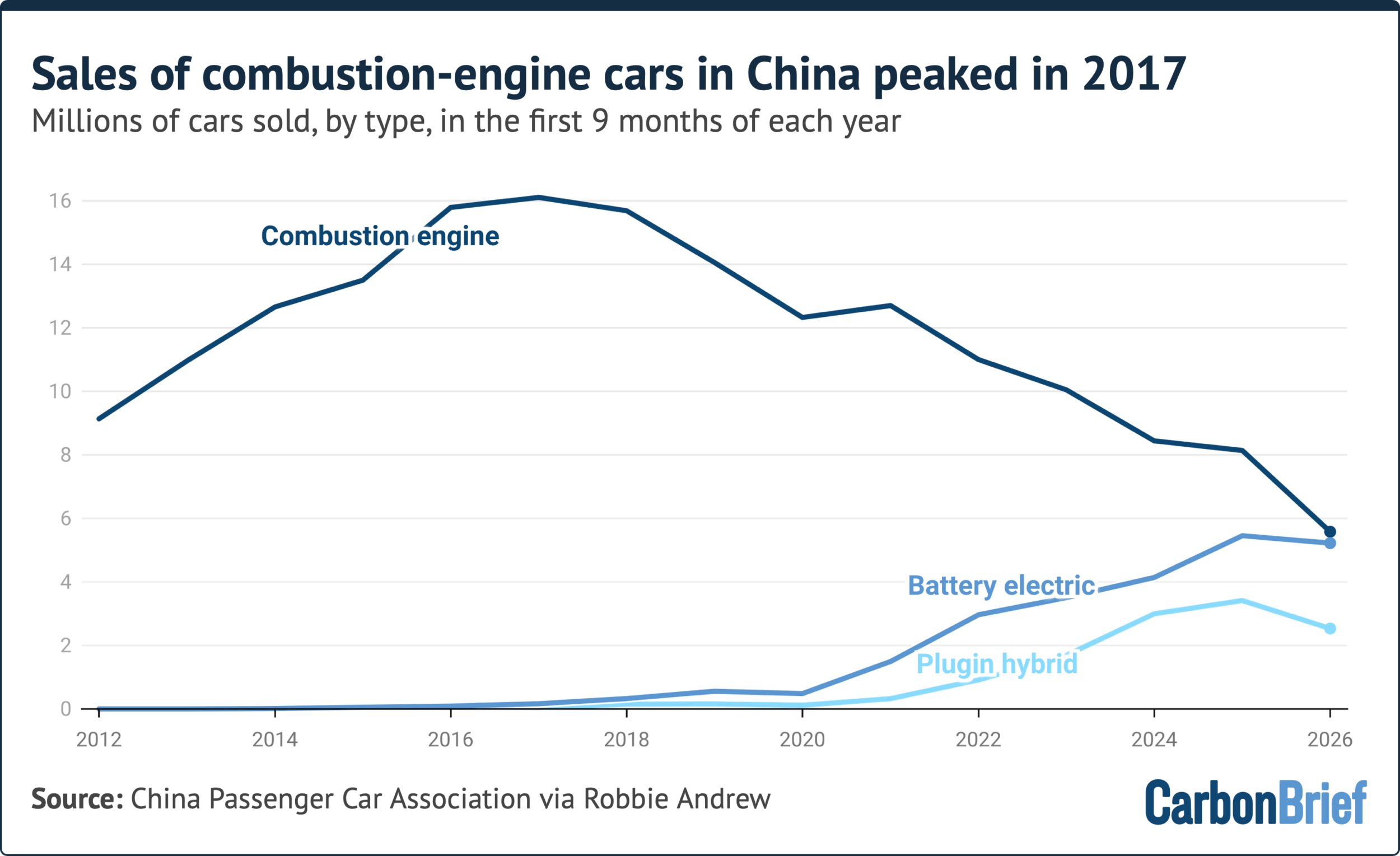
While the market changes in 2026 to date were particularly dramatic, they reflect a broad continuation of trends seen over the past decade.
Indeed, sales of combustion-engine cars in China peaked in 2017 and they have been declining ever since, shown in the figure below.
Impact of Hormuz
Part of the reason for the advance of NEVs in 2026, said Chinese technology news outlet OFweek, was petrol cars “giving up market share” as they were outperformed by electric alternatives.
Cui Dongshu, secretary-general of the CPCA, cited higher petrol prices as an explanation for September’s weak combustion-car sales, in comments to financial news outlet National Business Daily.
Imports of oil into China in January-September have fallen 15% compared to 2025, equivalent to 470m barrels, as ongoing conflict tightened supply and drove up prices.
China’s passenger-car NEV fleet has displaced 143m barrels of oil so far during the strait of Hormuz crisis, Euan Graham, senior energy analyst at thinktank Ember, tells Carbon Brief.
EVs “accounted for 12% of the decrease in China’s oil use post-Hormuz”, according to an estimate provided to thinktank the Brookings Institute by an unnamed analyst.
Erica Downs, a senior research scholar at Columbia University’s Center on Global Energy Policy, tells Carbon Brief that the strait of Hormuz crisis and higher oil prices are “reinforcing China’s electrification of road transport”.
She says the “world’s largest oil supply disruption” vindicates China’s early bet on EVs, which was partly driven by concerns about oil-supply security.
NEV demand down
Nevertheless, NEV sales have fallen year-on-year, albeit at a slower rate than overall car sales. The growth in NEV market share has also been decelerating.
Zhang Yichao, a partner at consulting firm AlixPartners, tells Carbon Brief that NEVs benefit from government trade-in policies and a “strong pipeline” of new models, particularly those involving innovation.
He says these factors help explain why NEVs sales have fallen at a slower rate to their combustion-car counterparts.
Cui told the state-run China National Radio that the fall for NEVs and for cars overall in September 2026, is also due to a high baseline of sales from the same month in 2025, as well as changes to trade-in policies and disruptions from the holiday period.
Other factors, says consulting firm Wood Mackenzie, are the weakened demand due to “demand pull-forward” in 2025 caused by the end of subsidies, as well as “tighter financing conditions”.
Zhang tells Carbon Brief he does not “see much more room ahead” for further growth in NEVs’ market share.
He adds that, in his view, their share in China is unlikely to exceed 80%, as some premium-market segments and specific use cases will continue to require combustion-engine vehicles.
Exports surge
Meanwhile, while domestic NEV retail sales fell 17% in September 2026, exports more than doubled, increasing 164% year-on-year, according to the CPCA.
This extends the decline in domestic sales and very strong growth in exports seen across 2026 to date, as shown in the figure below.
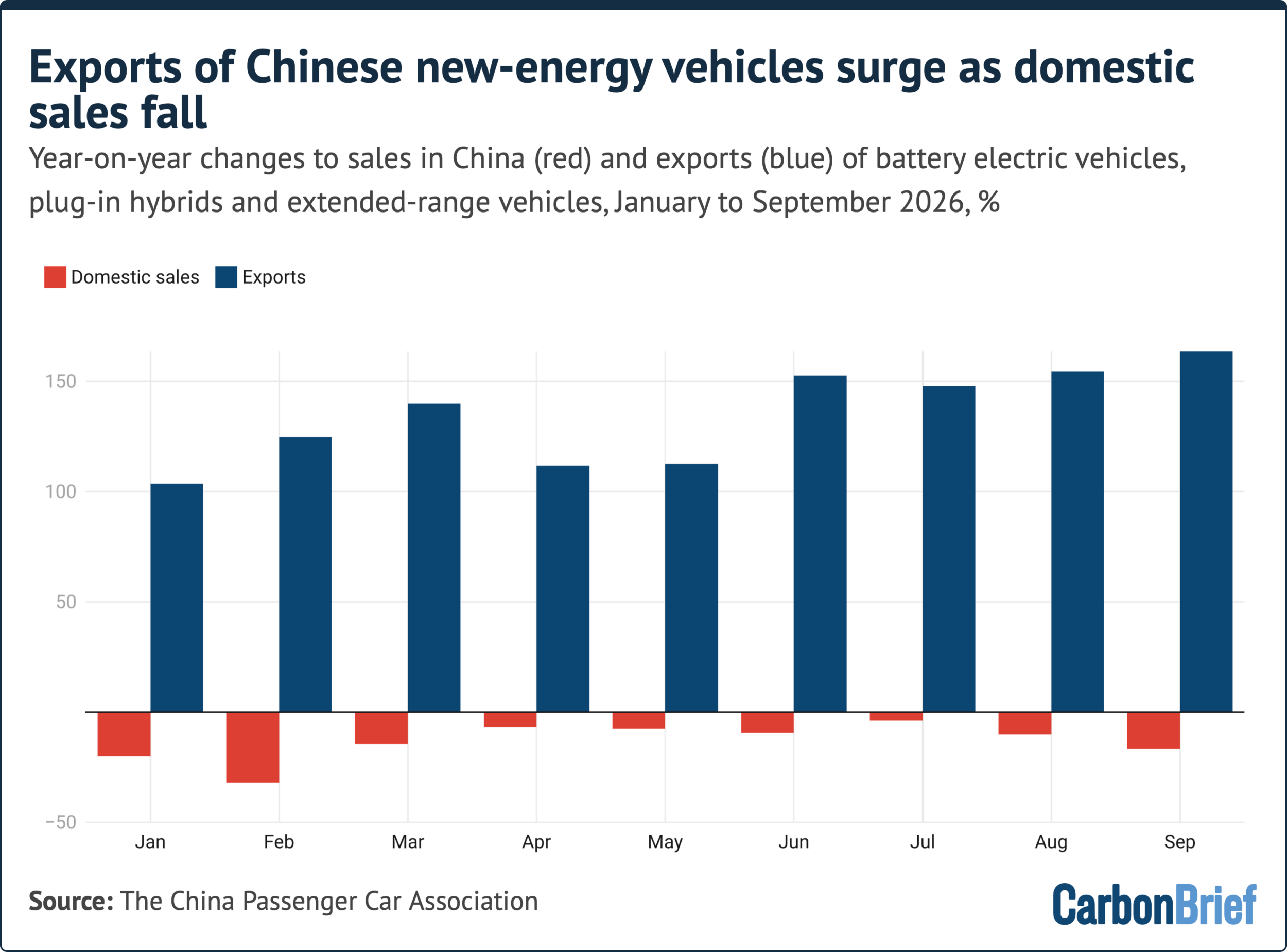
In September, 1,084,000 NEVs were sold domestically in China, while 558,000 NEVs were exported.
Exports are becoming increasingly important to Chinese carmakers, in the face of weaker domestic demand and cut-throat industrial competition.
The CPCA says exports have become “a core priority” for some carmakers.
However, the surge in exports from China has created concern in the EU, which has placed tariffs on imports of EVs from China and recently agreed plans to cut imports of hybrids.
Countries including Mexico and Turkey have also placed tariffs on Chinese EV imports.
At the same time, the Chinese government is putting policies in place that might be expected to disincentivise exports, such as cutting VAT export rebates.
Analysts differ on what impact this policy shift will have, with some saying it will be limited, while others believe it could cause the price of exported cars to rise.