

Em Fenton is Senior Director of Climate Diplomacy at Opportunity Green, supporting climate-vulnerable countries in multilateral negotiations, such as the International Maritime Organization.
Governments are gathering in London over the next two weeks to advance the International Maritime Organization’s (IMO) Net-Zero Framework (NZF) in a global effort to reduce emissions from international shipping. The meeting may not make headlines outside climate circles, but what happens there matters far beyond shipping.
The international shipping sector underpins around 80% of global trade and contributes roughly 3% of global annual emissions.
The NZF represents the best, most equitable solution currently viable to address this issue and, last April, a large majority of countries voted to put it forward for formal adoption through the IMO’s process.
The framework is a compromise from the most ambitious possible design, but it still represents a hard-fought victory for multilateralism, with countries coming together to create a solution aimed at the global best interest and providing a solid foundation for a just and equitable transition.
It combines a technical fuel standard (setting emissions limits on the fuels used in ships) and an economic element that puts a price on emissions from international shipping.
-
US-led alliance wins a year’s delay in adoption of green shipping deal
The IMO’s Net-Zero Framework will be up for approval again in October 2026, after the US and Saudi Arabia persuaded countries not to vote on it as planned -
IMO head: Shipping decarbonisation “has started” despite green deal delay
Arsenio Dominguez said the shipping industry’s net zero emissions goal is not in dispute although countries have stalled on adopting a framework to reach it -
Pacific nations want higher emissions charges if shipping talks reopen
US President Donald Trump and his allies want to weaken the IMO’s Net-Zero Framework, but Pacific island countries say they have compromised enough


A system under attack
With a global swing towards nationalism in recent years, some countries are increasingly placing domestic priorities over global climate action, despite legal obligations to act. And in doing so, they are overlooking the reality that abandoning multilateral decarbonisation efforts will ultimately exacerbate domestic challenges.
This trend is most notable the US’s withdrawal or removal of support from the Paris Agreement, the WHO and the UN Human Rights Council, but is also playing out in other areas, such as India’s decision to withdraw its bid to host COP33. All this begs the question: just how resilient is multilateralism in a period of intense geopolitical tension?
The system was built on two assumptions that now appear increasingly fragile: that countries would act through multilateral efforts in the collective interest; and that agreed action would be implemented at a scale and pace commensurate with need.
Coupled with this drift from its central purpose is an observable decline in its effectiveness across all five domains in which it operates – but most notably in climate action.
Because international shipping is inherently global and cannot be meaningfully regulated through unilateral or regional action, the IMO is one of the few institutions capable of delivering effective decarbonisation at scale. Failure to make progress at the IMO therefore sends a powerful signal about the limits of international cooperation more broadly, particularly on climate action.
IEA slashes pre-war oil demand forecast by nearly a million barrels per day
Within this context, progress has faced three distinct forms of resistance: rejection of the need for action, procedural delay or obstruction, and efforts to weaken outcomes to the point where ‘success is effectively meaningless.
At recent IMO meetings, these dynamics have become more pronounced, culminating in a successful move by the US and Saudi Arabia last October to delay the formal decision to adopt the NZF by a year.
The matter now sits in procedural limbo. This was further complicated by abstentions from two European Union countries (Greece and Cyprus), despite the broader EU’s support for adoption. Greece has subsequently affirmed their support for the US and Saudi position.
These procedural delays were accompanied by threats from the US administration of retaliatory measures, including tariffs, withdrawal of visa rights, or imposing fees on nationals visiting US ports.
Making the case for multilateralism
The stakes here extend well beyond shipping.
For multilateralism to remain meaningful, it must be able to produce binding outcomes – even when powerful states object. The IMO process is one of the few remaining forums where every country’s voice carries equal weight and no single state can exercise a veto.
If that process can be undermined through procedural delay and coercive pressure, it sets a precedent for other multilateral negotiations, particularly in climate governance.
This week in London, countries have a concrete opportunity to demonstrate that multilateralism still works – by being present in the room and actively supporting climate ambition.
This remains the most effective way to achieve climate goals, create the economic conditions for investment in the maritime transition, move away from an overreliance on fossil fuels, and protect the very foundations of multilateralism.
The alternative is not just a failure for shipping; it is a signal to every difficult negotiation that follows that obstruction works.
The post This week’s IMO green shipping talks are a test for multilateralism appeared first on Climate Home News.
This week’s IMO green shipping talks are a test for multilateralism

For the first time, new-energy vehicles (NEVs) made up 67% of new car sales in China in September, according to the latest data from the China Passenger Car Association (CPCA).
The figures show that NEVs, which include battery electric cars and plug-in hybrids, captured a record share of sales, even though fewer were sold than last year.
This is because sales of combustion-engine cars are falling steeply, a trend that the CPCA has attributed to rising petrol prices following the start of the Hormuz crisis.
Indeed, sales of fuel-only cars were down 31% year-on-year in the first nine months of 2026, with plug-in hybrid sales down 26% – whereas battery EV sales were only down 4%.
One analyst tells Carbon Brief that China’s rapidly growing EV fleet has offset demand for 143m barrels of oil since the start of the Hormuz crisis.
Another says that the crisis is “reinforcing China’s electrification of road transport”.
Meanwhile, amid slowing domestic sales, Chinese carmakers’ exports of NEVs more than doubled [in 2026 to date / in September] from a year earlier.
NEV record
A record two out of every three cars sold in September in China were NEVs, according to CPCA data, as shown in the figure below.
(NEVs predominantly include battery electric vehicles – BEVs – and plug-in hybrids – PHEVs. BEVs only run on electricity, whereas PHEVs also have a combustion engine.)
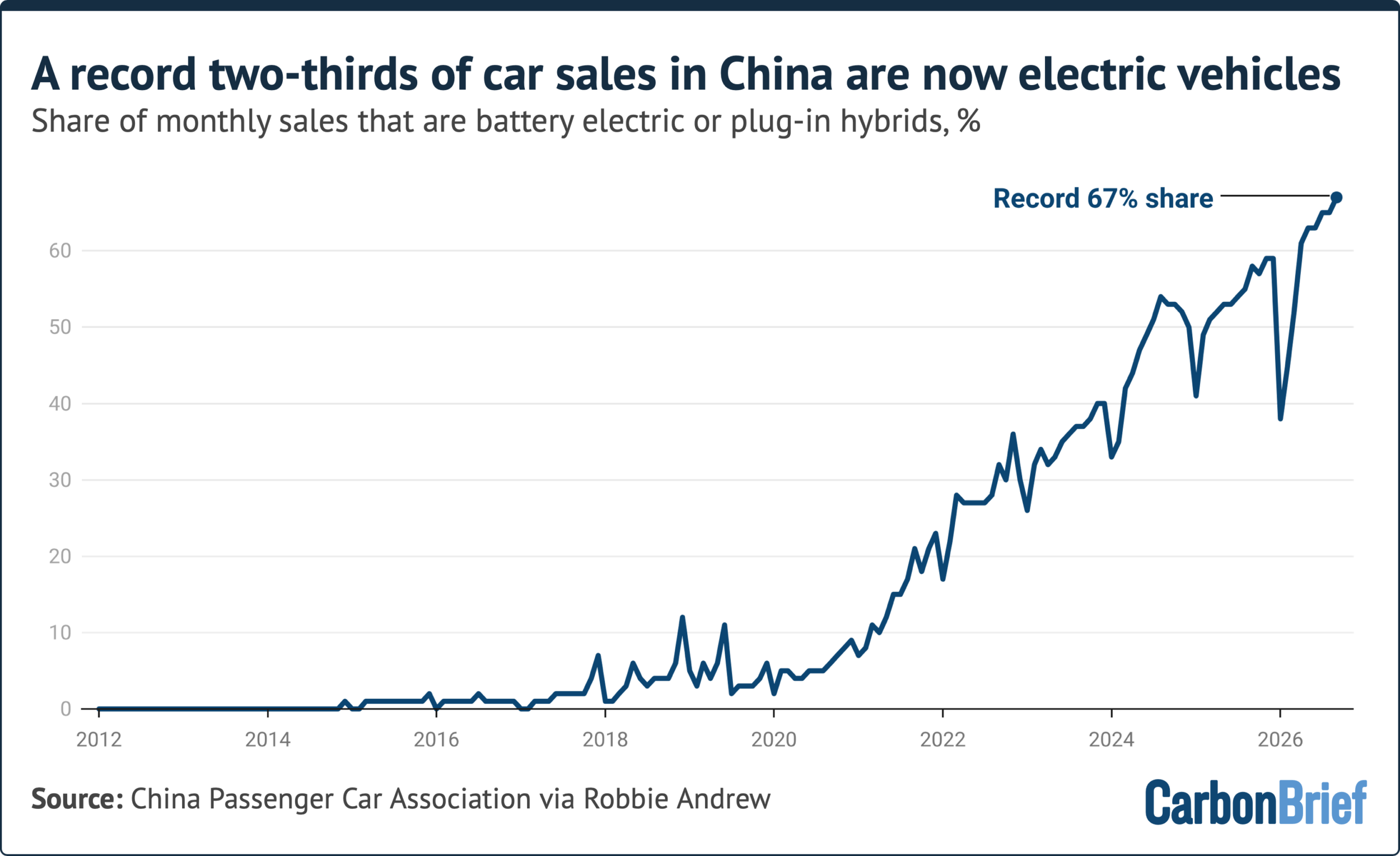
This marks a rapid rise for NEVs from just 6% of new car sales in 2020 up to 58% in 2026 to date – and a record 67% in the month of September.
This year, NEVs’ share of sales has also bounced back from a low of 39% in January, after the full purchase tax exemption that had been in place for more than a decade came to an end in December 2025.
The gain in NEV share in 2026 has come amid a slowdown across the wider domestic passenger-car market, which has hit sales of combustion-engine vehicles particularly hard.
This September, passenger-car retail sales across all categories declined, with overall sales volumes falling 28% year-on-year.
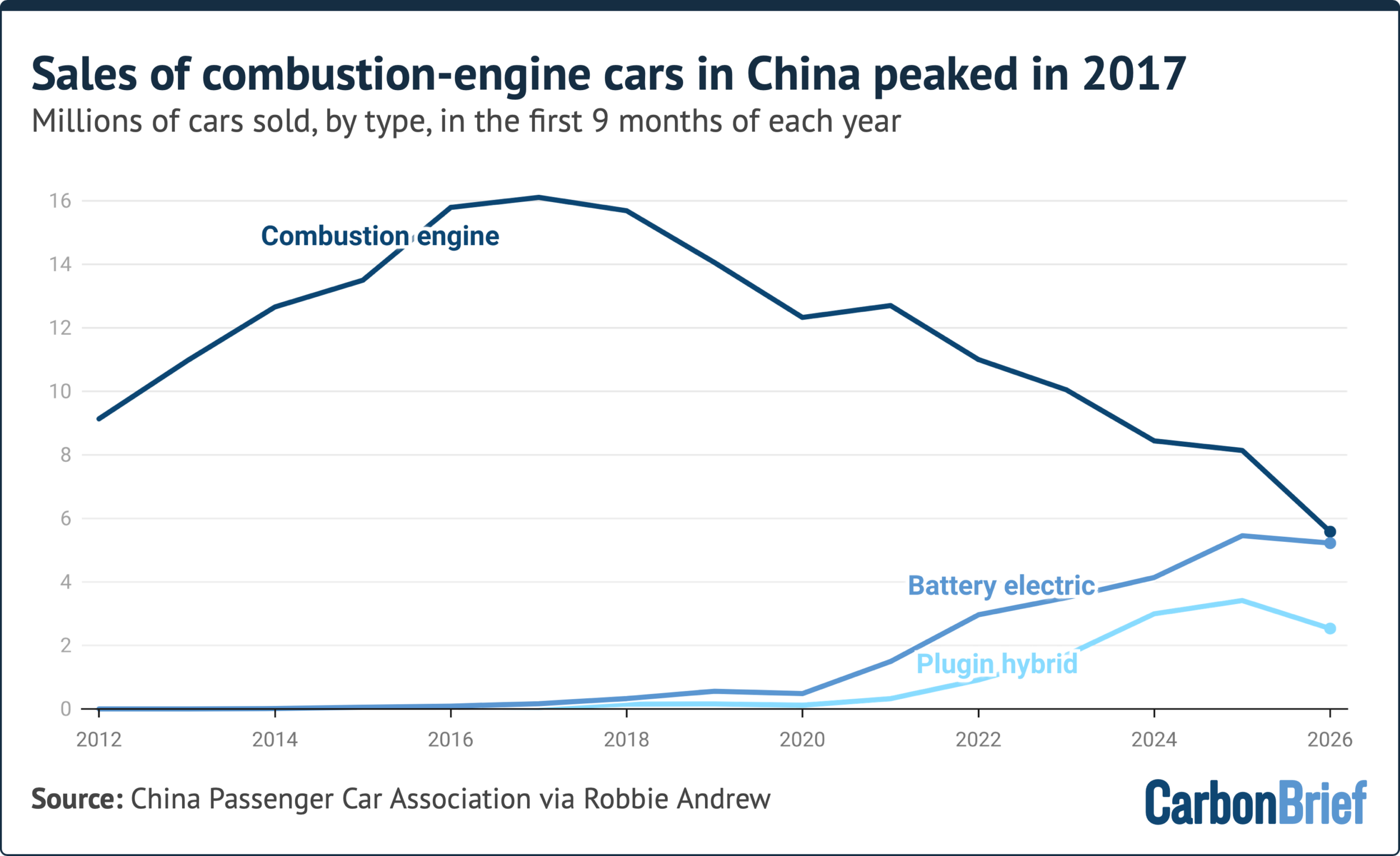
The contraction was led by combustion-engine vehicles, which saw sales fall 43% year-on-year in September and 31% in 2026 to date.
However, sales of PHEVs also fell by 36% year-on-year in September and by 26% in 2026 to date. By comparison, BEVs performed better, although sales still declined 8.5% from a year earlier in September and 4% in 2026 to date.
As a result, NEV sales overall fell by 17% in September and 13% in 2026 to date.
While the market changes in 2026 to date were particularly dramatic, they reflect a broad continuation of trends seen over the past decade.
Indeed, sales of combustion-engine cars in China peaked in 2017 and they have been declining ever since, shown in the figure below.
Impact of Hormuz
Part of the reason for the advance of NEVs in 2026, said Chinese technology news outlet OFweek, was petrol cars “giving up market share” as they were outperformed by electric alternatives.
Cui Dongshu, secretary-general of the CPCA, cited higher petrol prices as an explanation for September’s weak combustion-car sales, in comments to financial news outlet National Business Daily.
Imports of oil into China in January-September have fallen 15% compared to 2025, equivalent to 470m barrels, as ongoing conflict tightened supply and drove up prices.
China’s passenger-car NEV fleet has displaced 143m barrels of oil so far during the strait of Hormuz crisis, Euan Graham, senior energy analyst at thinktank Ember, tells Carbon Brief.
EVs “accounted for 12% of the decrease in China’s oil use post-Hormuz”, according to an estimate provided to thinktank the Brookings Institute by an unnamed analyst.
Erica Downs, a senior research scholar at Columbia University’s Center on Global Energy Policy, tells Carbon Brief that the strait of Hormuz crisis and higher oil prices are “reinforcing China’s electrification of road transport”.
She says the “world’s largest oil supply disruption” vindicates China’s early bet on EVs, which was partly driven by concerns about oil-supply security.
NEV demand down
Nevertheless, NEV sales have fallen year-on-year, albeit at a slower rate than overall car sales. The growth in NEV market share has also been decelerating.
Zhang Yichao, a partner at consulting firm AlixPartners, tells Carbon Brief that NEVs benefit from