

As oil prices spike due to the Iran war, a new diplomatic process launched in Colombia will support a group of 57 countries – among them large fossil-fuel producers – interested in designing national roadmaps and a new financial architecture to wean their economies off coal, oil and gas, as well as building a trade system that favours clean energy.
The first global conference on transitioning away from fossil fuels wrapped up on Wednesday in the coal-port city of Santa Marta after several days of discussions bringing together ministers, academics, Indigenous and Afro-descendant peoples, green groups, trade unions and business representatives.
It offered a space for governments frustrated by last year’s failed attempt at COP30 to develop a global roadmap away from fossil fuels to make progress on how to reduce their reliance on hydrocarbons in a fair and carefully planned way, in line with a commitment made at COP28 in Dubai. Large fossil fuel-producing countries have since blocked concrete advances at the UN talks on putting that into practice.
The Santa Marta outcomes will feed into a voluntary roadmap being crafted by COP30 hosts Brazil based on inputs from countries and civil society.
Santa Marta: Ministers grapple with practicalities of fossil fuel phase-out
At Wednesday’s closing plenary, Colombian environment minister Irene Vélez Torres announced that a second conference will be held early next year in the Pacific island nation of Tuvalu, co-chaired by Ireland, marking the start of a new policy-making process to run alongside the slower-paced climate COPs.
“For the first time, it demonstrates that it is possible to make a different type of environmental democracy,” Vélez Torres said, adding that improvements can be made to the methodology.
Colombia and the Netherlands, which jointly hosted the Santa Marta conference, said three workstreams had been set up to identify concrete ways to reduce fossil fuel dependence and strengthen co-operation between countries.
These workstreams are focused on designing national and regional roadmaps away from fossil fuels including coordinating support for implementation; reforming economic and financial architecture by reducing fossil fuel subsidies, unlocking investment and managing debt constraints; and connecting fossil fuel-producing and consuming nations to reshape the international trade system towards decarbonisation and green commerce.
A summary report of the conference said governments would receive policy support from a new panel of top scientists specialised in the energy transition, which will help countries develop roadmaps and align them with their national climate action plans (NDCs).
During two days of ministerial meetings, France was the first country to announce its own roadmap, which includes targets to end the consumption of coal by 2030, oil by 2045 and fossil gas by 2050 for energy purposes.
Dutch climate minister Stientje van Veldhoven said that, while “nobody is gonna force” governments to implement the anticipated roadmaps, “these countries came together because they want to transition to a different economy”, adding that the conference provides “safe space for dialogue”.
“The fact that we don’t have negotiations here gave us such different dynamics, so the psychology of the Santa Marta conference is something that we will definitely make sure to carry forward,” she told the plenary. Later she said at a press conference that the key was not to negotiate but to “collaborate”.
Call for a fossil fuel treaty
Countries gave mostly positive reactions to the conference proceedings and said the general mood had been uplifting. One government delegate from the Dominican Republic even had to fight back tears in the plenary as she thanked the hosts for inspiring the group of assembled countries.
While supportive of the Santa Marta discussions, oil-rich Nigeria advocated strongly for a “managed, just, orderly and equitable” transition away from fossil fuels, warning against any “sudden closures”. This stance was reflected in the summary report which notes that fossil fuels should “decline in a managed, fair, and politically viable way”.
-
Why the transition beyond fossil fuels depends on cities and collective action
Cities will help identify concrete pathways for an equitable shift to clean energy at the Santa Marta conference, with C40 members aiming to halve their fossil fuel use by 2030

Ghana, another fossil fuel-producing country, said oil and gas remain deeply tied to government revenues which fund public services. Nonetheless, the West African country urged others to join an initiative to negotiate a global “Fossil Fuel Treaty”, which a group of 18 nations called on the conference to endorse. The effort was not included in the Santa Marta workstreams.
Felix Wertli, Switzerland’s ambassador for the environment, said countries had found potential areas for collaboration around improving electricity grids, energy storage and green investments ahead of this year’s COP31 UN climate summit in Türkiye. “We are confident that this COP could support such a call,” he added.
“Groundbreaking” talks
Delegates said Santa Marta had offered a “more relaxed” and inclusive process than UN negotiations. Government officials met face-to-face in hours-long conversations and interacted with representatives of different social sectors, including Indigenous peoples, cities and academics in closed-door breakout sessions.
Panama’s climate envoy, Juan Carlos Monterrey, told Climate Home News that, while he had been sceptical of the process at first, it allowed for discussions to “flow” in a way that COPs do not. “That is groundbreaking – it is a massive change in how we deal with environmental diplomacy,” he said.
EU climate chief Wopke Hoekstra told journalists that the fact that the conference had happened at all just a few months after a tense COP30 was an achievement in itself. UK climate envoy Rachel Kyte also noted that the Santa Marta dialogue “is a proof of point that we can talk maturely about a really difficult issue”.
Comment: Santa Marta marks a new chapter in climate diplomacy
Observers also largely praised the conference. Catherine Abreu, director of the International Climate Politics Hub, called it a “productive space” for discussing the “stickiest issues” in the energy transition. WWF’s Manuel Pulgar Vidal, also a former COP president for Peru, said Santa Marta made “hope swell into momentum”, adding that its urgency must be sustained beyond this one summit.
Patricia Suárez, from the Organization of Indigenous Peoples of the Colombian Amazon (OPIAC), said Indigenous peoples were optimistic that the conference had placed “the urgency of moving away from fossil fuels on the table”. But more concrete measures must follow, she noted, including declaring key rainforest ecosystems as “fossil fuel exclusion zones”.
One area the conference was criticised for overlooking was the health harms caused by fossil fuels through air pollution, extreme heat and other impacts. Jeni Miller, executive director of the Global Climate and Health Alliance, which unites 250 health organisations, said leaders in Santa Marta “did not address the importance of protecting people’s health”, which should be put at the centre of the conversation.
Influencing UN negotiations
Most government officials at the conference recognised the need to grow the “coalition of the willing” cemented in Santa Marta into a larger network that can influence other spaces such as UN climate negotiations – and its organisers reiterated that the door is open for others countries to join.
Dutch minister van Veldhoven told the final plenary that while “we are here with an immense group in Santa Marta, it is still too small” to fully disentangle the world from fossil fuels. Colombia and the Netherlands did not invite some powerful fossil fuel-producing countries like Russia and the US to the gathering because of their “openly extractivist” views, and major players in the clean energy sector like China were also left off the list.
Comment: Six nations at Santa Marta could shape fossil fuel futures
Tuvalu’s climate minister, Maina Vakafua Talia, told Climate Home News that big actors like China should be at the table, saying the criteria for invitations could change for the second fossil fuel phase-out conference his country will organise in April 2027.
“If we are missing out the main players in the discussion, then we are moving in a loop,” he said. “We need to find somehow how we can engage with [them] because there is no point in talking to ourselves.”
Claudio Angelo, head of international politics at Brazilian NGO Observatório do Clima, said countries could decide to keep the ball rolling within the UN climate negotiations by presenting formal agenda items on roadmaps away from fossil fuels at the annual Bonn talks in June which set the scene for COPs.
Tina Stege, climate envoy from the Marshall Islands, argued “there is a strong recognition that what we’re doing here can complement the COP process and needs to inform that process” – a view backed by other Pacific islands.
The post Santa Marta summit kick-starts work on key steps for fossil fuel transition appeared first on Climate Home News.
Santa Marta summit kick-starts work on key steps for fossil fuel transition

Climate Change
WA EPA warned Woodside of ‘serious, significant and irreversible’ harms to Scott Reef from gas plans, new documents reveal
SYDNEY/PERTH, Tuesday 27 October 2026 — In response to Western Australian Environmental Protection Authority (WA EPA) documents about Woodside’s plans to drill for gas at Scott Reef, as reported today, the following comments can be attributed to Glenn Walker, Head of Nature at Greenpeace Australia Pacific:
“These WA EPA documents show the depth of concern echoed by multiple regulators about Woodside’s plans to drill for oil and gas at Scott Reef, a proposal that flouts legislated nature protection principles.
“The WA EPA appears to have informed Woodside that the Browse project was bound for rejection based on an extensive review process and the opinion of multiple state government departments and independent experts.
“Greenpeace analyses have confirmed this year that Woodside’s gas drilling plans at Scott Reef still risk destroying vulnerable green turtle homes, further endangering pygmy blue whales with atomic bomb-level seismic blasting noise, and unleashing the worst oil spill in Australian history.
“The federal environment department raised similar red flags about oil spill risk from Woodside’s Scott Reef drilling plans in 2025 and 2026 before handing the project’s assessment over to the National Environmental Protection Authority.
“Woodside’s suggested ‘fixes’ in response to grave concerns for the wellbeing of Scott Reef and threatened species have been unilaterally criticised by independent experts for lacking in scientific basis and adequate detail.
“It would be a major backflip for both the WA EPA and the National EPA to now recommend approving this project. It is now critical that these regulators maintain their independence from corporate and political influence and reject this destructive project once and for all.”
-ENDS-
Notes to editor
Greenpeace Technical assessments of Woodside’s Browse Pygmy Blue Whale Management Plan, the Turtle Management Plan, and an analysis of Woodside’s Browse Oil Spill Modelling and Risk Mitigation Plan
High res images and footage of Scott Reef can be found here
Media contact:
Emma Sangalli at emma.sangalli@greenpeace.org or 0431 513 465
The surprise re-election of Brazil’s President Luiz Inácio Lula da Silva on Sunday, in a tight race against right-wing candidate Flávio Bolsonaro, has raised hopes the country can meet a flagship target to end deforestation in all its biomes by 2030 and advance international fundraising to protect rainforests.
Defying expectations to win an unprecedented fourth term in office, Lula – who turns 81 this week – said in his acceptance speech that “we will show the world how climate policy is handled in this country”, and highlighted that, during his last four years as leader, the country has reduced deforestation every year.
Earlier this month, new data from Brazil’s space agency showed that forest-clearing in the Amazon fell to its lowest on record, after the introduction of a deforestation action plan that constrained illegal cattle ranching from expanding into the world’s largest rainforest.
Brazil leads “encouraging” decline in global rainforest destruction in 2025
At an international level, the country has long championed forest conservation, spearheading the creation of the newly established Tropical Forest Forever Facility (TFFF). As president of last year’s COP30 climate summit, the country is also developing a global roadmap to halt forest loss by the end of the decade, in line with a global goal, which will be presented at the upcoming UN climate summit in Antalya.
‘Much more needs to be done’
In 2023, Lula’s previous administration introduced a deforestation action plan that set a target of zero deforestation by 2030, achieving swift results. His re-election paves the way for this downward trend to continue.
Carlos Nobre, a veteran Brazilian climate scientist and co-chair of the Science Panel for the Amazon, said Brazil now has a “historic opportunity” to prevent a tipping point where large parts of the Amazon rainforest could turn into savanna, with dangerous impacts for the planet’s climate.
“The reduction in deforestation over recent years has been crucial, but much more needs to be done. Ending deforestation by 2030, tackling forest degradation and accelerating large-scale forest restoration are urgent priorities,” he said.
Anders Haug Larsen, advocacy director at the Norway Rainforest Foundation, described the election result as a “relief”, adding it makes it more attractive for donors to support rainforest protection in the country.
“Hope is a scarce commodity these days,” he said. “The international community must grasp this opportunity to strengthen efforts towards zero deforestation in the Amazon.”
Rainforest fund boosted by election result
Brazil was the original proponent of the TFFF, one of the highest-profile initiatives aimed at channelling new finance to protect the world’s rainforests. The fund aims to raise public seed capital to invest in financial markets, and then pay rainforest countries from the returns on those investments.
Despite being a developing country, Brazil has pledged $1 billion to the fund and is expected to play a key role in helping reach its goal to raise $10 billion from governments by the end of this year.
“We need more countries to come on board to meet the mobilisation target of $10 billion this year, and this election should inject trust in the calls from rainforest countries for support to their forest protection efforts,” Larsen said.
Brazil confident new rainforest fund will reach $10bn donor milestone
On Monday, the day after the election result, the Netherlands announced a €500-million contribution to the fund, which will be disbursed over ten years and is still subject to parliamentary approval. This brings the total pledged to the TFFF from a range of countries to $7.8 billion.
Norway’s climate minister Sigrun Aasland told a TFFF event on the sidelines of the UN biodiversity summit in Yerevan that she was hopeful the $10bn goal could be achieved by the end of this year.
Brazilian officials have led the TFFF’s fundraising efforts and said they are in conversations with more potential donors including China, Korea and Japan.
Congress shifts further to the right
Sonia Guajajara, former minister of Indigenous Peoples in Lula’s government, celebrated the president’s re-election but cautioned that the 20 indigenous territories created under his current administration must be consolidated, as they are “essential to tackling the climate crisis and preserving our biomes”.
Veteran Brazilian diplomat Bráulio Ferreira de Souza Dias, meanwhile, noted that Lula faces a difficult political scenario, as right-wing pro-Bolsonaro lawmakers have gained more seats in both legislative chambers. He added that the courts will become key battlegrounds to challenge anti-climate legislation.
Observatório do Clima, a network of Brazilian green groups, said seven out of every ten representatives and senators who will make up the next legislature are likely to vote against the climate and environmental agenda, urging Lula’s administration to strengthen its action in parliament and expand alliances.
Still, Ferreira de Souza Dias echoed the widespread view among climate policy-makers that a Bolsonaro win would have been “terrible” for the rainforest and Indigenous peoples, and said the country had avoided a scenario where deforestation threatened to increase again.
The post Lula’s election win in Brazil raises hopes for zero deforestation drive appeared first on Climate Home News.
Lula’s election win in Brazil raises hopes for zero deforestation drive
African governments are developing policies to manage waste from solar panels, batteries and other clean tech equipment as installations surge, with officials warning the energy transition could create a new environmental problem unless it is accompanied by investment in recycling and reuse.
Many African households and businesses are increasingly turning away from unreliable grid power or deciding not to wait for access, and are installing more solar panels and battery storage. Data from energy think-tank Ember, published in August, projects that the continent will install a record 17 gigawatts (GW) of solar capacity in 2026 – equal to around 100,000 solar panels every day. This would mark the third consecutive year of record growth, following increases of 51% in 2025 and 25% in 2024.
While generally a welcome sign of progress towards a cleaner energy mix, this trend could also create a headache for African officials. Anselm Marungu, Namibia’s deputy minister of environment, forestry and tourism, believes rules should be put in place to ensure that valuable materials can be recovered from discarded solar panels, batteries and inverters at the end of their useful life.
-
Made in Nigeria: The race to build an African solar industry from scratch
A solar power revolution is gathering pace in Africa and Nigeria wants a slice of the fast-growing industry, but competing with Chinese imports won’t be easy -
Indian start-ups mine e-waste for battery minerals but growing industry has a dark side
Recycling e-waste can unlock a vast and sustainable supply of transition minerals but in India the sector relies on a neglected informal economy -
DR Congo’s power-hungry mining sector drives record solar surge
As solar deployment rapidly accelerates across Africa, miners in the DRC are driving significant demand for clean energy to replace expensive diesel


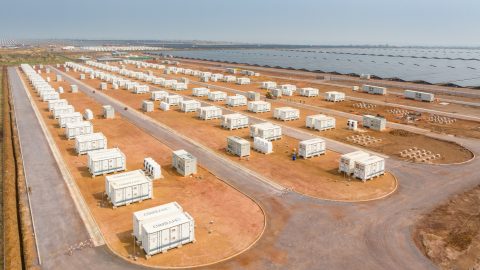
Some of the materials and minerals the world needs for manufacturing clean energy technologies – including glass, aluminium, copper, cobalt, lithium and nickel – can be obtained by recycling solar panels, inverters and batteries.
The International Energy Agency (IEA) estimates that recycling could reduce growth in new mining needs by 40% for copper and cobalt and by 25% for l