

Denmark is on its way to introducing a world-first tax on greenhouse gas emissions from agriculture in 2030.
Central to the proposals – announced by the Danish government on 24 June – is the plan to charge farmers for emissions from their livestock.
This carbon tax would cost around €100 (£85) annually per cow, according to the Financial Times.
The proposal is one part of a wider agreement between the government and different agriculture and environmental groups aimed at helping the country meet its climate goals for 2030 and beyond.
As a major producer of dairy and pork, one-quarter of Denmark’s greenhouse gas emissions come from agriculture.
In this Q&A, Carbon Brief explains the agriculture tax plans, the possible impacts on farmers and the effect it could have on cutting Denmark’s emissions.
- How will the tax work?
- How will this tax help Denmark meet its climate targets?
- How was the agreement reached?
- What will the tax mean for Danish farmers?
- Are other countries planning to introduce a carbon tax on agriculture?
How will the tax work?
Under the proposed plans, Danish landowners will pay a levy based on their emissions from “livestock, fertiliser, forestry and the disturbance of carbon-rich agricultural soils”, the Copenhagen Post reported.

The effective cost of the tax paid by farmers will amount to 120 Danish kroner (£14/$18) per tonne of CO2-equivalent (CO2e) emitted when the tax is implemented in 2030. It will rise to 300 kroner (£34/$44) per tonne of CO2e from 2035 onwards.
The true cost of these taxes is actually higher (300 kroner per tonne of CO2e in 2030 and 750 kroner per tonne from 2035 onwards), but the government will also implement a 60% deduction. The aim of this “basic tax break” is to “limit the impact of the measure on production costs”, says EurActiv. It adds that, in the long run, “the most climate-efficient farms could be close to paying no tax”.
The proceeds of the levy “are to be pooled in a fund to support the livestock industry’s green transition for at least two years after the tax comes into effect”, according to the Guardian.
The tax is just one element of a wider agreement on a “Green Denmark”. This was signed by a “green tripartite”, namely, a three-party agreement between the Danish government, conservation groups and the Danish industrial and agricultural sectors.

The agreement aims to “form the long-term basis for a historic reorganisation and transformation of Denmark’s land and of food and agricultural production”.
Under the deal, Denmark will relinquish some agricultural lands to provide more space for nature and biodiversity. Those lands will comprise heaths, meadows, river valleys and bogs that had historically been converted to agriculture.
The country will plant 250,000 hectares of new forests by 2045 and set aside 140,000 hectares of lowlands to protect their carbon-rich soils by 2030. It will also acquire strategic agricultural lands and distribute or sell them to private and public investments to “contribute to large nature areas” or “installation of renewable energy” and boost technologies and measures to cut emissions, the agreement says.

All these targets will be financed by a new Denmark’s Green Area Fund, which amounts to 40bn kroner (£4.6bn/$5.9bn). Denmark’s government will also use EU agricultural subsidies for the technology transition.
Finally, the agreement also aims to improve Denmark’s coastal waters and freshwater and reduce nitrogen fertiliser use.
The Danish parliament still needs to approve the plan, but Reuters noted that “political experts expect a bill to pass following the broad-based consensus”.
How will this tax help Denmark meet its climate targets?
According to Denmark’s most recent national inventory report, the agricultural sector is the country’s second-largest source of emissions, after the energy sector.
Agriculture contributes around 28% of Denmark’s total greenhouse gas emissions, the report says, and accounts for more than 80% of methane and nitrous oxide emissions specifically.
A “major part” of these emissions stem from livestock production, the report says. Denmark has more than 15,000 livestock farms containing millions of cows, pigs and other animals.
The country’s high agriculture emissions “cannot continue”, the climate minister Lars Aagaard said in a statement about the CO2-cutting proposals, adding that a “great deal of work awaits” to implement these plans.

By 2030, the country is aiming to cut overall greenhouse gas emissions by 70% and agriculture and forestry emissions by 55-65%.
The new proposals are estimated to cut 1.8m tonnes of CO2e emissions in 2030, according to the government.
This will help Denmark meet its 2030 climate goals and “take a big step closer to becoming climate neutral in 2045”, tax minister Jeppe Bruus said in a statement.
The agreement will also boost forests, large wetlands and nature protection, according to the president of the Danish Society for Nature Conservation, Maria Reumert Gjerding.

Prof Søren Petersen, a soil microbiologist at Aarhus University in Denmark, agrees that the plan “could lead to substantial reductions in agricultural emissions” if implemented correctly. He tells Carbon Brief:
“It is my impression that there is a real interest in promoting climate-smart solutions and developing solutions that achieve real reductions in emissions.”
Petersen says that the agreement highlights the “need to speed up” new climate technologies and measures to cut greenhouse gas emissions from agriculture. He adds:
“Perhaps the greatest barrier at the moment is that many technologies with potential for greenhouse gas mitigation have not yet been sufficiently documented, or that the source is highly variable and difficult to quantify.”
He notes that it is often “difficult to measure” agricultural emissions, adding:
“If we can arrive at a set of criteria for documenting emissions, and effects of mitigation measures, and if such criteria can also be accepted in the international review of the national inventory, then I do think there is potential for developing several technologies for use at farm level.
“But tangible impact will require land use changes, as well as mitigation technologies.”
Niklas Sjøbeck Jørgensen, senior advisor on food and bioresources at Green Transition Denmark, an environmental thinktank, says the agreement is “an important step in a greener direction”.
But, he says, it “fails by maintaining problematic animal production”, adding in a statement:
“Unfortunately, the CO2 tax is correspondingly lagging behind, as the floor deduction of 60% and large technology subsidies maintain the current intensive form of animal production.”
How was the agreement reached?
The Danish government and the other members of the green tripartite reached this “historic agreement” after almost five months of talks, Politico reported.
Agreeing the tax “has been a very difficult journey”, Martin Kristian Brauer, chief economist at the Danish Agriculture and Food Council, one of Denmark’s largest organisations representing farmers and part of the green tripartite, tells Carbon Brief.
Brauer says his organisation had been against the tax from the beginning of the negotiations since “the risk connected to such a tax is far too big for the sector”. But over the past two years, they have worked on identifying those risks, listening to farmers’ concerns and negotiating with the government. He tells Carbon Brief:
“Although we have many [farmers] in Denmark still oppos[ing] this tax, I think we reached a point where we can live with it.”

Brauer says that broad participation of the different sectors was fundamental to allowing this “very difficult issue” to turn “into real politics”. He tells Carbon Brief:
“That was an agreement among all the parties. It was not just closing a lot of agricultural farms and thereby reducing emissions. The goal was to make a new regulation, where Danish agriculture meets climate goals, but [also having] the possibility to develop…an economically sustainable sector.”
Members of the tripartite agreed that the country “must have a strong and competitive” agricultural sector “with attractive business potential and jobs”, according to a statement by the Danish Ministry of Economic Affairs.
The agreement also stated that the new Green Area Fund would attempt to “facilitate a land conversion that mitigates the economic consequences for Danish agriculture”.
Brauer points out that there will be subsidies to incentivise farmers to enrol in the programme. The Green Area Fund, according to the agreement, will support private afforestation, the conservation of aquatic ecosystems and drinking water and the conversion of other lands, including wetlands and lowlands.
What will the tax mean for Danish farmers?
Petersen tells Carbon Brief that the agricultural CO2 tax proposal is “quite flexible and lenient on farmers”.
He notes that the gradual increase in the cost farmers will pay from 2030 to 2035 will “buy time for farmers to adjust, and for researchers to deliver the documentation of the effects of potential mitigation measures”.
In fact, farmers that comply with proven climate solutions “can avoid the tax”, according to a statement by Søren Søndergaard, president of the Danish Agriculture and Food Council.
The agreement provides a number of climate measures already available for farms from fertiliser use to livestock feed management. It also states that Denmark’s government will document and look for new climate technologies and measures for the agricultural sector.
Feed additives may be used to reduce direct emissions from livestock, Brauer notes. He tells Carbon Brief:
“That is an additive put into the feed and when the cows eat [it], emissions are reduced by maybe 20 or 30%.”
Another part of the agreement is land conversion and management. The territorial reorganisation will be planned and implemented by local governments, with the participation of coastal water councils and river basin management groups, the agreement says.

Brauer, from the Danish Agriculture and Food Council, says that land conversion does not mean farmers will lose their lands, instead, they will receive a subsidy to “convert the land”. He tells Carbon Brief:
“The farmer in Denmark in the future will be not just an agricultural farmer, he will actually be a land manager and will have some areas which [are] going to be traditional agricultural farming, forests and maybe wetlands. So he will have a portfolio of different kinds of lands in his state that will all generate some income.”
The agreement points out that farmers’ participation in setting aside carbon-rich shallow soils and reducing nitrogen emissions is voluntary, but they can obtain financial incentives from the new fund for doing so.
Brauer adds that for those goals, each Danish region is mandated to reach certain targets. He says:
“If that area does not meet these goals together, then there will be a mandatory regulation set up for each farmer, pushed from the government.”
Regarding how small producers would be impacted, the agreement mentions that it is being analysed how to determine when a producer or farm will be subject to taxation, through a threshold that aims “to exempt farms with relatively low greenhouse gas emissions to ensure that the total administrative and economic costs of the tax are commensurate with the potential CO2e reductions”.
Are other countries planning to introduce a carbon tax on agriculture?
Denmark is the first country to introduce this kind of legislation, although other countries have considered it and, until recently, New Zealand was pioneering similar moves.
Around half of New Zealand’s greenhouse gas emissions come from agriculture, primarily livestock. To tackle this, in 2022 the previous government planned to include agriculture in the country’s emissions trading scheme from 2025 onwards.
Under this scheme, the government sets a limit for the amount of greenhouse gases companies in certain sectors can emit. Companies whose emissions fall under the limit can sell their extra allowances to other organisations. These limits reduce over time, in line with climate targets.

Some New Zealand farmers protested these plans and the government received pushback from farm lobby groups.
In June this year, the country’s relatively new centre-right government scrapped plans for the so-called “burp tax” – a reference to the methane produced by livestock. This fulfilled a “pre-election pledge by [New Zealand prime minister] Christopher Luxon’s National Party”, Al Jazeera said at the time.
The government said it would instead invest hundreds of millions of dollars on emissions-reduction technology and boost funding for an agricultural greenhouse gas research centre.
Agriculture minister Todd McClay said that the government is “committed to meeting our climate change obligations without shutting down Kiwi farms”.
The Green and Labour parties criticised the government’s decision, Radio New Zealand reported.

In the EU, there have been on-and-off discussions about bringing agriculture into the bloc’s emissions trading system.
In March, Carbon Pulse reported that the EU was “testing the waters” on either creating a new emissions trading system for agriculture or revising existing rules.
Since then, a new European parliament was elected and the next European Commission line-up will be finalised this summer.
The EU’s climate advisory board earlier this year recommended introducing emissions pricing for agriculture and land use.
Danish prime minister, Mette Frederiksen, said she hopes Denmark’s planned agriculture carbon tax will “pave the way forward regionally and globally” for similar moves, the Financial Times reported.
Brauer says that farmers in Denmark are “quite concerned” about the tax as it may lead to Danish products being “a little bit more expensive than a product from Germany or from elsewhere”. He adds:
“If we get some kind of regulation in the whole EU, this difficulty would disappear.”


The post Q&A: How Denmark plans to tax agriculture emissions to meet climate goals appeared first on Carbon Brief.
Q&A: How Denmark plans to tax agriculture emissions to meet climate goals

Drought and heatwaves occurring together – known as “compound” events – have “surged” across the world since the early 2000s, a new study shows.
Compound drought and heat events (CDHEs) can have devastating effects, creating the ideal conditions for intense wildfires, such as Australia’s “Black Summer” of 2019-20 where bushfires burned 24m hectares and killed 33 people.
The research, published in Science Advances, finds that the increase in CDHEs is predominantly being driven by events that start with a heatwave.
The global area affected by such “heatwave-led” compound events has more than doubled between 1980-2001 and 2002-23, the study says.
The rapid increase in these events over the last 23 years cannot be explained solely by global warming, the authors note.
Since the late 1990s, feedbacks between the land and the atmosphere have become stronger, making heatwaves more likely to trigger drought conditions, they explain.
One of the study authors tells Carbon Brief that societies must pay greater attention to compound events, which can “cause severe impacts on ecosystems, agriculture and society”.
Compound events
CDHEs are extreme weather events where drought and heatwave conditions occur simultaneously – or shortly after each other – in the same region.
These events are often triggered by large-scale weather patterns, such as “blocking” highs, which can produce “prolonged” hot and dry conditions, according to the study.
Prof Sang-Wook Yeh is one of the study authors and a professor at the Ewha Womans University in South Korea. He tells Carbon Brief:
“When heatwaves and droughts occur together, the two hazards reinforce each other through land-atmosphere interactions. This amplifies surface heating and soil moisture deficits, making compound events more intense and damaging than single hazards.”
CDHEs can begin with either a heatwave or a drought.
The sequence of these extremes is important, the study says, as they have different drivers and impacts.
For example, in a CDHE where the heatwave was the precursor, increased direct sunshine causes more moisture loss from soils and plants, leading to a drought.
Conversely, in an event where the drought was the precursor, the lack of soil moisture means that less of the sun’s energy goes into evaporation and more goes into warming the Earth’s surface. This produces favourable conditions for heatwaves.
The study shows that the majority of CDHEs globally start out as a drought.
In recent years, there has been increasing focus on these events due to the devastating impact they have on agriculture, ecosystems and public health.
In Russia in the summer of 2010, a compound drought-heatwave event – and the associated wildfires – caused the death of nearly 55,000 people, the study notes.

The record-breaking Pacific north-west “heat dome” in 2021 triggered extreme drought conditions that caused “significant declines” in wheat yields, as well as in barley, canola and fruit production in British Columbia and Alberta, Canada, says the study.
Increasing events
To assess how CDHEs are changing, the researchers use daily reanalysis data to identify droughts and heatwaves events. (Reanalysis data combines past observations with climate models to create a historical climate record.) Then, using an algorithm, they analyse how these events overlap in both time and space.
The study covers the period from 1980 to 2023 and the world’s land surface, excluding polar regions where CDHEs are rare.
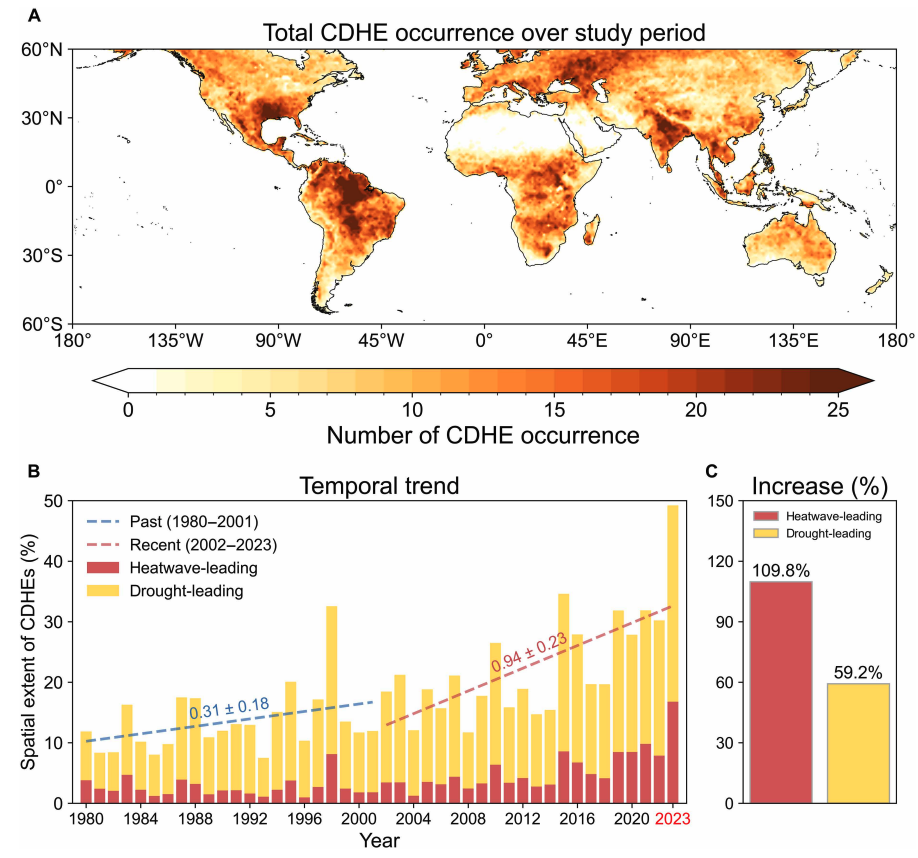
The research finds that the area of land affected by CDHEs has “increased substantially” since the early 2000s.
Heatwave-led events have been the main contributor to this increase, the study says, with their spatial extent rising 110% between 1980-2001 and 2002-23, compared to a 59% increase for drought-led events.
The map below shows the global distribution of CDHEs over 1980-2023. The charts show the percentage of the land surface affected by a heatwave-led CDHE (red) or a drought-led CDHE (yellow) in a given year (left) and relative increase in each CDHE type (right).
The study finds that CDHEs have occurred most frequently in northern South America, the southern US, eastern Europe, central Africa and south Asia.
Threshold passed
The authors explain that the increase in heatwave-led CDHEs is related to rising global temperatures, but that this does not tell the whole story.
In the earlier 22-year period of 1980-2001, the study finds that the spatial extent of heatwave-led CDHEs rises by 1.6% per 1C of global temperature rise. For the more-recent period of 2022-23, this increases “nearly eightfold” to 13.1%.
The change suggests that the rapid increase in the heatwave-led CDHEs occurred after the global average temperature “surpasse[d] a certain temperature threshold”, the paper says.
This threshold is an absolute global average temperature of 14.3C, the authors estimate (based on an 11-year average), which the world passed around the year 2000.
Investigating the recent surge in heatwave-leading CDHEs further, the researchers find a “regime shift” in land-atmosphere dynamics “toward a persistently intensified state after the late 1990s”.
In other words, the way that drier soils drive higher surface temperatures, and vice versa, is becoming stronger, resulting in more heatwave-led compound events.
Daily data
The research has some advantages over other previous studies, Yeh says. For instance, the new work uses daily estimations of CDHEs, compared to monthly data used in past research. This is “important for capturing the detailed occurrence” of these events, says Yeh.
He adds that another advantage of their study is that it distinguishes the sequence of droughts and heatwaves, which allows them to “better understand the differences” in the characteristics of CDHEs.
Dr Meryem Tanarhte is a climate scientist at the University Hassan II in Morocco, and Dr Ruth Cerezo Mota is a climatologist and a researcher at the National Autonomous University of Mexico. Both scientists, who were not involved in the study, agree that the daily estimations give a clearer picture of how CDHEs are changing.
Cerezo-Mota adds that another major contribution of the study is its global focus. She tells Carbon Brief that in some regions, such as Mexico and Africa, there is