

Dozens of the survivors of a devastating 2021 typhoon in the Philippines said on Thursday they would seek damages from Shell in a UK court over the oil giant’s role in climate change.
The landmark case, being brought by 67 people who were injured or lost relatives and property in Typhoon Odette and supported by Greenpeace Philippines, alleges that Shell’s actions contributed to anthropogenic climate change, making the tropical cyclone significantly more likely and more severe.
“With fossil fuel emissions being linked to stronger tropical storms like Odette, vulnerable communities like ours are struggling to keep their head above water,” said Trixy Elle, one of the claimants. “This is not acceptable, this is not just and we must fight.”
Typhoon Rai’s trail of destruction in the Philippines reignites loss and damage calls
Their case is the first civil claim to directly link oil and gas companies to death and personal injury in past climate disasters in the Global South, the group said, although other cases are in the pipeline.
Earlier this year, in another pioneering climate case, a German court threw out a Peruvian farmer’s lawsuit seeking damages from German utility RWE for allegedly putting his home at risk from floods due to melting glaciers caused by global warming.
Despite the dismissal of the case, experts said the judge’s ruling confirmed that climate science can establish legal liability for damage caused by emissions.
Right to a healthy environment
The filing of the lawsuit comes three years after the publication of a major report by the Philippines Commission on Human Rights, which concluded that polluters could potentially be held liable for climate change.
The case will be filed in Britain because that is where Shell is headquartered, but the ruling will apply the law of the Philippines, where the alleged harm occurred.
The claimants have sent the company an initial letter before action and plan to file a formal claim before the High Court in London later in December.
-
Philippines inquiry finds polluters liable for rights violations, urging litigation
The national human rights commission found 47 “carbon majors” acted “immorally” and could be sued – giving fresh impetus to legal challenges -
Peruvian farmer loses climate case against RWE – but paves way for future action
Experts say that despite dismissing the lawsuit, the ruling sets a precedent by confirming that climate science can establish legal liability for the damage caused by emissions -
Typhoon Rai’s trail of destruction in the Philippines reignites loss and damage calls
More than 400 people were killed and seven million lost homes or livelihoods to the category 5 storm that hit the Philippines in December


Lawyers will argue that Shell violated the claimants’ rights under the Philippine constitution, including their right to a balanced and healthy environment, and that the company acted with negligence because it had the opportunity to mitigate climate harm and an obligation to refrain from obfuscating climate science, but failed to do either.
They will also argue that Shell has profited enormously and unjustly from its business activities at the cost of the claimants.
A Shell spokesperson told Climate Home News the company had received the claimants’ letter, acknowledging that more global action was needed on climate change but rejecting the suggestion that Shell had unique knowledge about the problem.
“The issue of climate change and how to tackle it has been part of public discussion and scientific research for decades,” the spokesperson said.
Climate science advances
Typhoon Odette – known internationally as Typhoon Rai – struck the Philippines in December 2021, killing more than 400 people, severely injuring 1,000 more and destroying 1.4 million homes. It cost the Southeast Asian country millions of dollars.
The lawsuit draws on recent advances in climate attribution science, in particular a recent study which found that anthropogenic climate change – climate change caused by humans – more than doubled the risk of such an extreme event.
So far, no oil and gas company has been found legally liable for damages associated with climate change. But a growing number of lawsuits are trying to do so, with potential liabilities for the 25 largest oil and gas firms estimated at more than $20 trillion.

According to the Carbon Majors database, Shell was responsible for more than 2.5% of global fossil fuel emissions since the beginning of the industrial revolution, making it one of the world’s largest corporate emitters. By contrast, the Philippines has contributed just 0.2% of global carbon emissions.
Greg Lascelles, a partner at global law firm Hausfeld who is leading the legal team in the Odette case, said the lawsuit aimed to hold Shell accountable.
“By proving in court that Shell was at fault for this climate change-driven extreme weather event and the suffering it caused, the case highlights the far-reaching and direct impacts on vulnerable communities worldwide of oil and gas company activities,” Lascelles said.
Climate justice campaigner Tessa Khan, executive director of the UK-based organisation Uplift, called it a “genuinely unprecedented case”.
“It’s a new milestone in climate litigation and corporate accountability for the impact of climate change,” she said. “But it’s also really significant in the wider political context in which we’re seeing oil and gas companies, investors in the energy sector, all starting to roll back on their commitments to transition away from fossil fuels.”
The post Philippines storm victims to seek damages from Shell in “unprecedented” climate claim appeared first on Climate Home News.
Philippines storm victims to seek damages from Shell in “unprecedented” climate claim

The United Nations has said the world must cut greenhouse gas emissions by nearly 6% per year to limit global warming enough to be able to return to the 1.5C goal by 2100, as decades of insufficient climate action have now made an overshoot inevitable.
In a video message accompanying the UN Environment Programme’s (UNEP) 2026 Emissions Gap Report, UN Secretary-General António Guterres said the world could no longer avoid overshooting the 1.5C limit and that the consequences were already devastating. However, he said it was still possible to return average global temperatures to 1.5C above preindustrial times by the end of the century.
“Overshoot is not surrender,” he said, adding that the report, released on Wednesday, sets out what is needed to limit warming. That entails cutting global greenhouse gas emissions by 18% by 2030, 45% by 2035 and 69% by 2040, all compared with 2025 levels.
This implies average annual reduction rates of 5.7% for 2025-2035, higher than the pathways laid out by the Intergovernmental Panel on Climate Change in its last major scientific report, which required annual reduction rates of about 5%, UNEP said.
Paris Agreement committee names three countries snubbing it over NDCs
The more ambitious emissions reductions – which countries are still far off achieving – would put the world on the lowest-possible overshoot pathway, giving a 50% chance of limiting peak warming to 1.7–1.8C around mid-century before bringing global temperatures back to 1.5C or below by 2100, the report said. Reaching this scenario will also require carbon removal from the atmosphere, it added.
UNEP noted that if countries fully implement their current national climate plans (NDCs), they would only reduce emissions by 5-8% by 2030 and 11-15% by 2035, relative to 2025 levels.
UNEP Executive Director Inger Andersen said the world must not give up on the Paris Agreement’s most ambitious warming limit, adding that every additional fraction of a degree and additional year of heating above 1.5C increases climate change impacts and risks, such as the deadly floods, heatwaves and wildfires that have plagued many nations this year.
“We must pull out all the stops to minimise peak warming and return to 1.5C by the end of the century. This is possible,” she said, adding that governments must urgently implement policies that deliver rapid and sustained emissions reductions.
Climate pledges fall short
New climate pledges since last year’s report have made a negligible difference to projected emissions and warming, UNEP said. Under current policies, the world is on course for 2.8C of warming this century, while full implementation of national climate pledges and continued similar efforts would limit warming to 2.6C, the report found.
UNEP said its projections had deteriorated, attributing this to the withdrawal of the United States from the Paris Agreement under President Donald Trump and revised estimates of historical emissions.
Even with the most optimistic pledge-based scenario – which assumes countries deliver both their current national climate commitments and additional net-zero targets – warming would now only be limited to 2.1C this century, the report found.
IPCC scientists vow to press on with climate reports despite political deadlock
Speaking to journalists ahead of the report’s launch, co-author Anne Ohlhoff said the US exit from the Paris accord meant that its previous national climate target was no longer included in UNEP’s global projections. The country has also dropped its net-zero emissions goal, she said, affecting the outlook because the US is the world’s second-largest emitter.
She warned that there is still a large gap between countries’ emissions commitments for 2035 and the reductions needed under the report’s lowest-possible 1.5C overshoot scenario.
Every five years of carbon dioxide (CO₂) emissions at current levels pushes peak warming up by around 0.1C, she said, adding that without urgent action, it could quickly become impossible to keep peak warming below 1.7–1.8C.
Describing the emissions gap as a “leadership gap”, UN chief Guterres warned that current national climate plans and policies “fall dangerously short” of what is needed to limit warming. He urged countries to adopt credible roadmaps for transitioning away from fossil fuels, accelerate clean energy deployment and electrification, invest in electricity grids and storage, cut methane emissions and halt deforestation.
Carbon removal needed, but risky
Alongside deep emissions cuts, removal of CO₂ from the atmosphere needs to be accelerated throughout the century, the report found. The world will need to remove and permanently store about 320 billion tonnes of CO₂ from the atmosphere to return global temperatures to around 1.5C by 2100.
The estimated carbon removal is equivalent to around eight years of global CO₂ emissions at 2024 levels. However, UNEP cautions that removing carbon at this scale remains uncertain because of technological and socio-economic challenges.
Keywan Riahi, a contributor to the report, said carbon could be removed through nature-based approaches, such as planting forests and improving wetland management, which help ecosystems absorb carbon emissions, as well as engineering solutions that capture emissions from energy production or remove carbon directly from the air.
However, he warned that both nature-based and technological approaches face risks and might not deliver carbon removal at the scale needed. This is because nature solutions such as planetary sinks are weakening because of climate change while techno-fixes remain uncertain, he added.
“All of those technologies come with risks,” Riahi told reporters, adding that what the world needs is to try “to keep the overshoot as low as possible, so that we do not need to rely on these technologies to take CO₂ out of the atmosphere later on”.
Renewable energy supports emissions cuts
Despite the expected overshoot of the 1.5C warming limit, the UNEP Emissions Gap Report underscored that the rapid growth of renewable energy and the impact of climate policies so far show that deeper emissions cuts remain possible.
It stated that since the adoption of the Paris Agreement in 2015, global renewable electricity capacity has grown three times faster than anticipated, while solar photovoltaic (PV) deployment has increased sevenfold compared with projections made a decade ago.
Maintaining the recent pace of renewable energy expansion, alongside stronger policies, could put the world on track to meet the global goal of tripling renewable energy capacity by 2030, the report said. It could also increase the share of wind and solar in electricity generation to levels consistent with the pathway that limits the overshoot of 1.5C to the lowest possible level, it added.
SE Asia speeds up plan for connected clean power grid after oil shock
Andersen said the explosion of renewable energy and slower-than-projected growth in coal energy supply showed that accelerating climate action is possible. However, she warned that progress remains insufficient, particularly in phasing down fossil fuels and halting forest loss.
“Nations must understand that the point of return begins now, not later,” she said, calling for “fast, deep and sustained emissions reductions”. She urged governments to strengthen their climate action at upcoming UN climate talks and accelerate efforts to keep the 1.5C pathway within reach.
Bill Hare, chief executive of Climate Analytics, said major fossil fuel-producing countries need to take greater responsibility for reducing their emissions, saying that big polluters such as the US and Saudi Arabia need “to stop playing politics and face the scientific reality”.
“Right now they are looking at the fire, denying it exists and pouring more petrol on it, while their own citizens increasingly face searing heat, wildfires and other impacts,” he said. “Governments [need] to get on with enacting policies that cut fossil fuel use as soon as possible.”
The post UN sets steep emission cuts to reverse 1.5C overshoot by end of century appeared first on Climate Home News.
UN sets steep emission cuts to reverse 1.5C overshoot by end of century
When the Turkish COP31 presidency presented its priorities to international business leaders for the first time in New York in September, among those invited to give the private sector’s first response was Ali Koç, scion of one of Türkiye’s wealthiest families.
On stage, the vice chair of the board of Koç Holding said the family company, which weeks earlier had been announced as one of the top sponsors for the UN climate summit, can be seen as “quite exemplary” for its climate record.
What Koç did not mention was that the group’s biggest money-making arm – Türkiye’s largest oil refiner Tüpraş – plans to keep running its refineries “at maximum potential”. Nor did he say that, in 2025, both parent company and subsidiary cut their 2030 climate targets to a level they had already nearly achieved, as Climate Home News’ analysis of company records reveals.
The decision to hand Koç Holding a prominent role at COP31 – the company is also the summit’s “Global Business Partner” – has reignited a long-running controversy over the platforming of fossil fuel interests at the annual UN climate conference.
It has also thrown into question how COP sponsors are chosen and screened. The hosting agreement between the Turkish government and the UN climate secretariat (UNFCCC) says that a partner company’s “climate integrity” should be taken into account.
COP31 electrification pledge leaves out clean power commitment
But how that test is applied is unclear and the process for picking sponsors remains largely opaque. The Turkish COP31 presidency has not published its selection criteria, nor the financial terms of any of its partnership agreements, including Koç’s. The UNFCCC declined to clarify how it advises on such deals.
Campaigners have long argued that accepting sponsorship from polluting companies is wrong because it gives them a global stage, visibility and access to policymakers at talks that are meant to move the world away from fossil fuels, and tarnishes the reputation of the COPs.
Koç’s energy division, which is dominated by oil refiner Tüpraş, accounted for three-quarters of the parent firm’s income in the first half of 2026.
“How was Koç Holding ever chosen as a COP31 sponsor? Any corporation that makes most of its money from oil refining should not qualify as sustainable,” said Pascoe Sabido, a campaigner at Corporate Europe Observatory, which exposes company lobbying. “This is hugely embarrassing for the UNFCCC and its climate integrity check, which doesn’t appear to be worth the paper it’s written on.”
Koç Holding “is not just standing still but walking backwards”, he told Climate Home News.
Koç Holding and Tüpraş did not reply to multiple requests for comment. The UNFCCC secretariat and the Turkish COP31 presidency declined to respond to questions from Climate Home News on the sponsorship agreement.
Oil refining windfall
Türkiye’s biggest industrial group, Koç Holding has stakes in several key sectors of the economy, spanning vehicle manufacturing in a joint venture with Ford to electronics, home appliances and banking.
But the conglomerate’s crown jewel is oil refiner Tüpraş, which Koç controls. Last year its four refineries turned crude oil into 26.8 million tonnes of petrol, diesel, jet fuel and other products, enough to fill about 36 Olympic swimming pools every day.
The company plans to raise its production to 29 million tonnes in 2026 – already a bumper year so far with soaring profits, thanks to sky-rocketing refining margins driven by a crunch in global oil processing capacity caused by the Middle East crisis.
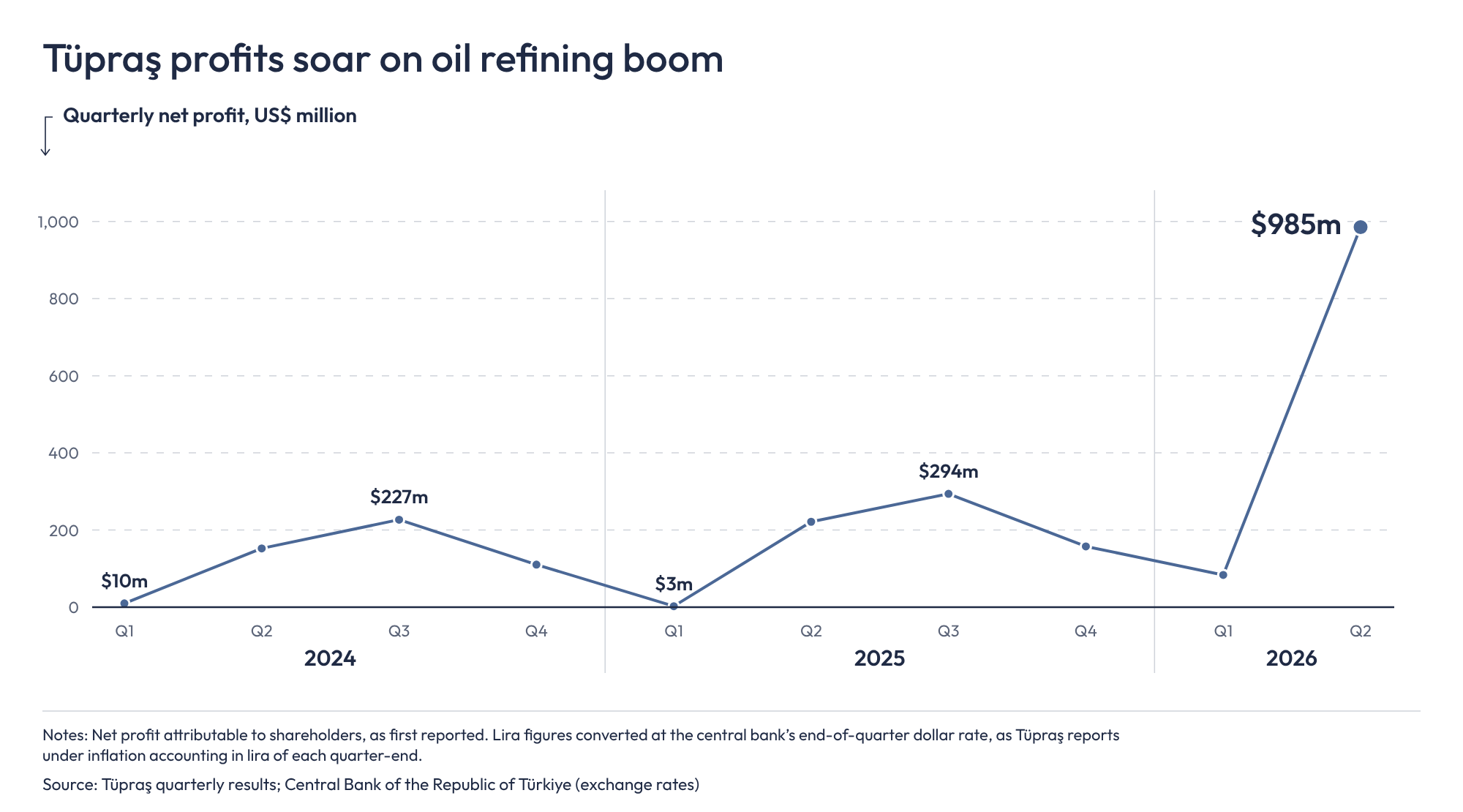
The oil business boom sits awkwardly with the climate and energy transition plans Koç and Tüpraş unveiled in 2021, when both pledged to become carbon neutral by 2050. Then, Tüpraş set out its aim to become “a leading carbon-neutral energy company”.
Despite these promises, in 2025, both companies lowered their targets for cutting emissions from their own operations by 2030, from 27% to 20% below 2017 levels. Tüpraş also cut its 2035 goal from 35% to 25%. The company still technically retains its long-term target of carbon neutrality by 2050, but the new plan will require much more drastic cuts after 2035.
Lowering the climate bar
Tüpraş blamed its weakening of climate ambition on “changing market dynamics, economic conditions and technological developments”. In a presentation announcing the revision to investors, the refiner said the energy outlook had changed since 2021.
The reasons it listed included elevated geopolitical tensions, increased investment in oil and gas extraction, which it said showed refined fuels remain vital for energy security – and even the depletion of the carbon budget to keep global warming to 1.5C.
Its parent company Koç pointed the finger at the slow pace of green hydrogen development, which the group said now had a “low feasibility” of transforming the energy sector after it had previously pinned much of its transition plan on the sustainable fuel.
The Turkish company’s new 2030 targets are certainly within reach. Tüpraş had already cut its operational emissions by 17% from 2017 levels by 2025, with nearly all of that progress achieved before the transition plan was unveiled, while Koç had reduced them by 16%.
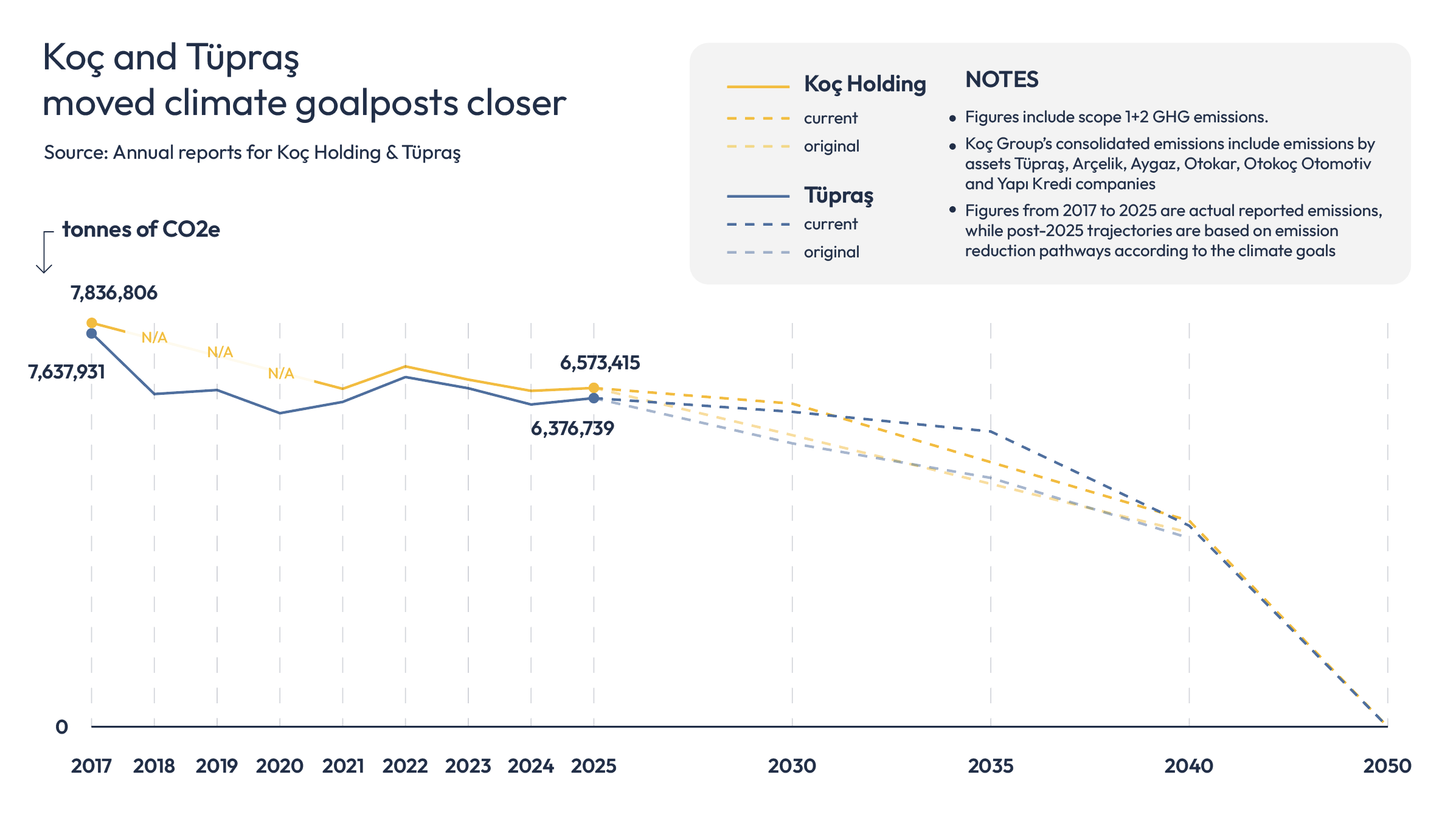
The softer targets also exclude the bulk of the group’s climate impact. Most of its emissions come not from its own refineries and factories but from the products it sells: petrol, diesel and jet fuel burned in the engines of cars or planes.
These so-called Scope 3 emissions make up about 97% of Koç’s carbon footprint. They rose by around a sixth between 2019 and 2024, and neither Koç nor Tüpraş has set a target to cut them.
Efe Baysal, Türkiye team lead at campaign group 350.org, said there is a “clear contradiction” between talking about climate action while weakening emission targets and seeing emissions from the use of petroleum products keep rising.
“If the company is serious about the transition, it needs a clear plan to wind down fossil fuel operations, rather than relying on efficiency measures and technologies that let business as usual continue,” she told Climate Home News.
‘Sustainable refining’ push
Tüpraş’s updated transition plan rules out expanding its oil refineries, but commits to “maintaining the existing capacity” and running it “at maximum potential”. Oil refining is expected to remain its main source of earnings for years to come. Koç listed “growing oil demand and diesel deficit” in Türkiye as a competitive advantage for its energy business in a pitch to investors last month.
The biggest component of the Tüpraş transition plan is what the company calls “sustainable refining”. It plans to invest $3.9 billion between 2025 and 2035 in programmes to modernise its refineries, improve their energy efficiency and bring down the direct emissions they generate. The company is also shifting some of its production to petrochemicals, which it expects to reduce its Scope 3 emissions.
Australia says COP31 co-presidency will work on a cover decision
Alongside these “sustainable refining” efforts, Tüpraş is also investing in renewable power.
Four years ago, it bought Entek, which produces electricity primarily from six hydropower plants and one gas plant. Since the acquisition, Tüpraş has started building a utility-scale solar farm in Romania and a wind power plant with storage in Türkiye, alongside smaller solar energy installations at some of its refineries. A dozen more renewable energy projects are currently in the pipeline, according to its latest annual report.
In a self-declared bid to become “Türkiye’s leading producer of zero-carbon electricity”, Tüpraş wants to reach installed capacity of 1.6 gigawatts (GW) by 2030 – a target it raised in its updated plan – and 2.5GW by 2035. The Turkish government has committed to rolling out 120GW of wind and solar capacity nationwide by then.
Setback for green fuels
Tüpraş plans to supply most of its low-carbon electricity to run its future production plants for green hydrogen, an alternative fuel that can replace fossil fuels in some heavy industries and long-distance transport.
A few years ago, green hydrogen looked set to become a key pillar of the global energy transition, with companies pitching visionary projects and governments rolling out strategies for the fuel to decarbonise economies. But inflated forecasts, high costs and weak demand have led to a reality check for prospective producers like Tüpraş.
The Turkish refiner significantly scaled back its green hydrogen plans last year. While it originally hoped to start producing the clean fuel in 2025, it now targets a first pilot project by 2030 with commercial large-scale production not expect