

The Paris Agreement’s official oversight body is set to decide this month how to deal with over 60 countries that have still not submitted updated national climate plans, over a year after the deadline.
Composed of 12 experts from different regions of the world, the little-known Paris Agreement Implementation and Compliance Committee (PAICC) is tasked with ensuring that nations respect their obligations under the landmark 2015 climate accord.
The Paris Agreement requires each signatory government to submit climate plans known as nationally determined contributions (NDCs), setting out how they will help limit global warming to 1.5C above pre-industrial levels.
Governments also agreed in Paris that NDCs should be updated every five years and submitted 9–12 months before the next UN climate summit. For COP30, that deadline was 10 February 2025. But, over a year after that deadline, sixty-two countries have not yet produced an updated NDC including significant emitters like India, Vietnam, Argentina and Egypt.
PAICC cannot punish countries, but it can publicly reprimand them for their failure to file new NDCs and other transparency reports and ask them to explain themselves.
Concern over lack of responses
After the overwhelming majority of nations missed the February 2025 deadline to submit their NDCs, PAICC opened over 170 separate cases to engage with governments on why they had not yet issued a climate plan and what steps they were taking to address the delay. Cases are closed once countries submit their NDCs.
While the majority of countries responded to the panel’s enquiries, the PAICC’s annual report said that over 45 nations had failed to provide any information by October 2025. This raised the committee’s concern.
-
China eases climate target but clean energy could still cut emissions, experts say
Beijing’s new five-year economic plan leaves questions unanswered on growing coal power fleet -
New summit in Colombia seeks to revive stalled UN talks on fossil fuel transition
Colombia will host the first conference on transitioning away from fossil fuels, after more than 80 countries pushed at COP30 for an end to coal, oil and gas -
Paris agreement’s police force begins with rebuke to Vatican
The Pope’s home state has not yet issued a climate plan, which is against the rules of the Paris Agreement it ratified last year


A PAICC member who did not wish to be named told Climate Home News that, while efforts to maintain an open dialogue will continue, the committee will now also discuss how to proceed further with countries that remain out of step with their commitments under the Paris Agreement. The committee will hold a meeting in the German city of Bonn, home to the UN climate change body, between 24-27 March.
“This is a new era, so every step we take we do it for the first time,” they said, adding that the actions the committee will take may vary from country to country, taking into account their individual circumstances.
Deciding next steps
Governments defined the committee’s mandate at COP24 in Katowice, Poland, in 2018 and produced a list of “appropriate measures” it can take to promote compliance with the Paris Agreement. Those include helping countries access technical help or finance, recommending the development of an action plan or “issuing findings of fact” when a country fails to submit an NDC.
The PAICC member said the committee still needs to determine exactly what the last option means in practice, but it will likely take the form of a public statement identifying countries that have failed to comply. The panel could potentially take other actions beyond those listed in its mandate as long as they are not punitive or adversarial.
“The legal obligations [of the Paris Agreement] are few and far between, so it is even more important to keep tabs on whether countries respect them,” the PAICC member added.
Andreas Sieber, head of political strategy at campaigning group 350.org, said national climate plans are “the currency of the Paris Agreement and how the world tracks progress and how countries plan their transitions”.
“Countries, especially the largest emitters, must honour their obligations under the Paris Agreement and submit credible NDCs,” he told Climate Home News, adding that the same applies to wealthy nations that have pledged climate finance.
Many reasons for delays
Many of the governments that have not yet submitted NDCs are low-emitting small or poorer nations, especially in Africa. But major economies that have not issued an updated climate plan – some of which also have energy transition deals with donors – include Egypt, the Philippines and Vietnam.
Countries without a new NDC contribute to 22% of global greenhouse gas emissions, according to data compiled by ClimateWatch.
In their discussions with PAICC over the past year, countries have cited a range of reasons for the delays, including financial constraints, technical challenges, limited data, changes in government, political instability and armed conflicts, according to the committee’s annual report.

India is the largest emitter without an NDC. At COP30 last November, the Indian government said that it would submit its climate plan “on time”, with environment minister Bhupender Yadav telling reporters it would be delivered “by December”. But that self-imposed deadline was not met.
The right-wing government of Argentina, which has considered leaving the Paris Agreement, unveiled caps on the country’s emissions for 2030 and 2035 in an online event on November 3, but has yet to formalise those targets in an NDC.
Undersecretary of the Environment Fernando Brom told Climate Home News that the country would present its NDC during the first week of COP30. That did not happen, although Argentinian negotiators participated in the climate summit.
Some local experts have pointed to the trade deal signed with the US in November as one of the reasons for the delay in submitting the NDC, while others cited the government’s disinterest in the climate agenda.
In January, the Vietnamese government said it was still working on the draft of its NDC, while the Philippines’ government has organised consultation events on its new NDC but has not indicated when it would be released.
The post Paris Agreement watchdog weighs action against countries missing climate plan appeared first on Climate Home News.
Paris Agreement watchdog weighs action against countries missing climate plan

Australia is looking to South Korea to help turn its vast renewable energy and mineral resources into new export industries supplying low-emissions materials to Korean manufacturers – a deal which campaigners hope will shift trade between the two nations away from fossil fuels.
In an agreement signed on the sidelines of the COP31 climate summit in Antalya, Türkiye, the two countries established a cooperation framework to connect South Korea’s growing industrial power demand with Australia’s clean energy resources.
The deal also aims to support investment in power grids, clean energy supply chains, and greening industries to accelerate emissions cuts.
Analysts say the agreement can help build competitive clean energy supply chains and attract long-term investment into decarbonising industrial processes.
Richie Merzian, CEO of the Clean Energy Investor Group (CEIG), an Australian industry body representing institutional investors in clean energy, told Climate Home News this was “a great example” of a government-to-government agreement that would give investors confidence to invest in green technologies.
-
SE Asia speeds up plan for connected clean power grid after oil shock
Countries are redoubling efforts to link their grids to bolster energy security and reduce their dependence on fossil fuels – but many challenges remain -
As COP31 weighs 35×35 pledge, IEA says Hormuz crisis driving electrification
The report estimates that a planned transition away from fossil fuels and into renewables can add energy jobs and cut energy bills -
Southeast Asia’s fragile grids threaten billions in clean energy investment
Renewables developers need reliable electricity infrastructure and stable policies to help the region meet climate goals and surging demand for power

For example, the deal could support Australian exports of green iron and other low-emissions materials, while giving Korean manufacturers access to cleaner inputs for steelmaking, batteries and other industries.
That in turn could help attract investments in Australian renewable power projects, hydrogen production and industrial infrastructure if developers know Korean customers are willing to pay for greener products.
“The high levels of capital for green iron and steel need certainty on demand and a credible path to offtake before it commits,” said Merzian. The partnership, he added, “will help smooth out the path for Korea’s significant industrial policy and capital to come down under”.
A model for cooperation
The Australian government described the partnership with one of its largest trading partners as “a significant economic opportunity“, opening new markets for its energy and mineral resources.
The agreement will also support the delivery of South Korea’s $750 billion energy transition strategy through 2035 to expand renewable energy capacity by 100 GW by 2030, bolster clean industries and decarbonise high-emissions sectors, such as steel, petrochemicals and cement.
South Korea’s climate and energy minister Kim Sungwhan said in a statement: “This cooperation will serve as an important opportunity for our two countries to combine their respective strengths and jointly pursue industrial decarbonisation, energy security and economic growth.”
In addition, both parties submitted a joint proposal to UN Climate Change to share best practice and lessons learnt on how bilateral cooperation “can serve as a practical and replicable model for broader international cooperation and collective action in addressing the global crisis crisis”.
A group of five civil society groups across Australia and South Korea welcomed the partnership as an opportunity to accelerate the transition away from fossil fuels “in a bilateral relationship historically built on coal and gas”.
Australia was South Korea’s top supplier of liquefied natural gas (LNG) in 2025, while South Korean institutions have a record of financing Australian gas and coal projects. “Without a clear plan to reduce this dependence, the new partnership risks expanding clean energy cooperation without meaningful changes to the trade and reliance on fossil fuels,” the group said in a statement.
Greening iron production: a major opportunity
Greening iron production could offer one of the biggest opportunities for increasing the trade of low-carbon goods between two countries, according to analysts.
Using hydrogen produced with renewable electricity instead of coal to remove oxygen from iron ore for steel production could cut emissions by as much as 85% according to one study. If the resulting metallic iron is then melted in an electric arc furnace powered by green electricity, steel-making emissions can be further reduced.
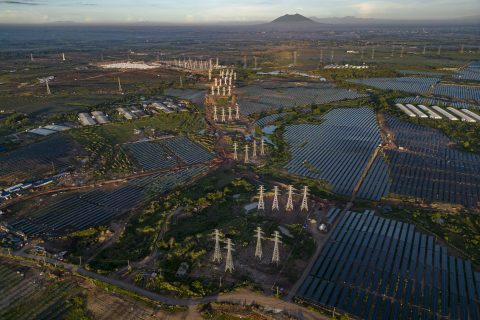
Australia’s abundant iron ore and renewable energy resources could make it a competitive producer of green iron, while South Korea’s established steel industry offers a prospective market for the material.
A 2025 study, commissioned by CEIG and conducted by consultancy Baringa, identified green iron as one of Australia’s most promising green export industries.
-
We must strengthen trade cooperation to deliver on global climate goals
As governments turn to trade-related measures to deliver on their climate targets, cooperation is vital to reduce fragmentation, costs and build more resilient economies -
Minerals for the planet or for war and AI? COP31 must make clear what we prioritise
As demand for minerals soars, intensifying pressure for new mining, meeting demand for the energy transition must come first

Under Baringa’s “renewables superpower” scenario, which assumes strong decarbonisation and that Australia leans into its green export potential, Australian green iron production could surge ninefold to 118 million tonnes between 2035 and 2050. Exports could be worth more than A$93 billion ($61 billion) annually by 2050, it estimated.
Producing the green hydrogen needed to power iron production of that scale would require roughly twice the current demand of Australia’s National Electricity Market, the modelling found.
Large-scale production would require substantial new renewable power generation, energy storage, transmission infrastructure, and hydrogen electrolysers – equipment which splits water into hydrogen and oxygen that could operate at times when renewable power is abundant and electricity is cheap.
Turning pledges into long-term deals
The agreement also identifies opportunities to strengthen cooperation on the critical minerals used in batteries, electric vehicles and other low-carbon technologies.
South Korea’s battery, automotive, electronics, and ship-building industries could provide markets for Australian lithium, nickel and other minerals. This could help Australian producers move up the value chain by processing minerals and producing higher-value products rather than exporting raw resources.
But the agreement is only a starting point, said Rebecca Mikula-Wright, CEO of the Asia Investor Group on Climate Change, an Asia-Pacific network of institutional investors focused on climate-related risks and opportunities. Its success will depend on whether governments and businesses can turn the commitments into viable projects and long-term supply deals, she said.
“Decarbonising critical global supply chains like steel and liquid fuels requires deep collaboration on the demand and supply side, and we hope this deal signposts further commitments between trade partners across the Asia Pacific,” she said.
The post Australia and South Korea’s clean energy deal could boost low-carbon trade appeared first on Climate Home News.
https://www.climatechangenews.com/2026/11/23/australia-and-south-koreas-clean-energy-deal-could-boost-low-carbon-trade/
Simon Kofe is Tuvalu’s Minister for Transport, Energy, Communication and Innovation
The just-wrapped COP31 has been called “the worst COP in history” for good reason.
What was billed as the “implementation summit”, translating previous climate promises into concrete progress for countries and people, collapsed without a deal. The meeting did not live up to the collective resolve to tackle the root cause of climate change: fossil fuels.
The fight is now moving to our next best opportunity to implement real action: at the UN’s International Maritime Organisation (IMO) decision summit starting on 30 November in London. The IMO’s 176 member states will debate the adoption of the world’s first global carbon pricing on any polluter, the Net-Zero Framework (NZF) for global shipping.
The IMO is different from the UNFCCC process in four key ways, which means it is much closer to actual implementation than any COP would ever be.
First, the talks focus on the climate impacts of international shipping, aiming to phase out around one gigatonne of greenhouse gas emissions a year. This is about the emissions share of major economies like Germany or Japan, a non-negligible chunk when science tells us every tonne of carbon and every degree of heating prevented matters.
Two, the IMO can set legally binding targets and enforceable measures to bring down shipping emissions. In other words, the IMO can regulate the entire global industry. This makes the outcomes of these negotiations far more consequential than big promises during COP announcements.
-
London talks raise hopes for green shipping deal
Despite fears of US wrecking tactics, the IMO says there have been “constructive discussions” over how to meet the industry’s green targets
