

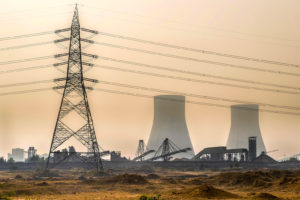
The number of new coal-fired power plants built around the world hit a “10-year high” in 2025, even as the global coal fleet generated less electricity, amid a “widening disconnect” in the sector.
That is according to the latest annual report from Global Energy Monitor (GEM), which finds that the world added nearly 100 gigawatts (GW) of new coal-power capacity in 2025, the equivalent of roughly 100 large coal plants.
It adds that 95% of the new coal plants were built in India and China.
Yet GEM says that the amount of electricity generated with coal fell by 0.6% in 2025 – with sharp drops in both China and India – as the fuel was displaced by record wind and solar output, among other factors.
The report notes that there have been previous dips in output from coal power and there could still be ups – as well as downs – in the near term.
For example, nearly 70% of the coal-fired units scheduled to retire globally in 2025 did not do so, due to postponements triggered by the 2022 energy crisis and policy shifts in the US.
However, GEM says that the underlying dynamics for coal power have now fundamentally shifted, as the cost of renewables has fallen and low usage hits coal profitability.
China and India dominate growth
In 2025, coal-capacity growth hit a 10-year high, with 97 gigawatts (GW) of new power plants being added, according to GEM.
(Capacity refers to the potential maximum power output, as measured in GW, whereas generation refers to power actually generated by the assets over a period of time, measured in gigawatt hours, GWh.)
This is the highest level since 2015 when 107GW began operating, as shown in the chart below. This makes 2025 the second-highest level of additions on record.
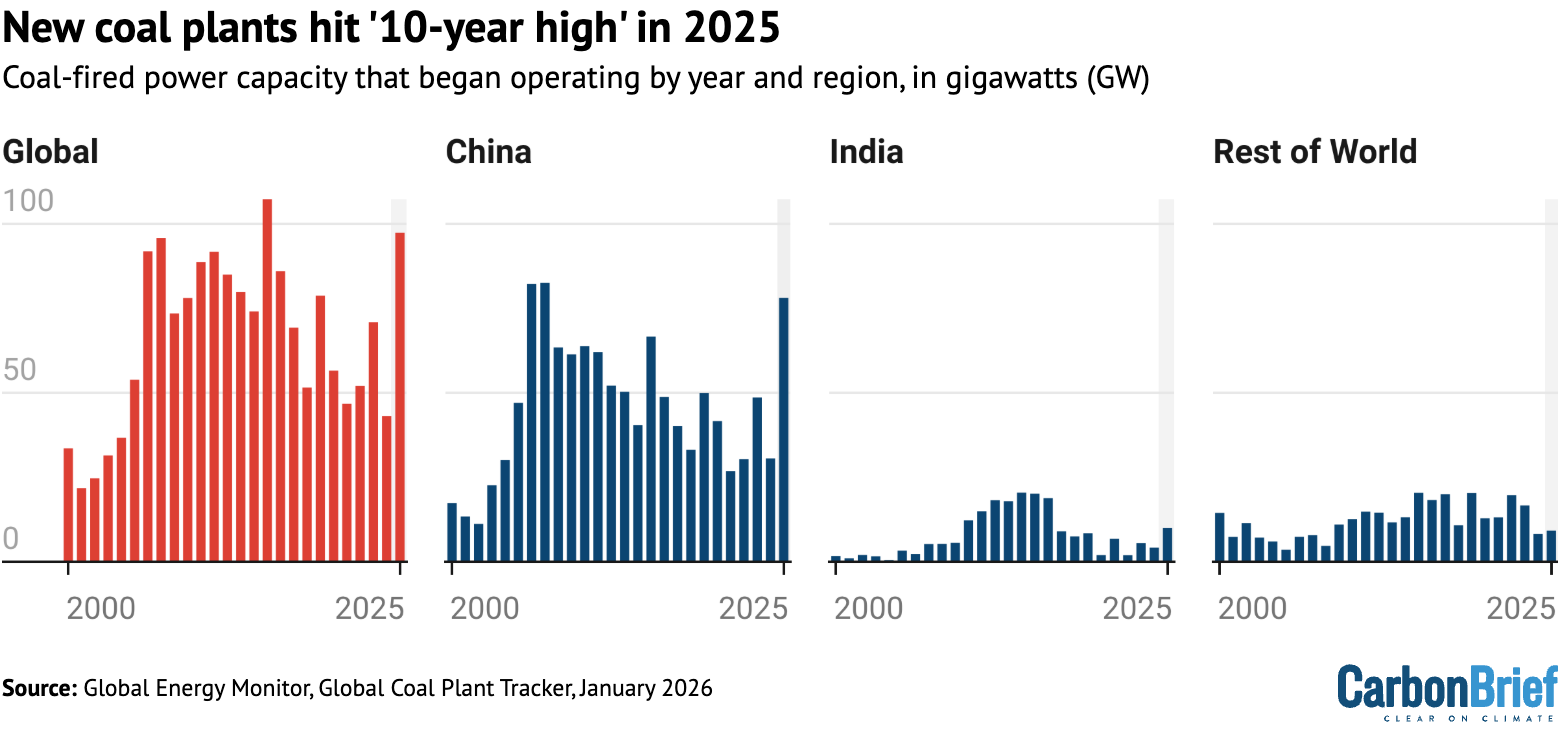
The majority of this growth came from China and India, which added 78GW and 10GW, respectively, against 9GW from all other countries.
Yet GEM points out that, even as coal capacity in China grew by 6%, the output from coal-fired power plants actually fell 1.2%. This means that each power plant would have been running less often, eroding its profitability. Similarly, capacity in India grew by 3.8%, while generation fell by 2.9%.
China and India had accounted for 87% of new coal-power capacity that came into operation in the first half of 2025. The shift up to 95% in the year as a whole highlights how increasingly just those two countries dominate the sector, GEM says.
Christine Shearer, project manager of GEM’s global coal plant tracker, said in a statement:
“In 2025, the world built more coal and used it less. Development has grown more concentrated, too – 95% of coal plant construction is now in China and India, and even they are building solar and wind fast enough to displace it.”
Both China and India saw solar and wind meet most or all of the growth in electricity demand last year.
Analysis for Carbon Brief last year showed that, in the first six months of 2025 alone, a record 212GW of solar was added in China, helping to make it the nation’s single-largest source of clean-power generation, for example.
However, the country continues to propose new coal plants. In 2025, a record 162GW of capacity was newly proposed for development or reactivated, according to GEM. This brought the overall capacity under development in the country to more than 500GW.
China’s 15th “five-year plan”, covering 2026-2030, had pledged to “promote the peaking” of coal use, while a more recent pair of policies introduced stricter controls on local governments’ coal use.
For its part, in India some 28GW of new coal capacity was newly proposed or reactivated last year, bringing the total under development to 107.3GW and under-construction capacity to 23.5GW.
The Indian government is planning to complete 85GW of new coal capacity in the next seven years, even as clean-energy expansion reaches levels that could cover all of the growth in electricity demand.
Outside of China and India, GEM says that just 32 countries have new coal plants under construction or under development, down from 38 in 2024.
Countries that have dropped plans for new coal in 2025 include South Korea, Brazil and Honduras, it says. GEM notes that the latter two mean that Latin America is now free from any new coal-power proposals.
This means that both electricity generation from coal and the construction of new coal-fired power plants are increasingly concentrated in just a few countries, as the chart below shows.
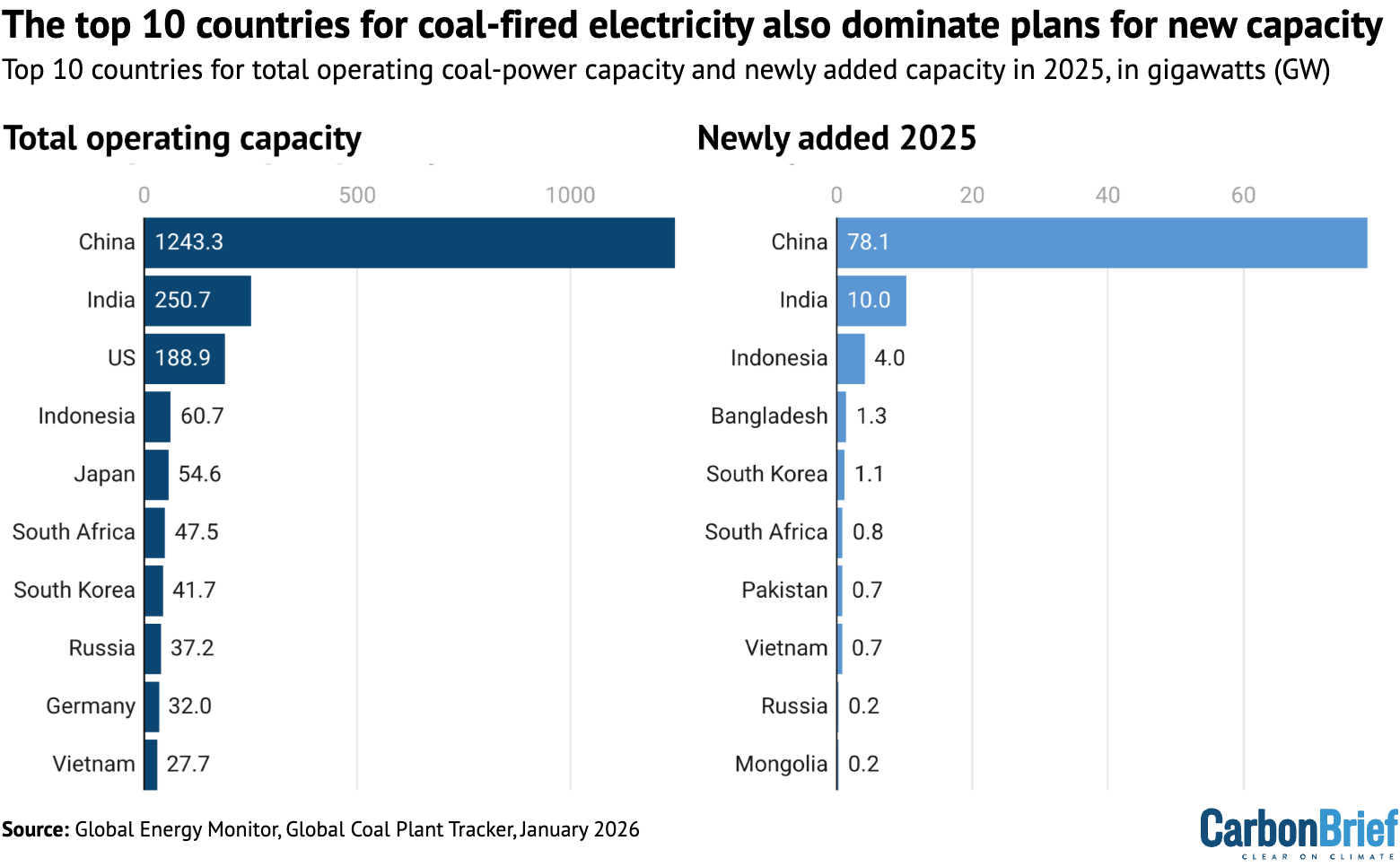
Indonesia’s coal fleet grew by 7% in 2025 to 61GW, with a quarter of the new capacity tied to nickel and aluminium processing, according to GEM.
Turkey – which is gearing up to host the COP31 international climate summit in November – has just one coal-plant proposal remaining, down from 70 in 2015.
The amount of new coal capacity that started to operate in south-east Asia fell for the third year in a row in 2025, according to GEM.
Countries in south Asia that rely on imported energy are increasingly looking to other technologies to protect themselves from fossil-fuel shocks, such as Pakistan, which is rapidly deploying solar, states the GEM report.
In Africa, plans for new coal capacity are concentrated in Zimbabwe and Zambia, the report shows, with the two countries accounting for two-thirds of planned development in the region.
‘Persistence of policies’
While new coal plants are still being built and even more are under development, GEM notes that the global electricity system is undergoing rapid changes.
Crucially, the growth of cheap renewable energy means that new coal plants do not automatically translate into higher electricity generation from coal.
Without rising output from coal power, building new plants simply results in the coal fleet running less often, further eroding its economics relative to wind and solar power.
Indeed, GEM notes that electricity generation from coal fell globally in 2025. Moreover, a recent report by thinktank Ember found that renewable energy overtook coal in 2025 to become the world’s largest source of electricity.
GEM notes that coal generation may fluctuate in the near term, in particular due to potential increases in demand driven by higher gas prices.
It adds that gas price shocks, such as the one triggered by the Iran war, can cause temporary reversals in the longer-term shift away from coal.
According to Carbon Brief analysis, at least eight countries announced plans to either increase their coal use or review plans to transition away from coal in the first month of the Iran war. However, a much-discussed “return to coal” is expected to be limited.
GEM’s report highlights that global fossil-fuel shocks can have an impact on the phase out of coal capacity over several years.
In the EU, for example, 69% of planned retirements did not take place in 2025, due to postponements that began in the 2022-23 energy crisis triggered by the Russian invasion of Ukraine, according to the report. Countries across the bloc chose to retain their coal capacity amid gas supply disruptions and concerns about energy security.
Yet coal-fired power generation in the bloc is now more than 40% below 2022 levels. Again, this highlights that coal capacity does not necessarily translate into electricity generation from coal, with its associated CO2 emissions.
Overall, GEM notes that “repeated exposure to fossil-fuel price volatility is as likely to accelerate the shift toward clean energy as it is to delay it”.
GEM’s Shearer says in a statement:
“The central challenge heading into 2026 is not the availability of alternatives, but the persistence of policies that treat coal as necessary even as power systems move increasingly beyond it.”
In the US, 59% of planned retirements in 2025 did not happen, according to GEM. This was due to government intervention to keep ageing coal plants online.
Five coal-power plants have been told to remain online through federal “emergency” orders, for example, even as the coal fleet continues to face declining competitiveness.
Keeping these plants online has cost hundreds of millions of dollars and helped drive an annual increase in the average US household electricity prices of 7%, according to GEM.
Despite such measures, Trump has overseen a larger fall in coal-fired power capacity than any other US president, according to Carbon Brief analysis.
Meanwhile, according to new figures from the US Energy Information Administration, solar and wind both set new records for energy production in 2025.
Despite challenges with policy and wider fossil-fuel impacts, the underlying dynamic has shifted, says GEM, as “clean energy becomes more competitive and widely deployed” around the world.
It adds that this raises the prospect of “a more sustained decoupling between coal-capacity growth and generation, particularly if clean-energy deployment continues at current rates”.

The post New coal plants hit ‘10-year’ global high in 2025 – but power output still fell appeared first on Carbon Brief.
New coal plants hit ‘10-year’ global high in 2025 – but power output still fell

Climate Change
WA EPA warned Woodside of ‘serious, significant and irreversible’ harms to Scott Reef from gas plans, new documents reveal
SYDNEY/PERTH, Tuesday 27 October 2026 — In response to Western Australian Environmental Protection Authority (WA EPA) documents about Woodside’s plans to drill for gas at Scott Reef, as reported today, the following comments can be attributed to Glenn Walker, Head of Nature at Greenpeace Australia Pacific:
“These WA EPA documents show the depth of concern echoed by multiple regulators about Woodside’s plans to drill for oil and gas at Scott Reef, a proposal that flouts legislated nature protection principles.
“The WA EPA appears to have informed Woodside that the Browse project was bound for rejection based on an extensive review process and the opinion of multiple state government departments and independent experts.
“Greenpeace analyses have confirmed this year that Woodside’s gas drilling plans at Scott Reef still risk destroying vulnerable green turtle homes, further endangering pygmy blue whales with atomic bomb-level seismic blasting noise, and unleashing the worst oil spill in Australian history.
“The federal environment department raised similar red flags about oil spill risk from Woodside’s Scott Reef drilling plans in 2025 and 2026 before handing the project’s assessment over to the National Environmental Protection Authority.
“Woodside’s suggested ‘fixes’ in response to grave concerns for the wellbeing of Scott Reef and threatened species have been unilaterally criticised by independent experts for lacking in scientific basis and adequate detail.
“It would be a major backflip for both the WA EPA and the National EPA to now recommend approving this project. It is now critical that these regulators maintain their independence from corporate and political influence and reject this destructive project once and for all.”
-ENDS-
Notes to editor
Greenpeace Technical assessments of Woodside’s Browse Pygmy Blue Whale Management Plan, the Turtle Management Plan, and an analysis of Woodside’s Browse Oil Spill Modelling and Risk Mitigation Plan
High res images and footage of Scott Reef can be found here
Media contact:
Emma Sangalli at emma.sangalli@greenpeace.org or 0431 513 465
The surprise re-election of Brazil’s President Luiz Inácio Lula da Silva on Sunday, in a tight race against right-wing candidate Flávio Bolsonaro, has raised hopes the country can meet a flagship target to end deforestation in all its biomes by 2030 and advance international fundraising to protect rainforests.
Defying expectations to win an unprecedented fourth term in office, Lula – who turns 81 this week – said in his acceptance speech that “we will show the world how climate policy is handled in this country”, and highlighted that, during his last four years as leader, the country has reduced deforestation every year.
Earlier this month, new data from Brazil’s space agency showed that forest-clearing in the Amazon fell to its lowest on record, after the introduction of a deforestation action plan that constrained illegal cattle ranching from expanding into the world’s largest rainforest.
Brazil leads “encouraging” decline in global rainforest destruction in 2025
At an international level, the country has long championed forest conservation, spearheading the creation of the newly established Tropical Forest Forever Facility (TFFF). As president of last year’s COP30 climate summit, the country is also developing a global roadmap to halt forest loss by the end of the decade, in line with a global goal, which will be presented at the upcoming UN climate summit in Antalya.
‘Much more needs to be done’
In 2023, Lula’s previous administration introduced a deforestation action plan that set a target of zero deforestation by 2030, achieving swift results. His re-election paves the way for this downward trend to continue.
Carlos Nobre, a veteran Brazilian climate scientist and co-chair of the Science Panel for the Amazon, said Brazil now has a “historic opportunity” to prevent a tipping point where large parts of the Amazon rainforest could turn into savanna, with dangerous impacts for the planet’s climate.
“The reduction in deforestation over recent years has been crucial, but much more needs to be done. Ending deforestation by 2030, tackling forest degradation and accelerating large-scale forest restoration are urgent priorities,” he said.
Anders Haug Larsen, advocacy director at the Norway Rainforest Foundation, described the election result as a “relief”, adding it makes it more attractive for donors to support rainforest protection in the country.
“Hope is a scarce commodity these days,” he said. “The international community must grasp this opportunity to strengthen efforts towards zero deforestation in the Amazon.”
Rainforest fund boosted by election result
Brazil was the original proponent of the TFFF, one of the highest-profile initiatives aimed at channelling new finance to protect the world’s rainforests. The fund aims to raise public seed capital to invest in financial markets, and then pay rainforest countries from the returns on those investments.
Despite being a developing country, Brazil has pledged $1 billion to the fund and is expected to play a key role in helping reach its goal to raise $10 billion from governments by the end of this year.
“We need more countries to come on board to meet the mobilisation target of $10 billion this year, and this election should inject trust in the calls from rainforest countries for support to their forest protection efforts,” Larsen said.
Brazil confident new rainforest fund will reach $10bn donor milestone
On Monday, the day after the election result, the Netherlands announced a €500-million contribution to the fund, which will be disbursed over ten years and is still subject to parliamentary approval. This brings the total pledged to the TFFF from a range of countries to $7.8 billion.
Norway’s climate minister Sigrun Aasland told a TFFF event on the sidelines of the UN biodiversity summit in Yerevan that she was hopeful the $10bn goal could be achieved by the end of this year.
Brazilian officials have led the TFFF’s fundraising efforts and said they are in conversations with more potential donors including China, Korea and Japan.
Congress shifts further to the right
Sonia Guajajara, former minister of Indigenous Peoples in Lula’s government, celebrated the president’s re-election but cautioned that the 20 indigenous territories created under his current administration must be consolidated, as they are “essential to tackling the climate crisis and preserving our biomes”.
Veteran Brazilian diplomat Bráulio Ferreira de Souza Dias, meanwhile, noted that Lula faces a difficult political scenario, as right-wing pro-Bolsonaro lawmakers have gained more seats in both legislative chambers. He added that the courts will become key battlegrounds to challenge anti-climate legislation.
Observatório do Clima, a network of Brazilian green groups, said seven out of every ten representatives and senators who will make up the next legislature are likely to vote against the climate and environmental agenda, urging Lula’s administration to strengthen its action in parliament and expand alliances.
Still, Ferreira de Souza Dias echoed the widespread view among climate policy-makers that a Bolsonaro win would have been “terrible” for the rainforest and Indigenous peoples, and said the country had avoided a scenario where deforestation threatened to increase again.
The post Lula’s election win in Brazil raises hopes for zero deforestation drive appeared first on Climate Home News.
Lula’s election win in Brazil raises hopes for zero deforestation drive
African governments are developing policies to manage waste from solar panels, batteries and other clean tech equipment as installations surge, with officials warning the energy transition could create a new environmental problem unless it is accompanied by investment in recycling and reuse.
Many African households and businesses are increasingly turning away from unreliable grid power or deciding not to wait for access, and are installing more solar panels and battery storage. Data from energy think-tank Ember, published in August, projects that the continent will install a record 17 gigawatts (GW) of solar capacity in 2026 – equal to around 100,000 solar panels every day. This would mark the third consecutive year of record growth, following increases of 51% in 2025 and 25% in 2024.
While generally a welcome sign of progress towards a cleaner energy mix, this trend could also create a headache for African officials. Anselm Marungu, Namibia’s deputy minister of environment, forestry and tourism, believes rules should be put in place to ensure that valuable materials can be recovered from discarded solar panels, batteries and inverters at the end of their useful life.
-
Made in Nigeria: The race to build an African solar industry from scratch
A solar power revolution is gathering pace in Africa and Nigeria wants a slice of the fast-growing industry, but competing with Chinese imports won’t be easy -
Indian start-ups mine e-waste for battery minerals but growing industry has a dark side
Recycling e-waste can unlock a vast and sustainable supply of transition minerals but in India the sector relies on a neglected informal economy

