

- Formal negotiations
- Turkish and Australian leadership
- Cover decision
- COP reform
- Adaptation
- Finance
- Just transition work programme
- Loss and damage
- Gender
- Article 6
- Agriculture and food security
- Mitigation work programme
- Response measures
- Action for climate empowerment
- Trade
- Second global stocktake
- Long-term goal review
- Around the COP
- Fossil fuels
- Action agenda
- Global leaders
- Electrification
- China at COP31
- Ocean
- Deforestation
- Methane
- New climate science
- Food and water
- NDCs
- Protests and access
- Road to COP32 and beyond

Manuel Pulgar–Vidal is WWF’s Global Lead for Climate and Energy and, previously, he was the COP20 President.
July will be a month of records. Athletes and spectators gather for the Paris Olympics to celebrate feats of human endurance and record-breaking achievement. But July is also seeing records of another kind breaking.
This month we experienced the hottest day ever in over 120,000 years meaning global temperatures are now the highest they have ever been as a result of climate change caused by burning coal, oil and gas, and deforestation.
This also means real-world impacts – every day, every hour and every minute. Just in the past few weeks, Hurricane Beryl destroyed parts of the Caribbean, a heatwave caused power outages in Saudi Arabia and Kuwait, and there were severe floods in Kenya.
In just four months, Azerbaijan will be in the global spotlight for two weeks when it will be responsible for spearheading UN climate talks in Baku. Government, businesses, media and civil society are anxious to know what the COP29 Presidency has been doing to shift the gears on diplomacy and ramp up global ambition.
COP29 priorities
In its recent Letter to Parties, the COP29 Presidency outlined some of its processes leading to Baku. It said its two pillars are to “Enhance Ambition, Enable Action”. It has pursued a raft of initiatives, but these will not pave the way for the systems change that is required.
The task at hand is clear.
First, we need a just and equitable transition away from fossil fuels. Second, we need a strong climate finance goal to deliver on this. Third, we need countries to submit ambitious Nationally Determined Contributions (NDCs) that respond to the Global Stocktake and robustly adhere to the science.
Comment: A global wealth tax is needed to help fund a just green transition
The COP29 Presidency has a crucial strategic role to play in building pressure on countries to demonstrate what they are doing to meet all these commitments. Finding the landing ground on these pillars cannot wait until November. The real work is done in the months and weeks before the summit.
Let’s not forget that the COP28 deal was meant to mark the “beginning of the end” of the fossil fuel era. Yet, progress on this since the Dubai summit has been woefully slow. The window for a 1.5℃ future is closing fast and Azerbaijan, a significant fossil exporter itself, cannot ignore the root cause of the problem.
Finance deal
Similarly, we must avert a failure to agree to the new climate finance goal in Baku.
The Presidency says negotiating a fair and ambitious New Collective Quantified Goal (NCQG) is their priority. If that’s the case, then the clock is ticking. Effectively leading these finance talks will require proactive steps and a recognition of the scale of financing required. At least $1 trillion of investment is needed for climate and environment by 2030.
Azerbaijan’s proposal for a Climate Finance Action Fund (yet another fund with insufficient money!) would rightly mean a mechanism through which polluters do finally pay. However, this cannot be used as an excuse for countries to continue with fossil fuel expansion.
UAE’s ALTÉRRA invests in fund backing fossil gas despite “climate solutions” pledge
The recent appointment of Denmark’s Dan Jørgensen and Egypt’s Yasmine Fouad as a Ministerial Pairing for the finance deal is welcome.
But in addition to their support, there has to be political will for system change. There must be alignment on areas of agreement and expectations. Balancing the needs and demands of 190+ countries is challenging. But by engaging with champions from business, government and civil society across the board it can be done.
Civil society engagement
Azerbaijan does not need to reinvent the wheel with shiny new deals. Creating the enabling conditions and encouraging countries to implement existing commitments can have the greatest impact on tackling the climate crisis.
Azerbaijan will benefit from continuing to engage tirelessly with credible actors who can help it avoid pitfalls and needless mistakes. Sporadic consultations will not suffice; consistent dialogue is key.
Lastly, Azerbaijan should be prepared for intense scrutiny from the media and civil society.
In the coming weeks and months, it must engage openly and transparently with those who will question its actions and motives. They must avoid increasing distrust in the process. They must directly address concerns over the COP being co-opted by fossil fuel interests as well as reports that it is intensifying a crackdown on civil society.
Azerbaijan’s role as the host of COP29 places it in a position of significant responsibility and opportunity not only to advance the negotiations but build a legacy for the climate regime and future generations. Setting clear timelines, leveraging expert advice, intensifying finance talks and keeping pressure on countries to deliver can all result in a successful COP.
The post It’s time for Azerbaijan to shift gears on diplomacy ahead of COP29 appeared first on Climate Home News.
It’s time for Azerbaijan to shift gears on diplomacy ahead of COP29
Continue Reading
The COP31 climate talks in Antalya, Turkey, have failed to reach agreement on a “pact” that lacked clear references to curbing fossil fuels or scaling up climate finance.
The “Antalya pact”, proposed by the joint Turkish-Australian presidency, was rejected in the final hours by the EU, the UK and several climate-vulnerable nations.
Meanwhile, many developing countries criticised the lack of progress on climate finance and indecision on a proposed $120bn target for funding climate adaptation.
With stark divisions preventing agreement on the presidency-led pact, UNFCCC chief Simon Stiell expressed “deep disappointment”, speaking of “scope to improve, modernise and reform” the UN climate process.
Despite a chaotic endgame that saw the overrunning COP become the longest in history, it did not end in complete failure, with many items adopted in the closing plenary.
These included fairly limited or procedural outcomes on a new “mechanism” for global “just transitions”, plus support for countries struck by climate disasters.
There was some progress beyond the negotiations, though, with growing coalitions of nations championing “roadmaps” for “transitioning away” from fossil fuels.
With the presidency promoting “electrification” as a key theme, around 80 nations also signed up to a global target of securing 35% of final energy consumption from electricity by 2035.
Here, Carbon Brief provides in-depth analysis of all the key outcomes from Antalya, both inside and outside the COP31 negotiations.
(See Carbon Brief’s coverage of COP30, COP29, COP28, COP27, COP26, COP25, COP24, COP23, COP22, COP21 and COP20.)
- Formal negotiations
- Turkish and Australian leadership
- Cover decision
- COP reform
- Adaptation
- Finance
- Just transition work programme
- Loss and damage
- Gender
- Article 6
- Agriculture and food security
- Mitigation work programme
- Response measures
- Action for climate empowerment
- Trade
- Second global stocktake
- Long-term goal review
- Guidance on NDCs
- Rio synergies
- Around the COP
- Road to COP32 and beyond
Formal negotiations
Turkish and Australian leadership
Turkey and Australia presided over the longest COP in history – and failed to find consensus on their proposed “cover decision”, exposing deep fractures between countries on key issues such as fossil fuels and the need for developed nations to meet climate-finance pledges.
Experts told Carbon Brief that, strictly, the talks did not “collapse” as several negotiated items were still adopted.
Rather, the rejection of the cover decision represented, for the first time, “those who want a higher level of ambition actively reject[ing] the lowest common denominator on offer”, said one veteran observer.
Dispute over who would host COP31 – representing the “western Europe and other states” region – had gone on for three years.
In the end, the two main rivals, Turkey and Australia, agreed to a deal last year at COP30 that the summit would take place in Antalya, Turkey, with Australia acting as “president of negotiations”.
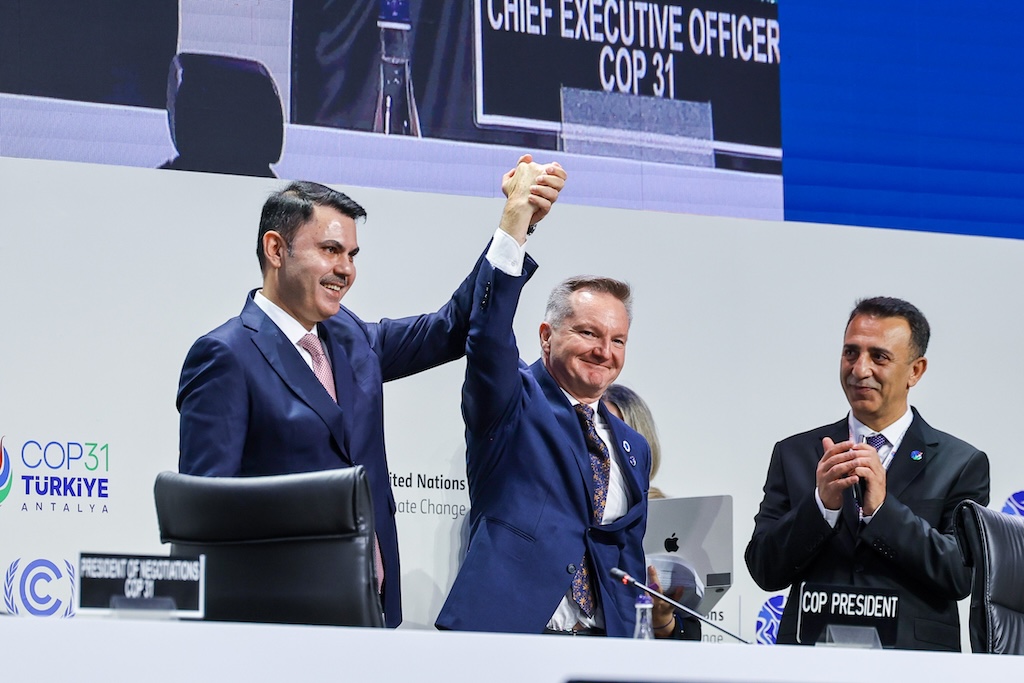
Critics questioned whether either country was well-placed to host, given their ongoing fossil-fuel expansion.
Turkey faced criticism for announcing the discovery of two new oil fields on the eve of the summit, while recent Carbon Brief analysis found that Australia is the third-largest CO2 exporter in history because of its fossil-fuel production.
Ahead of the summit, the presidency released four official letters outlining a vision for COP31.
The first letter, written by COP31 president Murat Kurum in April 2026, confirmed the appointment of Australian climate minister Chris Bowen as “president of the negotiations” and announced that a pre-COP would be held in Fiji in October.
The second letter, authored by both Kurum and Bowen from the Copenhagen climate ministerial in May, said that “COP31 presents a vital opportunity to further accelerate…in the areas of clean energy, electrification and resilient infrastructure”.
The third letter, published in August 2026, gave more details on the presidency’s plans for the “action agenda” – the part of the UN process that mobilises coalitions of nations and non-state actors to push climate action further.
This letter also introduced a key aim from the presidency to get countries to agree to increase electricity’s share of final energy consumption to 35% by 2035 (often referred to as “35 by 35”). (See: Electrification.)
The final letter, published in October ahead of the pre-COP in Fiji, said that the presidency would centre on “delivering a COP focused on accelerating implementation, electrification and resilience in an uncertain world”.
It added that “many parties have emphasised the importance of reviewing and continuously improving UNFCCC processes, to ensure it remains fit for purpose, sustainable and focused as negotiations evolve over time”, adding:
“At COP31, we will hold presidency consultations to hear parties’ views on how to strengthen UNFCCC processes, to ensure growing demands are met and to effectively deploy resources.”
The pre-COP in Fiji was held from 5-8 October and was attended by 3,000 people.
In this somewhat intimate setting, Bowen announced that Turkey and Australia had agreed to negotiate a “presidency-led” cover decision at COP31.
He added that revealing this before COP was part of the presidency’s “upfront, transparent and consultative approach”.
Later that month, the presidency named the five ministerial pairs from developed and developing countries that would take key negotiation issues forward at COP31. These issues were mitigation, adaptation, finance, just transition and oceans.
COP31 kicked off on 9 November, with climate negotiations scholar (and Carbon Brief contributing editor) Dr Joanna Depledge noting that it was clear from the summit’s opening ceremony that “Australia [was] the junior partner” in the presidency.
COP’s opening day ran late into the night as the presidency worked to avert a fight over proposed changes to the summit’s negotiations agenda.
Agenda adopted! Moments ago in Antalya, Turkey, COP31 president Murat Kurum outlined how an “agenda fight” has been averted, despite various proposals for additions to proceedings. This came after a short delay, while a series of huddles took place on…
 Simon Evans
COP31: Agenda adopted!

The next day, in plenary, Kurum announced that a resolution had been found.
He said that calls for new agenda items on adaptation finance and trade were rejected, whereas an item on a new climate finance “work programme” had been added. (The EU expressed “deep concern” about the addition.)
Kurum added that two extra proposed items on mountains and climate change – made more poignant by recent catastrophic floods in Nepal – were also not added to the agenda. However, he said that the presidency would instead hold consultations on the topic.
Though an early scrap over the agenda was avoided, the summit’s opening days were plagued with logistical problems.
Attendees were forced to spend hours navigating traffic and queues just to get into the venue – sparking serious access concerns.
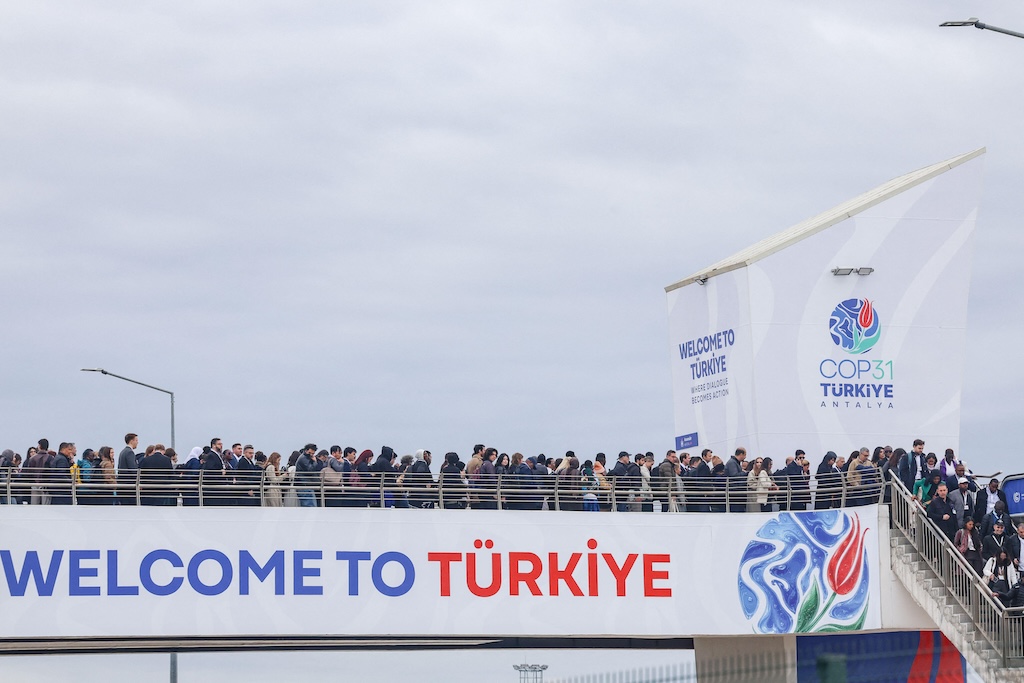
The problems persisted into the first day of the world leaders’ summit on 11 November, when delegates were informed that they should travel between the hours of 5-7am to secure access to the venue. Ire only grew when security staff still let people in after this time.
On Friday morning, the presidency released a “reflections” text from its consultations with countries on what they would like to see in a cover decision. This was an “informal note” with a bullet-pointed list of topics that might be included.
On Saturday evening, Kurum told a press conference that “around 30 countries” had indicated support for the 35 by 35 pledge.
However, he had little to share on progress in the negotiations and eluded questions on how he planned to include “fossil fuels” in the cover decision.
In the small hours of Sunday morning, half-way through the summit, Kurum announced presidency and ministerial consultations on “outstanding political issues”.
He also invited ministers to a “divan” – a group meeting, not a daybed – to discuss cross-cutting issues.
On Monday afternoon, the presidency dropped an 18-page first draft of its proposed cover decision – along with a short “presidency note” explaining that all elements were still in play, including whether or not they should appear in a final text. (See: Cover decision.)
At a press conference, Bowen told journalists that the presidency decided to release the text “early” to allow parties to debate on it for as long as possible and acknowledged that it would need to be “refined” down.
On Wednesday evening, the presidency held its divan, w