

Hundreds of millions of Indians will head to the polls from 19 April to 1 June amid scorching heat to cast their votes in the world’s biggest elections.
Their decisions could have significant consequences for how – or even if – India meets its climate goals and adapts rapidly to now almost daily extreme weather impacts.
Over the past decade, the Narendra Modi-led Indian government has been projected and perceived as a climate leader internationally: from his COP26 speech in Glasgow committing India to net-zero by 2070 through to his G20 presidency last year where he announced a renewable “tripling” target which was then echoed in the first “global stocktake” at COP28.
However, despite increasing renewable capacity, the Indian government’s rapid coal expansion and Modi’s links to fossil fuel interests have been dubbed problematic by many and “pragmatic” by others.
His party – the Bharatiya Janata Party (BJP) – holds a majority in the lower house of parliament and is the single largest party in the upper house, allowing it to pass controversial environmental and forest laws, with limited scrutiny and discussion.
While the BJP dominates – and expects to win the election – India still has more than 2,700 registered political parties and 56 state parties, of which six are officially recognised as national political parties.
Of these, the biggest and oldest is the Rahul Gandhi-led Indian National Congress (Congress), credited with giving India most of its progressive environmental laws and positions on climate, but also accused of ignoring them before its fall from national power in 2014.
In this interactive grid below, Carbon Brief tracks the commitments made by India’s major national political parties in their latest election manifestos across a range of issues connected to climate change.
The grid also includes proposals by the Communist Party of India (Marxist). Parties yet to publish their manifestos include the Aam Aadmi Party (AAP) led by Delhi’s recently jailed chief minister Arvind Kejriwal, the Bahujan Samaj Party (BSP) representing India’s historically marginalised castes and minorities, and the National Peoples’ Party representing India’s biodiverse northeastern states. (The grid will be updated when these remaining parties publish their manifestos.)
Each entry in the grid represents a direct quote from one of these documents.
(Note that the BJP refers to India as “Bharat” in most of its manifesto. This is seen by some as a reaction to 26 opposition parties banding together last year to brand themselves the Indian National Developmental Inclusive Alliance (INDIA) alliance.)
Despite an ongoing heatwave, drought, floods, farmer protests and debilitating smog blanketing most Indian cities, many argue that climate and environmental issues are too “peripheral” to sway the billion-strong Indian electorate. Others counter that “all key issues on the ballot in 2024” are linked to climate change.
Historically, however, Indian political parties have regularly rolled out campaigns and subsidies connected to energy, electricity and climate to appeal to Indian voters.
While welfare or development-based promises of free electricity for farmers and cooking gas price cuts are a running election feature, free public transport, land rights and managing natural resources, such as coal or forests, can also mobilise voters.
In 2014, for instance, Modi rode to power on a campaign promise of cleaning up corruption in India’s coal and mining sector, scarred by gargantuan scams.
Speaking to Carbon Brief, Aditya Valiathan Pillai from the Sustainable Futures Collaborative, says on one side you have welfare and developmental projects as a “balancing factor” for climate shocks. On the other side, “it’s about gas cylinders, energy access, cheaper electricity…all of that is climate. It’s just that it’s not ‘Extinction Rebellion’-style climate politics”.
Pillai adds:
“I think we see climate politics as the sort of existential, titanic fight for the future of humanity where climate progressives arm wrestle climate deniers. It’s not. There’s a much greater diversity in climate politics. The core difference is the politics of gain and the politics of loss, and we are very much in the politics of gain in India because it’s such a low baseline of development. In the West, it’s the exact opposite.”
Climate and environmental issues may not have been explicitly on top of voters’ or parties’ priorities before, but that has steadily changed since 2019.
While the BJP set out an ambitious renewable energy target of 175 gigawatts (GW) by 2022, AAP campaigned on its air pollution and electric vehicle policies in Delhi.
In 2019, while Congress pledged to bring back protections against deforestation and land-use change, the BSP and its allies promised to deploy clean energy to “destroy caste discrimination”, as “an over-dependence on coal directly impacts tribal populations who are constantly under threat in the name of power-generation”.
This year, climate change is mentioned in all national party manifestos published so far, along with commitments to promote renewable energy and, for the first time ever, critical minerals. For example, the BJP and Congress manifestos both emphasise working towards achieving net-zero by 2070.
The BJP manifesto promises the country “energy independence” by 2047 – a century since India achieved independence from the UK – through “a mix of electric mobility, network of charging stations, renewable energy production and improving energy efficiency”.
The BJP also sets out a 500GW renewable energy target – although it does not specify when this goal would be met. If voted in again, the Modi government says it plans to achieve this through setting up “mega” solar and wind parks and a clean energy corridor, with aims to turn India into a global renewable energy manufacturing hub.
It also emphasises scaling up bioenergy and green hydrogen production, developing small modular nuclear reactors and incentivising private investment in large-scale battery storage.
In the run-up to the elections, Modi has already announced a rooftop solar scheme and promised farmers in the critical election state of Uttar Pradesh to turn India’s sugarcane belt into a biofuel belt.
However, while the BJP’s manifesto pledges to support India’s automobile industry transition to electric vehicle manufacturing, it fails to mention coal even once or to outline how heavy industry will be decarbonised, beyond its existing Green Credit Programme.
While it outlines its commitment to meet India’s still-unclear carbon sink target, the BJP’s manifesto is silent on the forest rights of Indigenous communities, unlike Congress, which promises to set up a national mission to guarantee their rights and to stem deforestation.
In an election where unemployment is set to be a key voting issue, Congress pledged a “Green New Deal Investment Programme” and a “Green Transition Fund” in its manifesto. Congress pledges to generate millions of jobs in renewable energy, sustainable infrastructure and mining critical minerals. Its renewable energy plans lack specific targets, but remain strongly focused on decentralised power and job generation in rural India, with incentives for village councils and farmers to set up solar grids.
Congress is the only national party promising to increase allocations to India’s National Adaptation Fund and wants to create an independent environment authority akin to the US Environmental Protection Agency.
Both Congress and CPI have promised to look into landslides caused by floods that caused severe crop losses last year and to reverse “anti-people” amendments to India’s forest and environmental laws made under the Modi government.
The CPI is the only national party to explicitly mention coal in its manifesto, calling for unexplored private coal blocks to be returned to state-run Coal India, to reduce India’s dependence on coal imports and a judicial investigation into “fraudulent” imports by private companies.
Similarly, it is the only party to pledge a participatory “just transition plan” to protect communities and coal workers “affected in the process of transitioning to renewable energy from fossil fuel[s]”.
Its manifesto promises to end private monopolies in renewable energy, seeking to establish the government’s “decisive stake” in the sector “to protect our country’s energy sovereignty”.
To Bangalore-based climate activist Disha Ravi, protests by farmers, youth and citizen groups in the Himalayan region, as well as the visible climate impacts right before election season, have ensured environmental issues have “stayed fresh” in peoples’ minds and made it into manifestos.
However, she is concerned about follow-through, including from state governments where the opposition has been in power. She tells Carbon Brief:
“I live in Karnataka and one of our main environmental demands locally was to get back the right to protest. And they [Congress] haven’t enabled that since they’ve come back to power. They’ve been a little more open to conversations, and it’s great that they have these amazing-sounding policies on paper. But will they actually translate into real life? I don’t know that because they haven’t had a great track record.”
It remains to be seen whether the heat, deforestation or renewable jobs sway Indian voters as they step out to vote over seven phases this summer. But to activists and observers such as Ravi, it is time India has “a national-level climate conversation, and it shouldn’t be just because elections are around the corner”.


The post India election 2024: What the manifestos say on energy and climate change appeared first on Carbon Brief.
India election 2024: What the manifestos say on energy and climate change

Drought and heatwaves occurring together – known as “compound” events – have “surged” across the world since the early 2000s, a new study shows.
Compound drought and heat events (CDHEs) can have devastating effects, creating the ideal conditions for intense wildfires, such as Australia’s “Black Summer” of 2019-20 where bushfires burned 24m hectares and killed 33 people.
The research, published in Science Advances, finds that the increase in CDHEs is predominantly being driven by events that start with a heatwave.
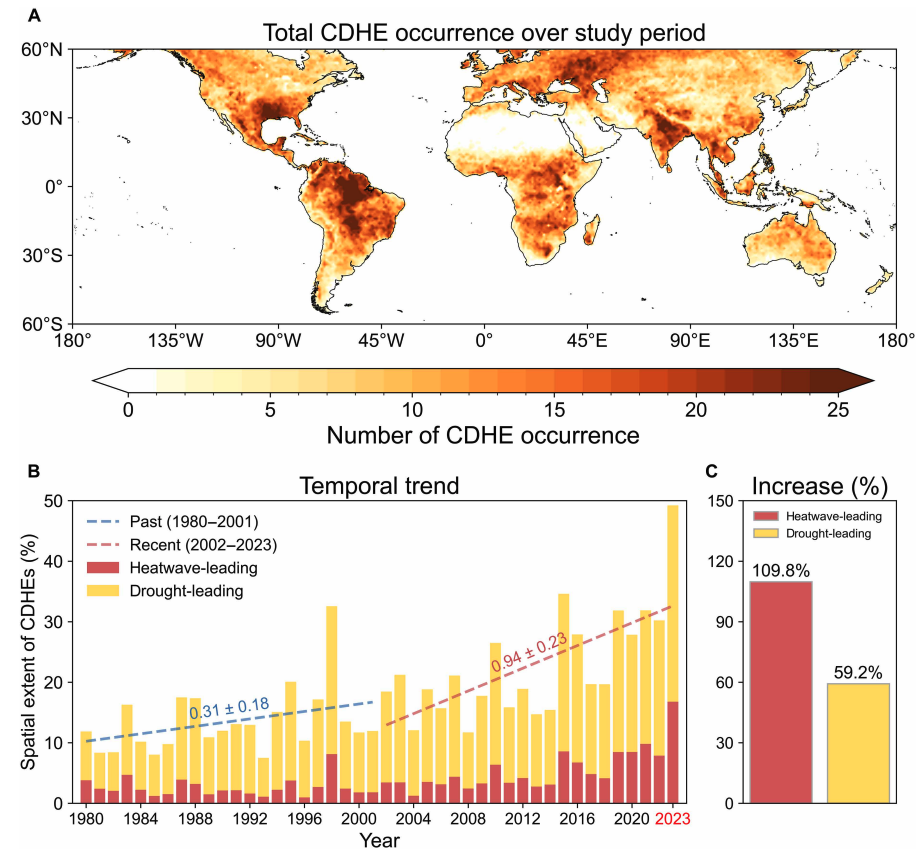
The global area affected by such “heatwave-led” compound events has more than doubled between 1980-2001 and 2002-23, the study says.
The rapid increase in these events over the last 23 years cannot be explained solely by global warming, the authors note.
Since the late 1990s, feedbacks between the land and the atmosphere have become stronger, making heatwaves more likely to trigger drought conditions, they explain.
One of the study authors tells Carbon Brief that societies must pay greater attention to compound events, which can “cause severe impacts on ecosystems, agriculture and society”.
Compound events
CDHEs are extreme weather events where drought and heatwave conditions occur simultaneously – or shortly after each other – in the same region.
These events are often triggered by large-scale weather patterns, such as “blocking” highs, which can produce “prolonged” hot and dry conditions, according to the study.
Prof Sang-Wook Yeh is one of the study authors and a professor at the Ewha Womans University in South Korea. He tells Carbon Brief:
“When heatwaves and droughts occur together, the two hazards reinforce each other through land-atmosphere interactions. This amplifies surface heating and soil moisture deficits, making compound events more intense and damaging than single hazards.”
CDHEs can begin with either a heatwave or a drought.
The sequence of these extremes is important, the study says, as they have different drivers and impacts.
For example, in a CDHE where the heatwave was the precursor, increased direct sunshine causes more moisture loss from soils and plants, leading to a drought.
Conversely, in an event where the drought was the precursor, the lack of soil moisture means that less of the sun’s energy goes into evaporation and more goes into warming the Earth’s surface. This produces favourable conditions for heatwaves.
The study shows that the majority of CDHEs globally start out as a drought.
In recent years, there has been increasing focus on these events due to the devastating impact they have on agriculture, ecosystems and public health.
In Russia in the summer of 2010, a compound drought-heatwave event – and the associated wildfires – caused the death of nearly 55,000 people, the study notes.

The record-breaking Pacific north-west “heat dome” in 2021 triggered extreme drought conditions that caused “significant declines” in wheat yields, as well as in barley, canola and fruit production in British Columbia and Alberta, Canada, says the study.
Increasing events
To assess how CDHEs are changing, the researchers use daily reanalysis data to identify droughts and heatwaves events. (Reanalysis data combines past observations with climate models to create a historical climate record.) Then, using an algorithm, they analyse how these events overlap in both time and space.
The study covers the period from 1980 to 2023 and the world’s land surface, excluding polar regions where CDHEs are rare.
The research finds that the area of land affected by CDHEs has “increased substantially” since the early 2000s.
Heatwave-led events have been the main contributor to this increase, the study says, with their spatial extent rising 110% between 1980-2001 and 2002-23, compared to a 59% increase for drought-led events.
The map below shows the global distribution of CDHEs over 1980-2023. The charts show the percentage of the land surface affected by a heatwave-led CDHE (red) or a drought-led CDHE (yellow) in a given year (left) and relative increase in each CDHE type (right).
The study finds that CDHEs have occurred most frequently in northern South America, the southern US, eastern Europe, central Africa and south Asia.
Threshold passed
The authors explain that the increase in heatwave-led CDHEs is related to rising global temperatures, but that this does not tell the whole story.
In the earlier 22-year period of 1980-2001, the study finds that the spatial extent of heatwave-led CDHEs rises by 1.6% per 1C of global temperature rise. For the more-recent period of 2022-23, this increases “nearly eightfold” to 13.1%.
The change suggests that the rapid increase in the heatwave-led CDHEs occurred after the global average temperature “surpasse[d] a certain temperature threshold”, the paper says.
This threshold is an absolute global average temperature of 14.3C, the authors estimate (based on an 11-year average), which the world passed around the year 2000.
Investigating the recent surge in heatwave-leading CDHEs further, the researchers find a “regime shift” in land-atmosphere dynamics “toward a persistently intensified state after the late 1990s”.
In other words, the way that drier soils drive higher surface temperatures, and vice versa, is becoming stronger, resulting in more heatwave-led compound events.
Daily data
The research has some advantages over other previous studies, Yeh says. For instance, the new work uses daily estimations of CDHEs, compared to monthly data used in past research. This is “important for capturing the detailed occurrence” of these events, says Yeh.
He adds that another advantage of their study is that it distinguishes the sequence of droughts and heatwaves, which allows them to “better understand the differences” in the characteristics of CDHEs.
Dr Meryem Tanarhte is a climate scientist at the University Hassan II in Morocco, and Dr Ruth Cerezo Mota is a climatologist and a researcher at the National Autonomous University of Mexico. Both scientists, who were not involved in the study, agree that the daily estimations give a clearer picture of how CDHEs are changing.
Cerezo-Mota adds that another major contribution of the study is its global focus. She tells Carbon Brief that in some regions, such as Mexico and Africa, there is a lack of studies on CDHEs:
“Not because the events do not occur, but perhaps because [these regions] do not have all the data or the expertise to do so.”
However, she notes that the reanalysis data used by the study does have limitations with how it represents rainfall in some parts of the world.
Compound impacts
The study notes that if CDHEs continue to intensify – particularly events where heatwaves are the precursors – they could drive declining crop productivity, increased wildfire frequency and severe public health crises.
These impacts could be “much more rapid and severe as global warming continues”, Yeh tells Carbon Brief.
Tanarhte notes that these events can be forecasted up to 10 days ahead in many regions. Furthermore, she says, the strongest impacts can be prevented “through preparedness and adaptation”, including through “water management for agriculture, heatwave mitigation measures and wildfire mitigation”.
The study recommends reassessing current risk management strategies for these compound events. It also suggests incorporating the sequences of drought and heatwaves into compound event analysis frameworks “to enhance climate risk management”.
Cerezo-Mota says that it is clear that the world needs to be prepared for the increased occurrence of these events. She tells Carbon Brief:
“These [risk assessments and strategies] need to be carried out at the local level to understand the complexities of each region.”




The post Heatwaves driving recent ‘surge’ in compound drought and heat extremes appeared first on Carbon Brief.
Heatwaves driving recent ‘surge’ in compound drought and heat extremes
Greenhouse Gases
DeBriefed 6 March 2026: Iran energy crisis | China climate plan | Bristol’s ‘pioneering’ wind turbine
Welcome to Carbon Brief’s DeBriefed.
An essential guide to the week’s key developments relating to climate change.
This week
Energy crisis
ENERGY SPIKE: US-Israeli attacks on Iran and subsequent counterattacks across the Middle East have sent energy prices “soaring”, according to Reuters. The newswire reported that the region “accounts for just under a third of global oil production and almost a fifth of gas”. The Guardian noted that shipping traffic through the strait of Hormuz, which normally ferries 20% of the world’s oil, “all but ground to a halt”. The Financial Times reported that attacks by Iran on Middle East energy facilities – notably in Qatar – triggered the “biggest rise in gas prices since Russia’s full-scale invasion of Ukraine”.
‘RISK’ AND ‘BENEFITS’: Bloomberg reported on increases in diesel prices in Europe and the US, speculating that rising fuel costs could be “a risk for president Donald Trump”. US gas producers are “poised to benefit from the big disruption in global supply”, according to CNBC. Indian government sources told the Economic Times that Russia is prepared to “fulfil India’s energy demands”. China Daily quoted experts who said “China’s energy security remains fundamentally unshaken”, thanks to “emergency stockpiles and a wide array of import channels”.
‘ESSENTIAL’ RENEWABLES: Energy analysts said governments should cut their fossil-fuel reliance by investing in renewables, “rather than just seeking non-Gulf oil and gas suppliers”, reported Climate Home News. This message was echoed by UK business secretary Peter Kyle, who said “doubling down on renewables” was “essential” amid “regional instability”, according to the Daily Telegraph.
China’s climate plan
PEAK COAL?: China has set out its next “five-year plan” at the annual “two sessions” meeting of the National Peopleâ€