

The Caribbean region is among the most vulnerable to climate change, despite historically contributing less than half of one percent of global greenhouse gas emissions.
Rising sea levels, extreme heat and more frequent and intense storms – such as the 2024 Hurricane Beryl, which made landfall in Grenada – pose urgent and growing threats to the small island states, coastal nations and overseas territories that comprise the Caribbean region.
With global progress to address climate change still too slow, Caribbean countries are taking matters into their own hands by enacting more robust legislation to help protect against climate risks.
In a new study published in the Carbon and Climate Law Review, we identified 78 climate laws and legally binding decrees across 16 Caribbean states, as well as two constitutional references to climate change and a growing recognition of the right to a healthy environment.
Our analysis suggests that, together, these developments are not only enhancing resilience, but also positioning Caribbean states as influential actors in the global climate arena.
Caribbean climate laws on the rise
Climate governance in the Caribbean has expanded significantly in recent years. In the past decade, countries such as Cuba and the Dominican Republic have embedded climate obligations and programmatic guidelines into their national constitutions.
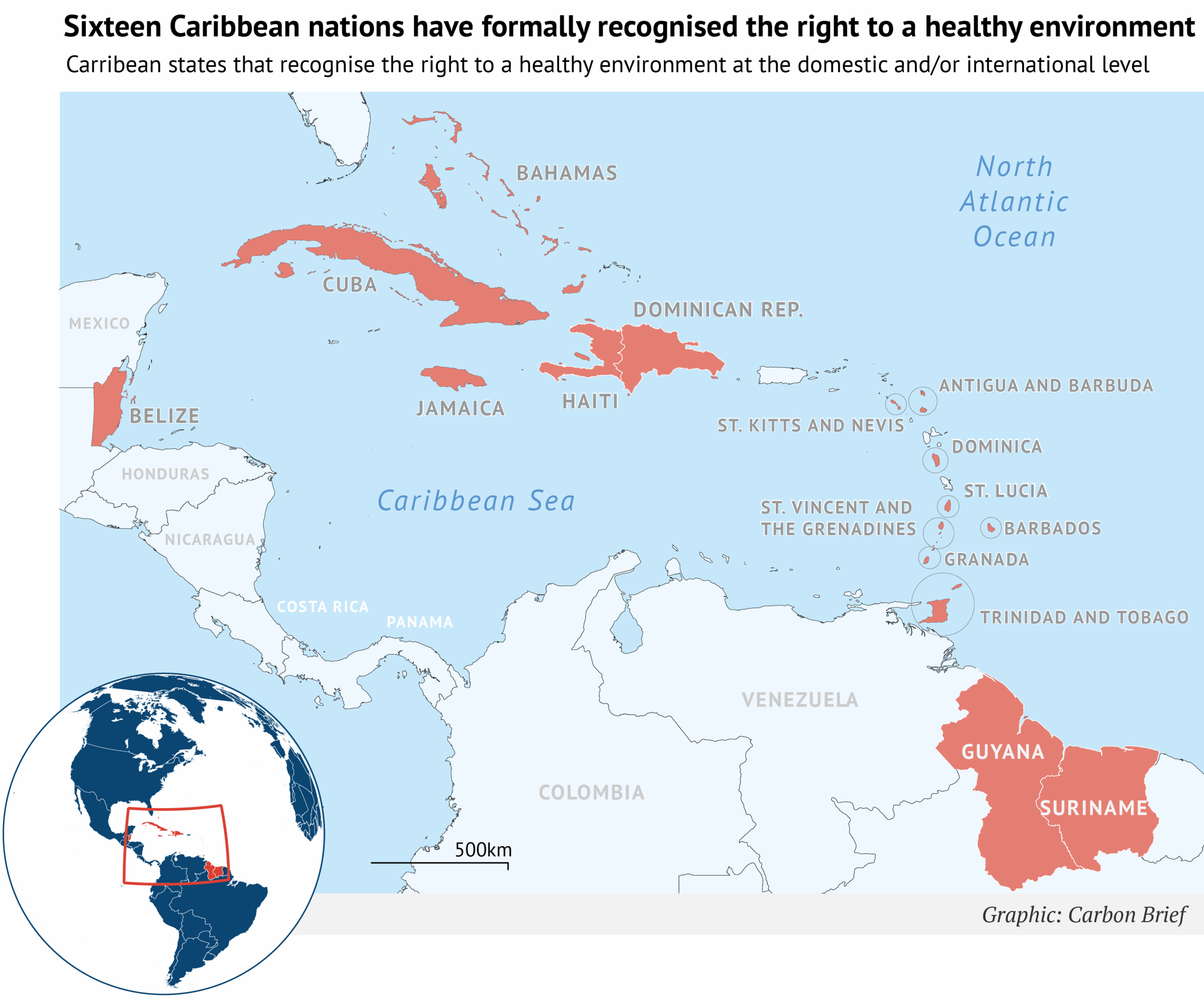
At the same time, legislative recognition of the human right to a healthy environment is gaining momentum across the region. Six Caribbean nations now affirm the right in their constitutions, while 15 have recognised it through international instruments, such as the UN Council, UN Assembly and the Escazu Agreement, as shown in the figure below.
More recently, there has been a notable rise in targeted, sector-specific climate frameworks that go beyond broader environmental statutes.
Saint Lucia stands out as the only country with a climate framework law, or a comprehensive national law that outlines long-term climate strategies across multiple domains. Meanwhile, several other Caribbean governments have adopted climate-specific laws that focus on individual sectors, such as energy, migration and disaster management.
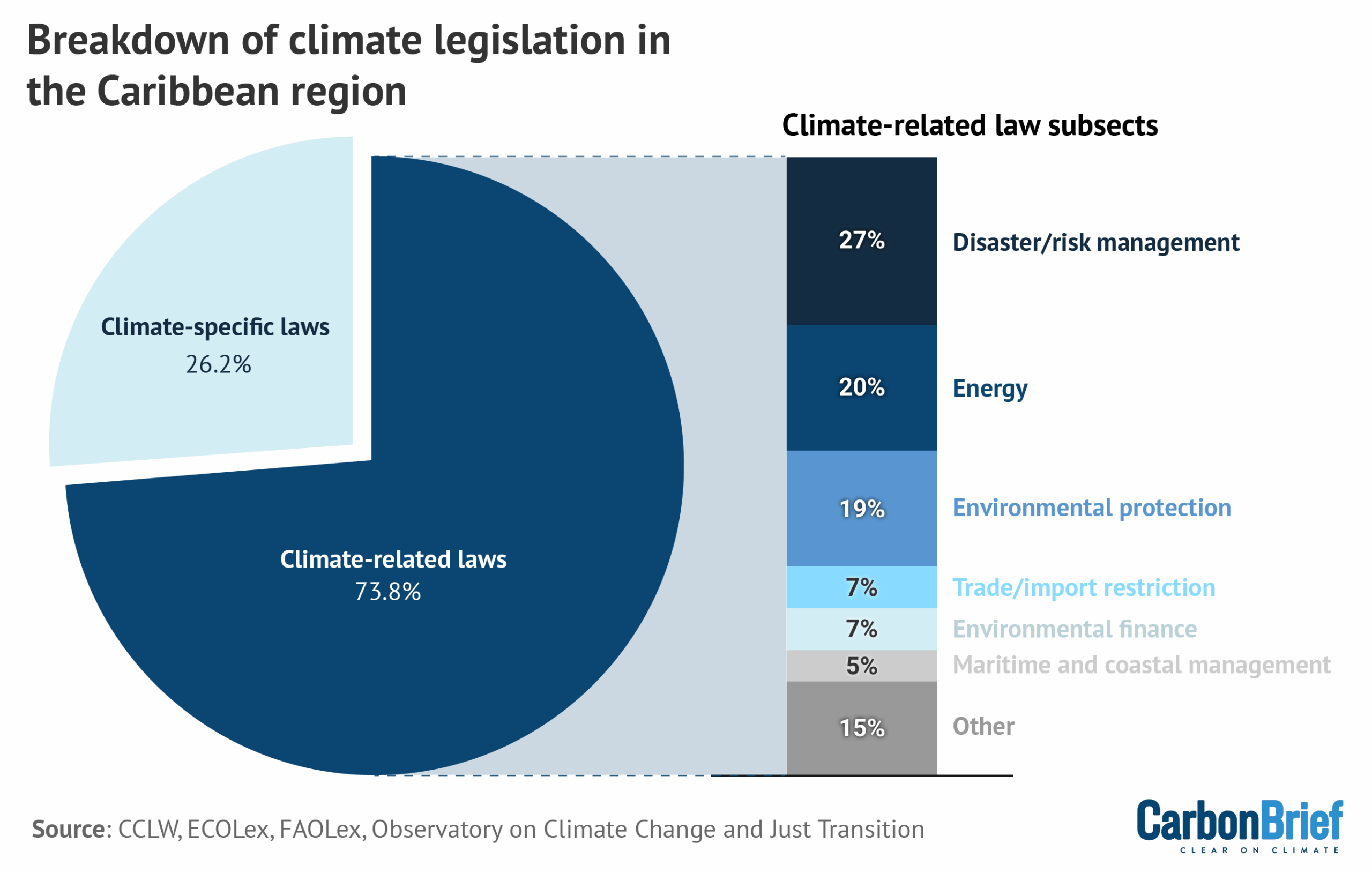
According to our analysis, more than a quarter of climate-relevant legislation in the region – comprising 21 laws and legally binding decrees – now has an explicit focus on climate change, as illustrated in the chart below.
Our research suggests that this represents an ongoing shift in legislative focus, reflecting changes in how climate legislation is being structured in one of the world’s most climate-vulnerable regions.
Caribbean nations are also advancing legal reforms to structure and institutionalise climate finance and market mechanisms directly into domestic law, aligned with Article 6.2 of the Paris Agreement.
For example, the Bahamas has introduced provisions for carbon credit trading, while Antigua and Barbuda, Barbados and Grenada have established national climate financing mechanisms to support mitigation and adaptation efforts.
Some states, including Belize and Saint Kitts and Nevis, have incorporated regional bodies such as the Caribbean Community Climate Change Centre – the climate arm of the intergovernmental Caribbean community organisation CARICOM – into national frameworks. This indicates an increasing alignment between regional cooperation and domestic law.
In addition to the influx of regulations specifically addressing climate change, Caribbean nations are also legislating broader environmental issues, which, in turn, could provide increased resilience from climate impacts and risks, as shown in the graph above.
Key trends in these types of climate-related laws include the expansion of disaster risk management governance, which addresses national preparedness for climate-induced weather events or related catastrophes. Likewise, energy law is an increasingly prominent focus, with countries including Antigua and Barbuda and Saint Vincent and the Grenadines integrating renewable energy and energy efficiency goals into national climate governance.
More broadly, many Caribbean nations have adopted wide-ranging and comprehensive environmental laws, many of which were developed in alignment with existing climate commitments. In combination, these legal developments reflect a dynamic and evolving climate governance landscape across the region.
Proactive vs reactive approaches
Despite general alignment with these broader regional trends, our research reveals distinct developmental pathways shaping domestic climate regulation.
In the eastern Caribbean, for example, we saw both proactive, long-term planning strategies and reactive, post-disaster reforms.
Saint Lucia’s multifaceted approach to climate resilience evolved steadily over the course of more than a decade. During this time, the country developed numerous adaptation plans, strengthened cross-sectoral coordination and engaged in institutional climate reforms in areas such as energy, tourism, finance and development.
More recently, the passage of Saint Lucia’s Climate Change Act in 2024 marked a milestone in climate governance, by giving legal force to the country’s obligations under the UNFCCC, the Kyoto Protocol and the Paris Agreement – making Saint Lucia one of the few small island states to incorporate global climate commitments into domestic law.
Our research indicates that this strategy has not only positioned the country as a more climate-resilient nation, but also solidified its access to international climate financing.
In contrast, Dominica’s efforts evolved more rapidly in the aftermath of Hurricane Maria in 2017, which destroyed over 200% of the country’s GDP. The storm’s impacts were felt across the country and hit particularly hard for the Kalinago people – the Caribbean’s last Indigenous community – highlighting the role of socioeconomic disparities in shaping climate vulnerability and resilience.
In response, the government passed the Climate Resilience Act, creating the temporary Climate Resilience Execution Agency for Dominica (CREAD).
Beyond establishing an exclusively climate-focused institution, the act aimed to embed resilience into governance by mandating the participation of vulnerable communities – including Indigenous peoples, women, older people and people with disabilities – in shaping and monitoring climate resilience projects.

As noted in a recent statement by the UN special rapporteur on Climate Change, Dr Elisa Morgera, these frameworks underscore the government’s ambition to become the world’s first “climate-resilient nation.”
Although challenges persist, Dominica’s efforts demonstrate how post-disaster urgency can drive institutional change, including the integration of rights and resilience into climate governance.
Uneven progress and structural gaps
Despite significant progress, our research shows that several key opportunities for climate governance across the Caribbean continue to exist, which could enable improvements in both resilience and long-term ambition.
The region’s legal landscape remains somewhat heterogeneous. While Saint Lucia has enacted a comprehensive climate framework law, the rest of the region lacks similar blanket legislation. This includes some states that entirely lack climate-specific laws, instead relying on related laws and frameworks to regulate and respond to climate-related risks.
Other nations have yet to adopt explicit disaster-risk management frameworks, leaving Caribbean populations vulnerable before, during and after climate emergencies. Most have yet to enshrine the right to a healthy environment at the national level.
Our research suggests that outdated legal frameworks are further limiting progress in addressing current climate risks. Because many of the longer-standing environmental laws in the region were adopted well before climate policy became a mainstream concern, some fail to address the nature, frequency and intensity of modern climate challenges, such as sea-level rise, tropical storms, wildfires, floods, droughts and other impacts.
More broadly, many Caribbean climate laws include limited integration of gender equity, Indigenous rights and social justice. As Caribbean nations such as Grenada and the Dominican Republic begin to link climate resilience with these issues, the region has an opportunity to lead by example.
Ultimately, capacity and resource constraints persist as significant barriers to implementation and adaptation.
The Caribbean region faces debt that exacerbates ongoing development challenges, a burden made heavier by the repeated economic shocks of climate-related disasters. Along with regional debt-for-resilience schemes, increased funding from high-emitting countries to support adaptation measures in climate-vulnerable nations – as endorsed under the Paris Agreement – is likely to be critical to ensuring the region’s climate laws can be executed effectively.
Global implications of Caribbean climate law
Our research suggests that Caribbean countries are outpacing other regions in terms of the scope and ambition of their climate laws. This legislation has the potential to serve as a model for climate-vulnerable nations worldwide.
Continuing efforts in the region show that legal frameworks in the field can not only drive resilience, embed rights and strengthen claims to international finance, but also highlight how regional cooperation and diplomacy can enhance global influence.
These findings demonstrate that innovation in climate law need not wait for action from major emitters, but can instead be led by those on the front lines of climate change.


The post Guest post: How Caribbean states are shifting climate legislation appeared first on Carbon Brief.
Guest post: How Caribbean states are shifting climate legislation

Drought and heatwaves occurring together – known as “compound” events – have “surged” across the world since the early 2000s, a new study shows.
Compound drought and heat events (CDHEs) can have devastating effects, creating the ideal conditions for intense wildfires, such as Australia’s “Black Summer” of 2019-20 where bushfires burned 24m hectares and killed 33 people.
The research, published in Science Advances, finds that the increase in CDHEs is predominantly being driven by events that start with a heatwave.
The global area affected by such “heatwave-led” compound events has more than doubled between 1980-2001 and 2002-23, the study says.
The rapid increase in these events over the last 23 years cannot be explained solely by global warming, the authors note.
Since the late 1990s, feedbacks between the land and the atmosphere have become stronger, making heatwaves more likely to trigger drought conditions, they explain.
One of the study authors tells Carbon Brief that societies must pay greater attention to compound events, which can “cause severe impacts on ecosystems, agriculture and society”.
Compound events
CDHEs are extreme weather events where drought and heatwave conditions occur simultaneously – or shortly after each other – in the same region.
These events are often triggered by large-scale weather patterns, such as “blocking” highs, which can produce “prolonged” hot and dry conditions, according to the study.
Prof Sang-Wook Yeh is one of the study authors and a professor at the Ewha Womans University in South Korea. He tells Carbon Brief:
“When heatwaves and droughts occur together, the two hazards reinforce each other through land-atmosphere interactions. This amplifies surface heating and soil moisture deficits, making compound events more intense and damaging than single hazards.”
CDHEs can begin with either a heatwave or a drought.
The sequence of these extremes is important, the study says, as they have different drivers and impacts.
For example, in a CDHE where the heatwave was the precursor, increased direct sunshine causes more moisture loss from soils and plants, leading to a drought.
Conversely, in an event where the drought was the precursor, the lack of soil moisture means that less of the sun’s energy goes into evaporation and more goes into warming the Earth’s surface. This produces favourable conditions for heatwaves.
The study shows that the majority of CDHEs globally start out as a drought.
In recent years, there has been increasing focus on these events due to the devastating impact they have on agriculture, ecosystems and public health.
In Russia in the summer of 2010, a compound drought-heatwave event – and the associated wildfires – caused the death of nearly 55,000 people, the study notes.

The record-breaking Pacific north-west “heat dome” in 2021 triggered extreme drought conditions that caused “significant declines” in wheat yields, as well as in barley, canola and fruit production in British Columbia and Alberta, Canada, says the study.
Increasing events
To assess how CDHEs are changing, the researchers use daily reanalysis data to identify droughts and heatwaves events. (Reanalysis data combines past observations with climate models to create a historical climate record.) Then, using an algorithm, they analyse how these events overlap in both time and space.
The study covers the period from 1980 to 2023 and the world’s land surface, excluding polar regions where CDHEs are rare.
The research finds that the area of land affected by CDHEs has “increased substantially” since the early 2000s.
Heatwave-led events have been the main contributor to this increase, the study says, with their spatial extent rising 110% between 1980-2001 and 2002-23, compared to a 59% increase for drought-led events.
The map below shows the global distribution of CDHEs over 1980-2023. The charts show the percentage of the land surface affected by a heatwave-led CDHE (red) or a drought-led CDHE (yellow) in a given year (left) and relative increase in each CDHE type (right).
The study finds that CDHEs have occurred most frequently in northern South America, the southern US, eastern Europe, central Africa and south Asia.

Threshold passed
The authors explain that the increase in heatwave-led CDHEs is related to rising global temperatures, but that this does not tell the whole story.
In the earlier 22-year period of 1980-2001, the study finds that the spatial extent of heatwave-led CDHEs rises by 1.6% per 1C of global temperature rise. For the more-recent period of 2022-23, this increases “nearly eightfold” to 13.1%.
The change suggests that the rapid increase in the heatwave-led CDHEs occurred after the global average temperature “surpasse[d] a certain temperature threshold”, the paper says.
This threshold is an absolute global average temperature of 14.3C, the authors estimate (based on an 11-year average), which the world passed around the year 2000.
Investigating the recent surge in heatwave-leading CDHEs further, the researchers find a “regime shift” in land-atmosphere dynamics “toward a persistently intensified state after the late 1990s”.
In other words, the way that drier soils drive higher surface temperatures, and vice versa, is becoming stronger, resulting in more heatwave-led compound events.
Daily data
The research has some advantages over other previous studies, Yeh says. For instance, the new work uses daily estimations of CDHEs, compared to monthly data used in past research. This is “important for capturing the detailed occurrence” of these events, says Yeh.
He adds that another advantage of their study is that it distinguishes the sequence of droughts and heatwaves, which allows them to “better understand the differences” in the characteristics of CDHEs.
Dr Meryem Tanarhte is a climate scientist at the University Hassan II in Morocco, and Dr Ruth Cerezo Mota is a climatologist and a researcher at the National Autonomous University of Mexico. Both scientists, who were not involved in the study, agree that the daily estimations give a clearer picture of how CDHEs are changing.
Cerezo-Mota adds that another major contribution of the study is its global focus. She tells Carbon Brief that in some regions, such as Mexico and Africa, there is a lack of studies on CDHEs:
“Not because the events do not occur, but perhaps because [these regions] do not have all the data or the expertise to do so.”
However, she notes that the reanalysis data used by the study does have limitations with how it represents rainfall in some parts of the world.
Compound impacts
The study notes that if CDHEs continue to intensify – particularly events where heatwaves are the precursors – they could drive declining crop productivity, increased wildfire frequency and severe public health crises.
These impacts could be “much more rapid and severe as global warming continues”, Yeh tells Carbon Brief.
Tanarhte notes that these events can be forecasted up to 10 days ahead in many regions. Furthermore, she says, the strongest impacts can be prevented “through preparedness and adaptation”, including through “water management for agriculture, heatwave mitigation measures and wildfire mitigation”.
The study recommends reassessing current risk management strategies for these compound events. It also suggests incorporating the sequences of drought and heatwaves into compound event analysis frameworks “to enhance climate risk management”.
Cerezo-Mota says that it is clear that the world needs to be prepared for the increased occurrence of these events. She tells Carbon Brief:
“These [risk assessments and strategies] need to be carried out at the local level to understand the complexities of each region.”




The post Heatwaves driving recent ‘surge’ in compound drought and heat extremes appeared first on Carbon Brief.
Heatwaves driving recent ‘surge’ in compound drought and heat extremes
Greenhouse Gases
DeBriefed 6 March 2026: Iran energy crisis | China climate plan | Bristol’s ‘pioneering’ wind turbine
Welcome to Carbon Brief’s DeBriefed.
An essential guide to the week’s key developments relating to climate change.
This week
Energy crisis
ENERGY SPIKE: US-Israeli attacks on Iran and subsequent counterattacks across the Middle East have sent energy prices “soaring”, according to Reuters. The newswire reported that the region “accounts for just under a third of global oil production and almost a fifth of gas”. The Guardian noted that shipping traffic through the strait of Hormuz, which normally ferries 20% of the world’s oil, “all but ground to a halt”. The Financial Times reported that attacks by Iran on Middle East energy facilities – notably in Qatar – triggered the “biggest rise in gas prices since Russia’s full-scale invasion of Ukraine”.
‘RISK’ AND ‘BENEFITS’: Bloomberg reported on increases in diesel prices in Europe and the US, speculating that rising fuel costs could be “a risk for president Donald Trump”. US gas producers are “poised to benefit from the big disruption in global supply”, according to CNBC. Indian government sources told the Economic Times that Russia is prepared to “fulfil India’s energy demands”. China Daily quoted experts who said “China’s energy security remains fundamentally unshaken”, thanks to “emergency stockpiles and a wide array of import channels”.
‘ESSENTIAL’ RENEWABLES: Energy analysts said governments should cut their fossil-fuel reliance by investing in renewables, “rather than just seeking non-Gulf oil and gas suppliers”, reported Climate Home News. This message was echoed by UK business secretary Peter Kyle, who said “doubling down on renewables” was “essential” amid “regional instability”, according to the Daily Telegraph.
China’s climate plan
PEAK COAL?: China has set out its next “five-year plan” at the annual “two sessions” meeting of the National People’s Congress, including its climate strategy out to 2030, according to the Hong Kong-based South China Morning Post. The plan called for China to cut its carbon emissions per unit of gross domestic product (GDP) by 17% from 2026 to 2030, which “may allow for continued increase in emissions given the rate of GDP growth”, reported Reuters. The newswire added that the plan also had targets to reach peak coal in the next five years and replace 30m tonnes per year of coal with renewables.
ACTIVE YET PRUDENT: Bloomberg described the new plan as “cautious”, stating that it “frustrat[es] hopes for tighter policy that would drive the nation to peak carbon emissions well before president Xi Jinping’s 2030 deadline”. Carbon Brief has just published an in-depth analysis of the plan. China Daily reported that the strategy “highlights measures to promote the climate targets of peaking carbon dioxide emissions before 2030”, which China said it would work toward