

Germany wants to stop using fossil fuels in the energy sector by 2045 at the latest, with plans for how to do that set out in the country’s transition roadmap published today on the sidelines of the UN General Assembly.
The blueprint focuses on electrifying transport, home heating and industry, while gradually replacing fossil fuel power generation with renewables. Renewables supplied about 55% of Germany’s electricity last year and the government wants that to reach at least 80% by 2030.
All coal-fired power stations – which generated almost a quarter of Germany’s electricity last year – must close by 2038 at the latest. That deadline has been set in German law since 2020, but the roadmap says the government is exploring the possibility of bringing the end date forward to 2035.
New gas-fired plants that receive state funding must be “hydrogen-ready” and run on climate-neutral fuels by 2045. The roadmap doesn’t specify what those fuels are but they generally include biofuels and green hydrogen.
At the same time, Berlin wants to install 2,000 more wind turbines and reduce the need for power plants by boosting the use of batteries.
At the UN General Assembly in New York, Secretary-General António Guterres urged all countries to submit national roadmaps to end the consumption and production of fossil fuels with “clear timelines and protection for affected workers and communities”.
A group of around 80 countries led a failed push at last year’s COP30 in Belém to create a global roadmap on transitioning away from fossil fuels. While the initiative was not adopted in the summit, some countries like France and the Netherlands opted for moving forward with their own national plans.
-
UN chief urges countries to adopt fossil fuel transition plans with timelines
In his last speech to the UN General Assembly, António Guterres for the first time called on every nation to deliver a plan to phase out coal, oil and gas while protecting workers -
UN SUMMIT LIVE: UN chief says world has tools to end the fossil fuel age
UN chief António Guterres hosts a high-level climate summit on the sidelines of the UN General Assembly -
Despite “real progress”, third of countries still lack early warning systems
About 60 nations have yet to put in place a multi-hazard early warning system to protect people from disasters before they happen, the UN says



Subsidies for EVs and heat pumps
To cut reliance on petrol for transport, the German government says it will make available 2.8 billion euros to subsidise the cost of buying electric vehicles for lower and middle income households.
Official projections suggest that by 2035 every new car sold in Germany will be electric, according to the document. Freight, shipping and aviation are expected to shift to a mix of electric vehicles, “sustainable” biofuels and hydrogen-based fuels.
For homes, the roadmap relies mainly on replacing gas and oil boilers with heat pumps, backed by state subsidies. Anyone who installs a new gas or oil heating system will have to use a rising share of “climate-neutral fuels” from 2029, reaching 60% by 2040. A proposed quota would require fuel suppliers to switch entirely to climate-neutral heating fuels from 2045.
Industry is expected to decarbonise by switching to electricity and hydrogen, becoming more energy efficient, and capturing carbon where emissions are hard to avoid.
Environment minister Carsten Schneider said the roadmap doesn’t just represent a climate strategy, but also an economic policy strategy. “The money we currently spend on importing oil and gas will increasingly flow into local value creation,” he added in a written statement. “Moving away from fossil fuels combines independence, affordability, and climate protection”.
In 2024, Germany spent about 76 billion euros to import fossil fuels. Around two-thirds of that went on oil and petroleum products, and the rest on gas and coal.
Campaigners call for faster phase out
Reactions to the roadmap from analysts and campaigners have been mixed, both praising the country’s initiative for launching this plan voluntarily but also calling for an even faster fossil fuel phase out.
Jennifer Morgan, former German climate envoy, said that, while the roadmap is a “welcome step”, to truly deliver the strategy must be backed by “a faster, more deliberate, and just phase-out paired with the rollout of green electrification”.
Laurie Van Der Burg, public finance lead at campaigning group Oil Change International, said Germany deserves credit for publishing the roadmap, but its efforts are “not commensurate with the reality of the crisis, or its responsibility as a wealthy, historic emitter”. She urged Germany to end its fossil fuel finance, strengthen the roadmap and redirect public money toward renewable energy.
Germany is the third European country to set out a national fossil fuel transition roadmap following France and the Netherlands. France has set end dates for coal (2030), oil (2045) and gas (2050), though its plan mostly brings existing policies together. The Dutch government has failed to set a binding end date for the country’s fossil fuel production and use, only indicating that should be “minimised” by 2050.
Linda Kalcher, executive director at Strategic Perspectives, said the targets in the three national roadmaps still fall short of what is needed to improve energy security, but they still send a powerful message to fossil fuel exports: “a huge share of the European market is planning for a future in which demand for coal, oil and gas declines”.
The post Germany plans to end use of fossil fuels in energy sector by 2045 appeared first on Climate Home News.
Germany plans to end use of fossil fuels in energy sector by 2045

For the first time, new-energy vehicles (NEVs) made up 67% of new car sales in China in September, according to the latest data from the China Passenger Car Association (CPCA).
The figures show that NEVs, which include battery electric cars and plug-in hybrids, captured a record share of sales, even though fewer were sold than last year.
This is because sales of combustion-engine cars are falling steeply, a trend that the CPCA has attributed to rising petrol prices following the start of the Hormuz crisis.
Indeed, sales of fuel-only cars were down 31% year-on-year in the first nine months of 2026, with plug-in hybrid sales down 26% – whereas battery EV sales were only down 4%.
One analyst tells Carbon Brief that China’s rapidly growing EV fleet has offset demand for 143m barrels of oil since the start of the Hormuz crisis.
Another says that the crisis is “reinforcing China’s electrification of road transport”.
Meanwhile, amid slowing domestic sales, Chinese carmakers’ exports of NEVs more than doubled [in 2026 to date / in September] from a year earlier.
NEV record
A record two out of every three cars sold in September in China were NEVs, according to CPCA data, as shown in the figure below.
(NEVs predominantly include battery electric vehicles – BEVs – and plug-in hybrids – PHEVs. BEVs only run on electricity, whereas PHEVs also have a combustion engine.)
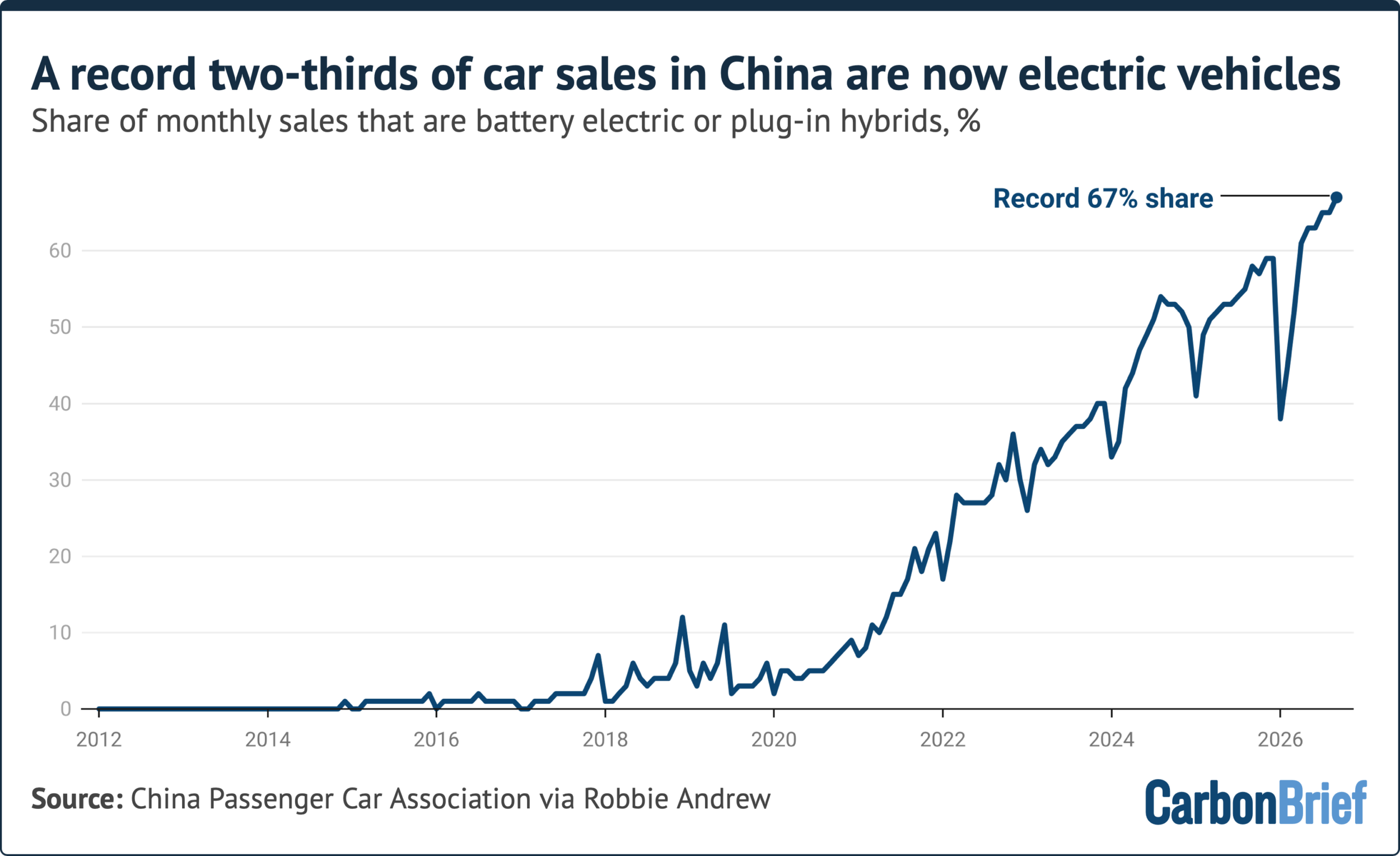
This marks a rapid rise for NEVs from just 6% of new car sales in 2020 up to 58% in 2026 to date – and a record 67% in the month of September.
This year, NEVs’ share of sales has also bounced back from a low of 39% in January, after the full purchase tax exemption that had been in place for more than a decade came to an end in December 2025.
The gain in NEV share in 2026 has come amid a slowdown across the wider domestic passenger-car market, which has hit sales of combustion-engine vehicles particularly hard.
This September, passenger-car retail sales across all categories declined, with overall sales volumes falling 28% year-on-year.
The contraction was led by combustion-engine vehicles, which saw sales fall 43% year-on-year in September and 31% in 2026 to date.
However, sales of PHEVs also fell by 36% year-on-year in September and by 26% in 2026 to date. By comparison, BEVs performed better, although sales still declined 8.5% from a year earlier in September and 4% in 2026 to date.
As a result, NEV sales overall fell by 17% in September and 13% in 2026 to date.
While the market changes in 2026 to date were particularly dramatic, they reflect a broad continuation of trends seen over the past decade.
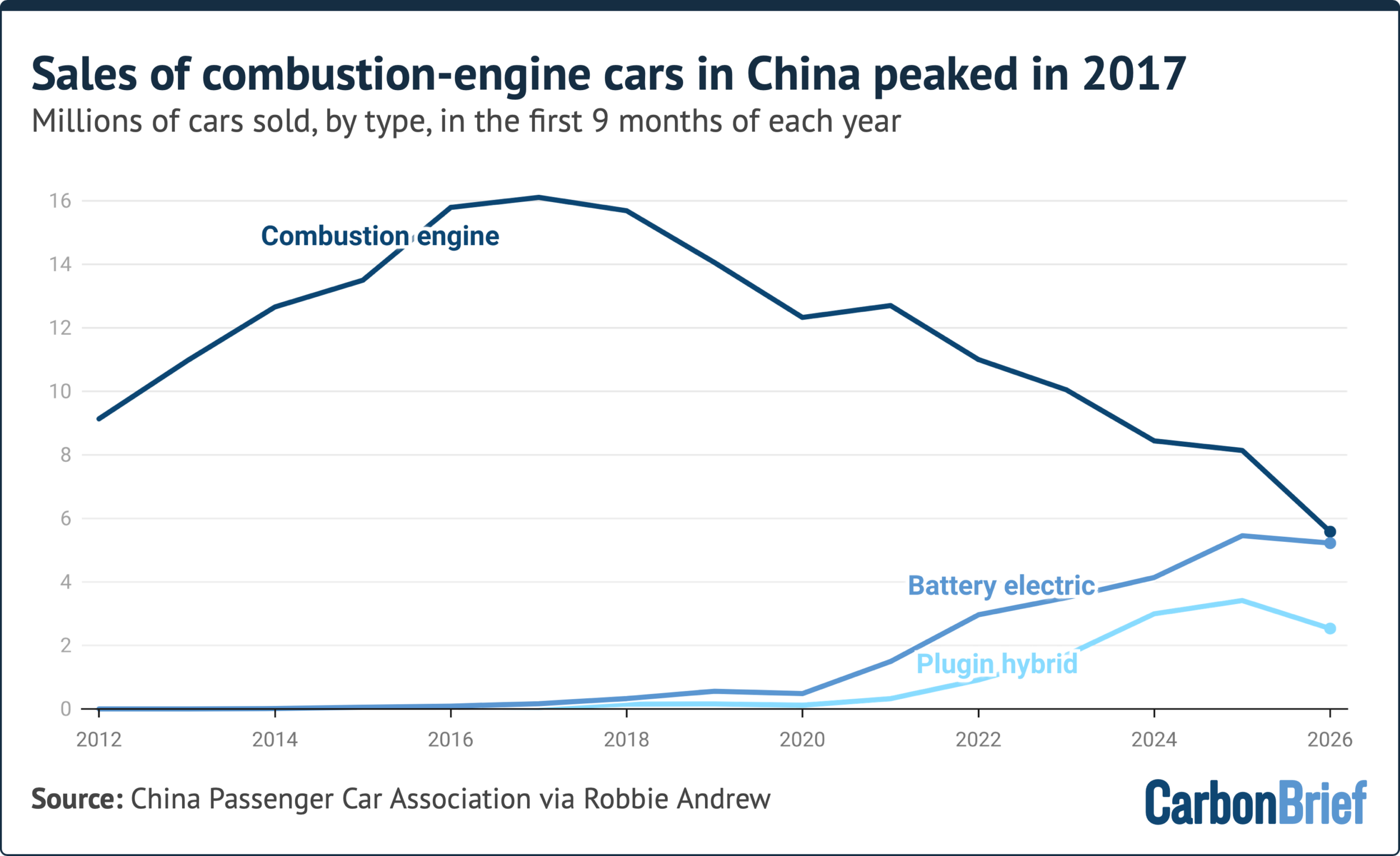
Indeed, sales of combustion-engine cars in China peaked in 2017 and they have been declining ever since, shown in the figure below.
Impact of Hormuz
Part of the reason for the advance of NEVs in 2026, said Chinese technology news outlet OFweek, was petrol cars “giving up market share” as they were outperformed by electric alternatives.
Cui Dongshu, secretary-general of the CPCA, cited higher petrol prices as an explanation for September’s weak combustion-car sales, in comments to financial news outlet National Business Daily.
Imports of oil into China in January-September have fallen 15% compared to 2025, equivalent to 470m barrels, as ongoing conflict tightened supply and drove up prices.
China’s passenger-car NEV fleet has displaced 143m barrels of oil so far during the strait of Hormuz crisis, Euan Graham, senior energy analyst at thinktank Ember, tells Carbon Brief.
EVs “accounted for 12% of the decrease in China’s oil use post-Hormuz”, according to an estimate provided to thinktank the Brookings Institute by an unnamed analyst.
Erica Downs, a senior research scholar at Columbia University’s Center on Global Energy Policy, tells Carbon Brief that the strait of Hormuz crisis and higher oil prices are “reinforcing China’s electrification of road transport”.
She says the “world’s largest oil supply disruption” vindicates China’s early bet on EVs, which was partly driven by concerns about oil-supply security.
NEV demand down
Nevertheless, NEV sales have fallen year-on-year, albeit at a slower rate than overall car sales. The growth in NEV market share has also been decelerating.
Zhang Yichao, a partner at consulting firm AlixPartners, tells Carbon Brief that NEVs benefit from government trade-in policies and a “strong pipeline” of new models, particularly those involving innovation.
He says these factors help explain why NEVs sales have fallen at a slower rate to their combustion-car counterparts.
Cui told the state-run China National Radio that the fall for NEVs and for cars overall in September 2026, is also due to a high baseline of sales from the same month in 2025, as well as changes to trade-in policies and disruptions from the holiday period.
Other factors, says consulting firm Wood Mackenzie, are the weakened demand due to “demand pull-forward” in 2025 caused by the end of subsidies, as well as “tighter financing conditions”.
Zhang tells Carbon Brief he does not “see much more room ahead” for further growth in NEVs’ market share.
He adds that, in his view, their share in China is unlikely to exceed 80%, as some premium-market segments and specific use cases will continue to require combustion-engine vehicles.
Exports surge
Meanwhile, while domestic NEV retail sales fell 17% in September 2026, exports more than doubled, increasing 164% year-on-year, according to the CPCA.
This extends the decline in domestic sales and very strong growth in exports seen across 2026 to date, as shown in the figure below.