

France and Kenya are set to launch an international taxation taskforce at Cop28 to push for new levies to raise more money for climate action.
The governments are in advanced discussions with a handful of European and Global South countries that could join the coalition in Dubai, according to a source with knowledge of the talks.
The taskforce is planning to consider a broad range of options, including levies on international shipping, aviation, financial transactions and fossil fuels, Climate Home understands.
Chrysoula Zacharopoulou, France’s development minister, said the goal is to agree on specific proposals by Cop30, in two years’ time. Those could then be negotiated in relevant international institutions, like the OECD, the UN or the G20, she added.
Barbados’s climate envoy Avinash Persaud told Climate Home the country is “happy to participate” in the initiative.
What can be taxed
Many country leaders and climate experts see taxes as among the most promising so-called innovative sources of finance that could help plug the large gap in the provision of climate funding to vulnerable countries.
“The need for additional resources internationally is paramount”, said Persaud. “The Green Climate Fund, the new loss and damage fund, these all need real resources in the billions of dollars and they can’t come from existing tax-revenues so easily, so we need additional revenues.”
Taxes on fossil fuel extraction and the emissions of the shipping industry could raise up to $210 billion and $60 billion a year respectively, according to a recent study by Climate Action Network and the European Commission.

Sources of taxation and potential revenues, according to the CAN study.
However, reaching an agreement over those measures is politically challenging and would require several years.
French-Kenyan alliance
Political momentum has gathered pace since the global financial summit in Paris last June, when 40 countries agreed to look into new avenues for international taxation, focussing initially on large greenhouse gas-emitting sectors.
Speaking at the end of the event, France President Emmanuel Macron stressed the importance of global coordination. “It doesn’t work when you do it alone, the financial flows go elsewhere”, he said.
Shades of green hydrogen: EU demand set to transform Namibia
Macron found a crucial ally in Kenya’s President William Ruto, who put the issue on the agenda at the African climate summit in Nairobi in September.
That summit’s final statement floated the idea of a global carbon taxation regime, formed by levies on fossil fuel trade, maritime transport and aviation, and potentially “augmented” by a global financial transaction tax (FTT).
Broad framework
The French and Kenyan governments have accelerated efforts over the last couple of months to form a broad coalition, receiving interest from countries, a source with knowledge of the matter told Climate Home.
Those pushing the plan have not yet finalised a detailed framework or specific targets because they don’t want to put any country off at this early stage, they added.

Farmers’ Protest in Gerona, Philippines. Basilio Sepe / Greenpeace
France’s Zacharopoulou said during last week’s Paris Peace Forum that the coalition will both provide a detailed analysis of each taxation option and gauge how acceptable they are to different governments.
“It is a sensitive conversation that needs to be led with a cool head”, she added.
Developing countries sensitivity
Many large developing countries have opposed climate-related international taxation. They claim they would distort markets, hamper development and shift responsibility for reducing emissions.
Brazil led resistance from a group of governments to a tax on the global emissions of the shipping sector at the International Maritime Organization (IMO) earlier this year.
They argued that such a tax would disproportionately hit developing countries and particularly Brazil, whose economy relies on shipping heavy low-value things long distances.
Countries eventually decided to study new ‘technical’ and ‘economic’ measures to tackle the climate impacts of shipping, pushing a decision into the future.
UK aid cuts leave Malawi vulnerable to droughts and cyclones
Persaud said the taskforce will need to pay close attention to these considerations. “We need to rethink shipping and aviation emissions levies so they’re not a tax on remoteness which is a concern today,” he added.
Rachel Owens from the European Climate Foundation, which is involved in setting up the taskforce, said countries will drive forward discussions “in an equitable way”.
“This means not putting the burden on developing countries and ensuring that any adverse impacts are mitigated”, she added.
The post France, Kenya set to launch Cop28 coalition for global taxes to fund climate action appeared first on Climate Home News.
France, Kenya set to launch Cop28 coalition for global taxes to fund climate action

A surge in wholesale costs driven by expensive gas is responsible for nearly 90% of the rise in UK household electricity bills since 2020, reveals new analysis.
The figures, shared with Carbon Brief by thinktank Nesta, show that wholesale gas costs are also behind the vast majority (77%) of the increase in household gas bills.
The analysis firmly contradicts the idea, which has become embedded in UK media and political narratives, that the UK’s net-zero target is to blame for high energy bills.
Andrew Sissons, director for sustainable future at Nesta, tells Carbon Brief that net-zero is, in fact, “helping to shelter Britain from the impact of expensive gas”. He adds:
“Rising gas prices, not net-zero, have driven most of the recent surge in Britain’s energy bills. Britain is particularly exposed, with over 80% of households connected to gas mains, while our electricity system still relies too much on gas as the marginal unit.”
The analysis comes after the UK government gave its approval for the Jackdaw gas field to be developed in the North Sea, despite stating that it “would not…affect prices”.
Another gas crisis
In January 2026, Carbon Brief reported that two-thirds of the rise in electricity bills since before the 2022 global energy crisis was due to high gas prices.
Now, amid ongoing conflict in the Middle East, wholesale gas prices are at their highest levels since Russia’s 2022 invasion of Ukraine.
Indeed, as of 19 October, UK wholesale gas prices stood at 220p per therm (£75 per megawatt hour, MWh), above the average for 2022 of 210p/therm (£72/MWh).
The figure below shows that, after accounting for inflation, typical UK annual household electricity bills had risen £180 by the fourth quarter of 2026, relative to the same period in 2020.
Some 90% of this increase (£161) is due to wholesale costs, driven by the price of gas.
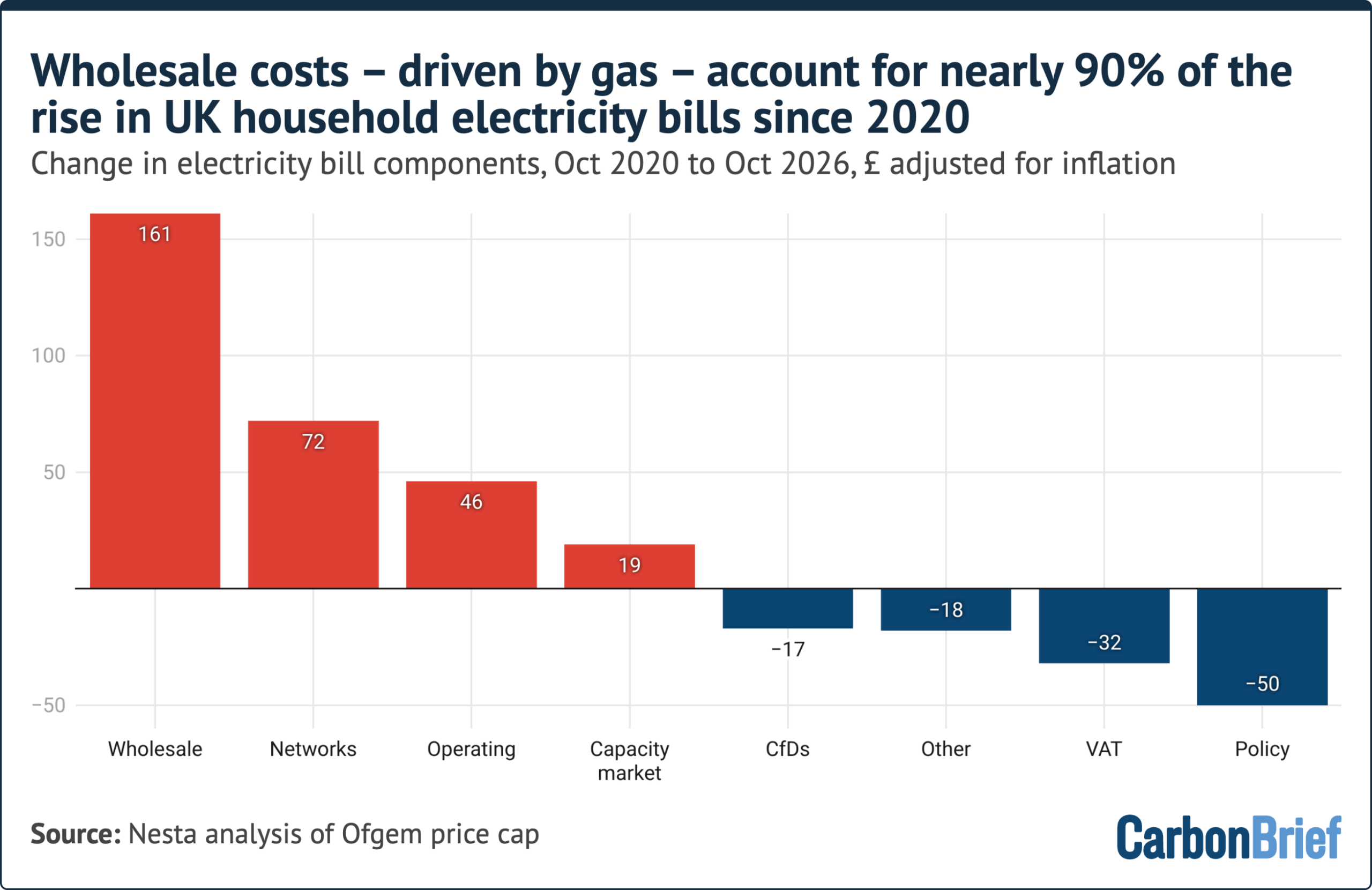
In contrast – and contrary to widespread perceptions – renewable “contracts for difference” (CfDs) are reducing electricity bills by £17 under the current price cap, according to the Nesta analysis.
In addition, the government has cut policy costs for electricity by moving 75% of legacy renewable support onto general taxation, ending the “ECO” efficiency scheme and temporarily removing VAT.
Network costs have added £72 to typical bills since 2020, according to Nesta. Most of this (£46) is for investment in the electricity transmission network, known as the “motorways” of the grid.
Only £21 of the rise in network costs relates to balancing the system, including “constraint payments” for turning off windfarms – and turning on gas plants – due to insufficient grid capacity.
Wind constraint payments regularly receive extensive news coverage, despite balancing costs – in total – making up just £35 (4%) of a typical £858 annual household electricity bill.
The Nesta figures show energy supplier operating costs have gone up by £46 since 2020. These costs are not broken down in the underlying Ofgem figures, but the increase is thought to be driven by the cost of rising household energy debt. Supplier profits are capped at 2.5% of bills.
Breaking the link
Notably, household electricity prices have increased far less rapidly since the Hormuz crisis than gas bills, with higher clean-energy generation helping break the link between the two.
Since 2020, household gas bills have increased by £368 in real terms, according to Nesta’s analysis. Some 77% of this (£283) is due to wholesale gas costs.
After accounting for inflation, total dual-fuel bills for a typical household have increased from £1,175 per year in October 2020 to £1,723 per year in October 2026, a rise of 47%.
The rise in wholesale costs driven by high gas prices accounts for £444 (81%) of this increase in real terms, as shown in the figure below.
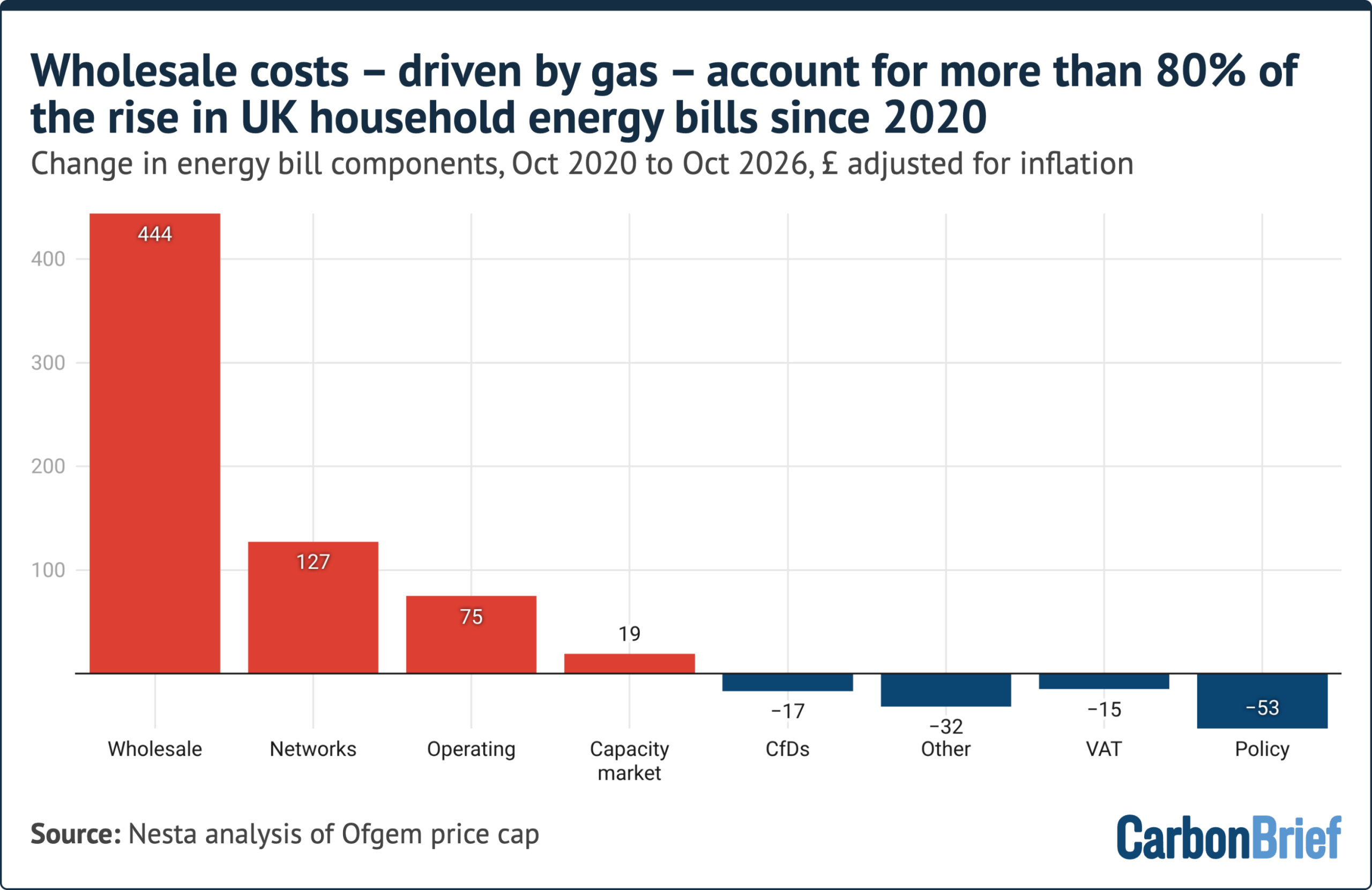
The £127 real-terms rise in network costs includes £72 for electricity transmission, distribution and balancing, as well as £55 for investment in the gas grid.
(According to the Energy Networks Association, up to 80% of the investment in electricity grids is required to maintain existing assets, with the remainder going towards expansion for net-zero.)
In total, the cost of government social and climate policies made up £183 (16%) of typical dual-fuel bills in October 2020. This had fallen to £114 (7%) as of the current October 2026 price cap.
Wholesale costs make up the largest share of the current cap, at £757 (44%). Network costs are the second-largest component of bills, at £417 (24%), followed by operating costs at £291 (17%).
Sissons tells Carbon Brief:
“Upgrading the grid is not cost-neutral, but that price tag is dwarfed by the impact of rising gas prices. In fact, net-zero is helping to shelter Britain from the impact of expensive gas. Since the start of the Iran war, electricity bills have begun to decouple from gas bills, thanks to the UK’s increased renewable power and support from contracts for difference.”
“Going further will require British households to have clean electricity, electric vehicles and heat pumps over fossil-fuel cars and boilers. By focusing on growing electricity demand, the government can spread upgrade costs more widely. This can lock in the consistent investment in electrification that is Britain’s best path to stop global turmoil showing up on winter energy bills.”
Related

Factcheck: UK Conservatives double the ‘cost of net-zero’ after spreadsheet blunder
Analysis: Wind and solar save UK from gas imports worth £5.9bn during Hormuz crisis
Analysis: EVs are now nine times cheaper than petrol or diesel to drive in the UK

CCC: Heathrow expansion could push flights to ‘80% of UK emissions by 2050’
The post Revealed: Expensive gas behind ‘nearly 90%’ of rise in UK electricity bills appeared first on Carbon Brief.
Revealed: Expensive gas behind ‘nearly 90%’ of rise in UK electricity bills
A temporary breach of the 1.5C global-warming limit is now “inevitable” following “decades of insufficient climate action”, says the UN Environment Programme (UNEP).
In its “sobering” annual assessment of the global “emissions gap”, UNEP says that exceeding the Paris Agreement’s 1.5C limit is “imminent and unavoidable”.
This year’s report, titled “The point of return”, says the “task now” is to minimise the size and scale of a temperature “overshoot” and to “establish a credible return path to 1.5C by the end of the century”.
Even the “lowest possible” overshoot scenario for 1.5C would first see global warming peak at around 1.7-1.8C in the middle of the century before declining, says the report.
This scenario – which is “still aligned with the long-term temperature goal of the Paris Agreement” – would require global emissions cuts of 18% by 2030 and 45% by 2035, while ramping up “removals” of carbon dioxide (CO2) from the atmosphere, says UNEP.
In contrast, it notes that the current climate pledges by countries around the world – even if fully implemented – would only reduce emissions by 5-8% by 2030 and 11-15 % by 2035, relative to 2025 levels.
Nonetheless, the report identifies “ample opportunity to accelerate action”, concluding that “countries can still limit peak warming, shorten the duration of overshoot and keep the goals of the Paris Agreement within reach”.
(See Carbon Brief’s detailed coverage of previous reports in 2014, 2015, 2016, 2017, 2018, 2019, 2020, 2021, 2022, 2023, 2024 and 2025.)
Emissions ‘comparable’ between 2024 and 2025
The report says that emissions in 2025 were “comparable” to those of 2024.
Global greenhouse gas emissions in 2025 totalled 58.4bn tonnes of CO2 equivalent (GtCO2e), according to the report. This is around 0.16GtCO2e lower than 2024 levels – albeit, with high levels of uncertainty around the numbers.
In addition, because the figures presented in the 2025 report are “provisional”, the report says, it is “not possible to conclude on the overall direction of emissions in 2025”.
The emissions growth rate has been slowing down in recent decades: the growth rate over 1990-2015 was, on average, 1.7% per year, while emissions have increased by an average of 0.8% per year since 2016.
The chart below shows the total human-driven emissions between 1990 and 2025, separated by greenhouse gas: CO2 from fossil-fuel combustion (dark grey), methane (light grey), nitrous oxide (blue), fluorinated gases (orange) and CO2 from land-use change (green).
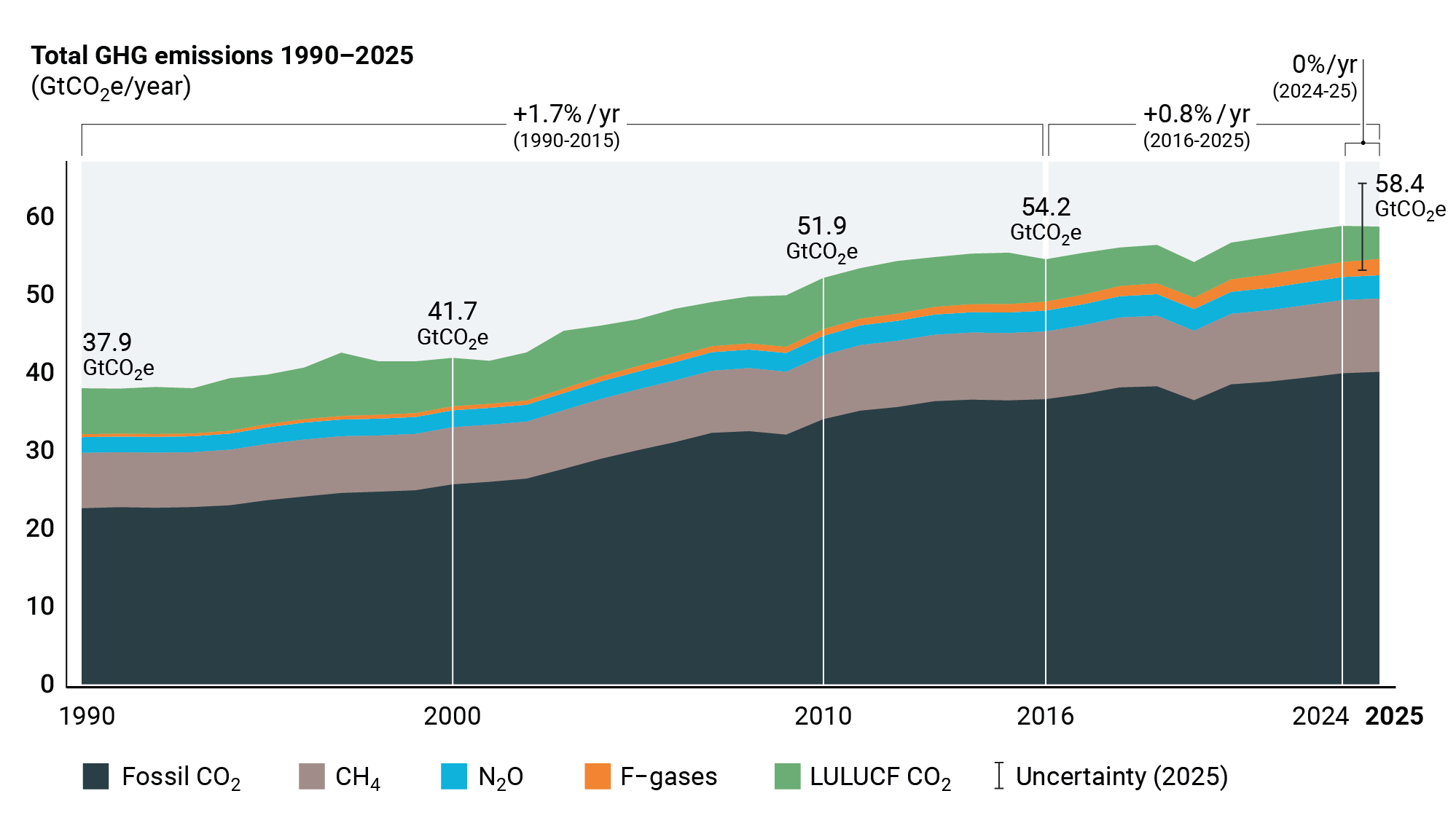
Compared to 2024, emissions from fossil fuels increased slightly, by between 0.4-1.1%, says the report. Emissions of both nitrous oxide and fluorinated gases increased by even higher rates, but since these comprise such a small part of total greenhouse gas emissions, “their contribution to the overall trend is relatively less significant”, it adds. Methane emissions remained steady over that time.
A reduction in the CO2 emissions from land use, land-use change and forestry (LULUCF) “slightly overcompensates” for the rise in emissions of fossil-fuel CO2 and other gases, according to the report. (For more on falling land-use emissions, see Carbon Brief’s explainer.)
The decrease in LULUCF emissions was “partially driven” by a decline in global wildfire emissions, particularly in Africa, South America and parts of south-east Asia. The report notes that these decreases were “likely connected to the ceasing of El Niño conditions”. The ongoing “super” El Niño is likely to cause LULUCF emissions to increase in 2026.
The report also examines countries’ contributions to the increase in greenhouse gas emissions – although here, it excludes LULUCF due to a lag in national-level emissions inventories for the sector.
Among the top six emitters, only the US saw a notable increase in 2025, says the report, whereas emissions in China, the EU, India, Russia and Indonesia were relatively flat. Emissions in the US grew by 133m tonnes of CO2e (MtCO2e) in 2025, due to increased electricity demand and a “rebound” of coal power. This growth in US emissions is likely due to a combination of market factors, including increased heating demand due to