

Ten years ago, switching from burning coal to gas was a key element of China’s policy to reduce severe air pollution.
However, while gas is seen in some countries as a “bridging” fuel to move away from coal use, rapid electrification, uncompetitiveness and supply concerns have suppressed its share in China’s energy mix.
As such, while China’s gas demand has more than doubled over the past decade, the fuel is not currently playing a decisive role in the country’s strategy to tackle climate change.
Instead, renewables are now the leading replacement for coal demand in China, with growth in solar and wind generation largely keeping emissions growth from China’s power sector flat.
While gas could play a role in decarbonising some aspects of China’s energy demand – particularly in terms of meeting power demand peaks and fuelling heavy industry – multiple factors would need to change to make it a more attractive alternative.
Small, but impactful
The share of gas in China’s primary energy demand is small and has remained relatively unchanged at around 8-9% over the past five years.
It also comprises 7% of China’s carbon dioxide (CO2) emissions from fuel combustion, according to the International Energy Agency (IEA).
Gas combustion in China added 755m tonnes of CO2 (MtCO2) into the atmosphere in 2023 – double the total amount of CO2 emitted by the UK.
However, its emissions profile in China lags well behind that of coal, which represented 79% of China’s fuel-linked CO2 emissions and was responsible for almost 9bn tonnes of CO2 emissions in 2023, according to the same IEA data.
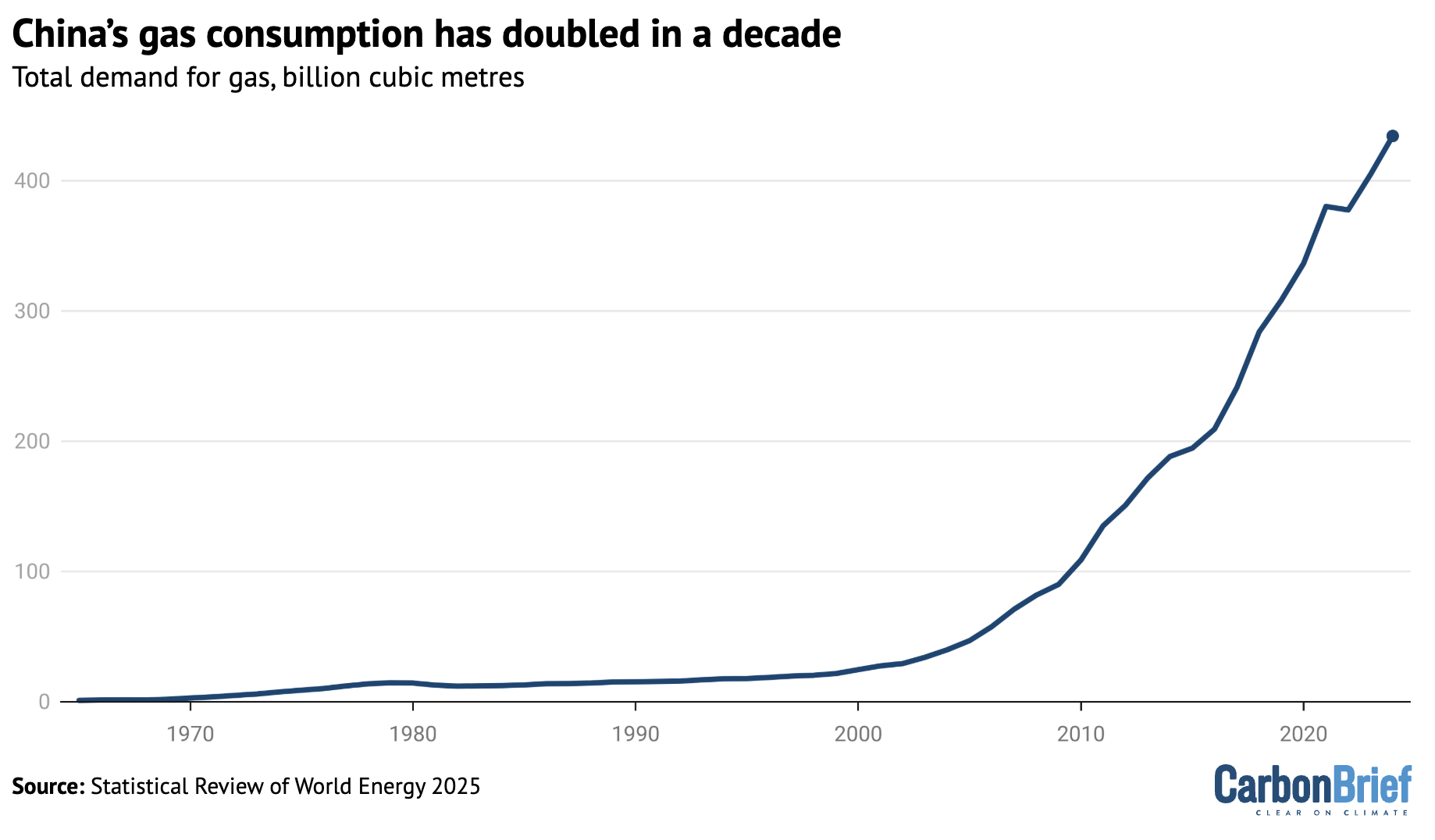
Gas consumption continues to grow in line with an overall uptick in total energy demand. Chinese gas demand, driven by industry use, grew by around 7-8% year-on-year in 2024, according to different estimates.
This rapid growth is, nevertheless, slightly below the 9% average annual rise in China’s gas demand over the past decade, during which consumption has more than doubled overall, as shown in the figure below.
The state-run oil and gas company China National Petroleum Corporation (CNPC) forecast in 2025 that demand growth for the year may slow further to just over 6%.
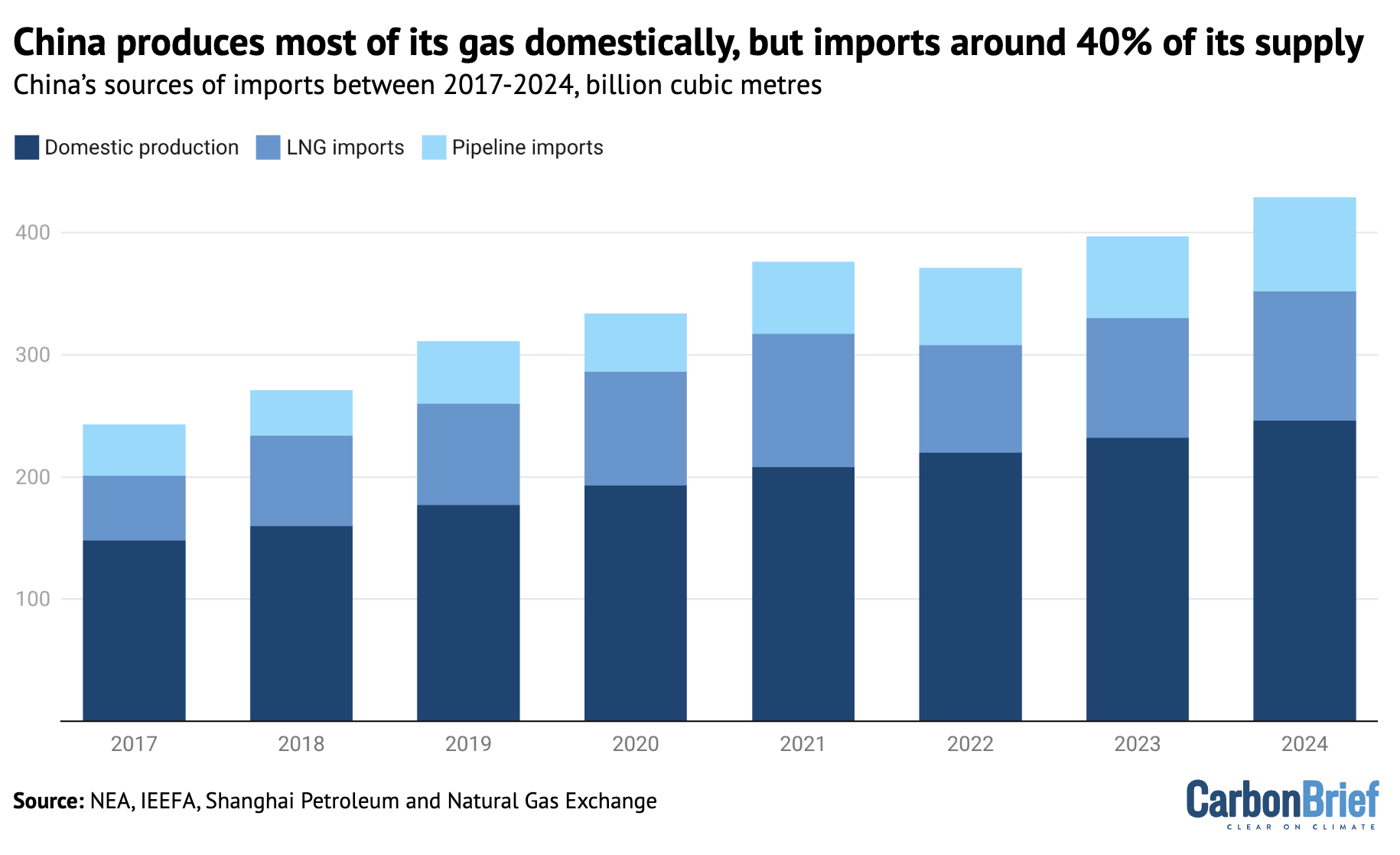
The majority of China’s gas demand in 2023 was met by domestic gas supply, according to the Institute for Energy Economics and Financial Analysis (IEEFA).
Most of this supply comes from conventional gas sources. But incremental Chinese domestic gas supply in recent years has come from harder-to-extract unconventional sources, including shale gas, which accounted for as much as 45% of gas production in 2024.
Despite China’s large recoverable shale-gas resources and subsidies to encourage production, geographical and technical limitations have capped production levels relative to the US, which is the world’s largest gas producer by far.
CNPC estimates Chinese gas output will grow by just 4% in 2025, compared with 6% growth in 2024. Nevertheless, output is still expected to exceed the 230bn cubic metre national target for 2025.
Liquified natural gas (LNG) is China’s second most-common source of gas, imported via giant super-cooled tankers from countries including Australia, Qatar, Malaysia and Russia.
This is followed by pipeline imports – which are seen as cheaper, but less reliable – from Russia and central Asia.
One particularly high-profile pipeline project is the Power of Siberia 2 pipeline project. However, Beijing has yet to explicitly agree to investing in or purchasing the gas delivered by the project. Disagreements around pricing and logistics have hindered progress.
Evolving role
Beijing initially aimed for gas to displace coal as part of a broader policy to tackle air pollution.
A three-year action plan from 2018-2020, dubbed the “blue-sky campaign”, helped to accelerate gas use in the industrial and residential sectors, as gas displaced consumption of “dispersed coal” (散煤)”– referring to improperly processed coal that emits more pollutants.
Meanwhile, several cities across northern and central China were also mandated to curtail coal usage and switch to gas instead. Many of these cities were based in provinces with a strong coal mining economy or higher winter heating demand.
China’s pollution levels saw “drastic improvement” as a result, according to a report by research institute the Centre for Research on Energy and Clean Air (CREA).
(In January 2026, there were widespread media reports of households choosing not to use gas heating despite freezing temperatures, as a result of high prices following the expiry of subsidies for gas use.)
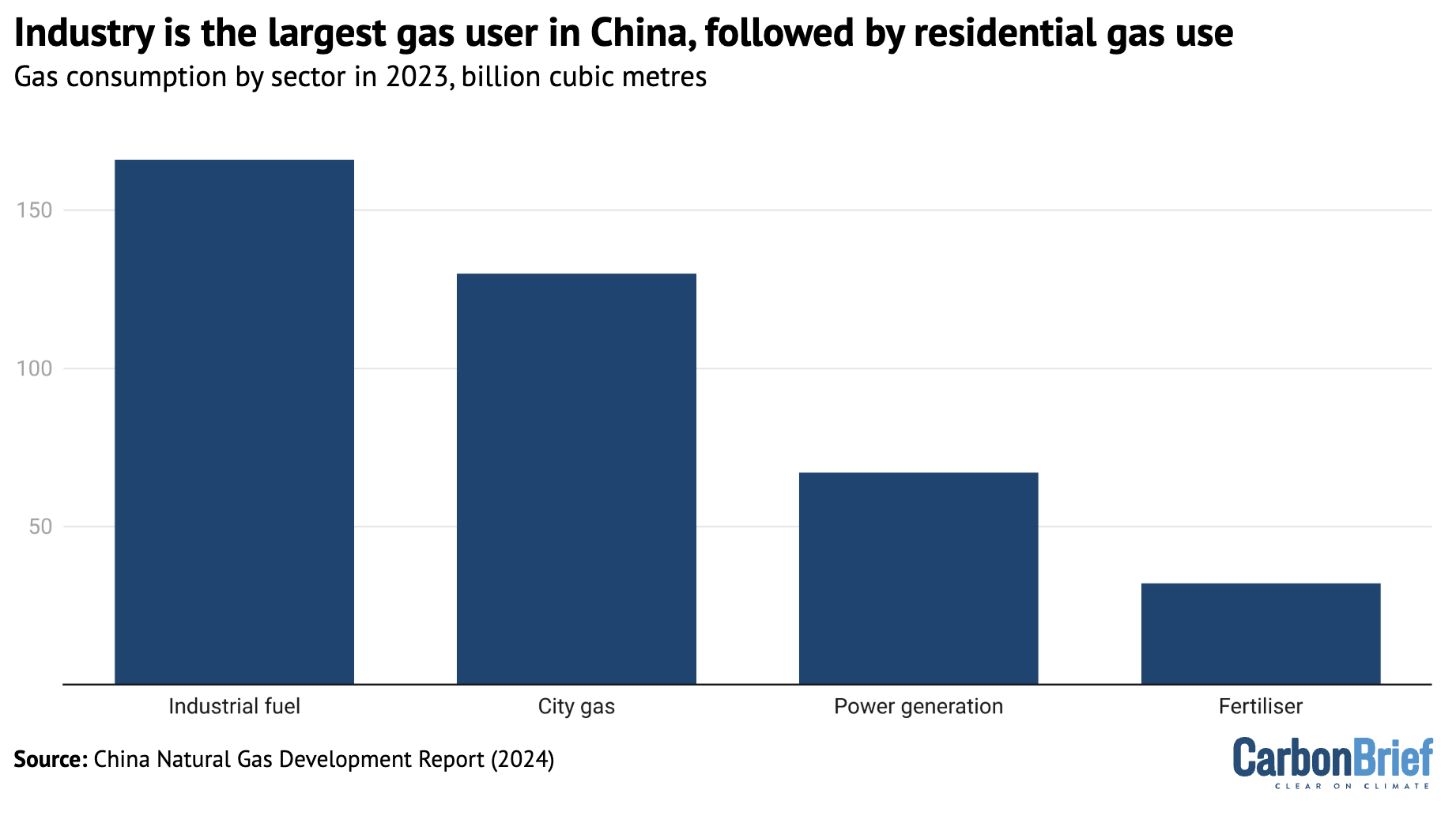
Industry remains the largest gas user in China, with “city gas” – gas delivered by pipeline to urban areas – trailing in second, as shown in the figure below. Power generation is a distant third.
Gas has never gained momentum in China’s power sector, with its share of power generation remaining at 4% while wind and solar power’s share has soared from 4% to 22% over the past decade, Yu Aiqun, a research analyst at the US-based thinktank Global Energy Monitor, tells Carbon Brief.
Yu adds that this stagnation is largely due to insufficient and unreliable gas supply, which drives up prices and makes gas less competitive compared to coal and renewables. She says:
“With the rapid expansion of renewables and ongoing geopolitical uncertainties, I don’t foresee a bright future for gas power.”
Average on-grid gas-fired power prices of 0.56-0.58 yuan per kilowatt hour (yuan/kWh) in China are far higher than that of around 0.3-0.4 yuan/kWh for coal power, according to some industry estimates. Recent auction prices for renewables are even cheaper than this.
Meanwhile, the share of renewables in China’s power capacity stood at 55% in 2024, compared with gas at around 4%.
Generation from wind and solar in particular has increased by more than 1,250 terawatt-hours (TWh) in China since 2015, while gas-fired generation has increased by just 140TWh, according to IEEFA.
As the share of coal has shrunk from 70% to 61% during this period, IEEFA suggests that renewables – rather than gas – are displacing coal’s share in the generation mix.
However, China’s gas capacity may still rise from approximately 150 gigawatts (GW) in 2025 to 200GW by 2030, Bloomberg reports.
A report by the National Energy Administration (NEA) on development of the sector notes that gas will continue to play a “critical role” in “peak shaving”, where gas turbines can be used for short periods to meet daily spikes in demand. As such, the NEA says gas will be an “important pillar” in China’s energy transition.
In 2024, a new policy on gas utilisation also “explicitly promoted” the use of gas peak-shaving power plants, according to industry outlet MySteel.
China’s current gas storage capacity is “insufficient”, according to CNPC, reducing its ability to meet peak-shaving demand. The country built 38 underground gas storage sites with peak-shaving capacity of 26.7bn cubic metres in 2024, but this accounts for just 6% of its annual gas demand.
Transport use
Gas is instead playing a bigger part in the displacement of diesel in the transport sector, due to the higher cost competitiveness of LNG as a fuel – particularly in the trucking sector.
CNPC expects that LNG displaced around 28-30m tonnes of diesel in the trucking sector in 2025, accounting for 15% of total diesel demand in China.
This is further aided by policy support from Beijing’s equipment trade-in programme, part of efforts to stimulate the economy.
However, gas is not necessarily a better option for heavy-duty, long-haul transportation, due to poorer fuel efficiency compared with electric vehicles (EVs).
In fact, “new-energy vehicles” (NEVs) – including hydrogen fuel-cell, pure-electric and hybrid-electric trucks – are displacing both LNG-fueled trucks and diesel heavy-duty vehicles (HDVs).
In the first half of 2025, battery-electric models accounted for 22% of all HDV sales, a year-on-year increase of 9%, while market share for LNG-fueled trucks fell from 30% in 2024 to 26%.
Gas can be cheaper than oil but is not competitive with EVs and – with the emergence of zero-emission fuels such as hydrogen and ammonia – gas may eventually lose even this niche market, says Yu.
Supply security
Chinese government officials frequently note that China is “rich in coal, poor in oil and short of gas” (“富煤贫油少气”). Concerns around import dependence have underpinned China’s focus on coal as a source of energy security.
However, Beijing increasingly sees electrification as a more strategic way to decarbonise its transport sector, according to some analysts.
“Overall, electrification is a clear energy security strategy to reduce exposure to global fossil fuel markets,” says Michal Meidan, head of the China energy research programme at the Oxford Institute for Energy Studies.
Chinese oil and gas production grew dramatically in the last few years under a seven-year action plan from 2019-25, as Beijing ordered its state oil firms to ramp up output to ensure energy security.
Despite this, gas import dependency still hovers at around 40% of demand. This, according to assessments in government documents, exposes the country to price shocks and geopolitical risks.
The graph below shows the share of domestically produced gas (dark blue), LNG imports (mid-blue) and pipeline imports (light blue), in China’s overall gas supply between 2017 and 2024.
“Gas use is unlikely to play a significant role in decarbonising the power system, but could be more significant in industrial decarbonisation,” Meidan tells Carbon Brief.
She estimates that if LNG prices fall to $6 per million British thermal units (btu), compared to an average of $11 in 2024-25, this could encourage fuel switching in the steel, chemical manufacturing, textiles, ceramics and food processing industries.
The chart below shows the year-on-year change in gas demand between 2001-2022.
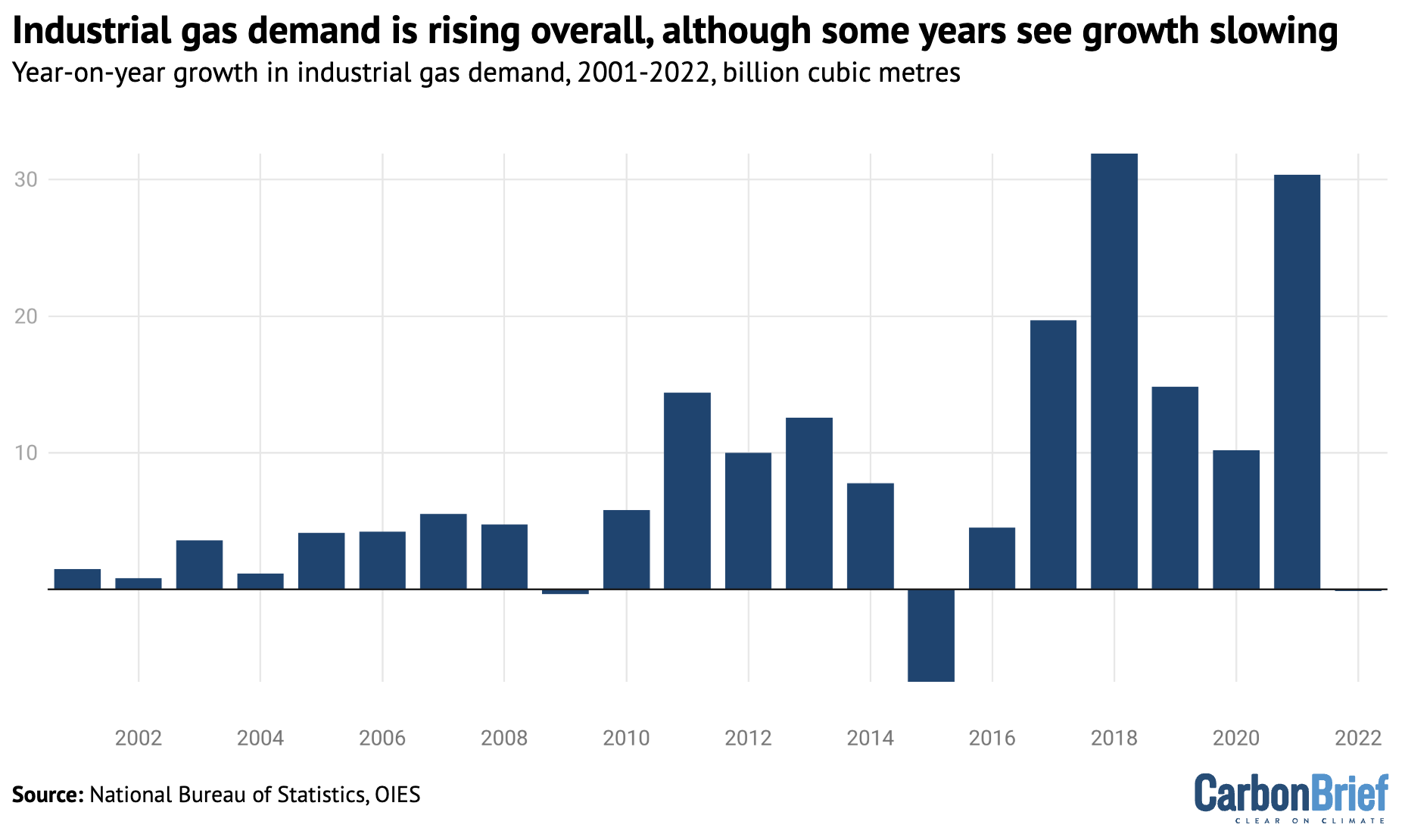
Growth in gas demand has been decelerating in some industries in recent years, such as refining. But it also remains unclear if Beijing will adopt more aggressive policies favouring gas, Meidan adds.
A roadmap developed by the Energy Research Institute (ERI), a thinktank under the National Development and Reform Commission’s Academy of Macroeconomic Research, finds that gas only begins to play an equivalent or greater role in China’s energy mix than coal by 2050 at the earliest – 10 years ahead of China’s target for achieving carbon neutrality.
Both fossil fuels play a significantly smaller role than clean-energy sources at this point.
Wang Zhongying and Kaare Sandholt, both experts at the ERI, write in Carbon Brief:
“Gas does not play a significant role in the power sector in our scenarios, as solar and wind can provide cheaper electricity while existing coal power plants – together with scaled-up expansion of energy storage and demand-side response facilities – can provide sufficient flexibility and peak-load capacity.”
Ultimately, China’s push for gas will be contingent on its own development goals. Its next five-year plan, from 2026-2030, will build a framework for China’s shift to controlling absolute carbon emissions, rather than carbon intensity.
Recent recommendations by top Chinese policymakers on priorities for the next five-year plan did not explicitly mention gas. Instead, the government endorses “raising the level of electrification in end-use energy consumption” while also “promoting peaking of coal and oil consumption”.
The Chinese government feels that gas is “nice to have…if available and cost-competitive but is not the only avenue for China’s energy transition,” says Meidan.




The post Explainer: Why gas plays a minimal role in China’s climate strategy appeared first on Carbon Brief.
Explainer: Why gas plays a minimal role in China’s climate strategy

Australian indie-folk duo Hollow Coves have found a special way to combine their love of music and the natural world. They have lent their, very soothing, voices to the Save Scott Reef campaign by recording a music video of their much-loved song Coastline at the reef.
We sat them down on the Rainbow Warrior to talk about their musical inspiration, their experience on the reef, and why they believe it’s so important to protect these incredible places for future generations.
1. Tell us a little about Hollow Coves and the music you make.
Matt: Our music is acoustic indie folk. We like bands like Angus and Julia Stone, Ben Howard, Mumford and Sons – acoustic music like that.
Ryan: Historically, a lot of our music has been inspired by travelling and seeing beautiful places in nature, and just writing about experiences in the world.
We both live on the east coast of Australia, on the Gold Coast, and we’re surrounded by nature. We’ve got beautiful oceans, amazing hinterland spots and some really cool rock pools.
2. Your music is often inspired by nature and the outdoors. What is your personal connection to the ocean?
Matt: I’m in the ocean as much as I can. I surf, and I’ve always loved the ocean. I grew up just outside Brisbane, and we would catch the ferry across to North Stradbroke Island. A lot of our mates would just camp over there on the weekends. It’s been a natural part of my life.
Ryan: I don’t surf, but I have an appreciation of the ocean. When we were writing Coastline, I was actually living in Canada, and being away from the ocean made me realise how much I missed it. There’s something about living near the ocean and being able to go and be by the ocean. It’s just a different feeling.

3. You recently joined Greenpeace aboard the Rainbow Warrior to visit Scott Reef and film a music video for Coastline. What made you want to get involved?
Ryan: We’ve been so fortunate to have the success that we’ve had with our music, and when this opportunity came up, we were like, man, it just feels so fitting to give back in whatever way we can. The music has been so inspired by these places of beauty, and so we just want to do our part to protect and preserve these places so that future generations can appreciate them in the same way that we do.
Matt: Collaborating with Greenpeace has just been so aligned with our mission as well. We love nature, we love singing about it, and I think it’s so important to protect these places that are vulnerable and unique to the world. They really are just a natural wonder.
4. What was it like seeing Scott Reef for the first time?
Matt: The first time was really magical. I didn’t realise there was even this amazing coral shelf out off the Kimberley Coast. Just being able to go snorkelling every day and see the wildlife and what’s actually underneath the water – the whole world around is just something else.
Ryan: The first day we arrived at the reef, the sun was rising and this pod of about 50 dolphins greeted us as we entered. It was like, wow, this place is just so brimming with life. It was really beautiful to see, and the colour of the water – everyone was just like, oh my gosh, this water is insane!
Matt: You just always forget that when you’re sailing, it’s obviously beautiful, and every sunset’s magical, but you forget there’s this whole world underneath the ocean and just how lively and vibrant it is.
5. Tell us about filming the Coastline music video. What was it like performing on that tiny island?
Matt: It was an amazing opportunity to be alongside this project and get on the Rainbow Warrior, see Scott Reef and go play on this amazing little sandbank island in the middle of the ocean. We were losing our minds with the beauty of it.
It was a big team effort. The island only comes out at low tide, and on the day we arrived it was completely submerged. We had to wait for the right opportunity to get onto the island safely.
Ryan: When we first got on there, the waves were still crashing over it from either side. As the tide kept going down, a bit more of the island was revealed.
Matt: There was a whole film crew, with a drone flying around to capture the scale of how small this little island is and how big the ocean is. It was just so magical, like a pinch-me moment. Something we’ll remember for the rest of our lives.

6. What surprised you most about Scott Reef and the marine life you discovered?
Matt: The third day was the highlight for me. I got to see a turtle swim by, a little reef shark and another sea snake which tried to chase me, which was pretty scary! But it was cool.
Ryan: Just the colours, all the coral and so many beautiful, colourful fish. It’s such a crazy experience to be down there.
Matt: I think you just forget there’s this whole world underneath the ocean. It just felt really cool to be down there and a part of it.
7. Before this trip, how much did you know about Scott Reef, and why do you think it’s important to raise awareness about it?
Ryan: Prior to this trip, we knew very little about Scott Reef, and I think that’s part of the problem. It hasn’t been very common for people to know about this place. Part of the trip is to bring awareness to how beautiful Scott Reef is and to show people that it is something worth protecting.
If we don’t stand up and protect these places, then we are at risk of losing them. It just sets a really bad precedent for coral reefs in Australia.
Matt: Scott Reef doesn’t really have the name like a lot of other places. I think that’s the key, to spread the word and tell people about what’s happening out here and how beautiful it is.

8. What is at stake if the proposed drilling project near Scott Reef goes ahead?
Ryan: Currently there’s a proposal for a drilling project that would take place near Scott Reef. If that was to go ahead, it would be a massive risk for the reef, and it would put a lot of the wildlife at risk as well.
Having been out there and seeing the beauty there, it just doesn’t feel right. It doesn’t feel like it’s a risk that we need to take. Particularly with these places that are so beautiful, why would we want to risk losing them?
Matt: I think it’d be an absolute tragedy. Just experiencing it yourself, it’s like, wow, this place is incredible. There are so many endangered sea creatures. I think for anyone that would come out here and experience it, everyone would be aligned with how important it is to keep this place.
9. What was your experience like aboard the Rainbow Warrior and getting to know the Greenpeace crew?
Matt: I didn’t really know what to expect, but everyone was so lovely and passionate. It was cool just being part of the process of running the ship. We had very strict schedules, and we did cleaning at eight o’clock every day! It was really cool to see how the ship operates.
Ryan: We were welcomed like family to the crew on board. Everyone’s been so encouraging and helpful. It was really special to see the amount of effort that goes into trying to protect these places.
I hadn’t really explored Greenpeace too much before this trip, so it’s been cool to learn more about the organisation and the people involved and hear more of their heart towards preserving these beautiful places.
10. What message would you like to share with people who want to help protect Scott Reef?
Matt: I think anyone that loves the ocean or finds nature a big part of their life should get behind this campaign. It’s about raising awareness, sharing the word of what Scott Reef is and how beautiful it is.
Being a father myself, it’s just made me even more passionate about these places that we have, how fragile they are and how important it is to pass them on to the next generation. I just want my kids to see it and future generations, because it really is a spectacular thing.
Ryan: I think it’s important to be on the right side of history with things like this. You can sit back and do nothing and just see these beautiful places be lost. Or you can stand up and fight for what’s right.
We’re at this point in history where we have an opportunity to make a difference. These places are constantly being put at risk, and if we do nothing, then we’ll just see them go. We’ve already lost so much, and so it’s important to stand up and fight for these places that we want to keep.
Matt: Absolutely, we’ve got this. Let’s spread the word. We can absolutely win this campaign!
Climate Change
‘Ode to Scott Reef’: Indie-folk duo Hollow Coves performs at famous Australian reef in call for protection
SCOTT REEF, Tuesday 24 November 2026 — Released today, a new music video with Gold Coast duo Hollow Coves performing onboard the flagship Rainbow Warrior at Scott Reef calls for protection of the ancient ecosystem from oil and gas drilling proposed by multinational Woodside.

- Watch ‘Coastline’ shot at Scott Reef here and see visuals from the shoot at sea here
The new music video, in collaboration with Greenpeace Australia Pacific, captures a performance of Hollow Coves’ viral single ‘Coastline’, joining a nationwide push by Australian artists to protect heritage-nominated Scott Reef, located 270 kilometres off WA’s Kimberley coast. The video was shot on multiple cameras including a Bolex 16mm vintage movie camera, and boasts original underwater and aerial footage of Scott Reef.
Scott Reef is home to thousands of marine species, genetically unique green sea turtles and endangered pygmy blue whales but is threatened by oil and gas drilling proposed by multinational corporation Woodside, the Browse project.
Matt Carins, Hollow Coves musician, said: “It would be such a tragedy if gas drilling happened at Scott Reef. It’s such an incredible part of the world and is something that we want to pass on to future generations. Being a father myself, I want to share these places with my kids.
“There’s still hope in saving Scott Reef. I think it’s our time now to spread the word of how beautiful this place is. It may not have the same fame as other reef systems, but it’s just as amazing and just as important.”
Ryan Henderson, Hollow Co