

Nearly 30% of cars sold this year are set to be electric as the war in Iran has sent petrol and diesel prices soaring and drivers in many parts of the world look to electric vehicles as a cheaper alternative.
The analysis, released on Wednesday by the International Energy Agency (IEA), shows that in March, after Iran effectively closed the Strait of Hormuz following US and Israeli military strikes, around 30 countries saw record-breaking monthly sales of battery electric cars and plug-in hybrids.
In the first three months of the year, sales grew by 80% in Asian countries outside of China and by 75% in Latin America – driven by adoption in Brazil and Mexico – compared to the same period last year. In Europe, sales were up close to 30% year-on-year.
Iran war creates upside potential for EV sales
Globally, electric car sales are expected to grow to 23 million this year, accounting for 28% of total car sales, despite falling in China and the US in the first quarter of the year.
In Europe, one in three cars sold this year is projected to be electric. In China, early data for April shows that monthly sales grew to more than 60% of total car sales. Outside China, sales are projected to rise by more than 50% in Asian countries and 45% in Latin America this year.
Araceli Fernandez, the head of the IEA’s technology innovation unit, said the energy crisis caused by the Middle East war has spotlighted the benefits of driving an electric car and created “an upside potential” for the agency’s EV forecast this year. But, she added, it will take time for this to be reflected in the market, partly because of the time lag between ordering a car and it being ready to drive.
Consumers might also be weary of the impact of the war on the economy and wait for government support and policy incentives to make the switch to electric. As a result, the extent to which the growth in sales recorded since the start of the year can be attributed to the energy crisis is hard to estimate, IEA analysts said.
Attractive response to the energy crisis
The road transport sector is the largest consumer of oil, accounting for close to half of global demand.
The IEA has described the blockade of the Strait of Hormuz, through which around a fifth of oil and gas trade passes, as the “largest supply disruption in the history of the global oil market”. Earlier this week, it warned that global oil inventories were depleting at record pace.
-
Nepal’s EV revolution pays off as oil crisis causes pain at the pumps
Import subsidies, abundant hydropower and charging investments have spurred EV adoption, with electric vehicles now making up about three-quarters of new car sales -
How green are batteries for electric vehicles?
What you need to know about electric vehicles (EVs) and their batteries


How governments respond to soaring oil prices could shape the global car market for years to come, according to the Paris-based agency, which was set up to respond to the oil crisis of the 1970s.
Unlike in the 1970s, electric vehicles are now an alternative to oil dependence for transport. In 2025, a quarter of all new cars sold were electric. That year, the global EV fleet avoided the consumption of around 1.7 million barrels of oil per day, according to the IEA’s analysis.
“Many governments in oil-importing countries in particular will potentially turn to identify ways for scaling up electric vehicle deployment,” said Timur Gül, the IEA’s chief energy technology officer.
Southeast Asia’s ‘spectacular growth’
Countries in Southeast Asia, including Vietnam, the largest EV market in the region, have already announced plans to expand or extend EV tax incentives in response to the energy crisis.
“It’s possible that other countries will follow,” said Gül, adding that supportive policies being implemented this year could lead to “important upside potential for EV sales”.
The region, which heavily depends on fuel imports from the Middle East, has been particularly affected by the crisis, with prices at the pump spiking.
In Nepal, where nearly three-quarters of new cars sold are electric, the EV roll-out has helped cushion the impact of the oil shock. In Bangladesh, where significant barriers to EV deployment remain, dealers of electric cars, scooters and three-wheelers said they have seen a rise in sales and customer enquiries in recent months.
Gül said electric car sales across Southeast Asia have seen “spectacular growth” over the last two to three years, reaching nearly 20% of car sales across the region last year, led mainly by Vietnam, Thailand and Indonesia.
More than half of the cars sold in the region were made by Chinese carmakers but around a third were manufactured by Vietnamese company VinFast, whose small affordable models have enabled mass adoption in the country. Nearly 40% of new car sales in Vietnam were electric in 2025 – above levels seen in most European countries.
China’s hegemony
Technological advances and cheaper prices have continued to drive EV deployment in China, the world’s largest oil importer.
In 2025, seven out of 10 electric cars sold in the country were cheaper to buy than their petrol and diesel engine counterparts in Europe. The cost of owning an electric truck is now competitive with owning a diesel one and last year, one in four trucks sold in China were electric – a market that doubled twice in just two years.
Cheaper EVs saw car exports from China double in 2025, mostly targeting Europe and Asia. Chinese automakers manufactured 60% of electric cars sold around the world last year and imports of Chinese cars account for more than half of sales outside Europe and the US.
“We are seeing increasingly intense competition domestically in China, which is squeezing the margins for electric car manufacturers and is making them increasingly look for export opportunities overseas,” said Fernandez.
The post Electric car sales race ahead in SE Asia and Latin America amid oil supply crisis appeared first on Climate Home News.
Electric car sales race ahead in SE Asia and Latin America amid oil supply crisis

Three countries have been named by the Paris Agreement’s compliance committee for failing to submit a nationally determined contribution (NDC) and repeatedly snubbing offers of help with their climate plans.
After months of internal debate over whether to identify serial non-responders, the Paris Agreement’s Implementation and Compliance Committee (PAICC) named the three countries which have failed to engage with it over their NDCs on Friday.
It named Democratic Republic of Congo, Senegal and North Korea in a footnote of its annual report, adding that it decided to name them “with a view to facilitating engagement”, adding that representatives of the three nations had been invited to its meeting in early 2027 “with the purpose of identifying any challenges and constraints”.
“The Committee noted the importance of Parties engaging with the Committee in a timely manner, while noting that some delays may be due to the national capabilities and circumstances of the Parties”, the report said.
-
Under US pressure, World Bank says it will back gas “where appropriate”
The US wants the World Bank to expand its gas support while climate campaigners are pushing for it to end – its head spoke this week of limited backing for the fossil fuel -
IPCC scientists vow to press on with climate reports despite political deadlock
After governments again failed to agree a timeline, nearly 120 IPCC authors pledged to complete their assessment on time and with full scientific rigour -
Paris Agreement committee snubbed over missing NDC climate plans
Many governments have still not submitted a nationally determined contribution to the UN, breaching a key requirement of the Paris Agreement

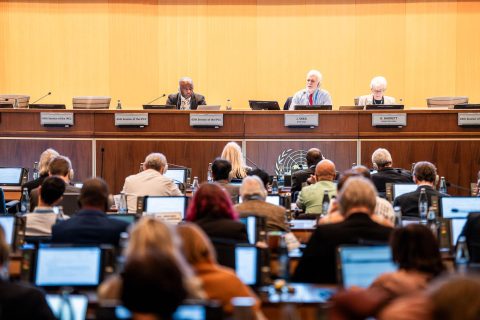

In July, PAICC said 12 countries had ignored its repeated attempts to discuss why they had not published an NDC as required every five years under the 2015 Paris accord.
Members of the committee had been divided over whether to name them, but at a September meeting decided to do so in their annual report to the annual climate COP summit.
By the time the report was published on Friday, only Congo, Senegal and North Korea “had not communicated an NDC or submitted a [Biennial Transparency Report] and had not yet responded to any of the Committee’s notifications, despite several reminders issued by the Committee in this regard”.
Rainforest and renewable energy ambitions
The silence from Congo and Senegal is notable because the former is home to much of the Congo Basin rainforest while the latter has sought billions of dollars in climate finance to support its renewable energy ambitions.
After Brazil, Congo has more rainforest than any country in the world. This forest, and the country’s peatlands, absorb huge amounts of greenhouse gas but are fast being lost to expanding farmland, charcoal production, logging and mining.
Senegal signed a Just Energy Transition Partnership with Canada and wealthy European nations in 2023, to help it meet its renewable energy targets under the-then government of Macky Sall. It was chair of the Least Developed Countries group between January 2022 and December 2023.

Tejas Rao, who is researching the PAICC as part of a doctoral thesis at Cambridge University, said the governments of the three countries should engage with the committee.
“Engagement costs these governments very little and the committee has shown it will listen,” he said.
“Silence leaves the committee with no basis to help, and it leaves the [governments] exposed to the narrative that they are simply disengaged,” he told Climate Home News.
Paris Agreement requirement
The 2015 Paris Agreement requires all parties to publish an NDC every five years outlining their emissions reduction targets, with each plan meant to be more ambitious than the country’s last NDC.
The latest set – the third round of plans, with new targets for 2035 – was due in February 2025. While most countries missed this deadline, all but around 30 – mostly small emitters but including Egypt, Vietnam and Argentina – have now submitted them.
Over the year, the PAICC – which is made up of government climate officials from developed and developing countries – has been communicating with governments that have not submitted NDCs and trying to overcome barriers to them doing so.
Some nations have cited exceptional circumstances as the reason for not submitting an NDC, a process that requires a significant amount of work in tracking emissions and consulting on how to curb them across the economy. For example, a letter from a Sudanese official to the PAICC, seen by Climate Home News, said that the country’s civil war had led to the suspension of its NDC preparation.
-
IPCC scientists vow to press on with climate reports despite political deadlock
After governments again failed to agree a timeline, nearly 120 IPCC authors pledged to complete their assessment on time and with full scientific rigour -
Under US pressure, World Bank says it will back gas “where appropriate”
The US wants the World Bank to expand its gas support while climate campaigners are pushing for it to end – its head spoke this week of limited backing for the fossil fuel -
Who shapes climate science? The equity question facing the IPCC
Early completion of the next global climate science assessment reports risks excluding research from the Global South, which is key to ensuring the findings are fair
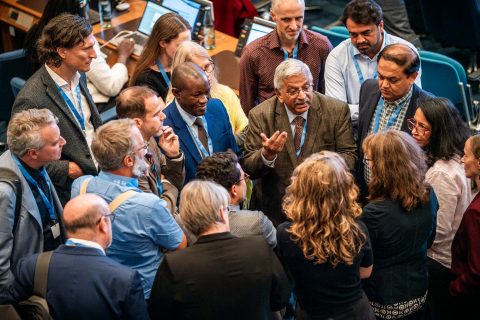
The US and Iran are not signed up to the Paris Agreement and so do not have active NDCs, nor does Taiwan, which is not a UN member state.
Rao said that because the PAICC is “facilitative and non-punitive”, naming the countries “is meant to open a door, not close one – the invited consultation is the point”.
“In recent months, governments that explained their constraints, whether capacity, finance or domestic process, have been met with follow-up and support rather than sanction, and the number of silent governments has fallen sharply,” Rao said.
The post Paris Agreement committee names three countries snubbing it over NDCs appeared first on Climate Home News.
Paris Agreement committee names three countries snubbing it over NDCs