

Welcome to Carbon Brief’s DeBriefed.
An essential guide to the week’s key developments relating to climate change.
This week
US climate credentials and consequences
CLIMATE VEEP: US vice president Kamala Harris’s selection of Tim Walz as her running mate is being heralded by climate advocates, Inside Climate News wrote. The Star Tribune summarised Walz’s environmental record, saying that the current Minnesota governor has “passed ambitious climate policy” while in office – but “also clashed with environmental advocates” on other issues, including the Line 3 oil pipeline.
RAINFALL WRECKAGE: Tropical Storm Debby has wreaked havoc across the south-eastern US, with slow wind speeds contributing to the historic rainfall levels, NPR said. The Post and Courier documented some of the storm’s impacts, including flooding and downed trees and powerlines. Meanwhile, fire- and flood-prone areas of the US are seeing a net influx of residents, the Washington Post reported.
Around the world
- CARBON CAP: China’s State Council announced a new “dual control” plan for its emissions that will put a cap on carbon for the first time, Carbon Brief’s China Briefing said. Analysis published by Carbon Brief also revealed that China’s emissions have seen their first quarterly fall since the nation’s Covid lockdowns.
- CLIMATE COLLAB: Brazilian president Lula da Silva stressed the need for regional cooperation against climate change at a meeting with Chilean president Gabriel Boric that saw the two countries sign 19 bilateral agreements, Agencia Brasil reported.
- HEAT STRESSED: The Korea Times reported that five Koreans died of heat-related causes over the weekend, bringing the year’s total to 13. Meanwhile, heatstroke claimed more than 120 lives in Tokyo during July, according to the Associated Press.
- IPCC UNCERTAINTY: Governments failed to agree upon the timeline for producing the next set of climate change assessment reports amid “deep divergences” at the meeting of the UN Intergovernmental Panel on Climate Change, Climate Home News reported. (See Carbon Brief’s detailed summary.)
- KEEPING THE COAL: Global commodity company Glencore walked back on its plan to split its business in two, deciding instead to retain its coal division – a “major profit engine”, the Financial Times wrote. The newspaper explained that most shareholders had opposed the proposed restructure.
- REQUESTING RELIEF: Bloomberg reported that the UN World Food Programme “is seeking 290,000 tonnes of corn from as far afield as Mexico and Ukraine” in an attempt to alleviate the effects of the El Niño-driven drought that decimated harvests across southern Africa.
$52,071,133
The amount of “lifetime campaign contributions” that the 123 climate-sceptic members of the current US Congress have together received from the fossil-fuel sector, according to a report from the Center for American Progress.
Latest climate research
- Ocean temperatures around Australia are the hottest they have been in 400 years, imperilling the Great Barrier Reef’s iconic corals, a Nature study found.
- According to research published in Earth’s Future, sea-level rise, land subsidence and other factors may cause increasingly saline groundwater in coastal areas by the end of the century.
- A study in Nature Cities concluded that urbanisation increases local drought severity, while a majority of urban areas will “consistently suffer exacerbated drought severity” by mid-century.
(For more, see Carbon Brief’s in-depth daily summaries of the top climate news stories on Monday, Tuesday, Wednesday, Thursday and Friday.)
Captured

Many of the world’s largest emitting countries also stand atop the Olympic medal table, with the US and China securing the most medals so far, with Japan, France and South Korea all in the top 10 across both categories. In contrast, the world’s most populous country and third-highest annual emitter – India – has received four medals, while Dominica is the lowest-emitting country to win a medal at these games. (One notable omission from the chart is Russia, the world’s fourth-largest emitter of CO2. Russia is officially excluded from the Paris games following its invasion of Ukraine.)
Spotlight
What will sport look like in a warming world?
This week, Carbon Brief looks at the impact of climate change-driven warming on global sport.
Amy Steel was an Australia-based professional netball player, in peak physical condition, when she collapsed following a pre-season match on a 39C day in 2016.
At the time, she was not aware that heat could have such devastating long-term consequences. “It was sort of like, ‘All right, well, off you go and get better then,’” she said. But she “just really never got better after that day”.
Today, Steel shares her experience in order to raise awareness of the risks that heat poses to athletes and to advocate for change. She told Carbon Brief:
“As an athlete, you do feel a little bit invincible. You do feel like – you’re at your peak fitness; nothing can really touch you.”
Feeling the heat
Exertional heat illness – that which arises from intense exercise – is “not the same thing as the heat stroke that would kill your grandma sitting in her apartment without AC”, Dr Madeleine Orr, an assistant professor of sport ecology at the University of Toronto, told Carbon Brief.
Exertional heat stress occurs when the body accumulates heat during exercise and – whether due to protective gear or environmental factors – is unable to dispel it. “You can experience exertional heat illness in almost any condition,” Orr said.
However, climate change is making dangerous conditions more likely – as well as expanding the range over which they occur. By 2050, 60% of urban areas around the world will be unsuitable for holding an Olympic Games in late July and early August, according to a recent analysis published by Axios.
Dr Jessica Murfree, an assistant professor of sport administration at the University of North Carolina at Chapel Hill, told Carbon Brief:
“These things are happening frequently. They’re severe. They’re happening to men and women, boys and girls.”
Murfree added that heat-related illness is “not going to necessarily discriminate” in terms of who it affects. But, she stressed, the reality of who is most affected by heat is influenced by myriad other factors, including socioeconomic status and historical discrimination.
Rethinking sport
According to Orr, there are four actions that can help mitigate the dangers of heat in sport: educating people on what heat illness looks like; providing safety equipment, such as shade and ice baths; creating and enforcing policies around heat; and rearranging the sporting calendar.
These changes do not occur without resistance, Orr said:
“The challenge again, always, is that sport is very traditional…The way things are is the way they should be. And that’s not necessarily an equation that works.”
Heat policies, when in place, are not always enforced. And particularly at the grassroots level, Steel said, there is “not a great amount of understanding of the policy and what [are] the actual risks”.
Steel told Carbon Brief she worries about the future of grassroots sport and the “ability to rock up on a weekend and know that there’s going to be sport”. Whereas professional leagues can afford to build high-tech facilities to protect their athletes, most communities do not have that luxury.
At the same time, Murfree said, those organisations have the advantage of being “ingrained in their immediate community” and, thus, being able to advocate most directly for the solutions that will work for them. That gives her hope, she told Carbon Brief:
“No one knows the realities of climate change in a community more than the people who are in it every single day.”
Watch, read, listen
ISLAND IN THE SUN: Channel News Asia documented Kiribati’s efforts to fortify its land – and its geopolitical alliances – to keep the island nation from being swallowed by the sea.
HIDDEN HISTORY: A historian of science has uncovered documents revealing that US politicians have known the dangers of climate change since at least the 1960s, Grist reported.
DEADLY HOT: The Guardian’s Today in Focus podcast looked at the dangers of extreme heat – and how society can mitigate them.
Coming up
- 12-16 August: Meeting of the working group on benefit-sharing from digital sequence information, Montreal
- 14 August: Kiribati parliamentary election
- 26-30 August: Pacific Islands Forum Leaders Meeting, Tonga
Pick of the jobs
- EarthRights International, Mekong campaign director | Salary: ฿110,000-160,000 per month. Location: Chiang Mai, Thailand
- University of Helsinki, doctoral researcher in biodiversity change science | Salary: €2,400-2,600 per month. Location: Helsinki
- Alliance Bioversity & CIAT, system agronomist | Salary: unknown. Location: Bukavu, Democratic Republic of the Congo
- Carbon Brief, section editor (science) | Salary: £47,000. Location: UK/hybrid
DeBriefed is edited by Daisy Dunne. Please send any tips or feedback to debriefed@carbonbrief.org.
This is an online version of Carbon Brief’s weekly DeBriefed email newsletter. Subscribe for free here.


The post DeBriefed 9 August 2024: China’s first quarterly emissions fall since Covid; Harris chooses ‘climate vice president’; Athletes feel the heat appeared first on Carbon Brief.

Drought and heatwaves occurring together – known as “compound” events – have “surged” across the world since the early 2000s, a new study shows.
Compound drought and heat events (CDHEs) can have devastating effects, creating the ideal conditions for intense wildfires, such as Australia’s “Black Summer” of 2019-20 where bushfires burned 24m hectares and killed 33 people.
The research, published in Science Advances, finds that the increase in CDHEs is predominantly being driven by events that start with a heatwave.
The global area affected by such “heatwave-led” compound events has more than doubled between 1980-2001 and 2002-23, the study says.
The rapid increase in these events over the last 23 years cannot be explained solely by global warming, the authors note.
Since the late 1990s, feedbacks between the land and the atmosphere have become stronger, making heatwaves more likely to trigger drought conditions, they explain.
One of the study authors tells Carbon Brief that societies must pay greater attention to compound events, which can “cause severe impacts on ecosystems, agriculture and society”.
Compound events
CDHEs are extreme weather events where drought and heatwave conditions occur simultaneously – or shortly after each other – in the same region.
These events are often triggered by large-scale weather patterns, such as “blocking” highs, which can produce “prolonged” hot and dry conditions, according to the study.
Prof Sang-Wook Yeh is one of the study authors and a professor at the Ewha Womans University in South Korea. He tells Carbon Brief:
“When heatwaves and droughts occur together, the two hazards reinforce each other through land-atmosphere interactions. This amplifies surface heating and soil moisture deficits, making compound events more intense and damaging than single hazards.”
CDHEs can begin with either a heatwave or a drought.
The sequence of these extremes is important, the study says, as they have different drivers and impacts.
For example, in a CDHE where the heatwave was the precursor, increased direct sunshine causes more moisture loss from soils and plants, leading to a drought.
Conversely, in an event where the drought was the precursor, the lack of soil moisture means that less of the sun’s energy goes into evaporation and more goes into warming the Earth’s surface. This produces favourable conditions for heatwaves.
The study shows that the majority of CDHEs globally start out as a drought.
In recent years, there has been increasing focus on these events due to the devastating impact they have on agriculture, ecosystems and public health.
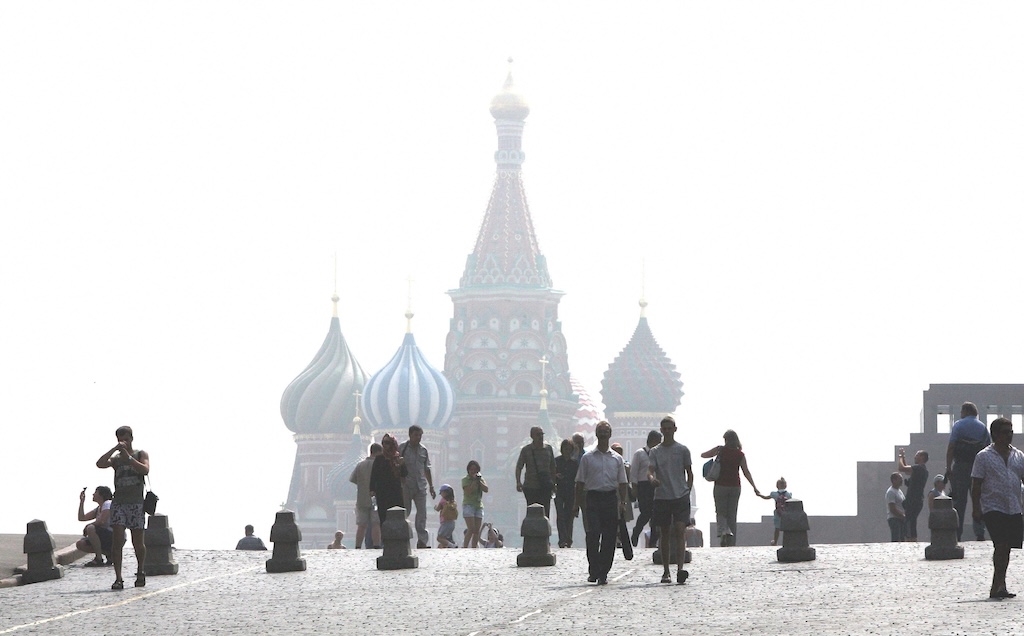
In Russia in the summer of 2010, a compound drought-heatwave event – and the associated wildfires – caused the death of nearly 55,000 people, the study notes.
The record-breaking Pacific north-west “heat dome” in 2021 triggered extreme drought conditions that caused “significant declines” in wheat yields, as well as in barley, canola and fruit production in British Columbia and Alberta, Canada, says the study.
Increasing events
To assess how CDHEs are changing, the researchers use daily reanalysis data to identify droughts and heatwaves events. (Reanalysis data combines past observations with climate models to create a historical climate record.) Then, using an algorithm, they analyse how these events overlap in both time and space.
The study covers the period from 1980 to 2023 and the world’s land surface, excluding polar regions where CDHEs are rare.
The research finds that the area of land affected by CDHEs has “increased substantially” since the early 2000s.
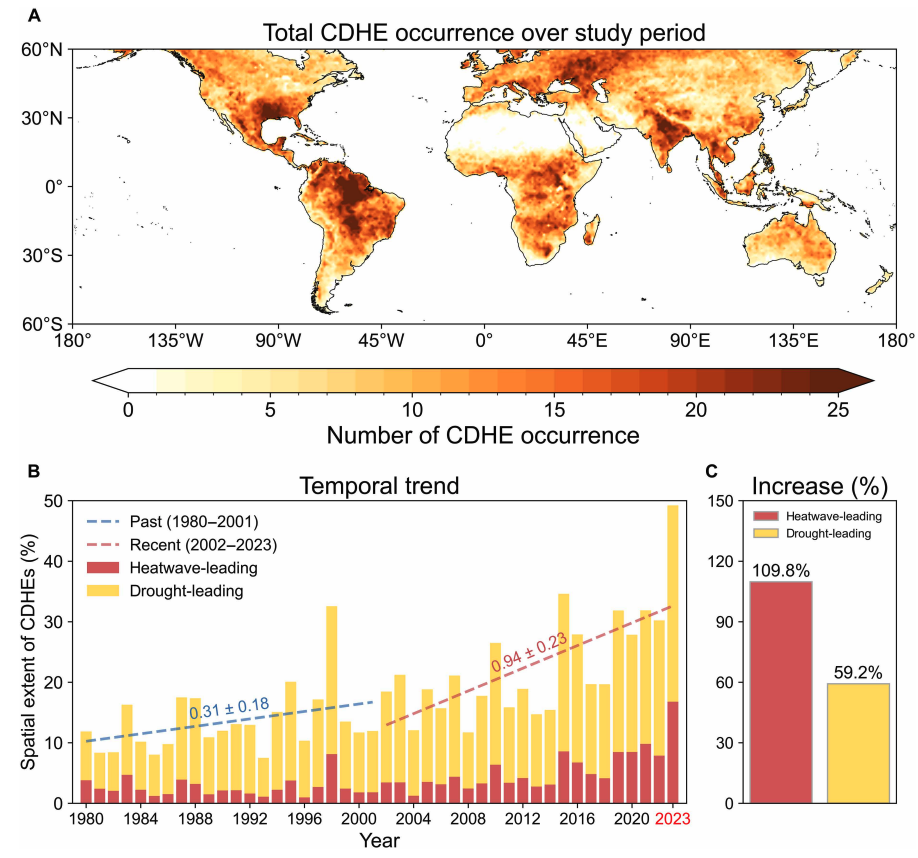
Heatwave-led events have been the main contributor to this increase, the study says, with their spatial extent rising 110% between 1980-2001 and 2002-23, compared to a 59% increase for drought-led events.
The map below shows the global distribution of CDHEs over 1980-2023. The charts show the percentage of the land surface affected by a heatwave-led CDHE (red) or a drought-led CDHE (yellow) in a given year (left) and relative increase in each CDHE type (right).
The study finds that CDHEs have occurred most frequently in northern South America, the southern US, eastern Europe, central Africa and south Asia.
Threshold passed
The authors explain that the increase in heatwave-led CDHEs is related to rising global temperatures, but that this does not tell the whole story.
In the earlier 22-year period of 1980-2001, the study finds that the spatial extent of heatwave-led CDHEs rises by 1.6% per 1C of global temperature rise. For the more-recent period of 2022-23, this increases “nearly eightfold” to 13.1%.
The change suggests that the rapid increase in the heatwave-led CDHEs occurred after the global average temperature “surpasse[d] a certain temperature threshold”, the paper says.
This threshold is an absolute global average temperature of 14.3C, the authors estimate (based on an 11-year average), which the world passed around the year 2000.
Investigating the recent surge in heatwave-leading CDHEs further, the researchers find a “regime shift” in land-atmosphere dynamics “toward a persistently intensified state after the late 1990s”.
In other words, the way that drier soils drive higher surface temperatures, and vice versa, is becoming stronger, resulting in more heatwave-led compound events.
Daily data
The research has some advantages over other previous studies, Yeh says. For instance, the new work uses daily estimations of CDHEs, compared to monthly data used in past research. This is “important for capturing the detailed occurrence” of these events, says Yeh.
He adds that another advantage of their study is that it distinguishes the sequence of droughts and heatwaves, which allows them to “better understand the differences” in the characteristics of CDHEs.
Dr Meryem Tanarhte is a climate scientist at the University Hassan II in Morocco, and Dr Ruth Cerezo Mota is a climatologist and a researcher at the National Autonomous University of Mexico. Both scientists, who were not involved in the study, agree that the daily estimations give a clearer picture of how CDHEs are changing.
Cerezo-Mota adds that another major contribution of the study is its global focus. She tells Carbon Brief that in some regions, such as Mexico and Africa, there is a lack of studies on CDHEs:
“Not because the events do not occur, but perhaps because [these regions] do not have all the data or the expertise to do so.”
However, she notes that the reanalysis data used by the study does have limitations with how it represents rainfall in some parts of the world.
Compound impacts
The study notes that if CDHEs continue to intensify – particularly events where heatwaves are the precursors – they could drive declining crop productivity, increased wildfire frequency and severe public health crises.
These impacts could be “much more rapid and severe as global warming continues”, Yeh tells Carbon Brief.
Tanarhte notes that these events can be forecasted up to 10 days ahead in many regions. Furthermore, she says, the strongest impacts can be prevented “through preparedness and adaptation”, including through “water management for agriculture, heatwave mitigation measures and wildfire mitigation”.
The study recommends reassessing current risk management strategies for these compound events. It also suggests incorporating the sequences of drought and heatwaves into compound event analysis frameworks “to enhance climate risk management”.
Cerezo-Mota says that it is clear that the world needs to be prepared for the increased occurrence of these events. She tells Carbon Brief:
“These [risk assessments and strategies] need to be carried out at the local level to understand the complexities of each region.”



The post Heatwaves driving recent ‘surge’ in compound drought and heat extremes appeared first on Carbon Brief.
Heatwaves driving recent ‘surge’ in compound drought and heat extremes
Greenhouse Gases
DeBriefed 6 March 2026: Iran energy crisis | China climate plan | Bristol’s ‘pioneering’ wind turbine
Welcome to Carbon Brief’s DeBriefed.
An essential guide to the week’s key developments relating to climate change.
This week
Energy crisis
ENERGY SPIKE: US-Israeli attacks on Iran and subsequent counterattacks across the Middle East have sent energy prices “soaring”, according to Reuters. The newswire reported that the region “accounts for just under a third of global oil production and almost a fifth of gas”. The Guardian noted that shipping traffic through the strait of Hormuz, which normally ferries 20% of the world’s oil, “all but ground to a halt”. The Financial Times reported that attacks by Iran on Middle East energy facilities – notably in Qatar – triggered the “biggest rise in gas prices since Russia’s full-scale invasion of Ukraine”.
‘RISK’ AND ‘BENEFITS’: Bloomberg reported on increases in diesel prices in Europe and the US, speculating that rising fuel costs could be “a risk for president Donald Trump”. US gas producers are “poised to benefit from the big disruption in global supply”, according to CNBC. Indian government sources told the Economic Times that Russia is prepared to “fulfil India’s energy demands”. China Daily quoted experts who said “China’s energy security remains fundamentally unshaken”, thanks to “emergency stockpiles and a wide array of import channels”.
‘ESSENTIAL’ RENEWABLES: Energy analysts said governments should cut their fossil-fuel reliance by investing in renewables, “rather than just seeking non-Gulf oil and gas suppliers”, reported Climate Home News. This message was echoed by UK business secretary Peter Kyle, who said “doubling down on renewables” was “essential” amid “regional instability”, according to the Daily Telegraph.
China’s climate plan
PEAK COAL?: China has set out its next “five-year plan” at the annual “two sessions” meeting of the National People’s Congress, including its climate strategy out to 2030, according to the Hong Kong-based South China Morning Post. The plan called for China to cut its carbon emissions per unit of gross domestic product (GDP) by 17% from 2026 to 2030, which “may allow for continued increase in emissions given the rate of GDP growth”, reported Reuters. The newswire added that the plan also had targets to reach peak coal in the next five years and replace 30m tonnes per year of coal with renewables.
ACTIVE YET PRUDENT: Bloomberg described the new plan as “cautious”, stating that it “frustrat[es] hopes for tighter policy that would drive the nation to peak carbon emissions well before president Xi Jinping’s 2030 deadline”. Carbon Brief has just published an in-depth analysis of the plan. China Daily reported that the strategy “highlights measures to promote the climate targets of peaking carbon dioxide emissions before 2030”, which China said it would work towards “actively yet prudently”.