

Welcome to Carbon Brief’s DeBriefed.
An essential guide to the week’s key developments relating to climate change.
This week
Donald Trump elected as US president
TRUMP ELECTED: Republican Donald Trump claimed victory and a “powerful mandate” in the US election this week, reported the Financial Times. According to Agence France-Presse, the result could “slam the brakes on the transition to green energy” and jeopardise international efforts to tackle climate change.
‘MAJOR SETBACK’: BBC News reported that Trump’s election was a “major setback for climate action” according to experts. Similarly, Politico stated that “any slowdown from the world’s second-largest emitter – itself a major driver of the global shift to clean energy – is bound to throw a wrench into global climate efforts”. Carbon Brief analysis published in March – which has been widely cited in global media this week – found that a Trump victory could lead to an additional 4bn tonnes of US emissions by 2030, compared with incumbent Joe Biden’s plans.
HINDERING COP: The election result is “set to cast a pall over the UN COP29 summit next week”, reported the Financial Times. The Trump campaign said the president has pledged to withdraw the US from the 2015 Paris Agreement, as he did during his first term, the article continued. It noted that nations are meant to agree to a new climate finance goal at COP29 and the US is “viewed as crucial to that”. (Carbon Brief is hosting a free webinar today at 15:30 GMT to discuss the implications of Trump’s victory.)
COP16 ends in disarray
UNRESOLVED: The two-week COP16 biodiversity summit in Cali, Columbia ended “in disarray” on Saturday, reported the Guardian, with “some breakthroughs but key issues left unresolved”. It concluded “in confusion” after the talks ran over by almost 12 hours on Friday, with governments still failing to reach a consensus on issues, such as nature funding and how targets over the next decade will be monitored, the article added.
CALI FUND: Climate Home News said “some progress had been made” at COP16, including the establishment of a new “Cali Fund”. It continued: “They also created a new permanent body for Indigenous people, granting them formal power to influence decisions made under the UN biodiversity convention. But no common ground was found on the most pressing issue facing governments: how to close the gap in biodiversity finance.”
BIODIVERSITY PLANS: Carbon Brief’s team of specialist journalists at the summit published a 13,000-word summary explaining all the key outcomes of COP16. The article highlighted that, by the summit’s end, just 44 out of 196 parties involved – 22% – had come up with new biodiversity plans. Additionally, the CB team held two webinars – one in English and one in Spanish – discussing the summit’s outcomes.
Around the world
- SKIPPING COP: Leaders from key countries including the EU’s Ursula von der Leyen, the US’s Joe Biden, France’s Emmanuel Macron, Canada’s Justin Trudeau, South Africa’s Cyril Ramaphosa, Brazil’s Luiz Inácio Lula da Silva and Australia’s Anthony Albanese are going to skip the COP29 climate summit in Baku, Azerbaijan, Politico reported. India’s Narendra Modi and China’s Xi Jinping also are not expected to attend, a recent New York Times article noted. Germany’s Olaf Scholz has also said he will not go. (See below.)
- RED ALERT: RTÉ reported that Spanish prime minister Pedro Sanchez announced a €10.6bn plan to help flooding victims, while the Times reported that Barcelona was placed on red alert, as the country’s deadly flooding continued. Elsewhere, “unprecedented” floods in eastern Senegal have displaced more than 56,000 people and devastated harvests, reported Le Monde.
- CARBON BORDER TAXES: China, on behalf of the BASIC country group, requested that countries at COP29 discuss carbon border taxes and other “unilateral restrictive trade measures” it says are harmful to developing countries, according to Reuters.
- CANADA CAP: The Canadian government issued draft regulations on greenhouse gas emissions from the oil and gas sector, which would cap emissions at 35% below 2019 levels by 2030, Reuters reported.
- GERMAN COALITION CRUMBLES: Germany’s coalition government under Olaf Scholz was on the verge of collapse, leaving a “host of unfinished policy proposals that risk grinding to a halt”, including those relating to climate and energy, according to Clean Energy Wire.
- WARMEST YEAR: BBC News reported that 2024 is now “virtually certain” to be the world’s warmest year of record, according to projections by the European Copernicus Climate Change Service. See Carbon Brief’s detailed analysis of the latest data.
$1.2 billion
The amount investors are estimated to have made from running bets against – “shorting” – renewable-energy stocks in the wake of Trump’s election, according to the Financial Times.
Latest climate research
- The climate conditions that drove extreme wildfires in the southwest of France in June 2022 were made twice as likely by human-caused climate change, according to a study in npj Climate and Atmospheric Science.
- A paper in Nature Geoscience found that weaker Atlantic meridional overturning circulation (AMOC) could “exert a systemic impact on the Amazon”.
- New research published in npj Climate and Atmospheric Science explored how “ecological fear” shapes attitudes to climate change across the US political spectrum.
(For more, see Carbon Brief’s in-depth daily summaries of the top climate news stories on Monday, Tuesday, Wednesday, Thursday and Friday.)
Captured

Great Britain’s National Energy System Operator (NESO) found that England, Wales and Scotland, collectively, will need to double onshore wind capacity, triple offshore wind and solar and increase battery storage and flexibility capacity fivefold to achieve clean power in 2030. Doing so would allow the country to become a net exporter of power and cut the share of unabated gas on the system from 35% to below 5%, which NESO said would meet the government’s “clean power by 2030” target. The report concluded that clean power by 2030 is a “huge challenge, but is achievable”.
Spotlight
The origin story of the $100bn climate-finance goal
Michael Jacobs, professor of political economy at the University of Sheffield and visiting senior fellow at ODI Global, plus a former special adviser to UK prime minister Gordon Brown, explains the origins of the $100bn climate finance goal ahead of COP29.

This year’s UN climate conference, COP29 in Baku, Azerbaijan, will be dominated by negotiations over the “new collective quantified goal” (NCQG), the finance target for the funds that will be channelled to developing nations over the next decade to help them tackle climate change.
The NCQG is often described as the successor to the $100bn-per-year climate-finance goal agreed at COP21 in 2015, alongside the Paris Agreement. In the sense that that goal formally runs out in 2025, and the NCQG will come into force in 2025, this is a fair description. But the $100bn came about through a very different process.
In fact, the NCQG represents the first time in the history of UN climate negotiations that countries have tried to negotiate a quantitative finance goal.
Where did the $100bn goal come from?
Then UK prime minister Gordon Brown first proposed the $100bn per year target in a speech in June 2009, in the run-up to COP15 in Copenhagen. At that point, developing countries were asking for climate finance of $300-400bn a year and developed ones thought they could afford $30-40bn.
Anxious that there would be no agreement, Brown asked his team to come up with a number based on estimates of climate needs in developing countries made by British economist Nick Stern and to which the UK could afford to contribute its share.
They suggested $100bn, envisaging that around half of this could come from public finance (both bilateral aid and via multilateral development banks) and half from the private sector, particularly through the Clean Development Mechanism.
Brown sought to persuade both developed and developing country leaders that $100bn by 2020 represented a feasible compromise.
EU leaders agreed on it in October 2009. In November, it was taken up by Meles Zenawi, prime minister of Ethiopia, then chair of the African group of nations. Having first resisted it, the US announced towards the end of COP15 that it too would accept it.
As a result, it was included in the Copenhagen Accord, the agreement negotiated by a group of around 30 leaders, ministers and officials, which was “taken note of”, but not formally adopted at the final COP15 plenary session.
At Zenawi’s insistence, the agreement also included a “fast-start” commitment to $30bn in the period 2010-12.
Almost all of the Copenhagen Accord, including the $100bn goal, was formally adopted at COP16 in Cancun the following year. The text (paragraphs 98-99) “recognises” the commitment made by developed countries to “mobilising jointly” $100bn per year by 2020 “in the context of meaningful mitigation actions and transparency on implementation”, plus agrees that this “may come from a wide variety of sources, public and private, bilateral and multilateral, including alternative sources”.
It remained a collective commitment made by the 23 “developed” countries, with no further specification on how the sum should be distributed between donors or between public or private sources, on what it should be spent, or to whom it should go.
Though agreed under the UNFCCC, at no point in any of these processes was the number subject to formal negotiation.
The ‘dog that didn’t bark’
In the run-up to the Paris COP in 2015, there were attempts by some developing countries to reopen the $100bn number. But, because the Paris Agreement was expected at that time only to take effect from 2020 – and the $100bn goal was for that year – these attempts did not get very far.
In practice, the $100bn in Paris was the “dog that didn’t bark”. Though the Organisation for Economic Co-operation and Development (OECD) methodology being used by developed countries was widely contested, the Paris text maintained both the $100bn figure and the language of “mobilisation” (meaning that private finance is included if it has come about through the leverage of developed country public finance).
The only effective negotiated outcome in Paris was to extend the $100bn as the annual goal from 2020 to 2025 and to set this as the floor for the NCQG from 2025 onwards.
The adoption of the $100bn might be thought of as a strange way to agree such an important figure. Negotiating the NCQG formally is certainly proving much harder.
Watch, read, listen
CLIMATE HISTORY: Interdisciplinary project Monsoon Voyages melded history with climate science in an effort to enhance our understanding of long-term climate changes and their impacts.
ATTENBOROUGH’S ASIA: In a new seven-part series on BBC, Sir David Attenborough explored the “wildlife and natural wonders of our planet’s largest continent”.
CLIMATE OPTIMISTS: A new podcast called Solving for Climate has data scientist Hannah Richie and “sustainability nerd” Rob Stewart unpacking potential climate solutions.
Coming up
- 11-22 November: UN Climate Change Conference COP29, Baku, Azerbaijan
- 14 November: IEA Oil Market report 2024
- 18-19 November: G20 Heads of State summit, Rio de Janeiro, Brazil
Pick of the jobs
- University of Arts London, research development and design assistant: climate justice | Salary: £33,661-40,377. Location: Hybrid (UAL High Holborn, London/Home).
- Premier League, sustainability manager | Salary: Unknown. Location: London, UK.
- Norfolk Wildlife Trust, director of nature recovery | Salary: £65,000. Location: Norwich, UK.
- Alexander von Humboldt Foundation, international climate protection fellowship. Salary: Unknown. Location: Germany.
- Energy Foundation China, program officer, low-carbon cities. Salary: Unknown. Location: Beijing, China.
DeBriefed is edited by Daisy Dunne. Please send any tips or feedback to debriefed@carbonbrief.org.
This is an online version of Carbon Brief’s weekly DeBriefed email newsletter. Subscribe for free here.


The post DeBriefed 8 November 2024: Trump wins; COP16 ‘disarray’; Origin story of ‘$100bn’ climate-finance goal appeared first on Carbon Brief.

Drought and heatwaves occurring together – known as “compound” events – have “surged” across the world since the early 2000s, a new study shows.
Compound drought and heat events (CDHEs) can have devastating effects, creating the ideal conditions for intense wildfires, such as Australia’s “Black Summer” of 2019-20 where bushfires burned 24m hectares and killed 33 people.
The research, published in Science Advances, finds that the increase in CDHEs is predominantly being driven by events that start with a heatwave.
The global area affected by such “heatwave-led” compound events has more than doubled between 1980-2001 and 2002-23, the study says.
The rapid increase in these events over the last 23 years cannot be explained solely by global warming, the authors note.
Since the late 1990s, feedbacks between the land and the atmosphere have become stronger, making heatwaves more likely to trigger drought conditions, they explain.
One of the study authors tells Carbon Brief that societies must pay greater attention to compound events, which can “cause severe impacts on ecosystems, agriculture and society”.
Compound events
CDHEs are extreme weather events where drought and heatwave conditions occur simultaneously – or shortly after each other – in the same region.
These events are often triggered by large-scale weather patterns, such as “blocking” highs, which can produce “prolonged” hot and dry conditions, according to the study.
Prof Sang-Wook Yeh is one of the study authors and a professor at the Ewha Womans University in South Korea. He tells Carbon Brief:
“When heatwaves and droughts occur together, the two hazards reinforce each other through land-atmosphere interactions. This amplifies surface heating and soil moisture deficits, making compound events more intense and damaging than single hazards.”
CDHEs can begin with either a heatwave or a drought.
The sequence of these extremes is important, the study says, as they have different drivers and impacts.
For example, in a CDHE where the heatwave was the precursor, increased direct sunshine causes more moisture loss from soils and plants, leading to a drought.
Conversely, in an event where the drought was the precursor, the lack of soil moisture means that less of the sun’s energy goes into evaporation and more goes into warming the Earth’s surface. This produces favourable conditions for heatwaves.
The study shows that the majority of CDHEs globally start out as a drought.
In recent years, there has been increasing focus on these events due to the devastating impact they have on agriculture, ecosystems and public health.
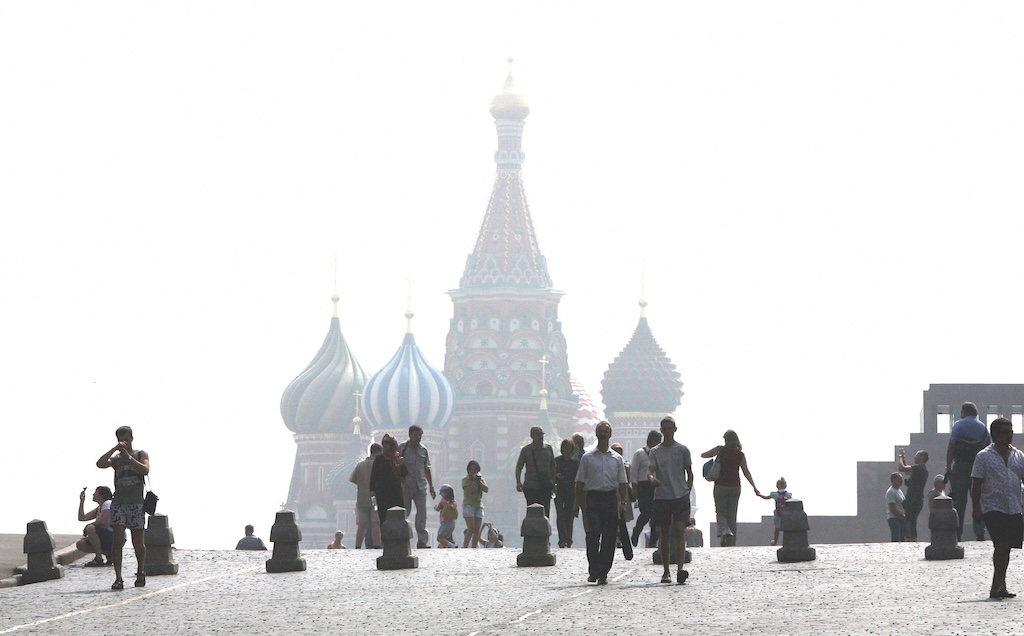
In Russia in the summer of 2010, a compound drought-heatwave event – and the associated wildfires – caused the death of nearly 55,000 people, the study notes.
The record-breaking Pacific north-west “heat dome” in 2021 triggered extreme drought conditions that caused “significant declines” in wheat yields, as well as in barley, canola and fruit production in British Columbia and Alberta, Canada, says the study.
Increasing events
To assess how CDHEs are changing, the researchers use daily reanalysis data to identify droughts and heatwaves events. (Reanalysis data combines past observations with climate models to create a historical climate record.) Then, using an algorithm, they analyse how these events overlap in both time and space.
The study covers the period from 1980 to 2023 and the world’s land surface, excluding polar regions where CDHEs are rare.
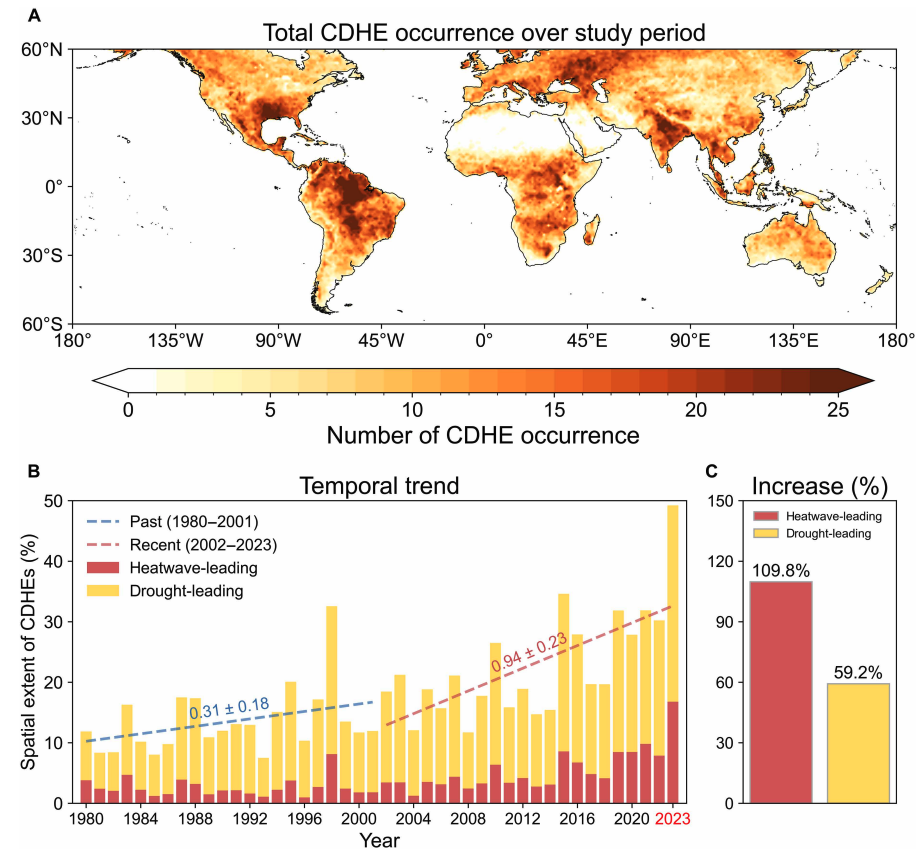
The research finds that the area of land affected by CDHEs has “increased substantially” since the early 2000s.
Heatwave-led events have been the main contributor to this increase, the study says, with their spatial extent rising 110% between 1980-2001 and 2002-23, compared to a 59% increase for drought-led events.
The map below shows the global distribution of CDHEs over 1980-2023. The charts show the percentage of the land surface affected by a heatwave-led CDHE (red) or a drought-led CDHE (yellow) in a given year (left) and relative increase in each CDHE type (right).
The study finds that CDHEs have occurred most frequently in northern South America, the southern US, eastern Europe, central Africa and south Asia.
Threshold passed
The authors explain that the increase in heatwave-led CDHEs is related to rising global temperatures, but that this does not tell the whole story.
In the earlier 22-year period of 1980-2001, the study finds that the spatial extent of heatwave-led CDHEs rises by 1.6% per 1C of global temperature rise. For the more-recent period of 2022-23, this increases “nearly eightfold” to 13.1%.
The change suggests that the rapid increase in the heatwave-led CDHEs occurred after the global average temperature “surpasse[d] a certain temperature threshold”, the paper says.
This threshold is an absolute global average temperature of 14.3C, the authors estimate (based on an 11-year average), which the world passed around the year 2000.
Investigating the recent surge in heatwave-leading CDHEs further, the researchers find a “regime shift” in land-atmosphere dynamics “toward a persistently intensified state after the late 1990s”.
In other words, the way that drier soils drive higher surface temperatures, and vice versa, is becoming stronger, resulting in more heatwave-led compound events.
Daily data
The research has some advantages over other previous studies, Yeh says. For instance, the new work uses daily estimations of CDHEs, compared to monthly data used in past research. This is “important for capturing the detailed occurrence” of these events, says Yeh.
He adds that another advantage of their study is that it distinguishes the sequence of droughts and heatwaves, which allows them to “better understand the differences” in the characteristics of CDHEs.
Dr Meryem Tanarhte is a climate scientist at the University Hassan II in Morocco, and Dr Ruth Cerezo Mota is a climatologist and a researcher at the National Autonomous University of Mexico. Both scientists, who were not involved in the study, agree that the daily estimations give a clearer picture of how CDHEs are changing.
Cerezo-Mota adds that another major contribution of the study is its global focus. She tells Carbon Brief that in some regions, such as Mexico and Africa, there is a lack of studies on CDHEs:
“Not because the events do not occur, but perhaps because [these regions] do not have all the data or the expertise to do so.”
However, she notes that the reanalysis data used by the study does have limitations with how it represents rainfall in some parts of the world.
Compound impacts
The study notes that if CDHEs continue to intensify – particularly events where heatwaves are the precursors – they could drive declining crop productivity, increased wildfire frequency and severe public health crises.
These impacts could be “much more rapid and severe as global warming continues”, Yeh tells Carbon Brief.
Tanarhte notes that these events can be forecasted up to 10 days ahead in many regions. Furthermore, she says, the strongest impacts can be prevented “through preparedness and adaptation”, including through “water management for agriculture, heatwave mitigation measures and wildfire mitigation”.
The study recommends reassessing current risk management strategies for these compound events. It also suggests incorporating the sequences of drought and heatwaves into compound event analysis frameworks “to enhance climate risk management”.
Cerezo-Mota says that it is clear that the world needs to be prepared for the increased occurrence of these events. She tells Carbon Brief:
“These [risk assessments and strategies] need to be carried out at the local level to understand the complexities of each region.”



The post Heatwaves driving recent ‘surge’ in compound drought and heat extremes appeared first on Carbon Brief.
Heatwaves driving recent ‘surge’ in compound drought and heat extremes
Greenhouse Gases
DeBriefed 6 March 2026: Iran energy crisis | China climate plan | Bristol’s ‘pioneering’ wind turbine
Welcome to Carbon Brief’s DeBriefed.
An essential guide to the week’s key developments relating to climate change.
This week
Energy crisis
ENERGY SPIKE: US-Israeli attacks on Iran and subsequent counterattacks across the Middle East have sent energy prices “soaring”, according to Reuters. The newswire reported that the region “accounts for just under a third of global oil production and almost a fifth of gas”. The