

Welcome to Carbon Brief’s DeBriefed.
An essential guide to the week’s key developments relating to climate change.
This is an online version of Carbon Brief’s weekly DeBriefed email newsletter. Subscribe for free here.
This week
Offshore wind off track
EMPIRE WIND 2: Energy majors BP and Equinor have terminated their power agreement with the state of New York to build a 1.26 gigawatt offshore wind farm, according to Bloomberg. The deal for the 147 turbine wind farm, 15 miles south of New York’s Long Island was signed in 2022, for a strike price of $107.50 per megawatt-hour, the Financial Times noted.
WIND WOES: BP and Equinor pointed to the “unforeseeable economic forces” – including inflation stemming from the war in Ukraine and Covid-19, supply chain bottlenecks and interest rate increases, along with permitting delays – which affected the “financial attractiveness” of the project, the FT added. Offshore wind developers have cancelled contracts to sell power in Massachusetts, Connecticut and New Jersey, as well as threatening to cancel agreements in other states, as project costs rise, Reuters reported.
VINEYARD WIND: Meanwhile, the first turbine in the Vineyard offshore wind development began generating power this week, delivering around 5 megawatts of power to the New England grid, the Guardian reported. Vineyard Wind is the first US large-scale offshore wind project, and is expected to have 62 turbines in total when complete.
UK’s second-warmest year
SECOND WARMEST: Data from the Met Office shows that 2023 was the UK’s second-warmest year of record, and the warmest year on record for Wales and Northern Ireland, BBC News reported. The average absolute temperature for last year was 9.97C, only slightly lower than the 10.02C recorded in 2022 – the warmest year on record for the UK – according to the Guardian.
TOP 10: The UK’s 10 warmest years have all occurred since 2003, the Guardian noted, with Met Office scientists emphasising that “such a warm year would have occurred only once in 500 years without human-caused global heating”. The news comes as heavy flooding driven by Storm Henk has hit the UK, with more than 550 flood warnings and alerts in place in England and Wales and hundreds of homes flooded, the Guardian reported.
REPEAT RECORDS: While 2023 is expected to be announced as the warmest on record in the coming weeks, the contributing factors that made it so warm will likely “push the dial even further in 2024”, New Scientist reported. The El Niño climate pattern in the Pacific Ocean is expected to reach its full strength – on top of warming driven by greenhouse gases – next year, it noted.
Around the world
- GERMAN EMISSIONS: Germany’s carbon dioxide emissions fell to their lowest level since the 1950s in 2023, due to less coal-fired power and a reduced output by energy-intensive industries, reported Reuters, but the decline is “unsustainable without climate policy changes”.
- OVERTAKING TESLA: Chinese firm BYD has knocked Elon Musk’s company “off the top spot” to become the world’s best-selling electric vehicle manufacturer for the first time, according to the Financial Times.
- COP29 PRESIDENT: Azerbaijan has appointed environmental minister Mukhtar Babayez as president of the COP29 climate talks, reported Climate Home News. Babayez is the former head of the country’s state-owned oil and gas company Socar.
- LOW-CARBON HYDROGEN: The US government has unveiled a new framework to support the production of low-carbon hydrogen, offering tax credits based on the life-cycle greenhouse gas emissions from the power source used in hydrogen production, according to Reuters.
- ‘POSTCODE LOTTERY’: Analysis of the 20 costliest climate disasters of 2023 has shown that “countries less able to rebuild or who have contributed least to climate crisis suffer worst”, reported the Guardian.
- PIPELINE PRACTICES: French energy giant TotalEnergies has launched a review of its land acquisition practices for the controversial $10bn East African crude oil pipeline in Uganda and Tanzania, Agence France-Presse reported.
324tn yuan
China will need to spend around 324tn yuan ($45.5tn), roughly 2.7 times its GDP in 2022, to realise its climate targets of peaking CO2 emissions before 2030 and going carbon neutral before 2060, reported China Daily.
Latest climate research
- Diversifying agricultural production in sub-Saharan Africa towards more micronutrient-rich foods is “necessary” to provide an adequate nutrient supply under increasing climate risks and population growth, according to a new study published in Nature Food.
- Using a large-scale experiment on Facebook, a new paper in Climatic Change found “little to no support” for the fear that attention on solar radiation management or carbon dioxide removal “might crowd out the desire to cut emissions”.
- The genes of an Antarctic octopus provide “empirical evidence” that the West Antarctic ice sheet previously “collapsed when the global mean temperature was similar to that of today”, warned a new study in Science, suggesting “the tipping point of future WAIS collapse is close”.
(For more, see Carbon Brief’s in-depth daily summaries of the top climate news stories on Tuesday, Wednesday, Thursday and Friday.)
Captured

Last year, the UK’s electricity from fossil fuels dropped to its lowest level since 1957, new analysis from Carbon Brief reveals. The amount of electricity from fossil fuels fell 22% year-on-year in 2023, to 104 terawatt hours (TWh), its lowest level in 66 years. Back then, Harold Macmillan was the UK prime minister and the Beatles’ John Lennon and Paul McCartney had just met for the first time. The chart above shows the fall of fossil fuels in the electricity mix, to meet just 33% of electricity needs in 2023, while renewable energy generation continues to surge.
Spotlight
Carbon Brief’s top five articles of 2023
Carbon Brief takes a look at its top five most-read stories published in 2023.
Factcheck: 21 misleading myths about electric vehicles
Carbon Brief’s most-read new article of 2023 was a factcheck by deputy editor Dr Simon Evans of 21 of the most common misleading myths about electric vehicles (EVs). The article explored claims often seen in the press, such as EVs having to travel more than 50,000 miles for their emissions to break even with a conventional car, EVs having little or no CO2 advantage over a car someone already drives, and sales of EVs appearing to be slowing.
As Evans explained, the sales of EVs have continued to surge in the UK and globally, as the vehicles become cheaper, charging infrastructure more widespread and bans on combustion engines loom closer. Despite this growth, EVs are still subject to “relentless hostile reporting across mainstream media in many major economies, including the UK”, Evans noted.
COP28: Key outcomes agreed at the UN climate talks in Dubai
At COP28 in Dubai, nearly every country in the world agreed to “transition away from fossil fuels” within the global stocktake – the first time fossil fuels have been explicitly mentioned in the 28 years of international climate negotiations.
Ten of Carbon Brief’s journalists attended the two-week event and pulled together this mammoth summary – covering everything from the significant loss-and-damage fund on the first day to the gritty negotiations around Article 6 and a just transition.
Analysis: Which countries have sent the most delegates to COP28?
More than 97,000 badges were issued for COP28 in Dubai, almost twice the number of participants that travelled to Sharm El Sheikh in Egypt in 2022. In Carbon Brief’s third most-read article of 2023, senior science editor Robert McSweeney detailed who registered for COP28, including 24,488 delegates representing parties, 14,338 observers from NGOs and 3,972 media delegates.
Analysis: China’s emissions set to fall in 2024 after record growth in clean energy
China’s carbon dioxide emissions are set to fall in 2024, according to analysis for Carbon Brief by Lauri Myllyvirta, lead analyst and co-founder of the Centre for Research on Energy and Clean Air (CREA). Myllyvirta explained how China’s emissions “could now be facing structural decline due to record growth in the installation of new low-carbon energy sources”. This came despite CO2 emissions rising 4.7% year-on-year in the third quarter of 2023 as they continued to rebound following China’s “zero-Covid” period.
Analysis: How low-sulphur shipping rules are affecting global warming
Rounding out the list of Carbon Brief’s top five most-read articles of 2023, is an analysis of how new international rules to reduce air pollution from shipping could affect the climate. The article – by Dr Zeke Hausfather, climate science contributor for Carbon Brief, and Prof Piers Forster, professor of climate physics at the University of Leeds – found that the new regulations, imposed in 2020, will likely add 0.05C to global temperatures by 2050.
Watch, read, listen
DOCUMENTING DROUGHT: A Guardian article explored the images Maasai photographers Claire Metito and Irene Naneu have been using to chronicle the everyday experiences of two elderly women in Esiteti in southern Kenya, where a prolonged drought has made life more challenging for women in pastoralist communities.
WITNESSING A WARMING WORLD: BBC’s Future Planet’s team of climate reporters have written from across five continents to share their thoughts on what they have witnessed as the world warmed in 2023.
PRESCIENT POSTERS: An article in the New York Times explored some of the most arresting images on display at a new exhibition at Poster House in Manhattan that highlights the differing approaches – “bright, witty, sombre, blunt, even sexy” – the environmental movement has taken in an effort to “save the world”.
Coming up
- 4-5 January: Goldman Sachs Energy, CleanTech and Utilities Conference 2024, Miami, Florida
- 10 January: Winter school on “Dealing Professionally with Climate Change Issues”, online event
- 17 January: Climate change adaptation: evaluating Scottish Marine Protected Area resilience, webinar
Pick of the jobs
- Grantham Research Institute on Climate Change and the Environment, research officer | Salary: £40,229-£48,456. Location: London, UK
- European Geosciences Union, media and communications officer | Salary: €53,000-€58,000. Location: Munich, Germany
- Rewilding Britain, chair and trustees | Salary: unknown. Location: UK
- ODI, communications collaborators | Salary: unknown. Location: unknown
DeBriefed is edited by Daisy Dunne. Please send any tips or feedback to debriefed@carbonbrief.org


The post DeBriefed 5 January 2024: US offshore wind; UK’s second warmest year; Carbon Brief’s top articles of 2023 appeared first on Carbon Brief.

Drought and heatwaves occurring together – known as “compound” events – have “surged” across the world since the early 2000s, a new study shows.
Compound drought and heat events (CDHEs) can have devastating effects, creating the ideal conditions for intense wildfires, such as Australia’s “Black Summer” of 2019-20 where bushfires burned 24m hectares and killed 33 people.
The research, published in Science Advances, finds that the increase in CDHEs is predominantly being driven by events that start with a heatwave.
The global area affected by such “heatwave-led” compound events has more than doubled between 1980-2001 and 2002-23, the study says.
The rapid increase in these events over the last 23 years cannot be explained solely by global warming, the authors note.
Since the late 1990s, feedbacks between the land and the atmosphere have become stronger, making heatwaves more likely to trigger drought conditions, they explain.
One of the study authors tells Carbon Brief that societies must pay greater attention to compound events, which can “cause severe impacts on ecosystems, agriculture and society”.
Compound events
CDHEs are extreme weather events where drought and heatwave conditions occur simultaneously – or shortly after each other – in the same region.
These events are often triggered by large-scale weather patterns, such as “blocking” highs, which can produce “prolonged” hot and dry conditions, according to the study.
Prof Sang-Wook Yeh is one of the study authors and a professor at the Ewha Womans University in South Korea. He tells Carbon Brief:
“When heatwaves and droughts occur together, the two hazards reinforce each other through land-atmosphere interactions. This amplifies surface heating and soil moisture deficits, making compound events more intense and damaging than single hazards.”
CDHEs can begin with either a heatwave or a drought.
The sequence of these extremes is important, the study says, as they have different drivers and impacts.
For example, in a CDHE where the heatwave was the precursor, increased direct sunshine causes more moisture loss from soils and plants, leading to a drought.
Conversely, in an event where the drought was the precursor, the lack of soil moisture means that less of the sun’s energy goes into evaporation and more goes into warming the Earth’s surface. This produces favourable conditions for heatwaves.
The study shows that the majority of CDHEs globally start out as a drought.
In recent years, there has been increasing focus on these events due to the devastating impact they have on agriculture, ecosystems and public health.
In Russia in the summer of 2010, a compound drought-heatwave event – and the associated wildfires – caused the death of nearly 55,000 people, the study notes.

The record-breaking Pacific north-west “heat dome” in 2021 triggered extreme drought conditions that caused “significant declines” in wheat yields, as well as in barley, canola and fruit production in British Columbia and Alberta, Canada, says the study.
Increasing events
To assess how CDHEs are changing, the researchers use daily reanalysis data to identify droughts and heatwaves events. (Reanalysis data combines past observations with climate models to create a historical climate record.) Then, using an algorithm, they analyse how these events overlap in both time and space.
The study covers the period from 1980 to 2023 and the world’s land surface, excluding polar regions where CDHEs are rare.
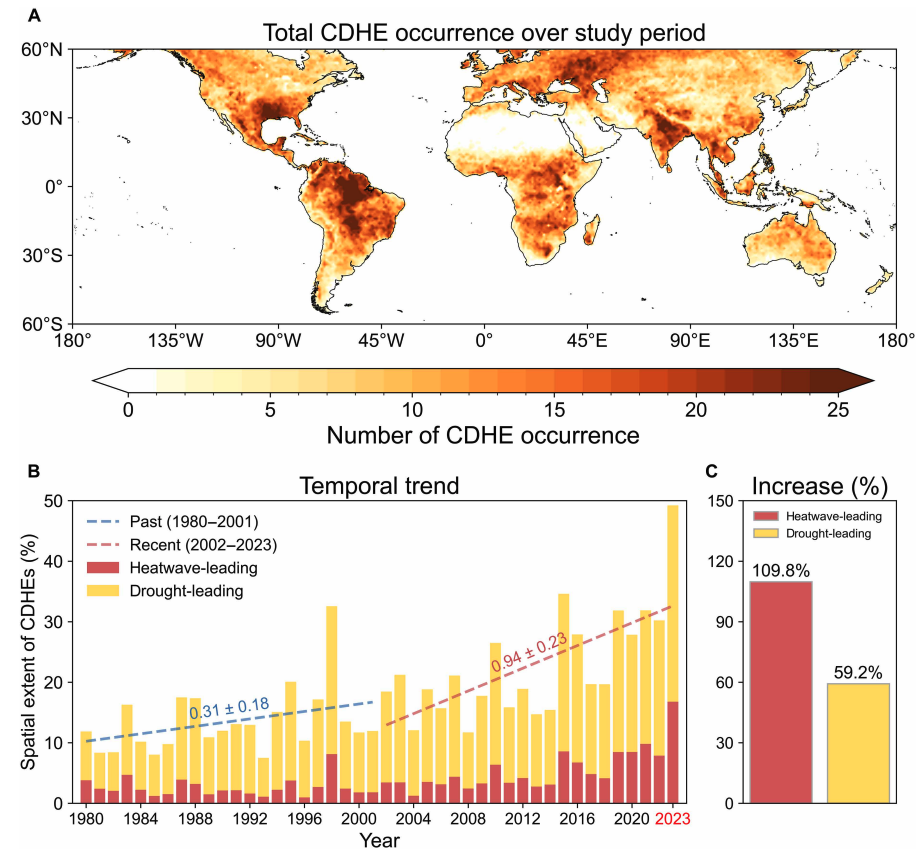
The research finds that the area of land affected by CDHEs has “increased substantially” since the early 2000s.
Heatwave-led events have been the main contributor to this increase, the study says, with their spatial extent rising 110% between 1980-2001 and 2002-23, compared to a 59% increase for drought-led events.
The map below shows the global distribution of CDHEs over 1980-2023. The charts show the percentage of the land surface affected by a heatwave-led CDHE (red) or a drought-led CDHE (yellow) in a given year (left) and relative increase in each CDHE type (right).
The study finds that CDHEs have occurred most frequently in northern South America, the southern US, eastern Europe, central Africa and south Asia.
Threshold passed
The authors explain that the increase in heatwave-led CDHEs is related to rising global temperatures, but that this does not tell the whole story.
In the earlier 22-year period of 1980-2001, the study finds that the spatial extent of heatwave-led CDHEs rises by 1.6% per 1C of global temperature rise. For the more-recent period of 2022-23, this increases “nearly eightfold” to 13.1%.
The change suggests that the rapid increase in the heatwave-led CDHEs occurred after the global average temperature “surpasse[d] a certain temperature threshold”, the paper says.
This threshold is an absolute global average temperature of 14.3C, the authors estimate (based on an 11-year average), which the world passed around the year 2000.
Investigating the recent surge in heatwave-leading CDHEs further, the researchers find a “regime shift” in land-atmosphere dynamics “toward a persistently intensified state after the late 1990s”.
In other words, the way that drier soils drive higher surface temperatures, and vice versa, is becoming stronger, resulting in more heatwave-led compound events.
Daily data
The research has some advantages over other previous studies, Yeh says. For instance, the new work uses daily estimations of CDHEs, compared to monthly data used in past research. This is “important for capturing the detailed occurrence” of these events, says Yeh.
He adds that another advantage of their study is that it distinguishes the sequence of droughts and heatwaves, which allows them to “better understand the differences” in the characteristics of CDHEs.
Dr Meryem Tanarhte is a climate scientist at the University Hassan II in Morocco, and Dr Ruth Cerezo Mota is a climatologist and a researcher at the National Autonomous University of Mexico. Both scientists, who were not involved in the study, agree that the daily estimations give a clearer picture of how CDHEs are changing.
Cerezo-Mota adds that another major contribution of the study is its global focus. She tells Carbon Brief that in some regions, such as Mexico and Africa, there is a lack of studies on CDHEs:
“Not because the events do not occur, but perhaps because [these regions] do not have all the data or the expertise to do so.”
However, she notes that the reanalysis data used by the study does have limitations with how it represents rainfall in some parts of the world.
Compound impacts
The study notes that if CDHEs continue to intensify – particularly events where heatwaves are the precursors – they could drive declining crop productivity, increased wildfire frequency and severe public health crises.
These impacts could be “much more rapid and severe as global warming continues”, Yeh tells Carbon Brief.
Tanarhte notes that these events can be forecasted up to 10 days ahead in many regions. Furthermore, she says, the strongest impacts can be prevented “through preparedness and adaptation”, including through “water management for agriculture, heatwave mitigation measures and wildfire mitigation”.
The study recommends reassessing current risk management strategies for these compound events. It also suggests incorporating the sequences of drought and heatwaves into compound event analysis frameworks “to enhance climate risk management”.
Cerezo-Mota says that it is clear that the world needs to be prepared for the increased occurrence of these events. She tells Carbon Brief:
“These [risk assessments and strategies] need to be carried out at the local level to understand the complexities of each region.”




The post Heatwaves driving recent ‘surge’ in compound drought and heat extremes appeared first on Carbon Brief.
Heatwaves driving recent ‘surge’ in compound drought and heat extremes
Greenhouse Gases
DeBriefed 6 March 2026: Iran energy crisis | China climate plan | Bristol’s ‘pioneering’ wind turbine
Welcome to Carbon Brief’s DeBriefed.
An essential guide to the week’s key developments relating to climate change.
This week
Energy crisis
ENERGY SPIKE: US-Israeli attacks on Iran and subsequent counterattacks across the Middle East have sent energy prices “soaring”, according to Reuters. The newswire reported that the region “accounts for just under a third of global oil production and almost a fifth of gas”. The Guardian noted that shipping traffic through the strait of Hormuz, which normally ferries 20% of the world’s oil, “all but ground to a halt”. The Financial Times reported that attacks by Iran on Middle East energy facilities – notably in Qatar – triggered the “biggest rise in gas prices since Russia’s full-scale invasion of Ukraine”.
‘RISK’ AND ‘BENEFITS’: Bloomberg reported on increases in diesel prices in Europe and the US, speculating that rising fuel costs could be “a risk for president Donald Trump”. US gas producers are “poised to benefit from the big disruption in global supply”, according to CNBC. Indian government sources told the Economic Times that Russia is prepared to “fulfil India’s energy demands”. China Daily quoted experts who said “China’s energy security remains fundamentally unshaken”, thanks to “emergency stockpiles and a wide array of import channels”.
‘ESSENTIAL’ RENEWABLES: Energy analysts said governments should cut their fossil-fuel reliance by investing in renewables, “rather than just seeking non-Gulf oil and gas suppliers”, reported Climate Home News. This message was echoed by UK business secretary Peter Kyle, who said “doubling down on renewables” was “essential” amid “regional instability”, according to the