

Welcome to Carbon Brief’s DeBriefed.
An essential guide to the week’s key developments relating to climate change.
This week
Shifting political players
EU LEADERSHIP: Ursula von der Leyen has secured another five years as president of the European Commission following a vote yesterday in which she won the backing of 401 MEPs – 40 more than needed, reported Bloomberg. In her reelection bid, von der Leyen committed to EU climate goals including the still-pending 90% emissions reduction by 2040 target and a new Clean Industrial Deal, Euractiv reported. However, the publication noted that her comments on nature protection were limited to “positive rhetoric” only.
PARIS PM: Elsewhere in Europe, veteran climate negotiator Laurence Tubiana has been proposed as the next French prime minister, with backing from the Socialist, Green and Communist parties in the current hung parliament, reported Climate Home News. Tubiana, who is currently CEO at the European Climate Foundation [which funds Carbon Brief], was one of the “architects” of the Paris Agreement in 2015, according to Bloomberg.
VANCE’S STANCE: In the US, Donald Trump’s newly selected running mate JD Vance has come under scrutiny for his climate scepticism. The Republican vice presidential candidate is “a staunch supporter of the oil and gas industry and an opponent of renewable energy”, according to the Independent, but has reportedly only held such views in recent years, a shift that coincides with his bid for Trump support. He also has investments in “green” technologies, reported E&E News, but the New York Times emphasised his public anti-climate sentiments and his sponsorship of green legislation repeals as a senator for Ohio.
AFRICAN COAL: In South Africa, a political ecologist wrote in the Conversation that the country’s newly appointed environment minister has shown support for continuing to use coal and said his government would not be “bullied” into transitioning away from fossil fuels too quickly. It comes as Agence France-Presse reported that the country’s president Cyril Ramaphosa has “reaffirmed the coal-dependent nation’s commitment to moving towards renewable energy, but insisted that communities and workers must not lose out”.
Labour must ‘make up lost ground’
KING’S SPEECH: The UK’s new Labour government has confirmed a legislative agenda with the environment “front and centre”, reported the Guardian. The king’s speech mentioned that the government will set up the publicly owned GB Energy to “own, manage and operate clean power projects” across the UK, reported BBC News. The company is set to be capitalised with an £8.3bn investment. Meanwhile, Politico reported that Labour is set to appoint a climate envoy, a role that has been empty for more than a year.
NEW ADVICE: The Climate Change Committee (CCC), which advises the UK government on its climate policies, released its annual progress report on Thursday, urging Labour to “make up lost ground” after a lack of sufficient action under the last Conservative government. Carbon Brief covered the recommendations in detail (more on this below). Elsewhere, the Times reported that Emma Pinchbeck, chief executive of the industry group Energy UK, has been appointed “preferred candidate” for the next chief executive of the CCC.
Around the world
- ‘HELLISHLY HOT’: A heatwave across southern Europe and the Balkans has led governments to issue severe weather warnings, said France 24, with temperatures rising above 40C.
- CHINA ‘THIRD PLENUM’: A communique from China’s highly influential “third plenum” meeting called for a “coordinated approach to carbon cutting, pollution reduction, green development and economic growth”, as well as for the country to “actively respond to climate change”, according to state news agency Xinhua.
- CARIBBEAN VULNERABILITY: In the aftermath of Hurricane Beryl, which killed at least a dozen people and destroyed infrastructure across the Caribbean, the Associated Press reported that officials are demanding more funding from “financial and development institutions” to rebuild and address climate change.
- PROTEST IN PERIL: Five UK climate activists from Just Stop Oil received record-length jail sentences of up to five years for a plan to block London’s M25 motorway, reported Reuters. Meanwhile, the right to peaceful protest in Australia is also “in peril”, the Guardian reported.
- GLOBAL FLOODS: Downpours and flooding have killed hundreds in South Asia, caused “emergency alerts” in China, left more than 50 people dead in Niger and caused damage in Toronto, Canada.
$8.4bn
The amount of debt eradicated through “debt-for-nature” swaps from 1987-2023.
$7.6tn
The total amount of debt service paid by low- and middle-income countries over the same timescale, illustrating how swap schemes are “far too small to have any impact”, experts told the Carbon Brief.
Latest climate research
- European “fire weather” – conditions favourable to the ignition and spread of wildfires – will become “more severe” due to climate change, showed a new study in Environmental Research Letters.
- Optimising the conversion of organic waste into biogas for energy has considerable decarbonisation potential in China, said new research in Nature Communications, which found that their proposed system could contribute 3.77% of the emissions reduction needed for the country’s 1.5C-aligned target.
- Nature-based solutions have “consistently proven to be a cost-effective approach” to address disaster risk, reported researchers in Science of the Total Environment.
(For more, see Carbon Brief’s in-depth daily summaries of the top climate news stories on Monday, Tuesday, Wednesday, Thursday and Friday.)
Captured

UK emissions have been falling steadily for years, largely driven by the phaseout of coal and the growth of renewable power. However, only one-third of the reductions required to achieve the UK’s goal under the Paris Agreement of cutting emissions 68% by 2030 are covered by plans the CCC deems to be “credible”, according to its latest progress report. There is an even larger credibility gap for the sixth carbon budget for 2033-2037, with only a quarter of the cuts needed covered by “credible” policies. This is illustrated in the chart above, which shows the emissions cuts needed to reach net-zero (red), compared to cuts expected from policies that the CCC deems “credible”.
Spotlight
The climate impact of generative AI
Carbon Brief investigates the climate implications of the accelerating use of generative AI tools.
Google’s latest environmental report indicated that its total emissions have increased by almost 50% since 2019 and 13% year-on-year – a change it puts down to the growth of its data centres and rising emissions in its supply chain.
The report added that rolling out artificial intelligence (AI) services might make it “challenging” to cut emissions due to the “increasing energy demands from the greater intensity of AI compute”.
Since March, Google has been integrating its generative AI tool Gemini into search functions, matching the exponential uptick in day-to-day AI use through Chat-GPT, Microsoft Copilot and other such tools. (“Generative AI” is AI that is capable of generating text, images, videos or other data from scratch in response to a prompt.)
But there’s a catch: when a query is sent to a generative AI model (a process known as inference), it uses a lot more energy than a traditional search, creating an expectation that the energy demand of data centres will shoot up as a result.
Soaring energy demand
A recent study, still awaiting peer review, found that a multipurpose AI system could use up to 33 times more energy than computers running task-specific software and that generating two images with AI uses as much energy as charging a smartphone.
Dr Sasha Luccioni, AI and climate lead at AI company Hugging Face and lead author of the study, explained to Carbon Brief that multipurpose models “tend to be larger in size” and are trained for several different outputs, “which makes them more computationally-intensive”.
Training AI models before they are available for use also takes large amounts of energy. OpenAI’s GPT-3 required 1,287MWh during training, enough electricity to power 120 average US households for one year.
Direct energy consumption is not the only factor to consider. Felippa Amanta, a PhD researcher of digital services at the University of Oxford’s Environmental Change Institute, told Carbon Brief that “generative AI can have quite unpredictable indirect energy effects from how they’re being used by households”.
People are also using AI assistants for things they never needed it for before – a phenomenon Amanta explained as “induced demand”.
AI is changing our day-to-day behaviour, “from finding recipes, to writing emails, making CVs and the list goes on”, she said. It is this increase in user inference that can drive up data centre energy demands.
A report from the International Energy Agency (IEA), released today, said that the rise of AI was putting an increased focus on the energy use of data centres. (AI currently accounts for around 10% of data-centre electricity use.)
It said that electricity consumption from data centres as a whole accounted for a “limited” 1-1.3% share of global electricity demand in 2022. This could rise to between 1.5% and 3% by 2026, according to its projections. (By contrast, electric vehicles are expected to account for between less than 1.5% and 2% by 2026.)
The agency noted that expectations of future data centre energy demand growth were highly uncertain, depending on the uptake of AI services and the efficiency of the chips used to run them. (It noted that chipmaker Nvidia recently unveiled a new chip that was 25 times more energy efficient than previous models.)
As with any electricity-intensive technology, the climate impact of surging AI use will be determined by the extent to which renewables can meet the demand. In April, the Financial Times reported that fossil-fuel companies are hoping that surging energy demand from AI use will “usher in a golden era” for gas production.
Efficiency and regulation
On the flip side, AI has the potential to be a tool for climate action, chiefly by increasing energy efficiency. For example, AI could be used to improve the efficiency of power grids or daily commutes.
But as generative AI tools become integrated into our lives, there is a risk of a rebound effect, where the ease and ubiquity of AI solutions make us use services more, countering any efficiency savings, Amanta said.
Another issue facing the rapidly changing AI environment is a lack of transparency.
The climate impacts of AI models can potentially be mitigated by increasing their computational efficiency, powering data centres with clean energy, or using more task-specific models – but a lack of transparent data is slowing the development of legislation to regulate this shift, Dr Luccioni told Carbon Brief:
“The fact that we can’t get an accurate estimate of the energy usage or emissions of the many AI-enabled tools used by millions of people daily is problematic.”
Without understanding the scope of the issue, it is difficult to regulate energy intensity or add constraints on companies, she added. The IEA’s report also called for more reliable data.
Amanta pointed to examples of policies being proposed in the US and Singapore that recognise the environmental impacts of AI’s growth and aim to regulate their efficiency and sources of energy. The EU’s AI Act, which came into force in June, includes environmental considerations.
Watch, read, listen
SEA LEVEL RISE: A coastal village in Myanmar is being eroded away due to rising sea levels and residents are struggling to access fresh groundwater, reported the Mekong Eye.
CLIMATE CONFLICT: Earthrise released a video exploring the intersectionality of climate change and conflict, speaking to Sudanese climate activist, Watan Mohamed.
FACTCHECKING TWISTERS: The new tornado disaster film gets a lot of things right about climate science, said experts in Nature.
Coming up
- 15 July-2 August: Second part of the 29th Session of the International Seabed Authority Assembly and Council, Kingston, Jamaica
- 22-26 July: 27th Session of the FAO Committee on Forestry, Rome
- 25-26 July: G20 3rd Finance Ministers and Central Bank Governors meeting, Rio de Janeiro
Pick of the jobs
- International Institute for Sustainable Development (IISD), senior communications officer, India energy programme | Salary: Unknown. Location: Delhi, India (remote)
- Environment America, climate solutions associate | Salary: $32,500. Location: Pennsylvania, US
- Climate Outreach, fundraising administrator | Salary: £23,000. Location: Oxford, UK (remote)
Climate Central, vice president for science | Salary: $140,000-$160,000. Location: Princeton, New Jersey, US (remote)
DeBriefed is edited by Daisy Dunne. Please send any tips or feedback to debriefed@carbonbrief.org.
This is an online version of Carbon Brief’s weekly DeBriefed email newsletter. Subscribe for free here.

The post DeBriefed 19 July 2024: New political players in EU and US; UK govt urged to make up ‘lost ground’ on targets; AI’s climate impact appeared first on Carbon Brief.
https://www.carbonbrief.org/debriefed-19-july-2024-new-political-players-in-eu-and-us-uk-govt-urged-to-make-up-lost-ground-on-targets-ais-climate-impact/

Drought and heatwaves occurring together – known as “compound” events – have “surged” across the world since the early 2000s, a new study shows.
Compound drought and heat events (CDHEs) can have devastating effects, creating the ideal conditions for intense wildfires, such as Australia’s “Black Summer” of 2019-20 where bushfires burned 24m hectares and killed 33 people.
The research, published in Science Advances, finds that the increase in CDHEs is predominantly being driven by events that start with a heatwave.
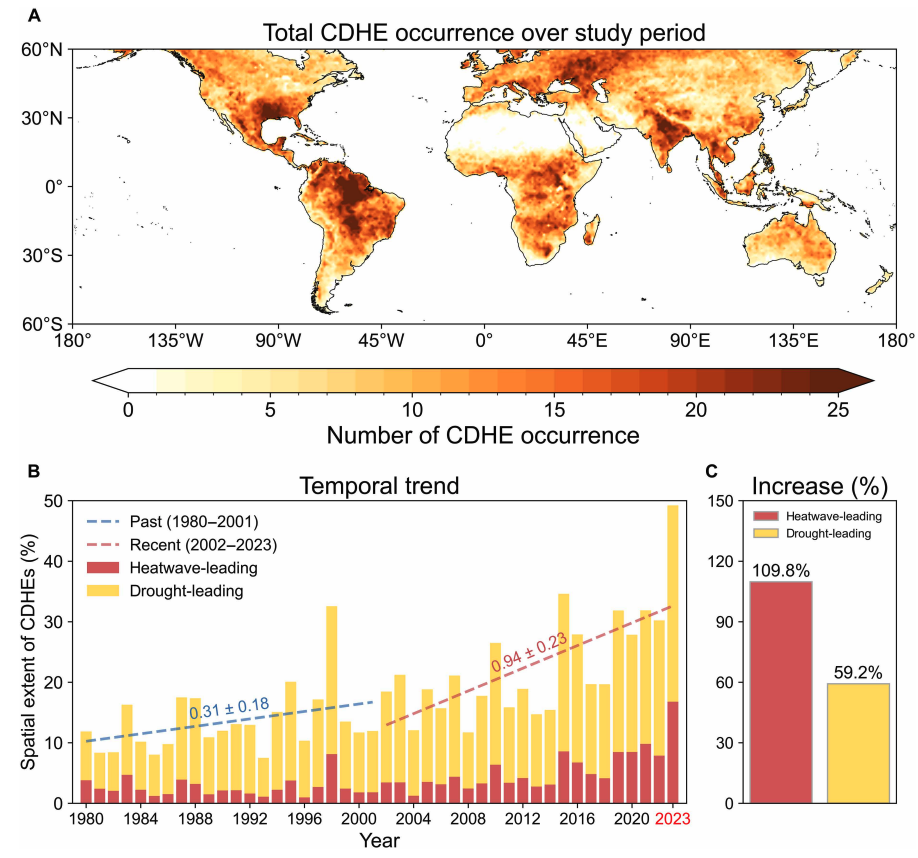
The global area affected by such “heatwave-led” compound events has more than doubled between 1980-2001 and 2002-23, the study says.
The rapid increase in these events over the last 23 years cannot be explained solely by global warming, the authors note.
Since the late 1990s, feedbacks between the land and the atmosphere have become stronger, making heatwaves more likely to trigger drought conditions, they explain.
One of the study authors tells Carbon Brief that societies must pay greater attention to compound events, which can “cause severe impacts on ecosystems, agriculture and society”.
Compound events
CDHEs are extreme weather events where drought and heatwave conditions occur simultaneously – or shortly after each other – in the same region.
These events are often triggered by large-scale weather patterns, such as “blocking” highs, which can produce “prolonged” hot and dry conditions, according to the study.
Prof Sang-Wook Yeh is one of the study authors and a professor at the Ewha Womans University in South Korea. He tells Carbon Brief:
“When heatwaves and droughts occur together, the two hazards reinforce each other through land-atmosphere interactions. This amplifies surface heating and soil moisture deficits, making compound events more intense and damaging than single hazards.”
CDHEs can begin with either a heatwave or a drought.
The sequence of these extremes is important, the study says, as they have different drivers and impacts.
For example, in a CDHE where the heatwave was the precursor, increased direct sunshine causes more moisture loss from soils and plants, leading to a drought.
Conversely, in an event where the drought was the precursor, the lack of soil moisture means that less of the sun’s energy goes into evaporation and more goes into warming the Earth’s surface. This produces favourable conditions for heatwaves.
The study shows that the majority of CDHEs globally start out as a drought.
In recent years, there has been increasing focus on these events due to the devastating impact they have on agriculture, ecosystems and public health.
In Russia in the summer of 2010, a compound drought-heatwave event – and the associated wildfires – caused the death of nearly 55,000 people, the study notes.

The record-breaking Pacific north-west “heat dome” in 2021 triggered extreme drought conditions that caused “significant declines” in wheat yields, as well as in barley, canola and fruit production in British Columbia and Alberta, Canada, says the study.
Increasing events
To assess how CDHEs are changing, the researchers use daily reanalysis data to identify droughts and heatwaves events. (Reanalysis data combines past observations with climate models to create a historical climate record.) Then, using an algorithm, they analyse how these events overlap in both time and space.
The study covers the period from 1980 to 2023 and the world’s land surface, excluding polar regions where CDHEs are rare.
The research finds that the area of land affected by CDHEs has “increased substantially” since the early 2000s.
Heatwave-led events have been the main contributor to this increase, the study says, with their spatial extent rising 110% between 1980-2001 and 2002-23, compared to a 59% increase for drought-led events.
The map below shows the global distribution of CDHEs over 1980-2023. The charts show the percentage of the land surface affected by a heatwave-led CDHE (red) or a drought-led CDHE (yellow) in a given year (left) and relative increase in each CDHE type (right).
The study finds that CDHEs have occurred most frequently in northern South America, the southern US, eastern Europe, central Africa and south Asia.
Threshold passed
The authors explain that the increase in heatwave-led CDHEs is related to rising global temperatures, but that this does not tell the whole story.
In the earlier 22-year period of 1980-2001, the study finds that the spatial extent of heatwave-led CDHEs rises by 1.6% per 1C of global temperature rise. For the more-recent period of 2022-23, this increases “nearly eightfold” to 13.1%.
The change suggests that the rapid increase in the heatwave-led CDHEs occurred after the global average temperature “surpasse[d] a certain temperature threshold”, the paper says.
This threshold is an absolute global average temperature of 14.3C, the authors estimate (based on an 11-year average), which the world passed around the year 2000.
Investigating the recent surge in heatwave-leading CDHEs further, the researchers find a “regime shift” in land-atmosphere dynamics “toward a persistently intensified state after the late 1990s”.
In other words, the way that drier soils drive higher surface temperatures, and vice versa, is becoming stronger, resulting in more heatwave-led compound events.
Daily data
The research has some advantages over other previous studies, Yeh says. For instance, the new work uses daily estimations of CDHEs, compared to monthly data used in past research. This is “important for capturing the detailed occurrence” of these events, says Yeh.
He adds that another advantage of their study is that it distinguishes the sequence of droughts and heatwaves, which allows them to “better understand the differences” in the characteristics of CDHEs.
Dr Meryem Tanarhte is a climate scientist at the University Hassan II in Morocco, and Dr Ruth Cerezo Mota is a climatologist and a researcher at the National Autonomous University of Mexico. Both scientists, who were not involved in the study, agree that the daily estimations give a clearer picture of how CDHEs are changing.
Cerezo-Mota adds that another major contribution of the study is its global focus. She tells Carbon Brief that in some regions, such as Mexico and Africa, there is a lack of studies on CDHEs:
“Not because the events do not occur, but perhaps because [these regions] do not have all the data or the expertise to do so.”
However, she notes that the reanalysis data used by the study does have limitations with how it represents rainfall in some parts of the world.
Compound impacts
The study notes that if CDHEs continue to intensify – particularly events where heatwaves are the precursors – they could drive declining crop productivity, increased wildfire frequency and severe public health crises.
These impacts could be “much more rapid and severe as global warming continues”, Yeh tells Carbon Brief.
Tanarhte notes that these events can be forecasted up to 10 days ahead in many regions. Furthermore, she says, the strongest impacts can be prevented “through preparedness and adaptation”, including through “water management for agriculture, heatwave mitigation measures and wildfire mitigation”.
The study recommends reassessing current risk management strategies for these compound events. It also suggests incorporating the sequences of drought and heatwaves into compound event analysis frameworks “to enhance climate risk management”.
Cerezo-Mota says that it is clear that the world needs to be prepared for the increased occurrence of these events. She tells Carbon Brief:
“These [risk assessments and strategies] need to be carried out at the local level to understand the complexities of each region.”




The post Heatwaves driving recent ‘surge’ in compound drought and heat extremes appeared first on Carbon Brief.
Heatwaves driving recent ‘surge’ in compound drought and heat extremes
Greenhouse Gases
DeBriefed 6 March 2026: Iran energy crisis | China climate plan | Bristol’s ‘pioneering’ wind turbine
Welcome to Carbon Brief’s DeBriefed.
An essential guide to the week’s key developments relating to