

Welcome to Carbon Brief’s DeBriefed.
An essential guide to the week’s key developments relating to climate change.
This week
Coral mass bleaching
FOURTH MASS BLEACHING: US government scientists confirmed that the world is facing its fourth mass coral bleaching event, which is on track to be the “most extensive on record”, the Guardian reported. Mass coral bleaching is a phenomenon of the climate change era, first occurring in 1998, the story said. It added that 54% of ocean waters with coral reefs have experienced heat stress high enough for bleaching.
BARRIER BREACHED: The Great Barrier Reef – the world’s largest coral reef – has been through its most acute and widespread heat stress event ever, Coral Reef Watch confirmed to the Guardian. Coral reef scientist Prof Terry Hughes told the New York Times that the “levels of heat stress measured in Florida, across the entire Caribbean, and now on the Great Barrier Reef are off the charts”.
THE BIG DRY: Meanwhile, scientists in the Conversation explained the causes of a mass vegetation “die-off” in Western Australia’s forests and shrublands in February 2024, as the region “sweltered” through its hottest summer on record. “Just like a coral bleaching event, plants are responding to the cumulative stress of the unusually long, hot and dry summer,” the authors wrote.
World Bank spring meetings
BETTER HAVE BILLIONS: All eyes were on the World Bank and International Monetary Fund (IMF) spring meetings in Washington DC this week. As civil society and economists said wealthy nations must pledge billions more in aid through the bank to tackle climate change, president Ajay Banga told journalists at the meeting “the climate crisis would be a priority” for the bank going forward, the Guardian reported. Experts quoted by the newspaper, however, questioned the bank’s willingness to reform “in a race against time”.
DEBT TRAP: While the “long-simmering theme” of who should pay for climate damages raised its head again, debt was at front and centre at the meetings, the Financial Times reported. A report quoted in a Climate Home News comment by Asian debt activist Lidy Nacpil warned that 47 developing countries could go bankrupt from climate spending, but cancelling fossil fuel debts could free up the money needed.
LUXURY LOANS: Elsewhere, a Climate Home News investigation found that the World Bank counted support for five-star luxury hotels in Senegal as climate finance. Fishermen told the publication that the hotels had “exacerbated erosion” in their area.
Dubai floods
DUBAI FLOODS: The UAE was hit by an intense storm, with almost a year and a half’s worth of rain pummeling the capital of Dubai on Tuesday, the Independent reported. The country experienced its heaviest rains in 75 years, said national meteorological authorities quoted in the Financial Times. The newspaper added that more than a dozen people were killed in neighbouring Oman. The rains were likely exacerbated by climate change, reported Reuters.
SEEDING DOUBT: While a Bloomberg article citing one person initially blamed “cloud-seeding” for the extreme rainfall, multiple meteorologists quoted in different outlets including the Guardian and the Associated Press debunked such claims. “You can’t create rain out of thin air per se and get six inches of water,” meteorologist Ryan Maue told AP.
DEJA VU DISASTER: Flash floods, lightning and heavy rain also claimed 63 lives in Pakistan, with the northwestern province of Khyber Pakhtunkhwa recording the most fatalities, the Associated Press reported. In Baluchistan, authorities declared a state of emergency, with more rains expected amid rescue and relief operations.
Around the world
- INDIA VOTES: The first phase of voting in India’s general elections began today, as millions queued in scorching summer temperatures. Carbon Brief mapped where key national parties stood on climate change in their election manifestos.
- DEFORESTATION DROPS: Deforestation on Indigenous lands across the Amazon has declined by 42% since last year and dropped to a six-year record low, according to a report by Brazilian research institute Imazon cited by O Globo.
- ECUADOR ENERGY EMERGENCY: On Tuesday, Ecuadorian president Daniel Noboa declared an “energy emergency”, after an El Niño-driven drought hit hydropower production and led to country-wide power cuts, Reuters reported.
- MORE FOOTWORK, MORE ENERGY: Scientist and Mexico’s election frontrunner Claudia Sheinbaum unveiled a $13.6bn investment plan for solar, wind, hydro and gas projects, Reuters reported, calling it a “significant shift” from the current president’s oil-first priorities.
- SCOTLAND SETBACK: The first country in the world to declare a “climate emergency” is “ditching” its ambitious target of reducing emissions by 75% by 2030, BBC News reported, after failing to meet eight of its 12 last annual targets.
- SBTi CONTROVERSY: The Science Based Targets initiative, the leading arbiter of corporate climate targets, said there was “no change” to its standards, after an earlier suggestion that companies might be able to use carbon offsets to meet their goals led to a staff revolt, the Financial Times reported.
$38 trillion
The annual cost of rising temperatures, heavier rainfall and more frequent and intense extreme weather by 2049, under a medium emissions scenario, according to a new study by Germany’s Potsdam Institute for Climate Impact Research.
Latest climate research
- The Atlantic hurricane season could increase by well over a month (between 27 to 41 days) in the future because of the combined impact of climate change and natural climate variability, according to new research in Geophysical Research Letters.
- Marine animals seeking cooler temperatures as oceans warm could end up in areas where they will be exposed to deadly cold snaps, new research found. Carbon Brief had all the details.
- A new World Weather Attribution study found that El Niño was a “key driver” of a current severe drought in southern African countries, while climate change did not play as significant a role. A second WWA study found that an extreme heatwave striking the Sahel region between the end of March and the beginning of April would have been impossible without climate change.
(For more, see Carbon Brief’s in-depth daily summaries of the top climate news stories on Monday, Tuesday, Wednesday, Thursday and Friday.)
Captured

New documents obtained by Carbon Brief as part of a freedom-of-information (FOI) request revealed that the UK government reclassified nearly £500m in humanitarian aid meant for war-torn nations as climate finance, in a bid to help meet its pledges under the Paris Agreement. According to Carbon Brief analysis, the humanitarian projects in nations such as Afghanistan, Yemen and Somalia being “double-counted” as climate finance have no explicit link to climate action. While the UK was previously viewed as setting higher standards than other countries on climate finance, experts told Carbon Brief that the government’s new approach of repackaging development and humanitarian aid instead of providing new money “risks breeding cynicism and mistrust”.
Spotlight
Elections in India’s coal and elephant country
On the eve of India’s general elections, Carbon Brief travels to the central Indian state of Chhattisgarh to speak to Indigenous communities protesting against coal mining in their sacred Hasdeo Arand forest.

On the winding hill road to the Hasdeo Arand forest, I was told by Indigenous activists to not get my hopes up for what I would – and would not – get to see. “Things are tense,” said an anxious Ramlal Kariyam on the phone to me. A thatched forest camp on the edge of the Parsa East Kete Basan (PEKB) coal mine was burned to the ground at 2am on 25 March, days before my visit. Police are still investigating the incident.
The camp was the epicentre of two-year-long relay protests to save one of India’s last contiguous tracts of dense sal forest from being clear-felled for coal. I had hoped to see the PEKB mine’s expansion and signs of rapid deforestation, but did not want to put villagers at risk. What I did not count on seeing through the sal trees on the side of the road was an elephant.
For years, India’s forest and state authorities ignored and concealed the presence of an elephant corridor in Hasdeo Arand, as they approved further fragmentation of what was once a “no-go” forest for coal mining. Even a spanner-like verdict in 2014 from India’s top environmental court acknowledging elephant presence and cancelling forest permits could not pause the excavators: its judgement remains stayed by India’s supreme court.
Mining in Hasdeo Arand began with the Bharatiya Janata Party (BJP) in power at the state level and the Congress party at the centre. But it gained pace after Modi assumed power at the national level in 2014. In 2018, voters in these districts gave Congress its most comprehensive victory in Chhattisgarh, after giving assurances that it would put Indigenous rights first. Instead, Congress greenlit the clearing of even more tracts of forest for coal and was voted out last December.
“There’s no relief for us in coal areas…In 2014, we passed resolutions in all our villages saying that there is very dense forest here that should never be bartered for coal, but the government has continued auctioning our lands based on falsified consent,” alleged Umeshwar Singh Armo, the 43-year-old chief of the village of Paturia, speaking to Carbon Brief in the spartan mud office of the Save Hasdeo Movement (pictured above). “We’ve tried every democratic, peaceful means to talk to the government, but nothing has happened.”
While mining was slow to first begin, its reserves have been exhausted faster than expected. “Brother, how much coal do you want? They’re mining with such speed that they can finish a place’s wealth in five years,” said Ramlal. “When I’m sitting alone, I often think to myself: Will we be able to save this place? When we’re displaced, what will happen to all the other creatures here? The state is extinguishing so many lives and species for just one man.”
The only thing that has been able to significantly stop more coal blocks from going under the hammer? Elephants.
In 2021, the state cabinet agreed to establish the stalled Lemru elephant reserve. In 2022, Chhattisgarh’s then-chief minister from the Congress party told the Modi government’s coal ministry that two coal blocks – including Gidhmuri-Paturia where Singh lives – should not be mined because they fall within the elephant reserve’s boundaries.
“Both [Congress and BJP] governments [state and national] work for the benefit of mining companies, but at least the Congress listens to democratic movements like ours that oppose mining,” said Singh. “The BJP, it doesn’t have that. If forests are finished, villages are finished, other species are finished, it makes no difference to them. The many laws that exist are all broken and made subservient to coal, they can magically turn dense forests into scrub forests when it suits them.”
As of last week, the movement has rebuilt its protest camp and is considering supporting Indigenous-led parties. Singh is defiant. He concluded:
“For the longest time, it’s just these two parties that called the shots, and yet both parties lost when they failed to keep our movements in mind. If you want to take our forest land from us, the very least you can do is to talk to us about it.”
Watch, read, listen
SWISS PRECEDENT: A podcast by the Guardian spoke to 76-year-old Elisabeth Stern, part of a 2,400-strong group of senior Swiss women who won a landmark climate case last week in the European court for human rights.
LOST SHEIN: A new longread in n+1 reviewed the strange, online universe of fast fashion’s “worst offender” Shein and the material costs of throwaway textile retail.
EV MYTHS BUSTED: Carbon Brief’s Dr Simon Evans busted electric vehicle myths on the Canadian podcast Buzzkill.
Coming up
- 15-20 April: World Bank and International Monetary Fund Spring Meetings, Washington DC
- 19 April: First phase of voting in India’s general election begins
- 23 April: IEA’s Global EV Outlook 2024 report launch, Paris
- 23-29 April: Fourth session of intergovernmental negotiations to develop a binding plastics treaty, Ottawa, Canada
Pick of the jobs
- Nature Communications, associate or senior editor (physical oceanography and climate sciences) | Salary: $74,000 or $91,000. Location: Shanghai, Beijing, Nanjing, New York, Washington, Jersey City or Pune (hybrid)
- Mongabay, staff writer – west and central Africa | Salary: Unknown. Location: Must be based in any part of west or central Africa
- Loss and Damage Research Observatory, scholars for the Saleemul Huq Memorial Scholarship | Scholarship amount: $5,000, with an additional $1,000 towards travel and research expenses. Location: Hybrid, researchers and local organisations from Least Developed Countries (LDCs) and Small Island Developing States (SIDS)
DeBriefed is edited by Daisy Dunne. Please send any tips or feedback to debriefed@carbonbrief.org.
This is an online version of Carbon Brief’s weekly DeBriefed email newsletter. Subscribe for free here.


The post DeBriefed 19 April 2024: ‘Most extensive’ global coral bleaching; World Bank spring meetings; India’s election kicks off appeared first on Carbon Brief.

Drought and heatwaves occurring together – known as “compound” events – have “surged” across the world since the early 2000s, a new study shows.
Compound drought and heat events (CDHEs) can have devastating effects, creating the ideal conditions for intense wildfires, such as Australia’s “Black Summer” of 2019-20 where bushfires burned 24m hectares and killed 33 people.
The research, published in Science Advances, finds that the increase in CDHEs is predominantly being driven by events that start with a heatwave.
The global area affected by such “heatwave-led” compound events has more than doubled between 1980-2001 and 2002-23, the study says.
The rapid increase in these events over the last 23 years cannot be explained solely by global warming, the authors note.
Since the late 1990s, feedbacks between the land and the atmosphere have become stronger, making heatwaves more likely to trigger drought conditions, they explain.
One of the study authors tells Carbon Brief that societies must pay greater attention to compound events, which can “cause severe impacts on ecosystems, agriculture and society”.
Compound events
CDHEs are extreme weather events where drought and heatwave conditions occur simultaneously – or shortly after each other – in the same region.
These events are often triggered by large-scale weather patterns, such as “blocking” highs, which can produce “prolonged” hot and dry conditions, according to the study.
Prof Sang-Wook Yeh is one of the study authors and a professor at the Ewha Womans University in South Korea. He tells Carbon Brief:
“When heatwaves and droughts occur together, the two hazards reinforce each other through land-atmosphere interactions. This amplifies surface heating and soil moisture deficits, making compound events more intense and damaging than single hazards.”
CDHEs can begin with either a heatwave or a drought.
The sequence of these extremes is important, the study says, as they have different drivers and impacts.
For example, in a CDHE where the heatwave was the precursor, increased direct sunshine causes more moisture loss from soils and plants, leading to a drought.
Conversely, in an event where the drought was the precursor, the lack of soil moisture means that less of the sun’s energy goes into evaporation and more goes into warming the Earth’s surface. This produces favourable conditions for heatwaves.
The study shows that the majority of CDHEs globally start out as a drought.
In recent years, there has been increasing focus on these events due to the devastating impact they have on agriculture, ecosystems and public health.
In Russia in the summer of 2010, a compound drought-heatwave event – and the associated wildfires – caused the death of nearly 55,000 people, the study notes.

The record-breaking Pacific north-west “heat dome” in 2021 triggered extreme drought conditions that caused “significant declines” in wheat yields, as well as in barley, canola and fruit production in British Columbia and Alberta, Canada, says the study.
Increasing events
To assess how CDHEs are changing, the researchers use daily reanalysis data to identify droughts and heatwaves events. (Reanalysis data combines past observations with climate models to create a historical climate record.) Then, using an algorithm, they analyse how these events overlap in both time and space.
The study covers the period from 1980 to 2023 and the world’s land surface, excluding polar regions where CDHEs are rare.
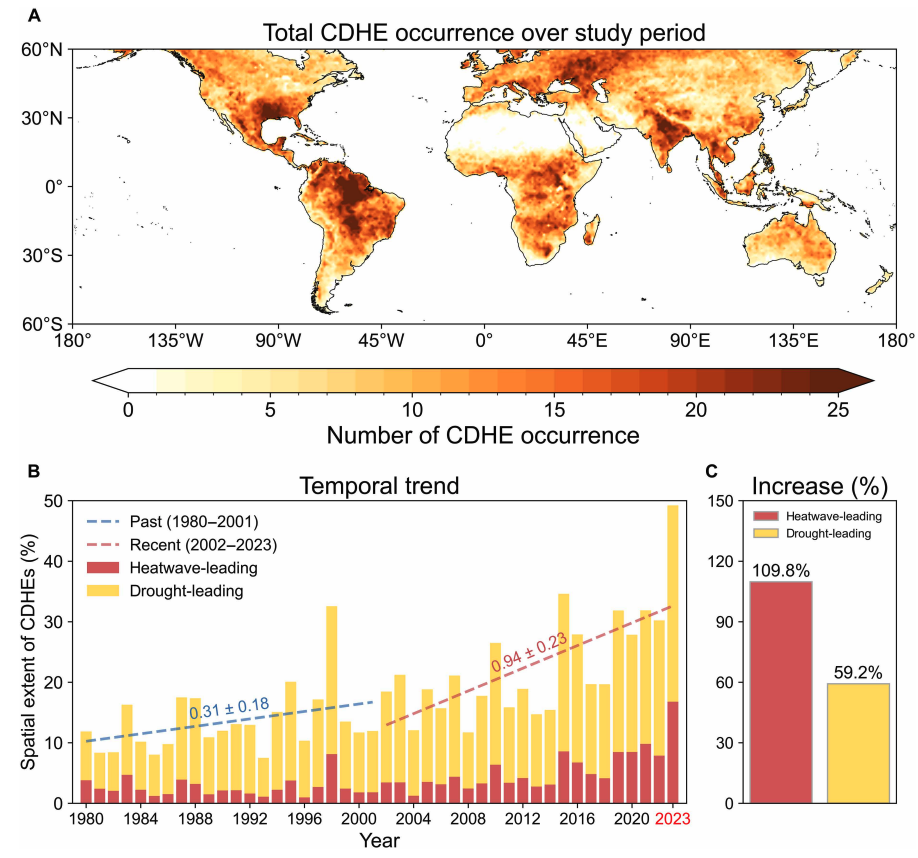
The research finds that the area of land affected by CDHEs has “increased substantially” since the early 2000s.
Heatwave-led events have been the main contributor to this increase, the study says, with their spatial extent rising 110% between 1980-2001 and 2002-23, compared to a 59% increase for drought-led events.
The map below shows the global distribution of CDHEs over 1980-2023. The charts show the percentage of the land surface affected by a heatwave-led CDHE (red) or a drought-led CDHE (yellow) in a given year (left) and relative increase in each CDHE type (right).
The study finds that CDHEs have occurred most frequently in northern South America, the southern US, eastern Europe, central Africa and south Asia.
Threshold passed
The authors explain that the increase in heatwave-led CDHEs is related to rising global temperatures, but that this does not tell the whole story.
In the earlier 22-year period of 1980-2001, the study finds that the spatial extent of heatwave-led CDHEs rises by 1.6% per 1C of global temperature rise. For the more-recent period of 2022-23, this increases “nearly eightfold” to 13.1%.
The change suggests that the rapid increase in the heatwave-led CDHEs occurred after the global average temperature “surpasse[d] a certain temperature threshold”, the paper says.
This threshold is an absolute global average temperature of 14.3C, the authors estimate (based on an 11-year average), which the world passed around the year 2000.
Investigating the recent surge in heatwave-leading CDHEs further, the researchers find a “regime shift” in land-atmosphere dynamics “toward a persistently intensified state after the late 1990s”.
In other words, the way that drier soils drive higher surface temperatures, and vice versa, is becoming stronger, resulting in more heatwave-led compound events.
Daily data
The research has some advantages over other previous studies, Yeh says. For instance, the new work uses daily estimations of CDHEs, compared to monthly data used in past research. This is “important for capturing the detailed occurrence” of these events, says Yeh.
He adds that another advantage of their study is that it distinguishes the sequence of droughts and heatwaves, which allows them to “better understand the differences” in the characteristics of CDHEs.
Dr Meryem Tanarhte is a climate scientist at the University Hassan II in Morocco, and Dr Ruth Cerezo Mota is a climatologist and a researcher at the National Autonomous University of Mexico. Both scientists, who were not involved in the study, agree that the daily estimations give a clearer picture of how CDHEs are changing.
Cerezo-Mota adds that another major contribution of the study is its global focus. She tells Carbon Brief that in some regions, such as Mexico and Africa, there is a lack of studies on CDHEs:
“Not because the events do not occur, but perhaps because [these regions] do not have all the data or the expertise to do so.”
However, she notes that the reanalysis data used by the study does have limitations with how it represents rainfall in some parts of the world.
Compound impacts
The study notes that if CDHEs continue to intensify – particularly events where heatwaves are the precursors – they could drive declining crop productivity, increased wildfire frequency and severe public health crises.
These impacts could be “much more rapid and severe as global warming continues”, Yeh tells Carbon Brief.
Tanarhte notes that these events can be forecasted up to 10 days ahead in many regions. Furthermore, she says, the strongest impacts can be prevented “through preparedness and adaptation”, including through “water management for agriculture, heatwave mitigation measures and wildfire mitigation”.
The study recommends reassessing current risk management strategies for these compound events. It also suggests incorporating the sequences of drought and heatwaves into compound event analysis frameworks “to enhance climate risk management”.
Cerezo-Mota says that it is clear that the world needs to be prepared for the increased occurrence of these events. She tells Carbon Brief:
“These [risk assessments and strategies] need to be carried out at the local level to understand the complexities of each region.”



The post Heatwaves driving recent ‘surge’ in compound drought and heat extremes appeared first on Carbon Brief.
Heatwaves driving recent ‘surge’ in compound drought and heat extremes
Greenhouse Gases
DeBriefed 6 March 2026: Iran energy crisis | China climate plan | Bristol’s ‘pioneering’ wind turbine
Welcome to Carbon Brief’s DeBriefed.