

Welcome to Carbon Brief’s DeBriefed.
An essential guide to the week’s key developments relating to climate change.
This week
Africa’s second climate summit
‘NOT CHARITY’: At the second Africa climate summit held in Addis Ababa in Ethiopia this week, leaders “chastised developed nations for failing to honor [climate finance] pledges” and said they will “tap the private sector” to help fill the gap, Bloomberg reported. In a joint statement, African leaders said that providing climate finance is “a legal obligation and not charity, as anchored in the UN Framework Convention on Climate Change and its Paris Agreement”, according to the outlet.
SOLUTIONS CENTRED: Climate Home News reported that Ethiopian president Taye Atske Selassie told the closing ceremony on Wednesday the summit had repositioned Africa “not as victims of a crisis it never created but as a global centre for climate solution, renewable energy and green growth”. The outlet added that the joint leaders’ declaration called for “strengthened and sustained support” to scale up African-led climate initiatives, such as the 8,000km Great Green Wall across the Sahel and the African Forest Landscape Restoration Initiative.
Around the world
- ‘SILLY’: Chris Wright, the climate-sceptic US energy secretary, has dismissed the impacts of climate change as “not incredibly important” and described the Paris Agreement as “silly”, reported the New York Times. Elsewhere, the group of “climate contrarians” behind Trump’s misleading climate report have been “disbanded” following a lawsuit challenging their appointment, CNN reported.
- CHINA BOOM: The world’s fossil-fuel use could begin to drop by 2030 as a result of China’s “rapid adoption of renewables and its increasing reliance on electricity”, Bloomberg reported, citing a new study by thinktank Ember.
- NDC INDECISION: EU member states are still “wrangling” over the bloc’s overdue 2035 climate target, “with no sign of agreement”, according to a leaked draft text seen by the Guardian.
- TRADE SPOTLIGHT: Brazil plans to propose a new forum for governments to discuss how climate policy affects trade at the next World Trade Organization meeting next week, according to Reuters.
- UK PUBLIC POLLED: In a frontpage story, the Times covered new polling it commissioned, reporting that the number of people who think the dangers of global warming are exaggerated has increased by more than 50% in the past four years, from 16% to 25%. [Polling experts have criticised the framing of the Times coverage, noting that a large majority of the public still back net-zero.]
£797 million
The record amount of UK climate aid spent on nature last year – largely due to an increase in spending on carbon offsets, according to new Carbon Brief analysis.
Latest climate research
- Disadvantaged communities in the US are eating more sugar as temperatures rise | Nature Climate Change
- Videos of climate scientists making personal appeals for climate action were more likely to motivate viewers to act if the messengers were “older, male [and] attractive” | PLOS One
- Carbon-credit purchases for major airlines often come at the expense of funding other decarbonisation measures | Nature Communications
(For more, see Carbon Brief’s in-depth daily summaries of the top climate news stories on Monday, Tuesday, Wednesday, Thursday and Friday.)
Captured
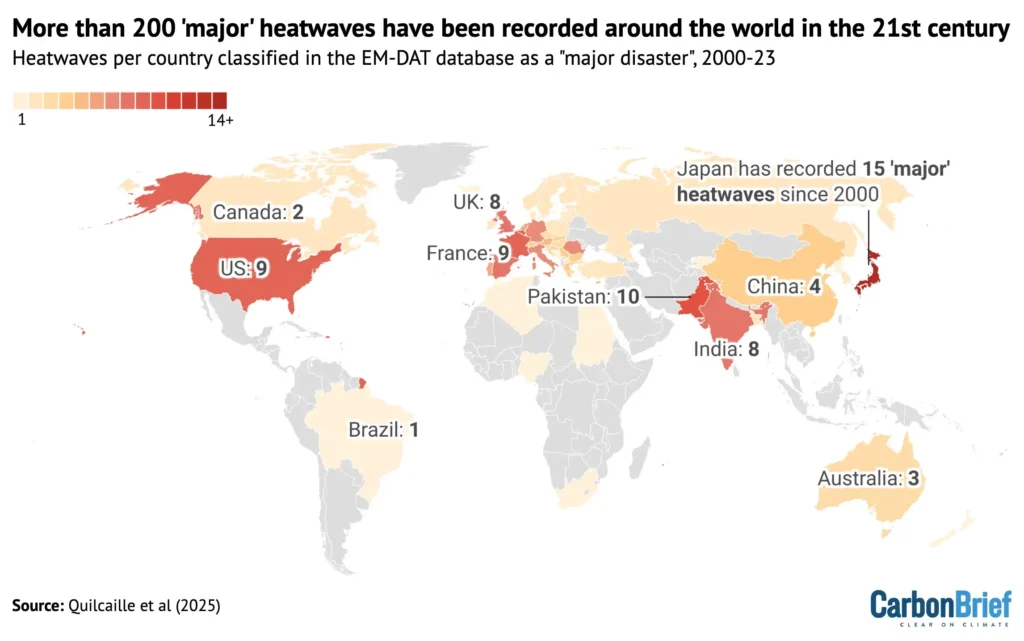
A new study used “extreme event attribution” to assess the impact of climate change on all 21st-century heatwaves that were classified as “major disasters”. It found that global warming linked to the world’s biggest 180 oil and gas companies made all 213 heatwaves analysed more intense and frequent. Meanwhile, one-quarter of the heatwaves would have been “virtually impossible” without human-caused global warming. The paper, covered by Carbon Brief, analysed 213 heatwaves over 2000-23 that were recorded in the EM-DAT database of “major disasters” . These heatwaves are shown in the map above.
Spotlight
How scientists can tackle net-zero backlash
This week, Carbon Brief asks climate scientists attending a summit at the University of East Anglia, UK how researchers can better combat net-zero misinformation.
It comes as the UK’s right-wing political parties and press are increasingly making misleading claims about net-zero.
Asher Minns, executive director of the Tyndall Centre for Climate Change Research at the University of East Anglia
The whole discourse around net-zero has become something that it was never intended to be. It’s a quite specific scientific concept that came out of the IPCC 1.5C report, following up on [the] Paris [Agreement], so it actually has quite a specific definition, but it has actually become a phrase that is being used really just to mean “removing CO2” or “saving energy”, even. It’s become this kind of huge term across public, across media, across policy, that everybody can just pin what they mean to “net-zero” without actually referring to what it actually is, which is absolute zero emissions, getting CO2 out of the atmosphere. The fact that there is a government department called “net-zero” isn’t great for that public discourse, for public understanding, and that’s why we’ve got a bit of a backlash. I don’t think we need to necessarily abandon the phrase net-zero, but I think we should just talk about clean energy and concepts that people have a chance of hanging onto, rather than something that’s really quite difficult.
Prof Corinne Le Quéré, Royal Society research professor of climate change science at the University of East Anglia
I think narratives about the way that we present climate action can be very negative, and, in fact, we do climate action all the time. We’ve cut emissions by half in the UK and most people haven’t realised that this is happening. Just talking about climate change in the way that there are things that you can do that are desirable and have benefits for you. Of course, the government needs to make climate solutions accessible to everybody. But improving the narratives about how we talk about climate change, that would be, for me, a small thing that we could do.
Prof Hayley Fowler, professor of climate change impacts at Newcastle University
I don’t think we can do it alone. I think we try to do everything alone and I don’t think that’s the right approach. My personal opinion is we need to be collaborating with key influencers and celebrities, quite honestly, who can actually get that message across to the people who need to hear that message. I think we need probably a few key spokespeople. And I don’t think they should be scientists, but they should have simple and clear scientific messages that they convey. There’s lots of misinformation and it’s conveyed in very clear ways with simple messaging. Often climate science is really, really complicated and that’s why people just don’t understand it, they don’t understand the jargon surrounding it and, therefore, perhaps they are more likely to understand the simple messages that come from the climate deniers.
Dr Ruth Wood, senior lecturer in environment and climate change at the University of Manchester
I find it quite challenging to work out how to engage in those discussions because they’re taking place in forums that I’m not at. Do we need a groundswell of voices around supporting net-zero, which have the same level of media savviness of the anti net-zero groups? If we had their same ability to mobilise and get the message out there, maybe that would counter some of their narratives. The gap between science and communication is a huge challenge.
Prof Charlie Wilson, professor of energy and climate change and senior research fellow in the Environmental Change Institute at the University of Oxford
I guess that part of the answer is how we’ve always done it, which is forceful rebuttals and corrections with appropriate evidence. The second bit is like learning how the algorithms work to promote both information, as well as misinformation. This misinformation is being amplified by algorithmic preferences expressed through social media platforms, which emphasise juicy clickbait-type stuff.
Watch, read, listen
FIXING TOMORROW: Climate scientist Dr Kimberly Nicholas and the NGO Project Drawdown released an evidence-based online guide for how individuals can take actions to address climate change.
‘WAR ON SCIENCE’: Bloomberg had a special feature on how Donald Trump’s “war on science” is crippling the US.
CLIMATE IN COURT: The New York Times unpacked how and why a group of students from the Pacific Islands took a climate case to the International Court of Justice.
Coming up
- 9-23 September: 80th session of the UN general assembly, New York
- 16 September: Malawi elections
- 19 September: First technical session of the UN Environment Programme working group on nitrogen, online
Pick of the jobs
- Floodlight, editor-in-chief | Salary: $130,000. Location: Remote (US)
- University of Birmingham, research fellow in climate intervention | Salary: £36,636-£46,049. Location: Birmingham, UK
- Climate Group, communications coordinator | Salary: 695,800-850,000 rupees. Location: New Delhi, India
- Wired, senior writer, science frontiers | Salary: Unknown. Location: London
DeBriefed is edited by Daisy Dunne. Please send any tips or feedback to debriefed@carbonbrief.org.
This is an online version of Carbon Brief’s weekly DeBriefed email newsletter. Subscribe for free here.


The post Debriefed 12 September 2025: Africa calls for promised finance; Deadly heat linked to big oil; How to tackle net-zero backlash appeared first on Carbon Brief.

Drought and heatwaves occurring together – known as “compound” events – have “surged” across the world since the early 2000s, a new study shows.
Compound drought and heat events (CDHEs) can have devastating effects, creating the ideal conditions for intense wildfires, such as Australia’s “Black Summer” of 2019-20 where bushfires burned 24m hectares and killed 33 people.
The research, published in Science Advances, finds that the increase in CDHEs is predominantly being driven by events that start with a heatwave.
The global area affected by such “heatwave-led” compound events has more than doubled between 1980-2001 and 2002-23, the study says.
The rapid increase in these events over the last 23 years cannot be explained solely by global warming, the authors note.
Since the late 1990s, feedbacks between the land and the atmosphere have become stronger, making heatwaves more likely to trigger drought conditions, they explain.
One of the study authors tells Carbon Brief that societies must pay greater attention to compound events, which can “cause severe impacts on ecosystems, agriculture and society”.
Compound events
CDHEs are extreme weather events where drought and heatwave conditions occur simultaneously – or shortly after each other – in the same region.
These events are often triggered by large-scale weather patterns, such as “blocking” highs, which can produce “prolonged” hot and dry conditions, according to the study.
Prof Sang-Wook Yeh is one of the study authors and a professor at the Ewha Womans University in South Korea. He tells Carbon Brief:
“When heatwaves and droughts occur together, the two hazards reinforce each other through land-atmosphere interactions. This amplifies surface heating and soil moisture deficits, making compound events more intense and damaging than single hazards.”
CDHEs can begin with either a heatwave or a drought.
The sequence of these extremes is important, the study says, as they have different drivers and impacts.
For example, in a CDHE where the heatwave was the precursor, increased direct sunshine causes more moisture loss from soils and plants, leading to a drought.
Conversely, in an event where the drought was the precursor, the lack of soil moisture means that less of the sun’s energy goes into evaporation and more goes into warming the Earth’s surface. This produces favourable conditions for heatwaves.
The study shows that the majority of CDHEs globally start out as a drought.
In recent years, there has been increasing focus on these events due to the devastating impact they have on agriculture, ecosystems and public health.
In Russia in the summer of 2010, a compound drought-heatwave event – and the associated wildfires – caused the death of nearly 55,000 people, the study notes.

The record-breaking Pacific north-west “heat dome” in 2021 triggered extreme drought conditions that caused “significant declines” in wheat yields, as well as in barley, canola and fruit production in British Columbia and Alberta, Canada, says the study.
Increasing events
To assess how CDHEs are changing, the researchers use daily reanalysis data to identify droughts and heatwaves events. (Reanalysis data combines past observations with climate models to create a historical climate record.) Then, using an algorithm, they analyse how these events overlap in both time and space.
The study covers the period from 1980 to 2023 and the world’s land surface, excluding polar regions where CDHEs are rare.
The research finds that the area of land affected by CDHEs has “increased substantially” since the early 2000s.
Heatwave-led events have been the main contributor to this increase, the study says, with their spatial extent rising 110% between 1980-2001 and 2002-23, compared to a 59% increase for drought-led events.
The map below shows the global distribution of CDHEs over 1980-2023. The charts show the percentage of the land surface affected by a heatwave-led CDHE (red) or a drought-led CDHE (yellow) in a given year (left) and relative increase in each CDHE type (right).
The study finds that CDHEs have occurred most frequently in northern South America, the southern US, eastern Europe, central Africa and south Asia.

Threshold passed
The authors explain that the increase in heatwave-led CDHEs is related to rising global temperatures, but that this does not tell the whole story.
In the earlier 22-year period of 1980-2001, the study finds that the spatial extent of heatwave-led CDHEs rises by 1.6% per 1C of global temperature rise. For the more-recent period of 2022-23, this increases “nearly eightfold” to 13.1%.
The change suggests that the rapid increase in the heatwave-led CDHEs occurred after the global average temperature “surpasse[d] a certain temperature threshold”, the paper says.
This threshold is an absolute global average temperature of 14.3C, the authors estimate (based on an 11-year average), which the world passed around the year 2000.
Investigating the recent surge in heatwave-leading CDHEs further, the researchers find a “regime shift” in land-atmosphere dynamics “toward a persistently intensified state after the late 1990s”.
In other words, the way that drier soils drive higher surface temperatures, and vice versa, is becoming stronger, resulting in more heatwave-led compound events.
Daily data
The research has some advantages over other previous studies, Yeh says. For instance, the new work uses daily estimations of CDHEs, compared to monthly data used in past research. This is “important for capturing the detailed occurrence” of these events, says Yeh.
He adds that another advantage of their study is that it distinguishes the sequence of droughts and heatwaves, which allows them to “better understand the differences” in the characteristics of CDHEs.
Dr Meryem Tanarhte is a climate scientist at the University Hassan II in Morocco, and Dr Ruth Cerezo Mota is a climatologist and a researcher at the National Autonomous University of Mexico. Both scientists, who were not involved in the study, agree that the daily estimations give a clearer picture of how CDHEs are changing.
Cerezo-Mota adds that another major contribution of the study is its global focus. She tells Carbon Brief that in some regions, such as Mexico and Africa, there is a lack of studies on CDHEs:
“Not because the events do not occur, but perhaps because [these regions] do not have all the data or the expertise to do so.”
However, she notes that the reanalysis data used by the study does have limitations with how it represents rainfall in some parts of the world.
Compound impacts
The study notes that if CDHEs continue to intensify – particularly events where heatwaves are the precursors – they could drive declining crop productivity, increased wildfire frequency and severe public health crises.
These impacts could be “much more rapid and severe as global warming continues”, Yeh tells Carbon Brief.
Tanarhte notes that these events can be forecasted up to 10 days ahead in many regions. Furthermore, she says, the strongest impacts can be prevented “through preparedness and adaptation”, including through “water management for agriculture, heatwave mitigation measures and wildfire mitigation”.
The study recommends reassessing current risk management strategies for these compound events. It also suggests incorporating the sequences of drought and heatwaves into compound event analysis frameworks “to enhance climate risk management”.
Cerezo-Mota says that it is clear that the world needs to be prepared for the increased occurrence of these events. She tells Carbon Brief:
“These [risk assessments and strategies] need to be carried out at the local level to understand the complexities of each region.”




The post Heatwaves driving recent ‘surge’ in compound drought and heat extremes appeared first on Carbon Brief.
Heatwaves driving recent ‘surge’ in compound drought and heat extremes
Greenhouse Gases
DeBriefed 6 March 2026: Iran energy crisis | China climate plan | Bristol’s ‘pioneering’ wind turbine
Welcome to Carbon Brief’s DeBriefed.
An essential guide to the week’s key developments relating to climate change.
This week
Energy crisis
ENERGY SPIKE: US-Israeli attacks on Iran and subsequent counterattacks across the Middle East have sent energy prices “soaring”, according to Reuters. The newswire reported that the region “accounts for just under a third of global oil production and almost a fifth of gas”. The Guardian noted that shipping traffic through the strait of Hormuz, which normally ferries 20% of the world’s oil, “all but ground to a halt”. The Financial Times reported that attacks by Iran on Middle East energy facilities – notably in Qatar – triggered the “biggest rise in gas prices since Russia’s full-scale invasion of Ukraine”.
‘RISK’ AND ‘BENEFITS’: Bloomberg reported on increases in diesel prices in Europe and the US, speculating that rising fuel costs could be “a risk for president Donald Trump”. US gas producers are “poised to benefit from the big disruption in global supply”, according to CNBC. Indian government sources told the Economic Times that Russia is prepared to “fulfil India’s energy demands”. China Daily quoted experts who said “China’s energy security remains fundamentally unshaken”, thanks to “emergency stockpiles and a wide array of import channels”.
‘ESSENTIAL’ RENEWABLES: Energy analysts said governments should cut their fossil-fuel reliance by investing in renewables, “rather than just seeking non-Gulf oil and gas suppliers”, reported Climate Home News. This message was echoed by UK business secretary Peter Kyle, who said “doubling down on renewables” was “essential” amid “regional instability”, according to the Daily Telegraph.
China’s climate plan
PEAK COAL?: China has set out its next “five-year plan” at the annual “two sessions” meeting of the National People’s Congress, including its climate strategy out to 2030, according to the Hong Kong-based South China Morning Post. The plan called for China to cut its carbon emissions per unit of gross domestic product (GDP) by 17% from 2026 to 2030, which “may allow for continued increase in emissions given the rate of GDP growth”, reported Reuters. The newswire added that the plan also had targets to reach peak coal in the next five years and replace 30m tonnes per year of coal with renewables.
ACTIVE YET PRUDENT: Bloomberg described the new plan as “cautious”, stating that it “frustrat[es] hopes for tighter policy that would drive the nation to peak carbon emissions well before president Xi Jinping’s 2030 deadline”. Carbon Brief has just published an in-depth analysis of the plan. China Daily reported that the strategy “highlights measures to promote the climate targets of peaking carbon dioxide emissions before 2030”, which China said it would work towards “actively yet prudently”.
Around the world
- EU RULES: The European Commission has proposed new “made in Europe” rules to support domestic low-carbon industries, “against fierce competition from China”, reported Agence France-Presse. Carbon Brief examined what it means for climate efforts.
- RECORD HEAT: The US National Oceanic and Atmospheric Administration has said there is a 50-60% chance that the El Niño weather pattern could return this year, amplifying the effect of global warming and potentially driving temperatures to “record highs”, according to Eur