

Welcome to Carbon Brief’s DeBriefed.
An essential guide to the week’s key developments relating to climate change.
This week
Intensifying hurricanes
STILL POWERFUL: Hurricane Milton made landfall in Florida on Wednesday “weakening but still tremendously powerful”, the Guardian reported, bringing “catastrophic winds likely to cause significant property damage” and leaving “nearly 3m homes and businesses…without power”. At least 16 people were killed across the state, officials told CBS News. Bloomberg noted that the US “has been hit by five hurricanes so far this year”.
2.5 TIMES MORE FREQUENT: Record-breaking sea temperatures across the Gulf of Mexico are a key driver of the intense hurricanes devastating the region this year, Carbon Brief reported (see more below). The Independent covered new World Weather Attribution analysis finding that hurricanes as intense as Hurricane Helene, the second most deadly US storm in history which made landfall just days before Milton, “are now about 2.5 times more frequent” because of human-caused climate change.
GLOBAL CRISIS: Elsewhere, “unprecedented” flooding in Niger killed 339 people and displaced more than 1.1 million, Radio France Internationale said, adding that “neighbouring Mali [saw] over 40 people killed and thousands displaced”. Floods and landslides in Bosnia killed at least 22 people, Le Monde reported. Finally, in Bangladesh, five people died and more than 100,000 were stranded by floods, Reuters said.
Oil rush
AMBITION ABANDONED: BP will abandon its “ambitious target” to cut oil and gas production by 40% by 2030, the Times reported, with the move expected to be formalised in February. The newspaper added that BP is “battl[ing] to close a valuation gap” with industry rivals and faces pressure from investors to increase fossil fuel production and “stop investing in any more ill-conceived wind projects”. (Any new fossil fuel projects globally are incompatible with keeping global warming at 1.5C.)
RACE TO THE BOTTOM: India will “radically reform regulations and invite foreign oil majors to explore both onshore and offshore [opportunities]” as the country “races to extract as much oil as possible while there remains a market”, according to the Financial Times. The newspaper noted that oil companies hope India’s strong economic growth forecast “will underpin future demand”.
UNLIKELY CHAMPIONS: In the US, oil companies are lobbying Republican presidential candidate Donald Trump “not to slash provisions of the Inflation Reduction Act”, the Wall Street Journal said, as many of them benefit from the law’s provision of billions of dollars in “tax credits vital for their investments in renewable fuel, carbon capture and hydrogen”.
Around the world
- NO-SHOWS: Ahead of COP29, the EU has called for a phaseout of “inefficient fossil fuel subsidies that do not address energy poverty or just transitions”, ENDS Europe reported. Meanwhile, Bank of America, BlackRock, Standard Chartered, Deutsche Bank and other financial institutions will “skip” COP29, the Financial Times said.
- STREAMLINING: COP16 host Colombia is pushing for the United Nations to combine the COPs for climate change, biodiversity and desertification in order to avoid “wasting time” and create “synergies” in countries’ climate plans, according to Reuters.
- NEW RULES: The UN has developed a compulsory mechanism that aims to prevent carbon credit project developers from breaching human rights or causing environmental damage with their activities, Climate Home News reported.
- ‘CATASTROPHIC’ DECLINE: Wildlife populations have dropped by a “catastrophic” average rate of 73% over the past 50 years, according to a World Wild Fund for Nature (WWF) report covered by the Washington Post.
- TWO EXTREMES: The World Meteorological Organization found that 2023 was the “driest year in more than three decades for the world’s rivers”, the Associated Press said. At the same time, the Financial Times reported, rising temperatures “helped drive extreme rainfall events” in September.
5,500
The amount of new renewable energy capacity, in gigawatts, to be added globally between 2024 and 2030, 2.6 times greater than total additions between 2017 and 2023, according to a new report by the International Energy Agency.
Latest climate research
- The presence of permafrost almost halves riverbank erosion rates in an Arctic river, according to a study published in Nature.
- Research in Nature Climate Change found that, even if global warming is limited to 1.5C, climate change’s impact will increase inequality by an average of 1.4 points of the Gini index, the most common measure of income disparity, by the end of the century.
- A new study in Nature Climate Change estimated that climate change will increase the risk of whale sharks, the world’s largest fish, crossing into global shipping routes and colliding with vessels.
(For more, see Carbon Brief’s in-depth daily summaries of the top climate news stories on Monday, Tuesday, Wednesday, Thursday and Friday.)
Captured

The amount of heat stored in the waters of the Gulf of Mexico has reached record levels this month amid an unprecedented marine heatwave. These temperatures, themselves made 200-500 times more likely by climate change, played a key role in causing the hurricanes devastating the US this year to be more intense, according to a new study covered by Carbon Brief. The hurricanes Helene and Milton, which struck the US within two weeks of each other, were made more powerful by passing over the gulf, due to the hotter ocean water passing more energy to the storms and making them intensify more quickly.
Spotlight
How Scotland is protecting its ancient stone circles from climate change
This week, Carbon Brief explores what climate change means for a 5,000-year-old monument in Orkney.
Orkney, in the north of Scotland, is famous for its neolithic monuments, including the Ring of Brodgar, the largest stone circle in Scotland.
Historic Environment Scotland (HES), a public body that maintains Scotland’s historic sites, encourages tourists to help monitor the monument for signs of the impact of climate change through the citizen science programme Monument Monitor.
Carbon Brief interviews Dr Mairi Davies, climate change policy manager at HES, about the impact of climate change on the site and the effectiveness of citizen science in combating it.
Carbon Brief: What impact has climate change had on the Ring of Brodgar?
Mairi Davies: In 2019, we hosted a workshop in Orkney to apply the Climate Vulnerability Index (CVI), a methodology developed to rapidly assess climate impacts for all types of world heritage properties, to the Heart of Neolithic Orkney World Heritage site (HONO), which includes the Ring of Brodgar.
HONO was determined to be extremely vulnerable to the impacts of three key climate drivers: sea level change; precipitation change; and storm intensity and frequency change.
Increased footfall at the Ring of Brodgar is interacting with changes in precipitation patterns – primarily increased precipitation, but also periods of very dry weather – which has led to serious and increasing footfall erosion, threatening the fabric of the site.
CB: What inspired HES to turn to citizen science to monitor these impacts? And has it been effective?
MD: We care for a diverse estate of properties, many of which are in remote areas. While we undertake regular site inspection visits, we can’t be everywhere at once.
Since launching in 2018, Monument Monitor has been a really useful tool for aiding conservation work across the sites we care for, as well as fostering engagement with visitors and local communities alike. Using pictures sent to us by visitors, we’ve been able to model how climate change is affecting flooding at Machrie Moor Standing Stone Circle in Arran, as well as measuring the impact of increased visitor footfall at Clava Cairns…At the Ring of Brodgar, visitor photos are helping us record how well the site can drain after increasing incidences of extreme weather.

CB: What more needs to be done to protect Scotland’s neolithic heritage from climate impacts?
MD: Over the last few years at the Ring of Brodgar, we have undertaken an extensive programme…to create more resilient footpaths for visitors. Balancing access at the Ring of Brodgar, especially to the inner ring, with conservation is now a key issue for site management, with periods of partial site closure required to allow areas of footpath to recover.
Projects such as SCAPE (Scotland’s Coastal Archaeology and the Problem of Erosion) work with the public to research and promote the eroding archaeological remains on Scotland’s coasts.
More broadly, HES will continue its work with communities and partners across Scotland to investigate the impacts of climate change on our historic sites and to support climate adaptation. Our Guide to Climate Impacts identifies many of the risks and hazards of climate change that are facing Scotland’s historic environment and offers owners, local communities and carers of historic sites routes to…enhance resilience to climate change.
The interview has been edited for length and clarity.
Watch, read, listen
EUROPE’S FUTURE: The Columbia Energy Exchange podcast spoke with European commissioner for energy Kadri Simson about the EU’s energy strategy following Russia’s invasion of Ukraine.
BY THE NUMBERS: The Associated Press interviewed the founder of consulting firm Rystad Energy about why he believed technology is key to “containing climate change”.
CHINA NDC: An op-ed in Foreign Policy argued that China must avoid setting “weak” targets in its 2035 climate commitments, adding it “is in China’s own interest” to include ambitious goals.
Coming up
- 13 October: Lithuania parliamentary elections (first round)
- 14-16 October: Intergovernmental Panel on Climate Change (IPCC) scoping meeting for carbon dioxide removal, Copenhagen, Denmark
- 16 October: IEA 2024 World Energy Outlook report launch
Pick of the jobs
- Ellen MacArthur Foundation, senior editor | Salary: £39,000. Location: Cowes, Isle of Wight or remote
- Oxford Economics, lead economist – climate consulting | Salary: Unknown. Location: Oxford or London
- Grantham Research Institute on Climate Change and the Environment, policy analyst and research advisor to Prof Lord Nicholas Stern | Salary: £40,229-£48,456. Location: London
- Bloomberg, Bloomberg Green editor | Salary: $120,000-160,000. Location: New York
DeBriefed is edited by Daisy Dunne. Please send any tips or feedback to debriefed@carbonbrief.org.
This is an online version of Carbon Brief’s weekly DeBriefed email newsletter. Subscribe for free here.


The post DeBriefed 11 October 2024: Hurricane Milton; BP abandons oil reduction target; Scotland’s ancient stone circles and climate change appeared first on Carbon Brief.

Drought and heatwaves occurring together – known as “compound” events – have “surged” across the world since the early 2000s, a new study shows.
Compound drought and heat events (CDHEs) can have devastating effects, creating the ideal conditions for intense wildfires, such as Australia’s “Black Summer” of 2019-20 where bushfires burned 24m hectares and killed 33 people.
The research, published in Science Advances, finds that the increase in CDHEs is predominantly being driven by events that start with a heatwave.
The global area affected by such “heatwave-led” compound events has more than doubled between 1980-2001 and 2002-23, the study says.
The rapid increase in these events over the last 23 years cannot be explained solely by global warming, the authors note.
Since the late 1990s, feedbacks between the land and the atmosphere have become stronger, making heatwaves more likely to trigger drought conditions, they explain.
One of the study authors tells Carbon Brief that societies must pay greater attention to compound events, which can “cause severe impacts on ecosystems, agriculture and society”.
Compound events
CDHEs are extreme weather events where drought and heatwave conditions occur simultaneously – or shortly after each other – in the same region.
These events are often triggered by large-scale weather patterns, such as “blocking” highs, which can produce “prolonged” hot and dry conditions, according to the study.
Prof Sang-Wook Yeh is one of the study authors and a professor at the Ewha Womans University in South Korea. He tells Carbon Brief:
“When heatwaves and droughts occur together, the two hazards reinforce each other through land-atmosphere interactions. This amplifies surface heating and soil moisture deficits, making compound events more intense and damaging than single hazards.”
CDHEs can begin with either a heatwave or a drought.
The sequence of these extremes is important, the study says, as they have different drivers and impacts.
For example, in a CDHE where the heatwave was the precursor, increased direct sunshine causes more moisture loss from soils and plants, leading to a drought.
Conversely, in an event where the drought was the precursor, the lack of soil moisture means that less of the sun’s energy goes into evaporation and more goes into warming the Earth’s surface. This produces favourable conditions for heatwaves.
The study shows that the majority of CDHEs globally start out as a drought.
In recent years, there has been increasing focus on these events due to the devastating impact they have on agriculture, ecosystems and public health.
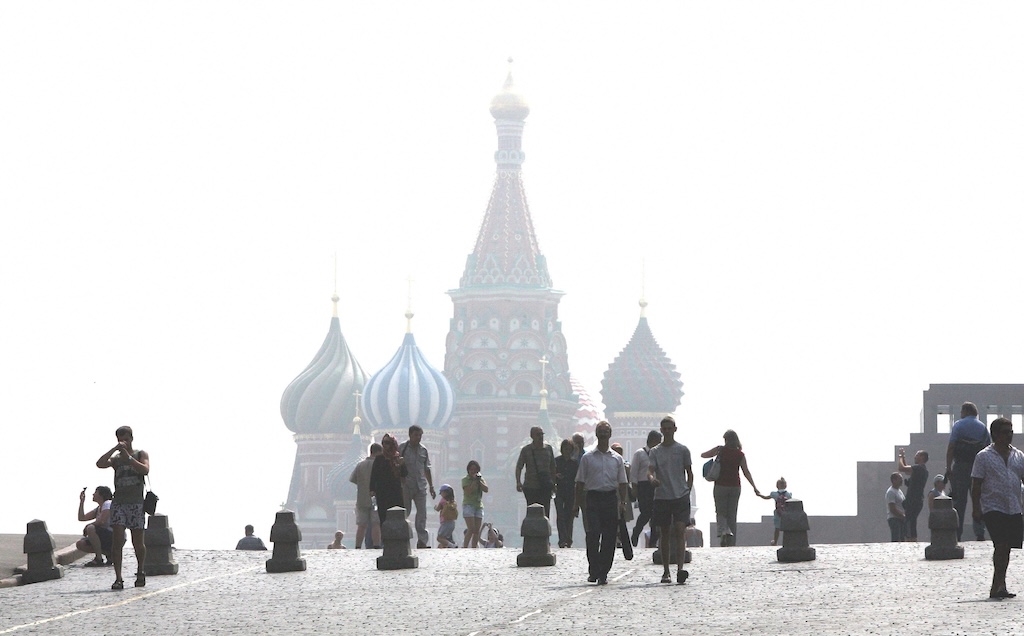
In Russia in the summer of 2010, a compound drought-heatwave event – and the associated wildfires – caused the death of nearly 55,000 people, the study notes.
The record-breaking Pacific north-west “heat dome” in 2021 triggered extreme drought conditions that caused “significant declines” in wheat yields, as well as in barley, canola and fruit production in British Columbia and Alberta, Canada, says the study.
Increasing events
To assess how CDHEs are changing, the researchers use daily reanalysis data to identify droughts and heatwaves events. (Reanalysis data combines past observations with climate models to create a historical climate record.) Then, using an algorithm, they analyse how these events overlap in both time and space.
The study covers the period from 1980 to 2023 and the world’s land surface, excluding polar regions where CDHEs are rare.
The research finds that the area of land affected by CDHEs has “increased substantially” since the early 2000s.
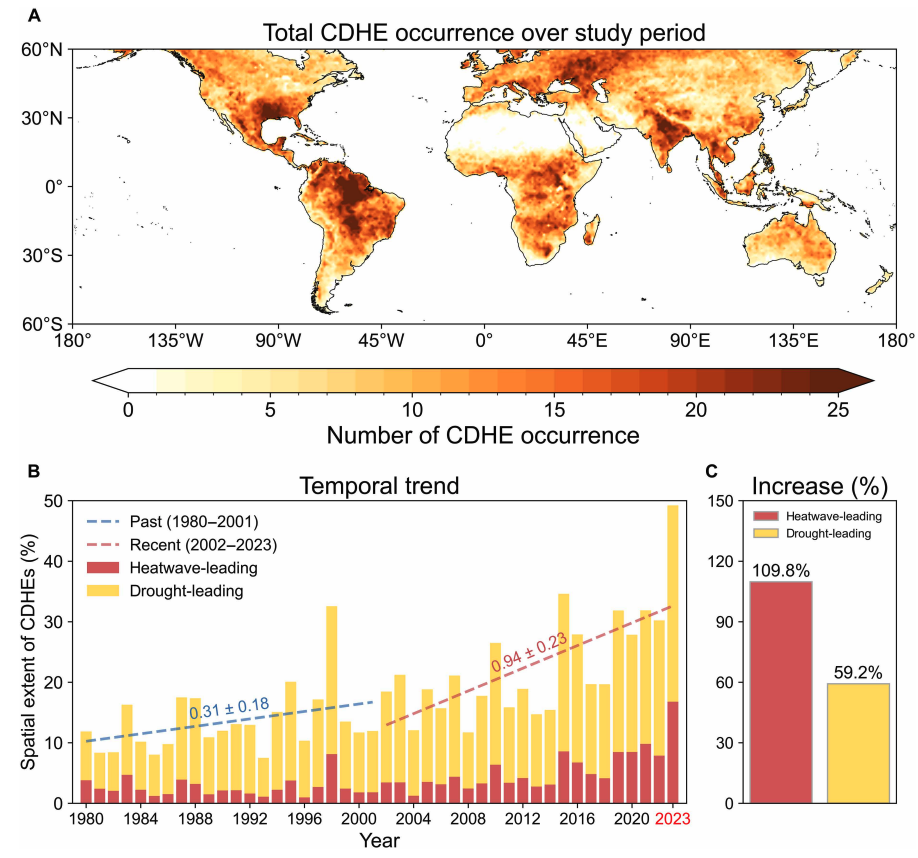
Heatwave-led events have been the main contributor to this increase, the study says, with their spatial extent rising 110% between 1980-2001 and 2002-23, compared to a 59% increase for drought-led events.
The map below shows the global distribution of CDHEs over 1980-2023. The charts show the percentage of the land surface affected by a heatwave-led CDHE (red) or a drought-led CDHE (yellow) in a given year (left) and relative increase in each CDHE type (right).
The study finds that CDHEs have occurred most frequently in northern South America, the southern US, eastern Europe, central Africa and south Asia.
Threshold passed
The authors explain that the increase in heatwave-led CDHEs is related to rising global temperatures, but that this does not tell the whole story.
In the earlier 22-year period of 1980-2001, the study finds that the spatial extent of heatwave-led CDHEs rises by 1.6% per 1C of global temperature rise. For the more-recent period of 2022-23, this increases “nearly eightfold” to 13.1%.
The change suggests that the rapid increase in the heatwave-led CDHEs occurred after the global average temperature “surpasse[d] a certain temperature threshold”, the paper says.
This threshold is an absolute global average temperature of 14.3C, the authors estimate (based on an 11-year average), which the world passed around the year 2000.
Investigating the recent surge in heatwave-leading CDHEs further, the researchers find a “regime shift” in land-atmosphere dynamics “toward a persistently intensified state after the late 1990s”.
In other words, the way that drier soils drive higher surface temperatures, and vice versa, is becoming stronger, resulting in more heatwave-led compound events.
Daily data
The research has some advantages over other previous studies, Yeh says. For instance, the new work uses daily estimations of CDHEs, compared to monthly data used in past research. This is “important for capturing the detailed occurrence” of these events, says Yeh.
He adds that another advantage of their study is that it distinguishes the sequence of droughts and heatwaves, which allows them to “better understand the differences” in the characteristics of CDHEs.
Dr Meryem Tanarhte is a climate scientist at the University Hassan II in Morocco, and Dr Ruth Cerezo Mota is a climatologist and a researcher at the National Autonomous University of Mexico. Both scientists, who were not involved in the study, agree that the daily estimations give a clearer picture of how CDHEs are changing.
Cerezo-Mota adds that another major contribution of the study is its global focus. She tells Carbon Brief that in some regions, such as Mexico and Africa, there is a lack of studies on CDHEs:
“Not because the events do not occur, but perhaps because [these regions] do not have all the data or the expertise to do so.”
However, she notes that the reanalysis data used by the study does have limitations with how it represents rainfall in some parts of the world.
Compound impacts
The study notes that if CDHEs continue to intensify – particularly events where heatwaves are the precursors – they could drive declining crop productivity, increased wildfire frequency and severe public health crises.
These impacts could be “much more rapid and severe as global warming continues”, Yeh tells Carbon Brief.
Tanarhte notes that these events can be forecasted up to 10 days ahead in many regions. Furthermore, she says, the strongest impacts can be prevented “through preparedness and adaptation”, including through “water management for agriculture, heatwave mitigation measures and wildfire mitigation”.
The study recommends reassessing current risk management strategies for these compound events. It also suggests incorporating the sequences of drought and heatwaves into compound event analysis frameworks “to enhance climate risk management”.
Cerezo-Mota says that it is clear that the world needs to be prepared for the increased occurrence of these events. She tells Carbon Brief:
“These [risk assessments and strategies] need to be carried out at the local level to understand the complexities of each region.”




The post Heatwaves driving recent ‘surge’ in compound drought and heat extremes appeared first on Carbon Brief.
Heatwaves driving recent ‘surge’ in compound drought and heat extremes
Greenhouse Gases
DeBriefed 6 March 2026: Iran energy crisis | China climate plan | Bristol’s ‘pioneering’ wind turbine