

Welcome to Carbon Brief’s Cropped.
We handpick and explain the most important stories at the intersection of climate, land, food and nature over the past fortnight.
This is an online version of Carbon Brief’s fortnightly Cropped email newsletter.
Subscribe for free here.
On Monday 4 November 2024, Carbon Brief will be hosting two webinars – one in English and one in Spanish – where we will be unpacking all of the details and decisions from COP16.
Key developments
Millions versus billions
FINANCE FIGHT: Resource mobilisation continues to be one of the most divisive negotiation topics at COP16, which provides the first litmus test for how developed countries have progressed on their finance commitments since Montreal. Pledges made so far have been far short of closing the $700bn-a-year finance gap for biodiversity. In a non-paper compiling countries’ views on a new resource mobilisation strategy for 2025-30, developing countries revived their call for a new financial mechanism under the COP, which is opposed by developed countries. The new fund “could become the biggest issue for debate” at the talks, Climate Home News reported. COP16 president Colombia’s attempt to include references to the global debt crisis have also faced marked opposition. The one point of consensus, however, is to mobilise funds for nature from “all sources”.
-
Sign up to Carbon Brief’s free “Cropped” email newsletter. A fortnightly digest of food, land and nature news and views. Sent to your inbox every other Wednesday.
ALL SOURCES GO?: Attempts to thaw the finance deadlock began right from the start of COP, chiefly through private and hybrid finance initiatives. The International Advisory Panel on Biodiversity Credits launched its “high-integrity” principles for biodiversity markets, which were called “extremely problematic” by the Green Finance Observatory, a sustainable finance thinktank. The Brazil-led Tropical Forests Finance Facility (TFFF) took centre stage on “finance day” at COP16. The fund aims to raise $125bn for six rainforest nations through re-investing long-term loans from developed countries. Seven countries, including New Zealand, France and Austria, as well as Quebec, pledged $163m in total to the Global Biodiversity Framework Fund. “We are talking about millions that have been pledged…But what we are expecting are billions,” Irène Wabiwa Betoko from Greenpeace told Reuters. Other observers told Carbon Brief that “at least this $163m is grant money and not loans”.
OCEAN ACTION: On 23 October, Panama ratified the “High Seas Treaty”, bringing the total number of ratifications to 14 out of the 60 that are required for the treaty to enter into force, according to the High Seas Alliance. At a press conference on Monday, a host of philanthropies announced a joint pledge of $51.7m to “accelerate the creation” of high-seas marine protected areas, which are critical for meeting the COP15 “30 by 30” target. Coral reefs are also garnering attention, with an “emergency special session” on coral reefs added to Wednesday’s schedule in response to the recent announcement that the current mass bleaching event is the largest ever. On Tuesday, ambassador Peter Thomson, UN special envoy for the ocean, warned that “we’re approaching the collapse of an entire ecosystem” and implored governments and philanthropies to open their wallets for coral reef protection.
Future plans
POLITICAL WILL: Colombian president Gustavo Petro criticised the “lack of action” on climate change and biodiversity loss around the world in a speech during COP16’s high-level segment. Petro joined five other heads of state, more than 100 ministers and other key figures at the event over 29-30 October. Petro noted that both COP16 and the COP30 climate talks, due to be held next year in Belém, Brazil, must be “decisive” and “turning points where we won’t continue doing the same thing”. UN secretary general António Guterres said in his speech that “nature is life”, but there is a “war against it”. He added: “Biodiversity is humanity’s ally. We should move from destroying it to preserving it.”
BIODIVERSITY PLEDGES: As negotiations inch towards consensus in Cali, there has been little progress on country-level biodiversity pledges, known as “national biodiversity strategies and action plans” (NBSAPs). On Tuesday, Germany released its NBSAP – leaving the UK as the only G7 nation still working to produce a new pledge. (The US is not a signatory to the Convention on Biological Diversity and so does not produce NBSAPs.) It means that 36 countries have now submitted NBSAPs, with 161 yet to do so. Countries that were unable to meet the deadline to submit NBSAPs ahead of COP16 were requested to instead submit national targets. These submissions – which have currently been submitted by 115 parties – list biodiversity targets that countries will aim for without an accompanying plan for how they will be achieved.
AMAZON ALLIANCE: A collection of organisations from the Amazon basin launched the “G9 Indigenous Amazon coalition”. The coalition aims to strengthen the voices of countries and Indigenous peoples living in that region, according to the Coordination of Indigenous Organisations of the Brazilian Amazon (COIAB). This is particularly important when they are participating in international negotiations at climate and biodiversity COPs, COIAB said. El Espectador covered the launch and reported that the G9 comprises Peru, Colombia, Brazil, Venezuela, Ecuador, Suriname, Guiana and French Guiana.
Close ties
CLIMATE LINKS: Forging closer links between action on climate change and biodiversity loss is a key priority of the Colombian COP16 presidency, with ministers expected to speak on the topic during a session of the high-level segment today. However, the negotiations for the decision text on links between climate change and biodiversity loss at the summit have been fraught. One negotiator told Carbon Brief that developing nations have concerns that tying the two problems closer together might reduce the already limited pool of funding available for either problem. Elsewhere, parties are having lengthy conversations about how the text should cover geoengineering, a term for techniques that seek to reduce warming either by drawing down CO2 from the atmosphere or reflecting sunlight away from Earth.
HEALTH TIES: A global plan to boost the policy links between biodiversity and the health of species and the environment is close to being agreed in Cali. A draft of the plan – which has been negotiated over the past four years – has just 15 square brackets (which denote matters that are still unresolved) left. Speaking at a COP16 side event, Dr Susan Lieberman, the vice-president of international policy at the Wildlife Conservation Society, said the plan is an “opportunity” to help governments tackle issues that can cause pandemics, such as the spread of pathogens from one species to another. Colman O’Criodain, the head of biodiversity policy at WWF International, told Carbon Brief in Cali: “At the end of the day, this plan is only going to be voluntary. But it’s still good guidance.”
‘ACCELERATING’ CONSERVATION: At COP16, the UN Environment Program (UNEP) and the International Union for Conservation of Nature (IUCN) launched a new report concluding that governments must “accelerate” progress to fulfil the target of protecting 30% of the planet by 2030. Currently, 17.6% of land and inland waters and 8.4% of the ocean and coastal areas lie in protected and conserved areas. However, the document added, for the countries to meet the 30 by 30 conservation target – established in the Kunming-Montreal Global Biodiversity Framework – the world will need to expand such areas.
News and views
CORPORATIONS AT COP: An investigation by DeSmog mapped the pathways to corporate influence at the UN biodiversity talks. Alongside the government negotiators are “delegates and observers from powerful industry groups, which represent the companies whose operations are actively depleting the natural world”, the outlet wrote. It listed a range of industries represented at COP16, including commodities giants, oil majors, pharmaceutical multinationals and agrochemical companies. The article said: “Compared to climate summits, where corporate logos and lobbyists are more visible, here they are flying under the radar. Yet they have found ways to tap into the negotiations.”
DON’T HAVE A COW: The loss of livestock biodiversity is “just as critical [a] biodiversity crisis” as the loss of nature’s flora and fauna, Dr Christian Tiambo of the International Livestock Research Institute argued in the Inter-Press Service. Tiambo wrote that countries must include plans to conserve livestock biodiversity in their NBSAPs. He added: “The ability to…make use of the locally adapted characteristics of indigenous breeds is becoming increasingly valuable as the impacts of climate change threaten conventional and exotic breeds.”
CONSERVING THE CHOCÓ: Colombia and Costa Rica “announced a major biodiversity agreement to fund conservation efforts across the Chocó Biogeographic Region” at the summit, Bogota’s City Paper reported. The Chocó “is a global biodiversity hotspot threatened by deforestation, climate change and illegal activities, such as mining and logging”, it added. The announcement will “mobilise resources” to protect the region, which stretches from Panama to Peru, but no details have yet emerged on the specifics of the plan.
‘ENVIRONMENTAL CRISIS’: Writing in the Conversation, Dr Jesica Lopez, who studies the Colombian Amazon, said that “the region is experiencing an environmental crisis” as “the rainforest is fast being deforested and turned into pastures for cattle ranches”. She identified a number of issues as critical to the success of COP16 and to the preservation of the Amazon, including “develop[ing] robust mechanisms to monitor progress” and “mobilis[ing] sufficient resources, particularly for developing countries”. Lopez concluded: “The summit should also work towards recognising Indigenous peoples’ rights and traditional knowledge, and including their voices in policy decisions, and must address violence against environmental defenders.”
Watch, read, listen
REVIVING A RIVER: Against the backdrop of COP16, a Deutsche Welle video explored a European plan to restore parts of the river Rhine, shared by Switzerland and Germany.
‘PLACEBO HOPE’: In the Guardian, Jonathan Watts reflected on promises made during COP season and warned of the “misuse of hope to encourage risk rather than responsibility”.
FOSSIL FOODS: A new Fuel to Fork podcast revealed the links between fossil fuels and food, looking at “how food accounts for 15% of global fossil fuel use”.
NATURE RIGHTS: Context.news looked at how Latin American countries are leading the way in granting nature legal rights and the challenges in translating court wins to conservation.
New science
- The average peak daily growth rate for “destructive fast fires” – defined as fires that grow more than 1,620 hectares in one day – more than doubled in the western US over 2001-20, according to new research published in Science. Using satellite data to analyse the growth rates of more than 60,000 fires, scientists found that destructive fast fires were responsible for 78% of destroyed structures and 61% of suppression costs in the US.
- Research in the Proceedings of the National Academy of Sciences found that a 1% increase in deforestation in the Brazilian Amazon was associated with a 6.3% jump in malaria cases the following month. Using monthly deforestation and malaria case data, researchers found that “the effect of deforestation on malaria was even larger in areas with higher forest cover”.
- The net amount of CO2 that the world’s land area absorbed last year was the smallest since 2003, said a new study in National Science Review. Land regions exposed to extreme heat in 2023 “contributed a gross carbon loss”, the researchers noted, “indicating that record warming in 2023 had a strong negative impact on the capacity of terrestrial ecosystems to mitigate climate change”.
In the diary
- 4-5 November: UN Water meeting | New York
- 5 November: US election
- 11-22 November:COP29 UNFCCC climate conference | Baku, Azerbaijan
Cropped is researched and written by Dr Giuliana Viglione, Aruna Chandrasekhar, Daisy Dunne, Orla Dwyer and Yanine Quiroz. Please send tips and feedback to cropped@carbonbrief.org.

The post Cropped 30 October 2024: The state of play at COP16 appeared first on Carbon Brief.

Drought and heatwaves occurring together – known as “compound” events – have “surged” across the world since the early 2000s, a new study shows.
Compound drought and heat events (CDHEs) can have devastating effects, creating the ideal conditions for intense wildfires, such as Australia’s “Black Summer” of 2019-20 where bushfires burned 24m hectares and killed 33 people.
The research, published in Science Advances, finds that the increase in CDHEs is predominantly being driven by events that start with a heatwave.
The global area affected by such “heatwave-led” compound events has more than doubled between 1980-2001 and 2002-23, the study says.
The rapid increase in these events over the last 23 years cannot be explained solely by global warming, the authors note.
Since the late 1990s, feedbacks between the land and the atmosphere have become stronger, making heatwaves more likely to trigger drought conditions, they explain.
One of the study authors tells Carbon Brief that societies must pay greater attention to compound events, which can “cause severe impacts on ecosystems, agriculture and society”.
Compound events
CDHEs are extreme weather events where drought and heatwave conditions occur simultaneously – or shortly after each other – in the same region.
These events are often triggered by large-scale weather patterns, such as “blocking” highs, which can produce “prolonged” hot and dry conditions, according to the study.
Prof Sang-Wook Yeh is one of the study authors and a professor at the Ewha Womans University in South Korea. He tells Carbon Brief:
“When heatwaves and droughts occur together, the two hazards reinforce each other through land-atmosphere interactions. This amplifies surface heating and soil moisture deficits, making compound events more intense and damaging than single hazards.”
CDHEs can begin with either a heatwave or a drought.
The sequence of these extremes is important, the study says, as they have different drivers and impacts.
For example, in a CDHE where the heatwave was the precursor, increased direct sunshine causes more moisture loss from soils and plants, leading to a drought.
Conversely, in an event where the drought was the precursor, the lack of soil moisture means that less of the sun’s energy goes into evaporation and more goes into warming the Earth’s surface. This produces favourable conditions for heatwaves.
The study shows that the majority of CDHEs globally start out as a drought.
In recent years, there has been increasing focus on these events due to the devastating impact they have on agriculture, ecosystems and public health.
In Russia in the summer of 2010, a compound drought-heatwave event – and the associated wildfires – caused the death of nearly 55,000 people, the study notes.

The record-breaking Pacific north-west “heat dome” in 2021 triggered extreme drought conditions that caused “significant declines” in wheat yields, as well as in barley, canola and fruit production in British Columbia and Alberta, Canada, says the study.
Increasing events
To assess how CDHEs are changing, the researchers use daily reanalysis data to identify droughts and heatwaves events. (Reanalysis data combines past observations with climate models to create a historical climate record.) Then, using an algorithm, they analyse how these events overlap in both time and space.
The study covers the period from 1980 to 2023 and the world’s land surface, excluding polar regions where CDHEs are rare.
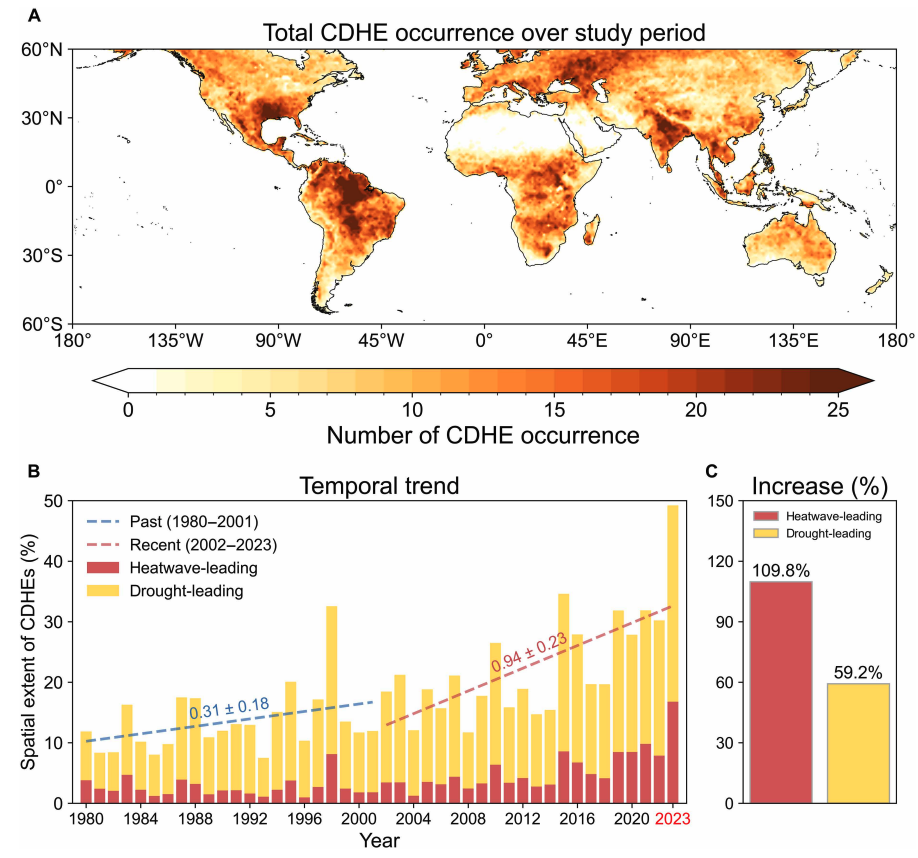
The research finds that the area of land affected by CDHEs has “increased substantially” since the early 2000s.
Heatwave-led events have been the main contributor to this increase, the study says, with their spatial extent rising 110% between 1980-2001 and 2002-23, compared to a 59% increase for drought-led events.
The map below shows the global distribution of CDHEs over 1980-2023. The charts show the percentage of the land surface affected by a heatwave-led CDHE (red) or a drought-led CDHE (yellow) in a given year (left) and relative increase in each CDHE type (right).
The study finds that CDHEs have occurred most frequently in northern South America, the southern US, eastern Europe, central Africa and south Asia.
Threshold passed
The authors explain that the increase in heatwave-led CDHEs is related to rising global temperatures, but that this does not tell the whole story.
In the earlier 22-year period of 1980-2001, the study finds that the spatial extent of heatwave-led CDHEs rises by 1.6% per 1C of global temperature rise. For the more-recent period of 2022-23, this increases “nearly eightfold” to 13.1%.
The change suggests that the rapid increase in the heatwave-led CDHEs occurred after the global average temperature “surpasse[d] a certain temperature threshold”, the paper says.
This threshold is an absolute global average temperature of 14.3C, the authors estimate (based on an 11-year average), which the world passed around the year 2000.
Investigating the recent surge in heatwave-leading CDHEs further, the researchers find a “regime shift” in land-atmosphere dynamics “toward a persistently intensified state after the late 1990s”.
In other words, the way that drier soils drive higher surface temperatures, and vice versa, is becoming stronger, resulting in more heatwave-led compound events.
Daily data
The research has some advantages over other previous studies, Yeh says. For instance, the new work uses daily estimations of CDHEs, compared to monthly data used in past research. This is “important for capturing the detailed occurrence” of these events, says Yeh.
He adds that another advantage of their study is that it distinguishes the sequence of droughts and heatwaves, which allows them to “better understand the differences” in the characteristics of CDHEs.
Dr Meryem Tanarhte is a climate scientist at the University Hassan II in Morocco, and Dr Ruth Cerezo Mota is a climatologist and a researcher at the National Autonomous University of Mexico. Both scientists, who were not involved in the study, agree that the daily estimations give a clearer picture of how CDHEs are changing.
Cerezo-Mota adds that another major contribution of the study is its global focus. She tells Carbon Brief that in some regions, such as Mexico and Africa, there is a lack of studies on CDHEs:
“Not because the events do not occur, but perhaps because [these regions] do not have all the data or the expertise to do so.”
However, she notes that the reanalysis data used by the study does have limitations with how it represents rainfall in some parts of the world.
Compound impacts
The study notes that if CDHEs continue to intensify – particularly events where heatwaves are the precursors – they could drive declining crop productivity, increased wildfire frequency and severe public health crises.
These impacts could be “much more rapid and severe as global warming continues”, Yeh tells Carbon Brief.
Tanarhte notes that these events can be forecasted up to 10 days ahead in many regions. Furthermore, she says, the strongest impacts can be prevented “through preparedness and adaptation”, including through “water management for agriculture, heatwave mitigation measures and wildfire mitigation”.
The study recommends reassessing current risk management strategies for these compound events. It also suggests incorporating the sequences of drought and heatwaves into compound event analysis frameworks “to enhance climate risk management”.
Cerezo-Mota says that it is clear that the world needs to be prepared for the increased occurrence of these events. She tells Carbon Brief:
“These [risk assessments and strategies] need to be carried out at the local level to understand the complexities of each region.”



The post Heatwaves driving recent ‘surge’ in compound drought and heat extremes appeared first on Carbon Brief.
Heatwaves driving recent ‘surge’ in compound drought and heat extremes
Greenhouse Gases
DeBriefed 6 March 2026: Iran energy crisis | China climate plan | Bristol’s ‘pioneering’ wind turbine
Welcome to Carbon Brief’s DeBriefed.
An essential guide to the week’s key developments relating to climate change.
This week
Energy crisis
ENERGY SPIKE: US-Israeli attacks on Iran and subsequent counterattacks across the Middle East have sent energy prices “soaring”, according to Reuters. The newswire reported that the region “accounts for just under a third of global oil production and almost a fifth of gas”. The Guardian noted that shipping traffic through the strait of Hormuz, which normally ferries 20% of the world’s oil, “all but ground to a halt”. The Financial Times reported that attacks by Iran on Middle East energy facilities – notably in Qatar – triggered the “biggest rise in gas prices since Russia’s full-scale invasion of Ukraine”.
‘RISK’ AND ‘BENEFITS’: Bloomberg reported on increases in diesel prices in Europe and the US, speculating that rising fuel costs could be “a risk for president Donald Trump”. US gas producers are “poised to benefit from the big disruption in global supply”, according to CNBC. Indian government sources told the Economic Times that Russia is prepared to “fulfil India’s energy demands”. China Daily quoted experts who said “China’s energy security remains fundamentally unshaken”, thanks to “emergency stockpiles and a wide array of import channels”.
‘ESSENTIAL’ RENEWABLES: Energy analysts said governments should cut their fossil-fuel reliance by investing in renewables, “rather than just seeking non-Gulf oil and gas suppliers”, reported Climate Home News. This message was echoed by UK business secretary Peter Kyle, who said “doubling down on renewables” was “essential” amid “regional instability”, according to the Daily Telegraph.
China’s climate plan
PEAK COAL?: China has set out its next “five-year plan” at the annual “two sessions” meeting of the National People’s Congress, including its climate strategy out to 2030, according to the Hong Kong-based South China Morning Post. The plan called for China to cut its carbon emissions per unit of gross domestic product (GDP) by 17% from 2026 to 2030, which “may allow for continued increase in emissions given the rate of GDP growth”, reported Reuters. The newswire added that the plan also had targets to reach peak coal in the next five years and replace 30m tonnes per year of coal with renewables.
ACTIVE YET PRUDENT: Bloomberg described the new plan as “cautious”, stating that it “frustrat[es] hopes for tighter policy that would drive the nation to peak carbon emissions well before president Xi Jinping’s 2030 deadline”. Carbon Brief has just published an in-depth analysis of the plan. China Daily reported that the strategy “highlights measures to promote the climate targets of peaking carbon dioxide emissions before 2030”, which China said it would work towards “actively yet prudently”.
Around the world
- EU RULES: The European Commission has proposed new “made in Europe” rules to support domestic low-carbon industries, “against fierce competition from China”, reported Agence France-Presse. Carbon Brief examined what it means for climate efforts.
- RECORD HEAT: The US National Oceanic and Atmospheric Administration has said there is a 50-60% chance that the El Niño weather pattern could return this year, amplifying the effect of global warming and potentially driving temperatures to “record highs”, according to Euronews.
- FLAGSHIP FUND: The Af