

With just three official days of talks left, the catch-all initial draft of the cover decision – which the Arab Group and Russia say they reject – has yet to be slimmed down.
To speed things up, the COP31 presidency has asked governments to send their top people to a meeting at 5pm local time dubbed a “Divan”, a word derived from an Ottoman council.
There, they are being encouraged to respond to the question: “How can COP31 send signals and capture a clear plan of action which meets the moment, while respecting national circumstances and priorities?”
Participants are encouraged to speak directly to each other rather than just reading out statements to the chair, who – despite Australia’s role as President of Negotiations – will be COP31 President Murat Kurum.
The aim is to “explain where their delegations see room for common ground and what they would need to reach agreement” on a text that is intended to be the cherry on the cake of “a balanced package” including negotiated agenda items. A handful of observer groups will also be present in the room.
It is unclear whether the next version of the text will come out before or after the “Divan” meeting. The presidency has said only that it will be published as soon as possible.
COP31 Bulletin Day 8: EU backs electrification goal, as more TAFF roadmaps promised
Before then on Wednesday, we are expecting announcements from a group of countries aiming for net negative emissions and we will be hearing from the European Union again at a 2pm press conference. There will also be a ministerial event to launch the next Global Stocktake of national climate plans, which is due to conclude in 2028.
One hot issue that has angered developing countries and campaigners alike this week is the reluctance of rich nations to put significant amounts of new finance on the table in Antalya, especially for adaptation, at a time when the impacts of global warming are hitting ever harder. A pledging session on Tuesday saw measly contributions of just $50 million for the Adaptation Fund against its annual target of $300 million.
Panama minister: Consensus system dooms COPs to failure
Panama’s environment minister Juan Carlos Navarro told a press conference on Wednesday morning that COPs “are doomed to failure” because they rely on consensus.
“For heaven’s sake, how can 192 countries agree by consensus on how to fix a crisis that they created and that most of the developed nations and the producers of fossil fuels are responsible for?” he asked.
“Our hearts are full of hope and goodwill, but we are crashing against a wall of perverse futility and the most blatant inflexibility from those who should lead the way,” he said, before criticising COP delegates as “bureaucrats and moochers” and people on “paid vacations” who “fill the halls with AI-generated beautiful speeches”.
“It’s about time the world grows up, and each nation accepts individual responsibility and stops hiding behind the smoke curtain of COPs and the miraculous way which they supposedly will fix, in this international fora by consensus, problems which we know will not be fixed with these exercises in hypocrisy,” he blasted.

The UNFCCC has responded to calls for reform of the UN climate process including COPs by consulting with a panel of experts. In Antalya, countries have also been airing their views on the topic in presidency-led consultations, which has angered some governments like Russia and the Arab nations.
But abolishing the COP’s consensus-based system is unlikely because doing so would require consensus – which countries like Saudi Arabia have always fiercely opposed.
The African Group is also against changing the rules – which have never been formally adopted – to a more nimble way of operating such as by majority voting.
Its chair, Antwi-Boasiako Amoah of Ghana, defended veto power at the mid-year talks in June, telling journalists that “countries are sovereign, national interests are different, and you cannot sacrifice one party’s interest for another’s”.
Some governments that want to move faster on thorny issues such as phasing out fossil fuels have formed so-called coalitions of the willing outside the UN climate talks, such as the Santa Marta process which brings together around 60 countries that want to plan their transition away from coal, gas and oil.
The post COP31 Bulletin Day 9: Crunch ministerial talks planned for Wednesday evening appeared first on Climate Home News.
COP31 Bulletin Day 9: Crunch ministerial talks planned for Wednesday evening

With COP31 set to agree that governments should do more to protect the oceans, climate campaigners and diplomats have warned that this must not be interpreted as encouragement for “unproven” marine-based geoengineering techniques.
Oceans absorb about 30% of the world’s planet-warming carbon dioxide, reducing the impacts of climate change. Initial research suggests that they could absorb more if altered with through techniques like ocean alkalinity enhancement or ocean iron fertilisation, where iron is put in the ocean so that algae grows on it and sucks up carbon.
The initial draft of the COP31 cover text contains a goal to increase carbon dioxide removal in general. Some ocean advocates said the link between this and oceans has not and should not be made. This language is contentious, with the EU opposed, and may not be in the final decision.
A political call to action released yesterday by COP31 co-presidency Türkiye encourages countries to protect marine ecosystems like mangroves and seagrasses, recognising their carbon storage potential, but it avoids any mention of marine geoengineering techniques.
At a COP31 press conference on Tuesday, Palau’s ambassador Ilana Seid said her Pacific country supported strong language on the protection of oceans but is concerned about marine carbon dioxide removal. “A lot of the science there is unproven and we are cautioning against that,” she said.
The main deal being negotiated in Antalya is the first one since the release of a major scientific report by the UN Environment Programme (UNEP) saying that overshooting the 1.5C temperature limit is now unavoidable and that, to bring temperatures back down, some technologies that remove carbon dioxide from the atmosphere will be needed.
Seid added that, while some CDR will be necessary, it should be “at the tail end of the equation” and should not become a substitute for reducing emissions, an argument echoed by UNEP’s chief Inger Andersen at an event in Antalya.
-
Rich countries must step up to replenish Green Climate Fund, Duarte says
GCF Executive Director Mafalda Duarte tells Climate Home News efforts to leverage the fund’s balance sheet more effectively and find new contributors do not mean letting wealthy donor nations off the hook -
Minerals for the planet or for war and AI? COP31 must make clear what we prioritise
As demand for minerals soars, intensifying pressure for new mining, meeting demand for the energy transition must come first -
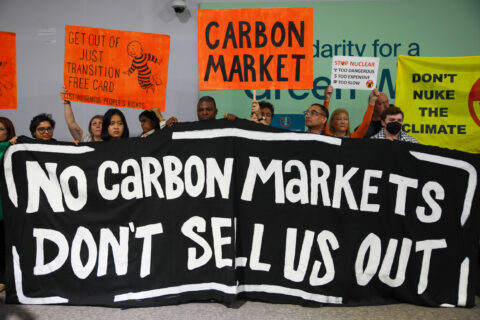
Countries take up industry push to loosen UN carbon market rules at COP31
A draft decision reflects demands from dozens of countries to reassess the UN carbon market’s integrity rules, a push campaigners blame on industry lobbying.


Uncertain impacts on nature
Marine Lecerf, head of international policy at Ocean and Climate Platform, told reporters at COP31 on Tuesday that she is wary about marine carbon removal techniques, and that COP31’s strong push for ocean solutions should focus on more proven actions that cut carbon emissions.
“There are many uncertainties surrounding [marine carbon dioxide removal’s] effectiveness, their scalability, their durability – but even more importantly, their potential adverse impact on nature,” she said.
A paper from earlier this year by the University of California and the US-based National Center for Atmospheric Research (NCAR) shows that, while ocean iron fertilisation’s impacts on nature “remain poorly understood”, disturbances may be stronger in some regions – like the equatorial Pacific – and lesser in others, like the Southern Ocean in Antarctica.
Speaking next to Lecerf at a COP31 press briefing, former Canadian environment minister Steven Guilbeault said the focus should instead be on ocean solutions that have already been proven to work. “We can perhaps another day talk about those technologies if we’re going to need them,” he said.
Asked what solutions are available, young Samoan activist Brianna Fruean spoke of a project she saw at the pre-COP in Fiji last month where the villagers of Naidiri have stopped fishing in an area of their waters and are replanting coral that has been bleached.
All the planters are volunteers though, she told Climate Home News, squeezing it in around their day jobs. With funding, they could be paid for their work – which began in 2009 – and restores the reef much faster, she added.
Push for ocean roadmap that informs next global stocktake grows at COP31
More research needed?
But some ocean advocates support research into these techniques. Kilaparti Ramakrishna, oceans and climate advisor at the Woods Hole Oceanographic Institution – which helped organise the COP31 oceans pavilion – told Climate Home News in September that research should be conducted into these techniques.
Ramakrishna said these techniques “have great potential in taking the carbon out of the atmosphere” and that scientific studies show that “it works” on a small scale. But, he said, the impacts on the environment if it is scaled up to draw a billion tonnes of carbon dioxide from the atmosphere are poorly understood. “So, we need to figure that out,” he said.
Woods Hole is conducting ocean iron fertilisation on a 10 square kilometre area and monitoring it for two years. “We’re already doing field studies”, said Ramakrishna, adding “those are the kinds of things that make the ocean a hero in terms of solving the climate problem. But we should always be mindful that in solving one problem we don’t create other problems”.
Back in September, Ramakrishna defended Woods Hole’s work, saying it does not take corporate money for its marine geongineering studies but only philanthropic foundations or governmental grants. It seeks permits from governments which involves long conversations and consultations, he added.
Pushing back against criticism, he said: “Some environmental groups say ‘oh my god, that is really messing with the environment. We are messing with the ocean environment today. You know, we should be mindful of that.”
The post Ocean advocates warn COP31 agreement should not be read as geoengineering boost appeared first on Climate Home News.
Ocean advocates warn COP31 agreement should not be read as geoengineering boost
Climate Change
ARIA nominees Teen Jesus, Fred Leone, Ocean Alley make red carpet statement to save heritage-nominated Scott Reef from oil and gas drilling
SYDNEY, Wednesday 18 November 2026 — Song of the Year Nominees Ocean Alley, nominee and opening performer Fred Leone, Best Group, Best Rock Album Nominees Teen Jesus and the Jean Teasers, and Hall of Fame inductees Spiderbait are among several artists to wear “Save Scott Reef” turtle-shaped pins and t-shirts at the 2026 ARIA awards ceremony.
- Photos and videos of artists wearing Save Scott Reef pins and t-shirts will be uploaded here, or check the ARIA official share point here.
The “Save Scott Reef” pins and t-shirts, designed by Greenpeace Australia Pacific, bring a nationwide push to save heritage-nominated Scott Reef, located 270 kilometres off WA’s Kimberley coast, into the spotlight at Australia’s top music event.
Scott Reef is home to thousands of marine species, genetically unique green sea turtles and endangered pygmy blue whales but is threatened by oil and gas drilling proposed by multinational corporation Woodside.
Hannah Schuch, Senior Campaigner at Greenpeace Australia Pacific, said: “This Ausmusic Month, artists across generations and genres are amplifying the call of half a million people who have called on the Australian Government to save Scott Reef from Woodside’s reckless plans to drill for oil and gas.
“Scott Reef is an irreplaceable, iconic piece of Australian heritage that has evolved over 15 million years, it is a no-brainer for musicians and creatives to call for the protection of this incredible ecosystem.
“Woodside’s Scott Reef drilling plans threaten to cause the worst oil spill in Australian history, harm threatened turtles and whales, and add to the pressure on our overstressed oceans.
“We’ll all be winners if the government rejects Woodside’s plans and saves Scott Reef.”
It comes as Scott Reef released a debut single titled “If Not Now” alongside Jimmy Barnes, King Gizzard & the Lizard Wizard and a supergroup of over 20 musicians, and over 150 Australian artists and entertainers, including Grammy-nominated Coachella headliner Kevin Parker, signed an open letter calling for Scott Reef’s protection.
Federal Environment Minister, Murray Watt, is expected to decide if Woodside will be allowed to drill at Scott Reef for the Browse oil and gas project in the coming months.
—ENDS—
Wealthy nations are expected to take the lead in topping up the UN’s Green Climate Fund (GCF) over the coming year, even though using taxpayers’ money for international climate finance is a hard sell in today’s political climate, the fund’s head, Mafalda Duarte, told Climate Home News.
As the GCF kickstarts its replenishment push for the 2028-2031 period, many governments in rich countries are redirecting their overseas aid budgets towards domestic priorities, including military spending amid ongoing conflicts in Ukraine and the Middle East.
At COP31 last week, the Solomon Islands made waves by becoming the first country to contribute to the GCF’s fourth fundraising round. It is also the first small island developing state (SID) and the first least developed country (LDC) to put money into the fund, which helps poorer nations cut their emissions and adapt to climate change.
COP31 Bulletin Day 8: EU dubs draft cover text “a shopping list” and endorses electrification goal
Speaking in an interview during the UN climate summit in Antalya, Duarte told Climate Home News the Solomon Islands’ $400,000 donation does not let richer countries off the hook. All nations are being invited to pledge, while “recognising that leadership is to be provided by developed countries”, she added.
“A country that is an LDC and a SID – which are the most vulnerable and the most impacted – they are basically signalling that this is a collective effort,” Duarte said. “If a country like the Solomon Islands can take this leadership, why shouldn’t others?”
Traditional donors tighten purse strings
Since it started operating 12 years ago, the GCF has backed 379 projects and programmes with $22.3 billion across Africa, the Asia-Pacific region, Latin America and the Caribbean, Eastern Europe, Central Asia and the Middle East.
In the last couple of years, wealthy governments have scaled back new commitments for international climate finance, and the UK has cut its current GCF contribution in half. Under climate-change sceptic President Donald Trump, the US has refused to deliver billions promised to the GCF under Democratic administrations.
Besides rich donor nations, higher-income developing countries have also contributed to the fund, including South Korea, Indonesia and Mongolia, although Duarte said that has tailed off somewhat since the fund’s initial fundraising round in 2014.
After approving a record $1.97 billion for 21 new projects last month, the GCF has about $3.7 billion left to allocate through the end of 2027, after managing to boost its available funds by more than $4 billion this year through reducing the amount of money it keeps in reserve to cover potential losses.
It is also planning to open up to contributions from non-government sources of funding such as philanthropic foundations and carbon markets, Duarte said, in a move that was approved by the fund’s board in October.
-
Pacific leaves empty handed from COP31 “pledging event” for new fund
With developed countries only re-announcing old pledges, the facility remains $300 million away from meeting its 2026 target of $500m for resilience projects -
Jordan’s mega-plan for water security risks locking in fossil gas demand
A giant desalination plant will help Jordan confront water scarcity, but solar power’s limited role in the energy-hungry project has raised questions about how climate adaptation finance is being spent


However, she insisted that the efforts to leverage the GCF’s balance sheet more effectively and find new contributors should not be interpreted as easing pressure on rich donor countries.
“Our intent is to maximise the resources that are available to developing countries,” she said, adding that the changes in managing the GCF’s reserves have enhanced the case for putting money into it. With every dollar that comes in, it now can programme 30% more for projects, she noted.
“We are putting all of the efforts we can to make sure that developed countries are as ambitious as