

- Formal negotiations
- Turkish and Australian leadership
- Cover decision
- COP reform
- Adaptation
- Finance
- Just transition work programme
- Loss and damage
- Gender
- Article 6
- Agriculture and food security
- Mitigation work programme
- Response measures
- Action for climate empowerment
- Trade
- Second global stocktake
- Long-term goal review
- Around the COP
- Fossil fuels
- Action agenda
- Global leaders
- Electrification
- China at COP31
- Ocean
- Deforestation
- Methane
- New climate science
- Food and water
- NDCs
- Protests and access
- Road to COP32 and beyond

A type of electric car battery based on iron and phosphorus that poses less of a threat to tropical forests is rapidly replacing batteries reliant on cobalt and nickel, recent data shows.
According to a report on energy transition minerals from the International Energy Agency (IEA) this month, in 2020, lithium iron phosphate (LFP) batteries made up less than a tenth of the electric car market, but by 2024 this had risen to nearly half, driving down the market share of lithium nickel manganese cobalt (NMC) batteries.
The IEA said this shift – which it predicts will continue – had led its experts to revise down their estimates for cobalt and nickel demand. Both minerals are mainly mined in rainforest countries: cobalt in the Democratic Republic of Congo (DRC) and nickel in Indonesia.
Perrine Fournier, a campaigner at forests and rights NGO Fern, told Climate Home that the transition to LFP batteries is “good news for the world’s forests, since they rely on materials such as iron which don’t generally sit under tropical forests”.
Researchers at the French think-tank négaWatt and the Vienna University of Economics and Business found in a recent report commissioned by Fern that if all new electric vehicles used LFP batteries, deforestation would drop by 43% by 2050 compared with business as usual.
Cobalt and nickel mines have attracted criticism from environmental and social justice campaigners, as well as from climate-sceptic opponents of electric cars. Many cobalt miners in the DRC endure harsh working conditions while nickel mines in Indonesia have taken over and destroyed forests on Indigenous land.
Indonesia turns traditional Indigenous land into nickel industrial zone
Lars Christian Bacher, CEO of Norwegian LFP producer Morrow Batteries, told Climate Home on a recent trip to Oslo that the lack of cobalt in LFP manufacturing was an advantage from an environmental point of view “or even some other issues related to child labour and others that we’ve read about”.
But, while LFP batteries may be preferable from the perspective of the environment and human rights, the IEA warned that their supply chain is even more dominated by China than traditional NMC batteries – a growing concern for Western politicians. In particular, the IEA’s head of critical minerals analysis Tae-Yoon Kim warned that manganese sulphate and phosphoric acid are “potential choke-points”.
He pointed out that China produces 95% and 75% respectively of these materials and called on governments to “pay great attention to the emerging bottlenecks in this new battery supply chain”. In January, China’s Ministry of Commerce proposed export restrictions on technology used to manufacture LFP batteries. China produces 98% of LFP cathodes.

LFP batteries began to boom initially because of high nickel and cobalt prices, the IEA said – and their market share is now growing because they are 30% cheaper. They have also become more energy dense, meaning the same size battery can take an electric car further on one charge. Chinese companies BYD and CATL say that their newest batteries can take a car 400-520 km on a five-minute charge.
Speaking to reporters in Oslo, Bacher said another reason Morrow had chosen to produce LFP batteries at its factory in the Norwegian forests is that they are “extremely safe”. He said customers had tested the batteries by trying to stick nails through them and set fire to them, without success.
In contrast, lithium-ion batteries – which are different to LFP batteries – have been described by experts like the British Safety Council as a “growing safety risk” due to battery fires, which grow quickly in intensity as gases are released, feeding the flames.
Does the world need a global treaty on energy transition minerals?
Other types of battery – including sodium-ion batteries and types of lithium-ion batteries rich in manganese – are “also gaining traction”, the IEA’s report said.
Unlike the others, sodium-ion batteries do not contain lithium – but a recent study in Nature Energy found that it will be “challenging” for sodium-ion to compete with lithium batteries on cost until at least the 2030s.
Urvi Mehta, who researches batteries for Lux Research, told an industry briefing that because of its energy density advantage – allowing for longer driving ranges – over sodium, “lithium is here to stay”.
The post Cobalt and nickel-free electric car batteries boom in “good news” for rainforests appeared first on Climate Home News.
Cobalt and nickel-free electric car batteries boom in “good news” for rainforests
Continue Reading
Climate Change
‘Ode to Scott Reef’: Indie-folk duo Hollow Coves performs at famous Australian reef in call for protection
SCOTT REEF, Tuesday 24 November 2026 — Released today, a new music video with Gold Coast duo Hollow Coves performing onboard the flagship Rainbow Warrior at Scott Reef calls for protection of the ancient ecosystem from oil and gas drilling proposed by multinational Woodside.
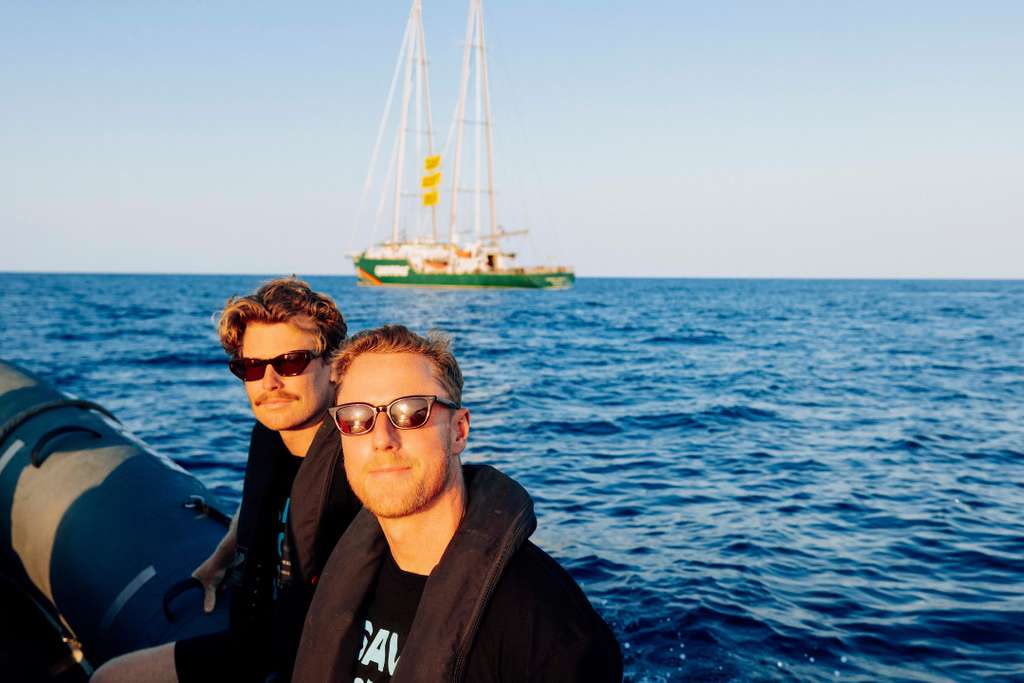
- Watch ‘Coastline’ shot at Scott Reef here and see visuals from the shoot at sea here
The new music video, in collaboration with Greenpeace Australia Pacific, captures a performance of Hollow Coves’ viral single ‘Coastline’, joining a nationwide push by Australian artists to protect heritage-nominated Scott Reef, located 270 kilometres off WA’s Kimberley coast. The video was shot on multiple cameras including a Bolex 16mm vintage movie camera, and boasts original underwater and aerial footage of Scott Reef.
Scott Reef is home to thousands of marine species, genetically unique green sea turtles and endangered pygmy blue whales but is threatened by oil and gas drilling proposed by multinational corporation Woodside, the Browse project.
Matt Carins, Hollow Coves musician, said: “It would be such a tragedy if gas drilling happened at Scott Reef. It’s such an incredible part of the world and is something that we want to pass on to future generations. Being a father myself, I want to share these places with my kids.
“There’s still hope in saving Scott Reef. I think it’s our time now to spread the word of how beautiful this place is. It may not have the same fame as other reef systems, but it’s just as amazing and just as important.”
Ryan Henderson, Hollow Coves musician, said: “Scott Reef is incredible. We were greeted by a pod of dolphins the first day we arrived. The whole place is brimming with wildlife.
“It would be such a shame to allow gas drilling to go ahead at Scott Reef. We wouldn’t allow drilling at the Great Barrier Reef so why should we allow it at Scott Reef which is also so beautiful and so precious. We want to preserve these places.
“There’s still hope. The Australian Government has an opportunity now to save Scott Reef and be on the right side of history.”
Hannah Schuch, Senior Campaigner at Greenpeace Australia Pacific, said: “It was a privilege to witness Hollow Coves playing their iconic single ‘Coastline’ live from Scott Reef, surrounded by wildlife and tranquil blue water.
“The ecological significance of Scott Reef to thousands of species, many of which are threatened, cannot be understated, but its surreal beauty is something that is so easy to capture and makes a perfect setting for a song like Coastline.
“Hollow Coves’ work is a perfect example of the symbiosis between Australian music and nature, and we are so excited to present this musical and cinematic ode to Scott Reef in collaboration with them.
“Drilling at Scott Reef is an unacceptable proposal, and Environment Minister Murray Watt has a generational opportunity to write a legacy of nature protection by putting a stop to Woodside’s plans and saving Scott Reef.”
Minister Watt is expected to decide if Woodside will be allowed to drill at Scott Reef for the Browse gas project in the coming months.
-ENDS-
Media contact
Emma Sangalli on 0431 513 465 or emma.sangalli@greenpeace.org
High res images and footage of Scott Reef can be found here
The COP31 climate talks in Antalya, Turkey, have failed to reach agreement on a “pact” that lacked clear references to curbing fossil fuels or scaling up climate finance.
The “Antalya pact”, proposed by the joint Turkish-Australian presidency, was rejected in the final hours by the EU, the UK and several climate-vulnerable nations.
Meanwhile, many developing countries criticised the lack of progress on climate finance and indecision on a proposed $120bn target for funding climate adaptation.
With stark divisions preventing agreement on the presidency-led pact, UNFCCC chief Simon Stiell expressed “deep disappointment”, speaking of “scope to improve, modernise and reform” the UN climate process.
Despite a chaotic endgame that saw the overrunning COP become the longest in history, it did not end in complete failure, with many items adopted in the closing plenary.
These included fairly limited or procedural outcomes on a new “mechanism” for global “just transitions”, plus support for countries struck by climate disasters.
There was some progress beyond the negotiations, though, with growing coalitions of nations championing “roadmaps” for “transitioning away” from fossil fuels.
With the presidency promoting “electrification” as a key theme, around 80 nations also signed up to a global target of securing 35% of final energy consumption from electricity by 2035.
Here, Carbon Brief provides in-depth analysis of all the key outcomes from Antalya, both inside and outside the COP31 negotiations.
(See Carbon Brief’s coverage of COP30, COP29, COP28, COP27, COP26, COP25, COP24, COP23, COP22, COP21 and COP20.)
- Formal negotiations
- Turkish and Australian leadership
- Cover decision
- COP reform
- Adaptation
- Finance
- Just transition work programme
- Loss and damage
- Gender
- Article 6
- Agriculture and food security
- Mitigation work programme
- Response measures
- Action for climate empowerment
- Trade
- Second global stocktake
- Long-term goal review
- Guidance on NDCs
- Rio synergies
- Around the COP
- Road to COP32 and beyond
Formal negotiations
Turkish and Australian leadership
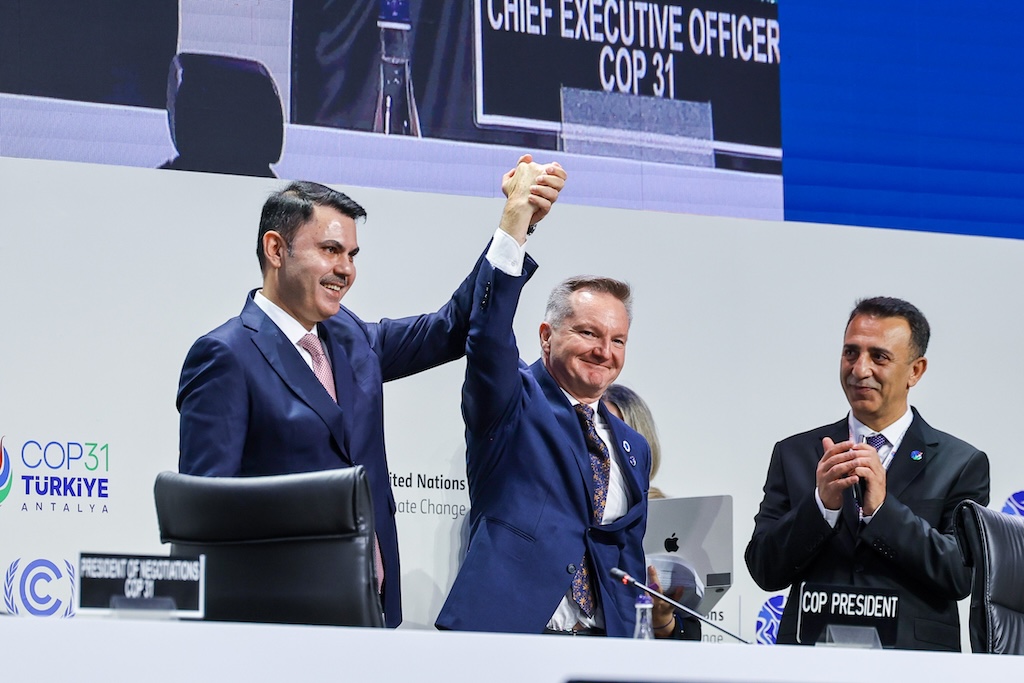
Turkey and Australia presided over the longest COP in history – and failed to find consensus on their proposed “cover decision”, exposing deep fractures between countries on key issues such as fossil fuels and the need for developed nations to meet climate-finance pledges.
Experts told Carbon Brief that, strictly, the talks did not “collapse” as several negotiated items were still adopted.
Rather, the rejection of the cover decision represented, for the first time, “those who want a higher level of ambition actively reject[ing] the lowest common denominator on offer”, said one veteran observer.
Dispute over who would host COP31 – representing the “western Europe and other states” region – had gone on for three years.
In the end, the two main rivals, Turkey and Australia, agreed to a deal last year at COP30 that the summit would take place in Antalya, Turkey, with Australia acting as “president of negotiations”.
Critics questioned whether either country was well-placed to host, given their ongoing fossil-fuel expansion.
Turkey faced criticism for announcing the discovery of two new oil fields on the eve of the summit, while recent Carbon Brief analysis found that Australia is the third-largest CO2 exporter in history because of its fossil-fuel production.
Ahead of the summit, the presidency released four official letters outlining a vision for COP31.
The first letter, written by COP31 president Murat Kurum in April 2026, confirmed the appointment of Australian climate minister Chris Bowen as “president of the negotiations” and announced that a pre-COP would be held in Fiji in October.
The second letter, authored by both Kurum and Bowen from the Copenhagen climate ministerial in May, said that “COP31 presents a vital opportunity to further accelerate…in the areas of clean energy, electrification and resilient infrastructure”.
The third letter, published in August 2026, gave more details on the presidency’s plans for the “