

When a South Korean firm pulled the plug on a multibillion-dollar investment last year, it was a major blow to Indonesia’s plans to build an integrated battery-manufacturing ecosystem – until a group of Chinese companies stepped into the breach.
Project Titan aims to tap Indonesia’s vast nickel reserves in East Halmahera – the epicentre for mining the sought-after metal – before shipping refined and processed material to make batteries for electric vehicles (EVs) more than 2,000 kilometres away in a factory in West Java.
Even before South Korean battery firm LG Energy Solution scrapped its planned $8.45 billion investment in Project Titan, citing “various factors” including market conditions, years of stalled feasibility studies had cast doubt on the initiative – a pillar of Indonesia’s goal to use its nickel riches to become a global battery manufacturing hub and a base for EV production in the region.
The $6-billion investment and cooperation framework struck earlier this year between state companies and a Chinese consortium keeps Project Titan alive, but it also highlights Indonesia’s heavy dependence on China for capital, technology and materials in battery manufacturing.
-
Allegations of harm at China-backed transition minerals projects rise
The growth in recorded abuses linked to Chinese investments comes as a new mediation mechanism between companies and communities gets underway -
Indonesia and Vietnam set for surge in coal use this decade despite transition deals
Rising demand in Southeast Asia and India is expected to prevent coal use from falling significantly this decade, the International Energy Agency predicts -
Cobalt and nickel-free electric car batteries boom in “good news” for rainforests
Lithium iron phosphate batteries do not contain cobalt and nickel, which are mostly found in rainforest nations like the DR Congo and Indonesia


“We get cash but there is no tech transfer or skilled labour jobs,” Zulfikar Rakhmat, director of the China-Indonesia Desk at the Jakarta-based Center of Economic and Law Studies, told Climate Home News. Indonesia’s dependence on China for funding, nickel smelting and processing capacity is “almost total”, he added.
And at a time when cheaper nickel-free battery alternatives are winning over the EV market, China’s outsized role could bring additional commercial risks for Indonesia’s emerging battery industry.
“If Indonesia’s battery chain is seen as entirely Chinese-owned and coal-powered, its product will struggle to enter the Western markets,” Rakhmat added, referring to efforts by countries, including the European Union, to break their dependence on Chinese cleantech and reduce imports of carbon-intensive goods.
A Chinese tale of two halves: steel and batteries
Chinese investment in industrial projects to develop Indonesia’s nickel reserves – the world’s largest – is not new.
China was “the main engine” behind the country’s successful push to refine its nickel domestically after the government banned the export of raw ore in 2020, said Berlin Syahputra Situmorang, a researcher at the Indonesian Initiative for Sustainable Mining.
China, which imported most of Indonesia’s raw nickel ore prior to the ban, invested billions of dollars in building the country’s refining capacity.
Large, mostly coal-powered industrial parks sprang up near mines to refine nickel, some of which have been associated with extensive environmental and human rights abuses.

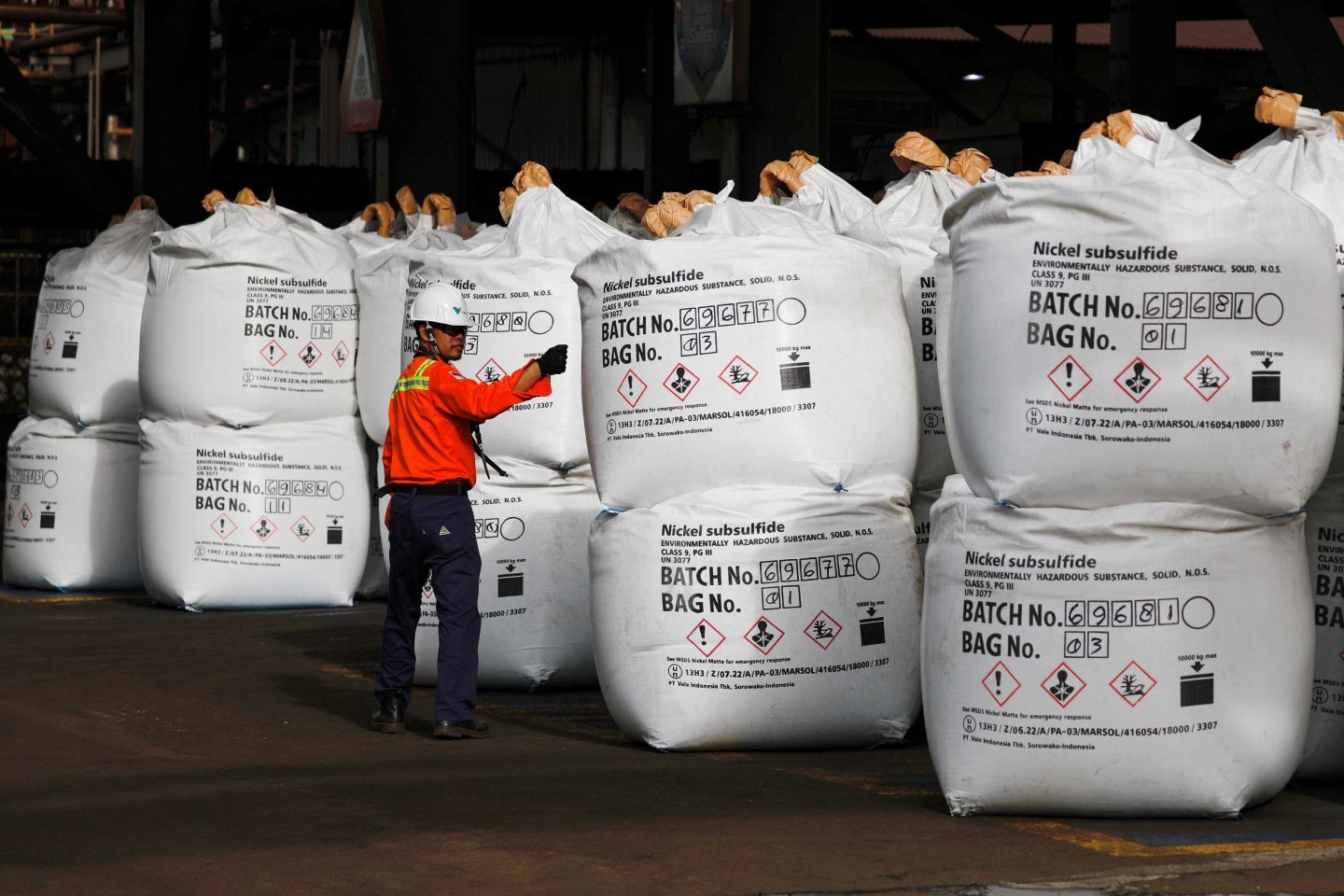
By 2025, Indonesia produced two-thirds of the world’s raw nickel supply and boasted 43% of nickel refining capacity. Yet three-quarters of the country’s refining capacity is controlled by Chinese firms, according to research by the Washington-based research organisation C4ADS.
And while the Indonesian government talked about developing its mineral wealth to power the batteries needed for the energy transition, Indonesia’s real success was to develop a stainless steel industry, the biggest consumer of nickel globally.
More than 80% of Indonesia’s nickel supplied the stainless steel sector in 2025, with only 17% going into the EV battery supply chain, according to analysis by the Centre for Research on Energy and Clean Air (CREA).
“It’s a tale of two different parts,” said Lloyd Hain, managing director of Xenith Market Services, an Australian mining and supply chain consultancy. “Indonesian stainless steel goes all over the world. The battery side, however, has been a completely different story.”
An emerging battery ecosystem
Developing a battery industry has proved a lot more difficult. Several plants to process nickel into battery-grade materials are planned or under construction across the country, but many remain at early stages of development.
Still, Indonesia’s battery exports exceeded $1 billion in 2025, according to data from the UN Comtrade Database. By 2028, CREA estimates that 30% of Indonesia’s nickel production will go towards making battery materials.
The nation’s first battery cell plant in Karawang, West Java, began operating in 2024. It was developed by South Korean car maker Hyundai and LG Energy Solution, which continues to operate the facility despite withdrawing from Project Titan.
-
Southeast Asia’s fragile grids threaten billions in clean energy investment
Renewables developers need reliable electricity infrastructure and stable policies to help the region meet climate goals and surging demand for power -
India looks to untapped graphite riches for slice of critical minerals boom
Clean energy demand for battery-grade graphite is surging, but India faces hurdles as it positions itself to compete with China’s grip on the supply chain -
Recycling could meet half of Europe’s critical mineral needs by 2050
A new report by an EU-funded research project says the bloc could harness its “urban mines” to reduce its dependence on China for energy transition minerals


Project Titan, the flagship integrated battery project, aims to develop 20 gigawatt hours (GWh) of capacity to produce nickel-based EV batteries as well as energy storage batteries to support the country’s goal of rolling out 100 GW of solar capacity in the next four years.
Under the deal agreed this year, it will be operated by Indonesian state companies and a consortium including China’s Zhejiang Huayou Cobalt and battery manufacturer EVE Energy.
Another $5.9-billion joint venture between state firms and a consortium led by Chinese battery giant CATL will develop nickel mining, processing and a battery-recycling factory in East Halmahera as well as a 6.9 GWh battery facility in Karawang, with plans to scale.

Collaboration with Chinese firms “is expected to encourage technology transfer so that national companies can become leaders in their own country”, Minister of Energy and Mineral Resources Bahlil Lahadalia said in a statement about Project Titan.
Foreign companies investing in Indonesia are required to partner with the Indonesia Battery Corporation (IBC), a state-owned enterprise made up of state mining and energy firms, tasked with establishing the capabilities for developing a battery and EV ecosystem.
It is the complexity of making batteries that underlies Indonesia’s dependence on Chinese know-how, said Situmorang of the Indonesian Initiative for Sustainable Mining.
Without a transfer of technology, Indonesia “risks remaining dependent on external players for the most advanced parts of the value chain”, Situmorang told Climate Home News.
Forging a path of its own
Indonesia’s reliance on China does not stop at money and technical knowledge. It also relies on Chinese imports of key battery materials, such as lithium and graphite.
That means Indonesia should aim to diversify its investment partners by working more closely with South Korean companies and seek long-term lithium and graphite supply deals with major producers such as Australia, said Rakhmat of the Center of Economic and Law Studies.
It must also invest in domestic research and development as well as nurturing its own engineering talent, he added.
Eventually, however, the Indonesian government will need to decide whether it wants to integrate its battery ecosystem “completely and unconditionally” into China’s EV supply chain “or go its own way”, said Shen Wei, a research fellow at the UK-based Institute of Development Studies.
He warned that it would be “inherently difficult” for Indonesia to continue to learn from China while simultaneously trying to compete with it.
In a sign of tension between Indonesia’s efforts to capture more value from its resources and the Chinese firms that have bankrolled the industry’s expansion, the Chinese Chamber of Commerce wrote to President Prabowo Subianto in May warning that recent policies, including a sharp reduction in nickel ore production quotas to push up prices, could undermine existing projects and future investment.
The Chinese Chamber of Commerce in Indonesia did not respond to a request for comment, nor did Indonesia’s Ministry of Energy and Mineral Resources or the Ministry of Investment and Downstream Industry.
A damaging myth: “Nickel is everything, forever”
The rapid shift towards nickel-free EV batteries poses another threat to Indonesia’s plans.
China is driving global adoption of lithium iron phosphate (LFP) batteries, a battery chemistry which relies on more common materials, is cheaper to produce and is better suited for frequent charge and discharge, making it an attractive alternative to power electric two- and three-wheelers, urban EVs and stationary power storage.
LFP batteries accounted for more than 55% of EV batteries deployed globally last year, driven by China and imports of Chinese-made vehicles by emerging market countries, according to the International Energy Agency. They also accounted for about 90% of battery storage deployment.
“If Indonesia stays too fixed on a ‘nickel equals EV future’ mindset, there’s a risk of missing where the bulk of the market is actually going,” Situmorang said, noting that in Indonesia, most of the EVs sold in 2025 used LFP batteries.
Nickel-based batteries, which can pack more energy in each battery, are still in demand for long-range and premium EVs popular in the US, Europe and upper-end Asian markets. Outside China, almost 80% of EV batteries used nickel-containing types in 2025.
Rakhmat said Indonesia is adapting its manufacturing strategy, targeting its nickel-based batteries for the export market and boosting production of LFP batteries to meet domestic demand.
Several Chinese firms are already investing to manufacture LFP batteries in Indonesia.
But Rakhmat said the realisation of changes in the market “came very late” and that many local officials still incorrectly believe that “nickel is everything and forever”.
Without a robust industrial policy and a strategy to create sustained domestic demand for “Made in Indonesia” batteries, “there is a possibility that we will be left behind,” he warned.
Main image: A view over the PT Virtue Dragon nickel industrial complex in Konawe, Southeast Sulawesi, Indonesia (Photo: Ulet Ifansasti/Getty Images)
The post China keeps Indonesia’s battery dream afloat but future less certain appeared first on Climate Home News.
China keeps Indonesia’s battery dream afloat but future less certain

Climate Change
‘COP-out’: COP31 fails to deliver the ambition needed to phase out fossil fuels and address climate breakdown
Antalya, Türkiye, Sunday 22 November 2026 — The COP31 climate summit in Antalya has ended in disappointment and anger, as the final COP31 outcome failed to deliver on critical issues like overshooting the 1.5°C limit, fossil fuel phase out and climate finance. Greenpeace Australia Pacific says that Australia did not deliver the deal that the world needed in a time of escalating climate breakdown.
In Antalya, Dr Susie Byers, Head of Advocacy at Greenpeace Australia Pacific, said: “We need to call this COP outcome what it is: a COP-out that has failed to deliver what the world urgently needs given the scale of the crisis we’re facing. It’s a colossal lost opportunity, and one that the world won’t easily forget.
“Coming out of Belém there was momentum to phase out fossil fuels, but COP31 wasn’t able to harness that energy and drive the world forward. The failure to adopt the Cover Decision means there’s now no acknowledgement of, let alone response to, 1.5°C overshoot — the survival line for Pacific nations. Electrification, defence of science, protection for the oceans, and advances on climate finance were all casualties of cynical attempts to derail climate action with dangerous distractions like CCUS.
“Australia knew how hard this task would be and put their hand up anyway. In the end, they didn’t get it done. This outcome validates exactly why so many countries are looking towards parallel tracks like the International Court of Justice Advisory Opinion and national transition roadmaps, where we’ve seen microdiplomacy and Pacific leadership again lead the way. This spirit of multilateralism and collaboration is how we will move beyond rhetoric to concrete actions, and end the fossil fuel chokehold.”
Also in Antalya, Shiva Gounden, Head of Pacific at Greenpeace Australia Pacific, said: “They called this an ‘implementation’ COP, but implementation means nothing when the foundation is broken. The frontline communities leading this fight came to Antalya demanding the urgent, definitive action required to confront the sickening realities of 1.5°C overshoot. Instead, developed countries turned their backs on their historical responsibilities, held climate finance hostage, and treated the debt they owe as a cheap bargaining chip.
“At the exact same time, Parties and negotiating blocs deliberately blocked the bold action the world needed on mitigation, peddled toxic distractions like CCUS, and intentionally scrubbed the words ‘fossil fuels’ from the final text. A strong Presidency that understood the urgency of the situation would not have let this happen; Australia failed to deliver what it promised the Pacific.
“Billions of people across the world are fiercely defending their lives, their homes, their cultures, and their livelihoods, and we came here with their voices demanding real action. By choking off the money and refusing to name the root cause of this collapse, polluting nations made a calculated choice to protect their own interests over our shared future. The Pacific will increasingly look towards parallel paths like the ICJ climate advisory opinion, and the Santa Marta process, to continue finding solutions because that is what our people need.”
ENDS
COP31 images and video available here in Greenpeace Media Library
Media contact: Kate O’Callaghan in Antalya (GMT+3) on +61 406 231 892 (Whatsapp/Signal)
Climate Change
COP31 Bulletin Day 13: New draft retains electrification goal but delays adaptation finance and science decisions
After an evening of tense discussions, a new version of the cover text was finally released at around 2am on Sunday morning. But, with many delegates flying home, it is unclear if – and for how long – there will be the two-thirds of governments present needed to legally adopt a decision.
The latest draft, which is – as of 9.30 – scheduled to be put to a plenary session for approval at 10am – retains a goal to boost electrification and links it more strongly with clean energy and storage. It does not, however, include language on transitioning away from fossil fuels as many countries had called for.
It ditches a specific numerical target for carbon capture, use and storage (CCUS), a controversial technology that is favoured by fossil fuel producers, which is now only an aim “to achieve gigatonne scale globally by 2035 as a collective global aspiration”. The previous version had two alternative targets, a weaker one of 0.5Gt “working towards” 1.3-2.5Gt and a stronger one of 2.5Gt.
The draft cover decision has strong language on responding to an almost certain overshoot of the 1.5C warming limit, recognising that it will increase loss and damage and result “in increasingly adverse, and in some cases irreversible, impacts and risks to human and natural systems”. As President of Negotiations Chris Bowen has repeatedly drawn attention to, this is the first COP held since the UN acknowledged that overshoot is inevitable.
In pursuing efforts to limit any overshoot, the decision recognises the need for “deep, rapid and sustained reductions in greenhouse gas emissions in line with 1.5 °C pathways” – which is a push towards greater ambition.
The text also resolves to close adaptation gaps and boost action and support to help countries and communities to better cope with adverse climate impacts. But it does not put a figure to a goal agreed at COP30 last year to triple adaptation finance by 2035.
The goal did not specify a baseline year and African nations, least-developed countries and small island states had pushed for it to be a later and higher baseline and therefore a larger target number of $120 bn a year. Instead, the text launches a “roadmap” on adaptation finance to be considered at COP32.
Loss and damage finance has been cut from the roadmap’s scope, as have references to about half the money pledged to the loss and damage fund having yet to be sent to the fund’s bank account and the gap between the $2.8 billion of loss and damage funding requested by developing countries in the fund’s start-up stage and the $0.342 billion allocated to fund these projects. “Erasing the shortfall doesn’t make it disappear for families who have lost everything”, said Harjeet Singh, global convenor of Fill the Fund.
The new text drops its invitation to the Intergovernmental Panel on Climate Change (IPCC) to publish all of its next three reports in time for the 2028 global stocktake of climate progress. Instead, it just invites them to “continue to provide policy-relevant information as input to the UNFCCC processes, including outputs from the seventh assessment cycle to the next global stocktake”. It no longer specifies that all their reports, including the third on reducing emissions, are published. The IPCC will have an online meeting in December to discuss this issue but COP31 guidance will be influential in its decision.
As Climate Home News entered the venue around 7.30am, tired-looking negotiators from Saudi Arabia and from the Alliance of Small Island Developing States were seen entering the area which houses the Presidency’s offices, as others dozed on sofas. A source close to the German delegation said that negotiations had been intense and were not necessarily resolved.
If the Presidency does not think it can get agreement on a cover text, then it can withdraw it or it can issue it a Presidency declaration, which does not have much weight. Some of its provisions could be added into other agenda items and adopted seperately. Governments could also decide to reconvene COP31 at a later date – known as a bis – as happened at COP6.
The post COP31 Bulletin Day 13: New draft retains electrification goal but delays adaptation finance and science decisions appeared first on Climate Home News.
COP31 Bulletin Day 13: Germany rejects text moments before plenary meeting