

Welcome to Carbon Brief’s China Briefing.
China Briefing handpicks and explains the most important climate and energy stories from China over the past fortnight. Subscribe for free here.
Key developments
China called for ‘strengthened’ climate cooperation
‘URGENT ACTION’: As the COP30 climate talks in Brazil drew to a close (see today’s spotlight below), world leaders gathered in South Africa for the G20 summit, where China’s premier Li Qiang urged countries to “strengthen ecological and environmental cooperation”, “take urgent action” on climate issues and “accelerate” implementation of COP30’s outcomes, state news agency Xinhua said. The Hong Kong-based South China Morning Post said that, due to the US being a “no-show”, “China and its allies drove the consensus” leading to the final G20 leaders’ declaration, adding that it “delivered major wins for African countries on debt, climate and critical minerals processing”.
-
Sign up to Carbon Brief’s free “China Briefing” email newsletter. All you need to know about the latest developments relating to China and climate change. Sent to your inbox every Thursday.
MINERALS REGIMES: The G20 declaration included a call to ensure critical mineral value-chain resilience, highlighting “geopolitical tensions, unilateral trade measures inconsistent with [World Trade Organization] rules, pandemics or natural disasters” as potential risks, Bloomberg reported, in a “seemingly veiled reference to China’s sweeping export curbs”. Bloomberg also quoted Li defending China’s need to “cautiously manage” critical-mineral exports for military use, adding that China launched a “green mining initiative with 19 nations” at the summit.
MINING TIES: Meanwhile, China and South Africa agreed an “initiative for supporting Africa’s modernisation” pledging to “assist Africa in achieving a fair, just, open and inclusive green and low-carbon transition”, according to the Communist party-affiliated People’s Daily. The text also “encourages countries to strengthen international cooperation on green infrastructure and green mining”, including in “building responsible, transparent, stable and resilient critical mineral value chains”. Reuters said that, in a meeting between the Chinese and German government, Li “pitched stronger ties” in the face of tensions over rare-earth minerals. The UK has “rolled out a critical minerals strategy designed to reduce dependence on foreign suppliers by 2035”, Reuters also reported.
‘SPECIAL’ CONNECTION: Li highlighted China and Russia’s “special, strategic” cooperation in the “oil, gas, coal and nuclear sectors” in talks with Russia’s prime minister, Reuters said. However, at a meeting of the Shanghai Cooperation Organisation in Moscow, Li said governments “should work together to advance green and low-carbon transformation”, the People’s Daily reported. Executive vice-premier Ding Xuexiang also said at the China-Russia energy business forum that the two countries should “deepen cooperation on energy transition”, the People’s Daily also said. Russian oil and gas giant Gazprom is “pushing ahead with plans” for the Power of Siberia 2 pipeline, according to the Financial Times, which added that Chinese officials have yet to confirm the project.
Coal covered October’s power surge
COAL BACKUP: A heatwave in southern China in October caused a surge in power demand, with “coal-power plants picking up the slack amid slow growth in renewables”, Bloomberg reported. This could “make it difficult” for the country to see a plateau or reduction in carbon emissions this year, it added. David Fishman, principal at the consultancy Lantau Group, theorised on Twitter that this could have been due to the rigidity of China’s power-purchasing mechanisms, availability of coal power on spot markets and poor wind-power generation in October.

SLOWING APPROVALS: China’s permitting for new coal-fired power units is on track to hit its lowest level since 2021, according to new research from Greenpeace East Asia. Around 42 gigawatts (GW) of new capacity was permitted in the first three quarters of 2025, it said, noting that the amount of new coal power approved between 2021-2025 was still “more than twice the total permitted” between 2016-2020. Separately, Swiss bank UBS estimated that power demand in China will grow 8% between 2028 and 2030, said finance outlet Yicai.
RENEWABLES RISE: Meanwhile, 13GW of new solar capacity was added in October, as well as 9GW of wind and 8GW of thermal power, reported Bloomberg. According to energy news outlet BJX News, from January to October 2025, China added 253GW of solar, 70GW of wind and 65GW of thermal power, mostly coal.
Managing industry emissions
MARKETS EXPAND: China has approved plans to expand its national carbon market “via a test system” some time this year, reported Bloomberg, effectively confirming that steel, aluminum and cement will be covered in the mechanism by the end of 2025. The government has also released its third batch of methodologies for its voluntary carbon market, all of which are projects related to the country’s oil and gas sector, according to energy news outlet China Energy Net.
SUPER-POLLUTANT PLAN: Separately, the government issued two plans restricting the manufacturing of products using the potent greenhouse gases known as hydrofluorocarbons (HFCs) and a particular type of hydrochlorofluorocarbon (HCFC), such as refrigerators, freezers and insulation foam boards, reported state news agency Xinhua. An interview with an environment ministry official on the state-run China Environment News noted that the policies “clarify” that the HFC controls “include exported household refrigerators and freezers”, although it “excludes vehicle-mounted refrigerators”. Experts had previously told Carbon Brief that exported products were not covered by an action plan to enhance China’s HFC controls published in April that governs these two policies.
ALL-IN ON HYDROGEN: “Green hydrogen” capacity is being “ramp[ed] up”, said Bloomberg, with several projects coming online in the past few months “after Beijing signaled its continued support” for the sector. The government has “backed [hydrogen] tech with several pilot projects this year” and allowed the sector to access “carbon credits to help with funding”, it added. China has also developed its first “coal-to-chemicals project integrating green hydrogen”, which is forecast to produce 71m cubic metres of hydrogen per year, according to Reuters. Meanwhile, the hydrogen industry has also launched its first “anti-involution” initiative, pledging to avoid or prohibit actions such as “below-cost bidding”, “false planning” and “blind pessimism”, said economic news outlet Jiemian.
Spotlight
How China approached COP30 endgame
As negotiations at COP30 entered their final stages, China’s positions in several of the debates proved to be central to discussions.
Below is an excerpt of our coverage of what China said, wanted and got at COP30. The full article is available on Carbon Brief’s website.
Climate finance
One of China’s key priorities – the provision of “financial resources” from developed to developing countries under Article 9.1 of the Paris Agreement – proved to be a significant sticking point in negotiations.
With discussions on climate finance looming large, China proposed during the second week the development of a “practical roadmap for implementation”, predominantly by developed countries, of the $300bn per year “NCQG” climate-finance goal.
China delegation head Li Gao said this would help “avoid blame-shifting…and prevent further erosion of trust” on climate finance.
In the end, while COP30 resulted in a plan within the mutirão decision to develop a “two-year work programme on climate finance” that included a mention of Article 9.1, it was situated within the “context of Article 9…as a whole”. This means that developing countries’ contributions also fall under its scope.
“The EU needed to spend its biggest leverage [at COP30] to adjust the adaptation-finance goal,” Kate Logan, director of the China climate hub and climate diplomacy at the Asia Society Policy Institute (ASPI), told Carbon Brief.
EU-China non-alignment
There was a marked lack of EU-China coordination at COP30 overall, despite efforts to develop a united stance in July.
Multiple observers told Carbon Brief that early negotiations featured a rancorous back-and-forth between the two on the ambitiousness of their respective 2035 emissions reduction targets.
Another point of contention between the two was the role of “unilateral trade measures” (UTMs), which the “like-minded” bloc of developing countries (LMDCs, of which China is a member) asked to be included on the agenda.
Japan, the EU and others argued that other fora would be “more appropriate” for discussions. The EU also implied that China’s critical-mineral export restrictions could also fall into the scope of discussion, should the item be included.
Ultimately, China and others secured its inclusion in the mutirão text and agreement on three annual dialogues on UTMs, culminating in a “high-level event” and report in 2028.
China was also among the countries present for the COP30 presidency’s launch of an integrated forum on climate change and trade, although Carbon Brief understands that it has not formally joined the platform.
Meanwhile, a mention of critical minerals in a draft just-transition text – a potential first for COP – was deleted by the final version.
Joseph Dellatte, head of energy and climate studies at the Institut Montaigne, told Carbon Brief: “Even though the EU is worried about China’s trade measures on [critical materials], it still wants to strike a deal with Beijing.”
Fossil-fuel fracas
China also faced significant pressure on its approach to mitigating emissions.
It was not among countries supporting the idea of a roadmap away from fossil fuels as part of the COP30 outcome. It also opposed calls to emphasise the 1.5C temperature limit, instead “requesting the entire Paris Agreement temperature goal [which includes “well-below” 2C]…be mentioned”.
While the final mutirão text does emphasise the 1.5C limit, fossil fuels were not explicitly mentioned.
Arguments by China that the UAE dialogue should not become a “mini-GST [global stocktake]” also seem to have been considered, with no mention of an annual agenda item in the final outcomes.
The mutirão text “sends a red alert” on the consensus on fossil fuels, Greenpeace East Asia’s global policy advisor Yao Zhe told Carbon Brief.
But Li Shuo, director of ASPI’s China climate hub, said that, despite this, China’s prior agreement to transition away from fossil fuels would “guide its domestic energy reforms”.
Watch, read, listen
VISUALISING CHANGE: Greenpeace East Asia published its work with Chu Weimin, who has used drone photography to document how China’s clean-energy transition is reshaping “landscapes, communities and people’s everyday lives”.
CLIMATE ENVOY’S DEBRIEF: Climate envoy Liu Zhenmin explained why China felt a fossil-fuel roadmap was “unfeasible”, in a wide-ranging interview with the Paper held at the end of COP30.
NDC AMBITION: The Outrage + Optimism podcast spoke with Wang Yi, vice-chair of China’s expert panel on climate change, among others, during week two of COP30.
MISCONCEPTIONS: Wang Binbin, founding director of the Climate Future Global Innovation Lab, explained the thinking behind China’s climate strategy – and how mistranslations underplay its ambition – for China News.
60
The number of nuclear reactor units in China, once the newest unit at Fujian Zhangzhou nuclear power plant – the world’s “largest Hualong One nuclear power base” – completes final checks, Jiemian reported. The unit began delivering power to the grid on 22 November.
New science
Climate warming and forest expansion significantly enhance China’s forest methane sink
Agricultural and Forest Meteorology
China’s forest methane sink “significantly increased” over 1982-2020, according to new research. The paper used a database of “forest methane fluxes” to produce a map of changes in forest methane uptake, finding that rising temperatures, decreasing soil moisture and forest expansion were the main drivers of the increased methane sink. The authors said their study “highlights the positive contribution of climate warming-drying and afforestation to methane sink enhancement”.
Quantifying global climate change impacts on daily record-breaking temperature events in China over the past six decades
International Journal of Climatology
A new study found that summer record-breaking high-temperature events occurred more frequently in China than “theoretically predicted”, while winter record-breaking low-temperature events occurred less frequently. The authors carried out statistical analysis of record-breaking events, using daily surface-air temperature data, collected over 1960-2023 from around 2,300 meteorological stations across China. They found a “more pronounced acceleration” in the frequency of high-temperature record-breaking events after the year 2020.
China Briefing is compiled by Wanyuan Song and Anika Patel. It is edited by Wanyuan Song and Dr Simon Evans. Please send tips and feedback to china@carbonbrief.org

The post China Briefing 27 November 2025: COP30 wraps; Climate and critical minerals at G20; Coal use up appeared first on Carbon Brief.
China Briefing 27 November 2025: COP30 wraps; Climate and critical minerals at G20; Coal use up

Drought and heatwaves occurring together – known as “compound” events – have “surged” across the world since the early 2000s, a new study shows.
Compound drought and heat events (CDHEs) can have devastating effects, creating the ideal conditions for intense wildfires, such as Australia’s “Black Summer” of 2019-20 where bushfires burned 24m hectares and killed 33 people.
The research, published in Science Advances, finds that the increase in CDHEs is predominantly being driven by events that start with a heatwave.
The global area affected by such “heatwave-led” compound events has more than doubled between 1980-2001 and 2002-23, the study says.
The rapid increase in these events over the last 23 years cannot be explained solely by global warming, the authors note.
Since the late 1990s, feedbacks between the land and the atmosphere have become stronger, making heatwaves more likely to trigger drought conditions, they explain.
One of the study authors tells Carbon Brief that societies must pay greater attention to compound events, which can “cause severe impacts on ecosystems, agriculture and society”.
Compound events
CDHEs are extreme weather events where drought and heatwave conditions occur simultaneously – or shortly after each other – in the same region.
These events are often triggered by large-scale weather patterns, such as “blocking” highs, which can produce “prolonged” hot and dry conditions, according to the study.
Prof Sang-Wook Yeh is one of the study authors and a professor at the Ewha Womans University in South Korea. He tells Carbon Brief:
“When heatwaves and droughts occur together, the two hazards reinforce each other through land-atmosphere interactions. This amplifies surface heating and soil moisture deficits, making compound events more intense and damaging than single hazards.”
CDHEs can begin with either a heatwave or a drought.
The sequence of these extremes is important, the study says, as they have different drivers and impacts.
For example, in a CDHE where the heatwave was the precursor, increased direct sunshine causes more moisture loss from soils and plants, leading to a drought.
Conversely, in an event where the drought was the precursor, the lack of soil moisture means that less of the sun’s energy goes into evaporation and more goes into warming the Earth’s surface. This produces favourable conditions for heatwaves.
The study shows that the majority of CDHEs globally start out as a drought.
In recent years, there has been increasing focus on these events due to the devastating impact they have on agriculture, ecosystems and public health.
In Russia in the summer of 2010, a compound drought-heatwave event – and the associated wildfires – caused the death of nearly 55,000 people, the study notes.

The record-breaking Pacific north-west “heat dome” in 2021 triggered extreme drought conditions that caused “significant declines” in wheat yields, as well as in barley, canola and fruit production in British Columbia and Alberta, Canada, says the study.
Increasing events
To assess how CDHEs are changing, the researchers use daily reanalysis data to identify droughts and heatwaves events. (Reanalysis data combines past observations with climate models to create a historical climate record.) Then, using an algorithm, they analyse how these events overlap in both time and space.
The study covers the period from 1980 to 2023 and the world’s land surface, excluding polar regions where CDHEs are rare.
The research finds that the area of land affected by CDHEs has “increased substantially” since the early 2000s.
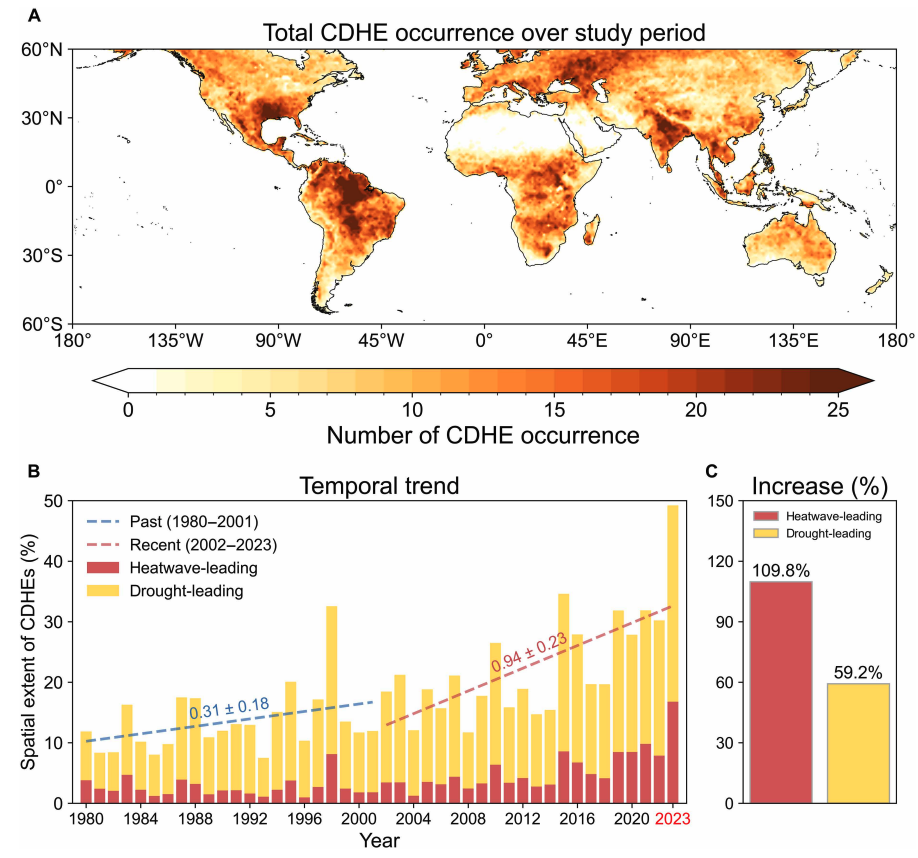
Heatwave-led events have been the main contributor to this increase, the study says, with their spatial extent rising 110% between 1980-2001 and 2002-23, compared to a 59% increase for drought-led events.
The map below shows the global distribution of CDHEs over 1980-2023. The charts show the percentage of the land surface affected by a heatwave-led CDHE (red) or a drought-led CDHE (yellow) in a given year (left) and relative increase in each CDHE type (right).
The study finds that CDHEs have occurred most frequently in northern South America, the southern US, eastern Europe, central Africa and south Asia.
Threshold passed
The authors explain that the increase in heatwave-led CDHEs is related to rising global temperatures, but that this does not tell the whole story.
In the earlier 22-year period of 1980-2001, the study finds that the spatial extent of heatwave-led CDHEs rises by 1.6% per 1C of global temperature rise. For the more-recent period of 2022-23, this increases “nearly eightfold” to 13.1%.
The change suggests that the rapid increase in the heatwave-led CDHEs occurred after the global average temperature “surpasse[d] a certain temperature threshold”, the paper says.
This threshold is an absolute global average temperature of 14.3C, the authors estimate (based on an 11-year average), which the world passed around the year 2000.
Investigating the recent surge in heatwave-leading CDHEs further, the researchers find a “regime shift” in land-atmosphere dynamics “toward a persistently intensified state after the late 1990s”.
In other words, the way that drier soils drive higher surface temperatures, and vice versa, is becoming stronger, resulting in more heatwave-led compound events.
Daily data
The research has some advantages over other previous studies, Yeh says. For instance, the new work uses daily estimations of CDHEs, compared to monthly data used in past research. This is “important for capturing the detailed occurrence” of these events, says Yeh.
He adds that another advantage of their study is that it distinguishes the sequence of droughts and heatwaves, which allows them to “better understand the differences” in the characteristics of CDHEs.
Dr Meryem Tanarhte is a climate scientist at the University Hassan II in Morocco, and Dr Ruth Cerezo Mota is a climatologist and a researcher at the National Autonomous University of Mexico. Both scientists, who were not involved in the study, agree that the daily estimations give a clearer picture of how CDHEs are changing.
Cerezo-Mota adds that another major contribution of the study is its global focus. She tells Carbon Brief that in some regions, such as Mexico and Africa, there is a lack of studies on CDHEs:
“Not because the events do not occur, but perhaps because [these regions] do not have all the data or the expertise to do so.”
However, she notes that the reanalysis data used by the study does have limitations with how it represents rainfall in some parts of the world.
Compound impacts
The study notes that if CDHEs continue to intensify – particularly events where heatwaves are the precursors – they could drive declining crop productivity, increased wildfire frequency and severe public health crises.
These impacts could be “much more rapid and severe as global warming continues”, Yeh tells Carbon Brief.
Tanarhte notes that these events can be forecasted up to 10 days ahead in many regions. Furthermore, she says, the strongest impacts can be prevented “through preparedness and adaptation”, including through “water management for agriculture, heatwave mitigation measures and wildfire mitigation”.
The study recommends reassessing current risk management strategies for these compound events. It also suggests incorporating the sequences of drought and heatwaves into compound event analysis frameworks “to enhance climate risk management”.
Cerezo-Mota says that it is clear that the world needs to be prepared for the increased occurrence of these events. She tells Carbon Brief:
“These [risk assessments and strategies] need to be carried out at the local level to understand the complexities of each region.”



The post Heatwaves driving recent ‘surge’ in compound drought and heat extremes appeared first on Carbon Brief.
Heatwaves driving recent ‘surge’ in compound drought and heat extremes
Greenhouse Gases
DeBriefed 6 March 2026: Iran energy crisis | China climate plan | Bristol’s ‘pioneering’ wind turbine
Welcome to Carbon Brief’s DeBriefed.
An essential guide to the week’s key developments relating to climate change.
This week
Energy crisis
ENERGY SPIKE: US-Israeli attacks on Iran and subsequent counterattacks across the Middle East have sent energy prices “soaring”, according to Reuters. The newswire reported that the region “accounts for just under a third of global oil production and almost a fifth of gas”. The Guardian noted that shipping traffic through the strait of Hormuz, which normally ferries 20% of the world’s oil, “all but ground to a halt”. The Financial Times reported that attacks by Iran on Middle East energy facilities – notably in Qatar – triggered the “biggest rise in gas prices since Russia’s full-scale invasion of Ukraine”.
‘RISK’ AND ‘BENEFITS’: Bloomberg reported on increases in diesel prices in Europe and the US, speculating that rising fuel costs could be “a risk for president Donald Trump”. US gas producers are “poised to benefit from the big disruption in global supply”, according to CNBC. Indian government sources told the