

As COP30 approaches, the Caribbean counts the cost of Hurricane Melissa and Spain marks one year since the flooding disaster in its eastern region of Valencia, the need for stronger climate resilience and more financing for climate adaptation has taken centre stage.
Experts told Climate Home News that last year’s destruction in Spain highlights a little considered problem that can put people at greater risk from increasingly heavy rains: an over-reliance on road transportation.
In late October 2024, a weather system known locally as the DANA killed 229 people and turned towns near Valencia into rivers of mud. In the days that followed, images of wrecked cars swept by floodwaters into piles as high as buildings circulated around the world.
It emerged that many of the victims had died while trying to rescue their cars from flooded garages. The disaster destroyed about 130,000 vehicles in the Valencia region and claimed another 800 that were never found.
Residents are now pushing local governments to consider climate change in rebuilding efforts and to rethink how people get around, to protect them better against future torrential rains.
-
Business-as-usual: Donors pour climate adaptation finance into big infrastructure, neglecting local needs
A deep-sea port project in Bangladesh highlights how some major donor nations are labelling funds for industry-friendly transport and energy projects as adaptation finance, reporting by Climate Home News shows -
Jamaica set for post-Melissa payout but experts warn of limits to hurricane insurance
Catastrophe bonds are likely to bring Jamaica $150 million but critics say premiums may now rise and it’s unfair that taxpayers must fund them -
UN accepts overshooting 1.5C warming limit – at least temporarily – is “inevitable”
UN chief António Guterres says the world’s temperature will rise by more than 1.5C over pre-industrial levels but can be brought down


Over the past year, survivors and victims’ relatives have fiercely criticised the Valencian regional government for only sending out warnings several hours after the floods started, when it was far too late to prepare and people were already drowning or missing. Carlos Mazon, Valencia’s right-wing leader, resigned on Monday over his handling of the crisis.
According to a group of researchers from the University of Valencia, the damage to vehicles and people’s attempts to salvage them reflect the central role played by cars and vans in many suburban areas of Spain, underscoring the urgent need to make sustainable mobility a key pillar of climate adaptation.
‘Crucial to daily life’
Josep Vicent Boira Maiques, a human geography professor at the University of Valencia who has studied the issue following the DANA floods, said building mobility systems that prioritise rail transport between municipalities could help reduce carbon emissions from petrol and diesel cars, and also avoid situations where piled-up vehicles hamper drainage or rescue of survivors.
The Valencia metro area – home to 2.5 million people – has five suburban train lines. Buses cover the rest of the region, but travelling between small towns on public transport can be a challenge.
“You cannot criticise the behaviour of people who died while trying to save their car from a garage without understanding that those people saw their car as a crucial element in their daily life,” Boira Maiques told Climate Home News.

The post-flood rebuilding process must be an occasion to strengthen climate adaptation, and mobility should be a big part of that, he believes.
“If we build back with the same territorial model and the same mobility model, which is a car-centric one, we can find ourselves again in similarly dangerous situations,” he added.
Josep Eliseu Pardo Pascual, professor of cartographic engineering at the Polytechnic University of Valencia, built an interactive map showing how the water level rose as high as 3 metres during the floods. He said the high number of cars parked on roadsides and along riverbanks likely played a big role in this.
More dangerous rains
Maria Jimenez Collado, 45, was born and raised in Aldaia, a town of about 30,000 people a few kilometres west of Valencia. Growing up, she remembers seeing rain during the months of October and November, but not of the intensity experienced in 2024.
“It would rain for weeks, but slowly,” she said. “That way, the water was able to flow and didn’t destroy things the way it does now. The DANA [flooding] has given us a lot of information about what awaits us. We used to say that was the future, but it’s now the present.”
Jimenez Collado’s family home was flooded a year ago, and she is still living with her furniture and personal belongings piled up in her living room as she waits for the remaining humidity to dry out. Her family also lost two cars, and she was only recently able to buy a new one thanks to government aid.


While she had no car, Jimenez Collado would walk to places or take buses, which she said were often impossible to get on due to overcrowding.
Since she was little, the number of cars in the area has increased, she explained, because workplaces like factories and offices have moved to bigger towns – and while people can no longer walk to work, public transport hasn’t caught up.
Climate-friendly railways
Jimenez Collado is part of a group of citizens that is pushing the local government to consider climate change in the post-flood rebuilding process, and to retrofit existing infrastructure so as to cope better with future extreme weather events.
They are proposing, for example, a redesign of one of the existing rail lines that connect the city of Valencia – Spain’s third largest – to some of the surrounding towns.
According to a proposal the group is presenting to the Spanish infrastructure ministry, the old train line – which is also a CO2 emitter as it only supports diesel-powered trains – would be replaced with a tramway lined with cycling paths and green space.

Alejandro Gaita, a resident of Sedavì, another town that was flooded last year, has been gathering evidence and adaptation ideas to discuss with the government. He said the current train lines in the Valencia area can worsen flooding in nearby towns, because their high barriers and track underpinnings hold back water instead of letting it flow away.
“This has been causing us serious issues,” Gaita said. “We are asking either to put railways in tunnels, or to turn them into light rails.” The adaptation proposals from Gaita’s committee were included in a public consultation by the Spanish ecological transition ministry last summer.
Cost-effective for governments
To geographer Boira Maiques, this kind of intervention is more difficult when metropolitan areas have fragmented municipal governments, as is the case in Valencia and many other urban areas in Spain whose regions also have considerable autonomy from Madrid.
France, Germany and the UK, on the other hand, have more unified metropolitan governments and better integrated transport systems between towns.
In the German city of Hanover, a regional government was formed in recent decades that oversees public transport. Suburban trains connect the city with the surrounding towns and villages.
Urda Eichhorst, mobility and cities team lead at Germany’s GIZ development agency, said climate impact assessments and climate risk management must be mainstreamed into infrastructure planning processes – not least to keep costs down in the longer-term.
“Nothing is more expensive than not adapting to climate change,” Eichhorst told Climate Home News.
The missing piece in COP climate talks: Market signals for adaptation
A recent study from the World Resources Institute found that every dollar invested in climate resilience and adaptation generates more than $10 in benefits over a ten-year period.
The COP30 presidency recently said it expects “a major turning point” in adaptation at the upcoming climate summit in Brazil, adding that investing in adaptation can not only protect communities, but also bring major economic benefits and help tackle inequality.
For people living on the frontlines of climate change, as Jimenez Collado and other Valencia residents found out last year, concrete plans to adapt cannot come soon enough: “Someone has to listen to us,” she said. “Our lives are at stake.”
The post Car-driven climate risk: Valencia floods expose need for sustainable transport appeared first on Climate Home News.
Car-driven climate risk: Valencia floods expose need for sustainable transport

Climate Change
‘COP-out’: COP31 fails to deliver the ambition needed to phase out fossil fuels and address climate breakdown
Antalya, Türkiye, Sunday 22 November 2026 — The COP31 climate summit in Antalya has ended in disappointment and anger, as the final COP31 outcome failed to deliver on critical issues like overshooting the 1.5°C limit, fossil fuel phase out and climate finance. Greenpeace Australia Pacific says that Australia did not deliver the deal that the world needed in a time of escalating climate breakdown.
In Antalya, Dr Susie Byers, Head of Advocacy at Greenpeace Australia Pacific, said: “We need to call this COP outcome what it is: a COP-out that has failed to deliver what the world urgently needs given the scale of the crisis we’re facing. It’s a colossal lost opportunity, and one that the world won’t easily forget.
“Coming out of Belém there was momentum to phase out fossil fuels, but COP31 wasn’t able to harness that energy and drive the world forward. The failure to adopt the Cover Decision means there’s now no acknowledgement of, let alone response to, 1.5°C overshoot — the survival line for Pacific nations. Electrification, defence of science, protection for the oceans, and advances on climate finance were all casualties of cynical attempts to derail climate action with dangerous distractions like CCUS.
“Australia knew how hard this task would be and put their hand up anyway. In the end, they didn’t get it done. This outcome validates exactly why so many countries are looking towards parallel tracks like the International Court of Justice Advisory Opinion and national transition roadmaps, where we’ve seen microdiplomacy and Pacific leadership again lead the way. This spirit of multilateralism and collaboration is how we will move beyond rhetoric to concrete actions, and end the fossil fuel chokehold.”
Also in Antalya, Shiva Gounden, Head of Pacific at Greenpeace Australia Pacific, said: “They called this an ‘implementation’ COP, but implementation means nothing when the foundation is broken. The frontline communities leading this fight came to Antalya demanding the urgent, definitive action required to confront the sickening realities of 1.5°C overshoot. Instead, developed countries turned their backs on their historical responsibilities, held climate finance hostage, and treated the debt they owe as a cheap bargaining chip.
“At the exact same time, Parties and negotiating blocs deliberately blocked the bold action the world needed on mitigation, peddled toxic distractions like CCUS, and intentionally scrubbed the words ‘fossil fuels’ from the final text. A strong Presidency that understood the urgency of the situation would not have let this happen; Australia failed to deliver what it promised the Pacific.
“Billions of people across the world are fiercely defending their lives, their homes, their cultures, and their livelihoods, and we came here with their voices demanding real action. By choking off the money and refusing to name the root cause of this collapse, polluting nations made a calculated choice to protect their own interests over our shared future. The Pacific will increasingly look towards parallel paths like the ICJ climate advisory opinion, and the Santa Marta process, to continue finding solutions because that is what our people need.”
ENDS
COP31 images and video available here in Greenpeace Media Library
Media contact: Kate O’Callaghan in Antalya (GMT+3) on +61 406 231 892 (Whatsapp/Signal)
Climate Change
COP31 Bulletin Day 13: New draft retains electrification goal but delays adaptation finance and science decisions
After an evening of tense discussions, a new version of the cover text was finally released at around 2am on Sunday morning. But, with many delegates flying home, it is unclear if – and for how long – there will be the two-thirds of governments present needed to legally adopt a decision.
The latest draft, which is – as of 9.30 – scheduled to be put to a plenary session for approval at 10am – retains a goal to boost electrification and links it more strongly with clean energy and storage. It does not, however, include language on transitioning away from fossil fuels as many countries had called for.
It ditches a specific numerical target for carbon capture, use and storage (CCUS), a controversial technology that is favoured by fossil fuel producers, which is now only an aim “to achieve gigatonne scale globally by 2035 as a collective global aspiration”. The previous version had two alternative targets, a weaker one of 0.5Gt “working towards” 1.3-2.5Gt and a stronger one of 2.5Gt.
The draft cover decision has strong language on responding to an almost certain overshoot of the 1.5C warming limit, recognising that it will increase loss and damage and result “in increasingly adverse, and in some cases irreversible, impacts and risks to human and natural systems”. As President of Negotiations Chris Bowen has repeatedly drawn attention to, this is the first COP held since the UN acknowledged that overshoot is inevitable.
In pursuing efforts to limit any overshoot, the decision recognises the need for “deep, rapid and sustained reductions in greenhouse gas emissions in line with 1.5 °C pathways” – which is a push towards greater ambition.
The text also resolves to close adaptation gaps and boost action and support to help countries and communities to better cope with adverse climate impacts. But it does not put a figure to a goal agreed at COP30 last year to triple adaptation finance by 2035.
The goal did not specify a baseline year and African nations, least-developed countries and small island states had pushed for it to be a later and higher baseline and therefore a larger target number of $120 bn a year. Instead, the text launches a “roadmap” on adaptation finance to be considered at COP32.
Loss and damage finance has been cut from the roadmap’s scope, as have references to about half the money pledged to the loss and damage fund having yet to be sent to the fund’s bank account and the gap between the $2.8 billion of loss and damage funding requested by developing countries in the fund’s start-up stage and the $0.342 billion allocated to fund these projects. “Erasing the shortfall doesn’t make it disappear for families who have lost everything”, said Harjeet Singh, global convenor of Fill the Fund.
The new text drops its invitation to the Intergovernmental Panel on Climate Change (IPCC) to publish all of its next three reports in time for the 2028 global stocktake of climate progress. Instead, it just invites them to “continue to provide policy-relevant information as input to the UNFCCC processes, including outputs from the seventh assessment cycle to the next global stocktake”. It no longer specifies that all their reports, including the third on reducing emissions, are published. The IPCC will have an online meeting in December to discuss this issue but COP31 guidance will be influential in its decision.
As Climate Home News entered the venue around 7.30am, tired-looking negotiators from Saudi Arabia and from the Alliance of Small Island Developing States were seen entering the area which houses the Presidency’s offices, as others dozed on sofas. A source close to the German delegation said that negotiations had been intense and were not necessarily resolved.
If the Presidency does not think it can get agreement on a cover text, then it can withdraw it or it can issue it a Presidency declaration, which does not have much weight. Some of its provisions could be added into other agenda items and adopted seperately. Governments could also decide to reconvene COP31 at a later date – known as a bis – as happened at COP6.
The post COP31 Bulletin Day 13: New draft retains electrification goal but delays adaptation finance and science decisions appeared first on Climate Home News.
COP31 Bulletin Day 13: Germany rejects text moments before plenary meeting
On Friday night, COP31 approved a series of less controversial agenda items and then COP President Murat Kurum told governments to hang around the venue until midnight in case his team wanted to consult them on the cover text, which is still Thursday’s version.
If you don’t hear from us, Kurum said, go home and get some rest and don’t bother coming in before 9am. Governments appear to have taken his advice. Around 10am, the conference centre was ghostly and there was still no sign of a new draft cover text.
COP31 Bulletin Day 11: Countries decry cover text for omitting fossil fuels
Friday night’s plenary did offer a few moments of drama. An activist was ushered out of the room by security after holding a rope around his neck and shouting “you keep doing nothing, nothing at all” and “you are killing the future, just kill me now” to a smattering of applause.
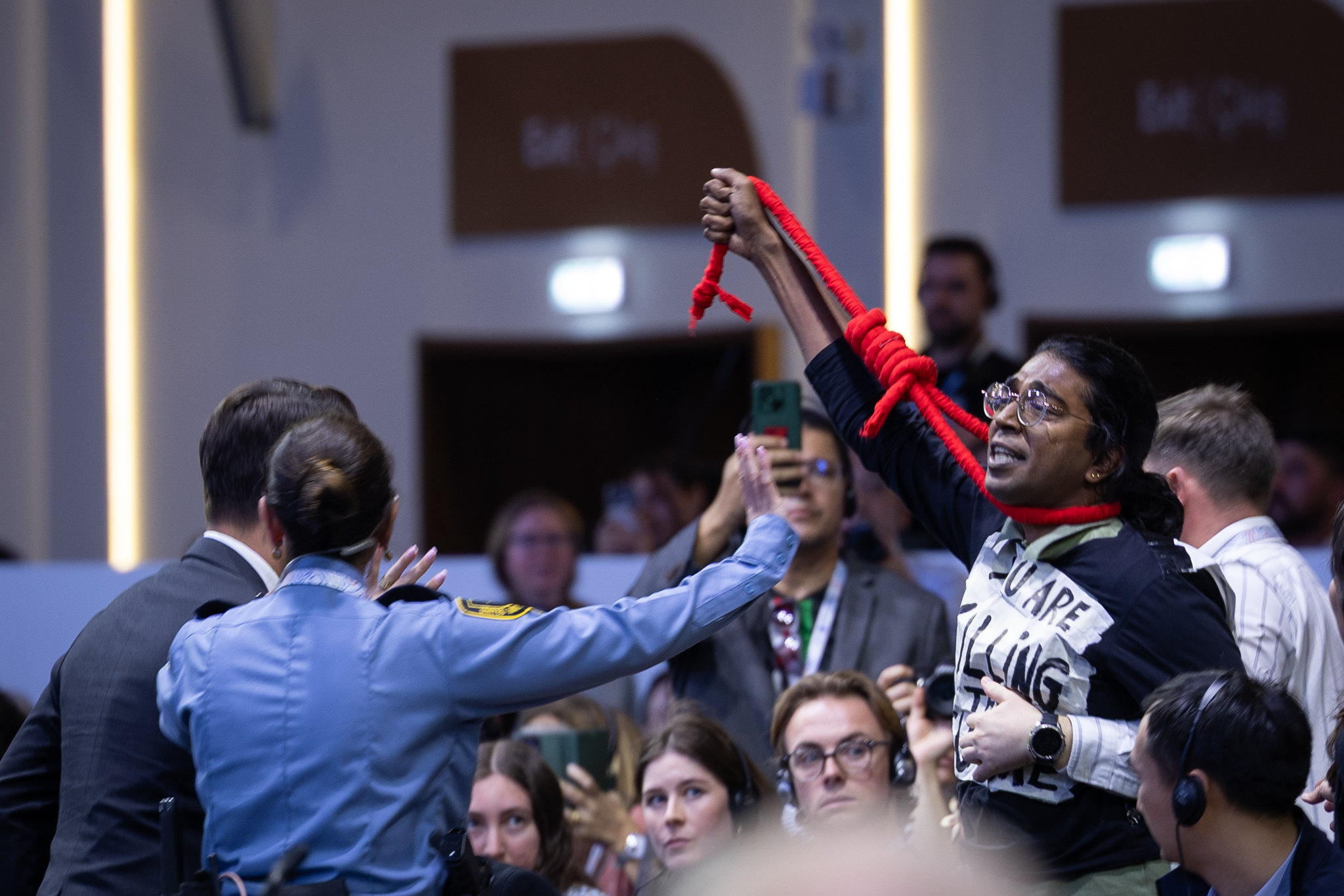
Panama’s environment minister Juan Carlos Navarro urged Kurum to ensure full respect of the rules of procedure when gavelling decisions through this weekend. Given he has led threats to object to the cover text if it is not ambitious enough, this sounded like a warning to Kurum not to ignore objections, as previous COP presidents have been accused of doing.
Another significant development on Friday night was a joint statement from Australia and China which, among other things, expressed China’s backing for the 35×35 electrification goal. More on that here.
The post COP31 Bulletin Day 12: ‘Don’t ignore us,’ Panama warns as COP31 runs into overtime appeared first on Climate Home News.
COP31 Bulletin Day 12: ‘Don’t ignore us,’ Panama warns as COP31 runs into overtime