

The world’s most biodiverse nation, Brazil, has belatedly published its UN plan for halting and reversing nature decline by the end of this decade.
Brazil is home to 10-15% of all known species on Earth, 64% of the Amazon rainforest and it supplies 10% of global food demand, according to official estimates.
It was among around 85% of nations to miss the 2024 deadline for submitting a new UN nature plan, known as a national biodiversity strategy and action plan (NBSAP), according to a joint investigation by Carbon Brief and the Guardian.
On 29 December 2025, Brazil finally published its new NBSAP, following a lengthy consultation process involving hundreds of scientists, Indigenous peoples and civil society members.
The NBSAP details how the country will meet the goals and targets of the Kunming-Montreal Global Biodiversity Framework (GBF), the landmark deal often described as the “Paris Agreement” for nature, agreed in 2022.
Below, Carbon Brief walks through six key takeaways from Brazil’s belated NBSAP:
- The government plans to ‘conserve’ 80% of the Brazilian Amazon by 2030
- It plans to ‘eliminate’ deforestation in Brazilian ecosystems by 2030
- Brazil has ‘aligned’ its actions on tackling climate change and biodiversity loss
- The country seeks to ‘substantially increase’ nature finance from a range of sources
- Brazil’s plans for agriculture include ‘sustainable intensification’
- Brazil conducted a largest-of-its-kind consultation process before releasing its NBSAP
The government plans to ‘conserve’ 80% of the Brazilian Amazon by 2030
The third target of the GBF sets out the aim that “by 2030 at least 30% of terrestrial, inland water and of coastal and marine areas…are effectively conserved and managed”. This is often referred to as “30 by 30”.
Previous analysis by Carbon Brief and the Guardian found that more than half of countries’ pledges were not aligned with this aim. (Importantly, all of the GBF’s targets are global ones and do not prescribe the amount of land that each country must protect.)
Brazil’s NBSAP sets a substantially higher goal – it seeks to conserve 80% of the Amazon rainforest within its borders, as well as 30% of the country’s other ecosystems.
Since Brazil is one of the largest countries in the world, in addition to being the most biodiverse, this higher target represents a significant step towards achieving the global target.
For the purposes of its protected areas target, Brazil considers not just nationally designated protected areas, but also the lands of Indigenous peoples, Quilombola territories and other local communities.
As the NBSAP notes, Brazil has already taken several steps towards achieving the “30 by 30” target.
In 2018, the country created or expanded four marine protected areas in its territorial waters, increasing its protected area coverage from around 1.5% to greater than 25%.
According to Brazil’s sixth national report, submitted to the CBD in 2020, 18% of the country’s “continental area” – that is, its land and inland waters – was part of a protected area. More than 28% of the Amazon received such a designation.
A further 12% of the country is demarcated as Indigenous lands, which “provide important protection to a large territorial extension of the country, particularly in the Amazon biome”, the report says.
The action plan that accompanies the new NBSAP sets out 15 actions in support of achieving target three, including recognising and titling Indigenous lands, establishing ecological corridors and biosphere reserves and implementing national strategies for mangrove, coral reef and wetlands protection.
It plans to ‘eliminate’ deforestation in Brazilian ecosystems by 2030
As well as committing to the GBF targets of protecting and restoring ecosystems, Brazil’s NBSAP also sets a separate target to “eliminate” deforestation in Brazilian biomes by 2030.
Target 1B of Brazil’s NBSAP says that the country aims to “achieve zero deforestation and conversion of native vegetation by 2030”.
The country hopes to achieve this “through the elimination of illegal deforestation and conversion, compensation for the legal suppression of native vegetation, prevention and control of wildfires, combating desertification and attaining land degradation neutrality”.
This goes above and beyond what is set out in the GBF, which does not mention “deforestation” at all.
Brazilian president Luiz Inácio Lula da Silva was reelected as leader in 2022 on a promise to achieve “zero deforestation”, following a rise in Amazon destruction under his predecessor, Jair Bolsonaro.
Data from Global Forest Watch (GFW), an independent satellite research platform, found that deforestation in the Brazilian Amazon fell by a “dramatic” 36% in 2023 under Lula.
However, Brazil remains the world’s largest deforester. Separate GFW data shows that the country accounted for 42% of all primary forest loss in 2024 – with two-thirds of this driven by wildfires fuelled by a record drought.
Brazil has ‘aligned’ its actions on tackling climate change and biodiversity loss
Brazil’s NBSAP comes shortly after it hosted the COP30 climate summit in the Amazon city of Belém in November.
One of the presidency’s priorities at the talks was to bring about greater coordination between global efforts to tackle climate change and biodiversity loss.
At the Rio Earth summit in 1992, the world decided to address Earth’s most pressing environmental problems under three separate conventions: one on climate change, one on biodiversity and the final one on land desertification.
But, for the past few years, a growing number of scientists, politicians and diplomats have questioned whether tackling these issues separately is the right approach.
And, at the most recent biodiversity and land desertification COPs, countries agreed to new texts calling for closer cooperation between the three Rio conventions.
At COP30, the Brazilian presidency attempted to negotiate a new text to enhance “synergies” between the conventions. However, several nations, including Saudi Arabia, vocally opposed the progression of a substantive outcome.
Following on from this, Brazil’s NBSAP states that its vision for tackling nature loss is “aligned” with its UN climate plan, known as a nationally determined contribution (NDC).
In addition, the NBSAP states that Brazil is taking a “holistic approach to addressing the existing crises of climate change and biodiversity loss in a synergistic manner”.
It lists several targets that could help to address both environmental problems, including ending deforestation, promoting sustainable agriculture and restoring ecosystems.
Brazil joins a small number of countries, including Panama and the UK, that have taken steps to bring their actions to tackle climate change and biodiversity loss into alignment.
The country seeks to ‘substantially increase’ nature finance from a range of sources
According to target 19 of the NBSAP, the Brazilian government will “develop and initiate” a national strategy to finance the actions laid out in the document by the end of 2026.
This financial plan “should aim to substantially increase…the volume of financial resources” for implementing the NBSAP.
These resources should come in the form of federal, state and municipal funding, international finance, private funding and incentives for preserving biodiversity, the document continues.
The accompanying action plan includes a number of specific mechanisms, which could be used to finance efforts to tackle nature loss. These include biodiversity credits, a regulated carbon market and the Tropical Forest Forever Facility.
Separately, the NBSAP sets out a goal in target 18 of identifying “subsidies and economic and fiscal incentives that are directly harmful to biodiversity” by the end of this year. Those identified subsidies should then be reduced or eliminated by 2030, it adds.
The document notes that the phaseout of harmful subsidies should be accompanied by an increase in incentives for “conservation, restoration and sustainable use of biodiversity”.
The NBSAP does “important work” in translating the targets of the GBF into “ambitious targets” in the national context, says Oscar Soria, co-founder and chief executive of civil-society organisation the Common Initiative.
Soria tells Carbon Brief:
“While the document is laudable on many aspects and its implementation would change things for the better, the concrete financial means to make it a reality – funding it and halting the funding of activities going against it – are still lacking. In this regard, this NBSAP is a good example of the GBF’s problem at the global level.
“The hardest part of political negotiations will begin only now: in 2026, the Brazilian government will have to evaluate the cost of implementing the NBSAP and where finance will come from.”
Brazil’s plans for agriculture include ‘sustainable intensification’
Brazil is one of the world’s leading food producers, meeting 10% of global demand, according to its NBSAP.
It is also the world’s largest grower of soya beans and the second-largest cattle producer.
However, agriculture is also a major driver of biodiversity loss in Brazil, largely due to the clearing of rainforest or other lands for soya growing and cattle ranching. Agriculture itself is also affected by biodiversity loss, particularly the loss of pollinators. The NBSAP says:
“Biodiversity loss directly undermines agricultural production and human well-being, demonstrating that agriculture, other productive activities and biodiversity conservation are interdependent rather than antagonistic.”
Brazil’s NBSAP addresses sustainable agriculture in target 10A, which aims to “ensure that, by 2030, areas under agriculture, livestock, aquaculture and forestry are managed sustainably and integrated into the landscape”.
It lists several approaches to achieving sustainable production, including agroecology, regenerative agriculture and sustainable intensification.
Targets seven and 10B also pertain to food systems. Target seven seeks to reduce the impacts of pollution, including nutrient loss and pesticides, on biodiversity, while target 10B commits to the sustainable fishing and harvesting of other aquatic resources.
In 2021, Brazil launched its national low-carbon agriculture strategy, known as the ABC+ plan. The plan promotes sustainability in the agricultural sector through both adaptation and mitigation actions.
Brazil conducted a largest-of-its-kind consultation process before releasing its NBSAP
Brazil was among the majority of nations to miss the UN deadline to submit a new NBSAP before the COP16 biodiversity summit in Colombia in October 2024.
At the time, a representative from the Brazilian government said that it was unable to meet the deadline because it was embarking on an ambitious consultation process for its NBSAP.
Braulio Dias, director of biodiversity conservation at the Brazilian Ministry of Environment, who is responsible for the NBSAP process, told Carbon Brief and the Guardian in 2024:
“Brazil is a huge country with the largest share of biodiversity [and] a large population with a complex governance. We are a federation with 26 states and 5,570 municipalities. We started the process to update our NBSAP in May last year and have managed to conclude a broad consultation process involving over a thousand people in face-to-face meetings.
“We are in the process of consolidating all proposals received, consulting all the departments of the Brazilian Ministry of the Environment and Climate Change, all the federal ministries and agencies engaged in the biodiversity agenda and the National Biodiversity Committee, before we can have a high-level political endorsement.
“Then we still have to build a monitoring strategy, a finance strategy and a communication strategy. We will only conclude this process toward the end of the year or early next year.”
In its NBSAP, the Brazilian government says it engaged with around 200 scientific and civil society organisations and 110 Indigenous representatives while preparing its NBSAP.
Around one-third of the Amazon is protected by Indigenous territories.
Indigenous peoples in Brazil have continuously called for more inclusion in UN processes to tackle climate change and nature loss, including by holding multiple demonstrations during the COP30 climate summit in November.
Michel Santos, public policy manager at WWF Brazil, says that many in Brazil’s civil society were pleased with the NBSAP’s extensive consultation process, telling Carbon Brief:
“Brazilian civil society is very happy with everything. It was a long process with broad participation. It took a while to be completed, but we consider the result quite satisfactory.”


The post Brazil’s biodiversity pledge: Six key takeaways for nature and climate change appeared first on Carbon Brief.
Brazil’s biodiversity pledge: Six key takeaways for nature and climate change

Drought and heatwaves occurring together – known as “compound” events – have “surged” across the world since the early 2000s, a new study shows.
Compound drought and heat events (CDHEs) can have devastating effects, creating the ideal conditions for intense wildfires, such as Australia’s “Black Summer” of 2019-20 where bushfires burned 24m hectares and killed 33 people.
The research, published in Science Advances, finds that the increase in CDHEs is predominantly being driven by events that start with a heatwave.
The global area affected by such “heatwave-led” compound events has more than doubled between 1980-2001 and 2002-23, the study says.
The rapid increase in these events over the last 23 years cannot be explained solely by global warming, the authors note.
Since the late 1990s, feedbacks between the land and the atmosphere have become stronger, making heatwaves more likely to trigger drought conditions, they explain.
One of the study authors tells Carbon Brief that societies must pay greater attention to compound events, which can “cause severe impacts on ecosystems, agriculture and society”.
Compound events
CDHEs are extreme weather events where drought and heatwave conditions occur simultaneously – or shortly after each other – in the same region.
These events are often triggered by large-scale weather patterns, such as “blocking” highs, which can produce “prolonged” hot and dry conditions, according to the study.
Prof Sang-Wook Yeh is one of the study authors and a professor at the Ewha Womans University in South Korea. He tells Carbon Brief:
“When heatwaves and droughts occur together, the two hazards reinforce each other through land-atmosphere interactions. This amplifies surface heating and soil moisture deficits, making compound events more intense and damaging than single hazards.”
CDHEs can begin with either a heatwave or a drought.
The sequence of these extremes is important, the study says, as they have different drivers and impacts.
For example, in a CDHE where the heatwave was the precursor, increased direct sunshine causes more moisture loss from soils and plants, leading to a drought.
Conversely, in an event where the drought was the precursor, the lack of soil moisture means that less of the sun’s energy goes into evaporation and more goes into warming the Earth’s surface. This produces favourable conditions for heatwaves.
The study shows that the majority of CDHEs globally start out as a drought.
In recent years, there has been increasing focus on these events due to the devastating impact they have on agriculture, ecosystems and public health.
In Russia in the summer of 2010, a compound drought-heatwave event – and the associated wildfires – caused the death of nearly 55,000 people, the study notes.

The record-breaking Pacific north-west “heat dome” in 2021 triggered extreme drought conditions that caused “significant declines” in wheat yields, as well as in barley, canola and fruit production in British Columbia and Alberta, Canada, says the study.
Increasing events
To assess how CDHEs are changing, the researchers use daily reanalysis data to identify droughts and heatwaves events. (Reanalysis data combines past observations with climate models to create a historical climate record.) Then, using an algorithm, they analyse how these events overlap in both time and space.
The study covers the period from 1980 to 2023 and the world’s land surface, excluding polar regions where CDHEs are rare.
The research finds that the area of land affected by CDHEs has “increased substantially” since the early 2000s.
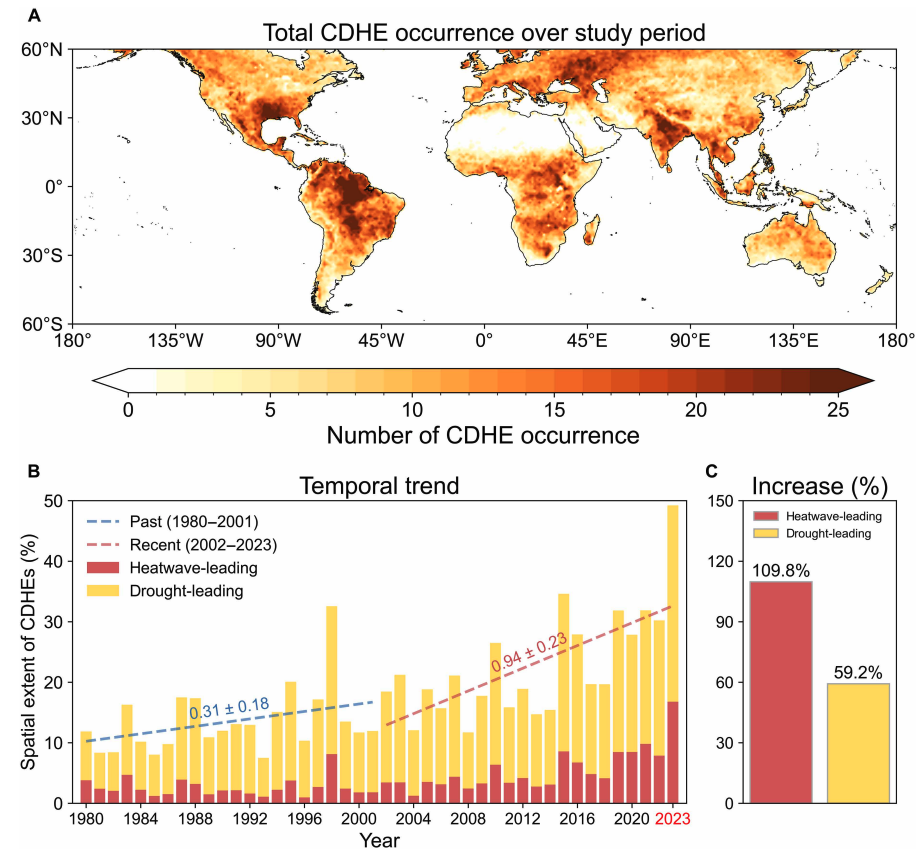
Heatwave-led events have been the main contributor to this increase, the study says, with their spatial extent rising 110% between 1980-2001 and 2002-23, compared to a 59% increase for drought-led events.
The map below shows the global distribution of CDHEs over 1980-2023. The charts show the percentage of the land surface affected by a heatwave-led CDHE (red) or a drought-led CDHE (yellow) in a given year (left) and relative increase in each CDHE type (right).
The study finds that CDHEs have occurred most frequently in northern South America, the southern US, eastern Europe, central Africa and south Asia.
Threshold passed
The authors explain that the increase in heatwave-led CDHEs is related to rising global temperatures, but that this does not tell the whole story.
In the earlier 22-year period of 1980-2001, the study finds that the spatial extent of heatwave-led CDHEs rises by 1.6% per 1C of global temperature rise. For the more-recent period of 2022-23, this increases “nearly eightfold” to 13.1%.
The change suggests that the rapid increase in the heatwave-led CDHEs occurred after the global average temperature “surpasse[d] a certain temperature threshold”, the paper says.
This threshold is an absolute global average temperature of 14.3C, the authors estimate (based on an 11-year average), which the world passed around the year 2000.
Investigating the recent surge in heatwave-leading CDHEs further, the researchers find a “regime shift” in land-atmosphere dynamics “toward a persistently intensified state after the late 1990s”.
In other words, the way that drier soils drive higher surface temperatures, and vice versa, is becoming stronger, resulting in more heatwave-led compound events.
Daily data
The research has some advantages over other previous studies, Yeh says. For instance, the new work uses daily estimations of CDHEs, compared to monthly data used in past research. This is “important for capturing the detailed occurrence” of these events, says Yeh.
He adds that another advantage of their study is that it distinguishes the sequence of droughts and heatwaves, which allows them to “better understand the differences” in the characteristics of CDHEs.
Dr Meryem Tanarhte is a climate scientist at the University Hassan II in Morocco, and Dr Ruth Cerezo Mota is a climatologist and a researcher at the National Autonomous University of Mexico. Both scientists, who were not involved in the study, agree that the daily estimations give a clearer picture of how CDHEs are changing.
Cerezo-Mota adds that another major contribution of the study is its global focus. She tells Carbon Brief that in some regions, such as Mexico and Africa, there is a lack of studies on CDHEs:
“Not because the events do not occur, but perhaps because [these regions] do not have all the data or the expertise to do so.”
However, she notes that the reanalysis data used by the study does have limitations with how it represents rainfall in some parts of the world.
Compound impacts
The study notes that if CDHEs continue to intensify – particularly events where heatwaves are the precursors – they could drive declining crop productivity, increased wildfire frequency and severe public health crises.
These impacts could be “much more rapid and severe as global warming continues”, Yeh tells Carbon Brief.
Tanarhte notes that these events can be forecasted up to 10 days ahead in many regions. Furthermore, she says, the strongest impacts can be prevented “through preparedness and adaptation”, including through “water management for agriculture, heatwave mitigation measures and wildfire mitigation”.
The study recommends reassessing current risk management strategies for these compound events. It also suggests incorporating the sequences of drought and heatwaves into compound event analysis frameworks “to enhance climate risk management”.
Cerezo-Mota says that it is clear that the world needs to be prepared for the increased occurrence of these events. She tells Carbon Brief:
“These [risk assessments and strategies] need to be carried out at the local level to understand the complexities of each region.”




The post Heatwaves driving recent ‘surge’ in compound drought and heat extremes appeared first on Carbon Brief.
Heatwaves driving recent ‘surge’ in compound drought and heat extremes
Greenhouse Gases
DeBriefed 6 March 2026: Iran energy crisis | China climate plan | Bristol’s ‘pioneering’ wind turbine
Welcome to Carbon Brief’s DeBriefed.
An essential guide to the week’s key developments relating to climate change.
This week
Energy crisis
ENERGY SPIKE: US-Israeli attacks on Iran and subsequent counterattacks across the Middle East have sent energy prices “soaring”, according to Reuters. The newswire reported that the region “accounts for just under a third of global oil production and almost a fifth of gas”. The Guardian noted that shipping traffic through the strait of Hormuz, which normally ferries 20% of the world’s oil, “all but ground to a halt”. The Financial Times reported that attacks by Iran on Middle East energy facilities – notably in Qatar – triggered the “biggest rise in gas prices since Russia’s full-scale invasion of Ukraine”.
‘RISK’ AND ‘BENEFITS’: Bloomberg reported on increases in diesel prices in Europe and the US, speculating that rising fuel costs could be “a risk for president Donald Trump”. US gas producers are “poised to benefit from the big disruption in global supply”, according to CNBC. Indian government sources told the Economic Times that Russia is prepared to “fulfil India’s energy demands”. China Daily quoted experts who said “China’s energy security remains fundamentally unshaken”, thanks to “emergency stockpiles and a wide array of import channels”.
‘ESSENTIAL’ RENEWABLES: Energy analysts said governments should cut their fossil-fuel reliance by investing in renewables, “rather than just seeking non-Gulf oil and gas suppliers”, reported Climate Home News. This message was echoed by UK business secretary Peter Kyle, who said “doubling down on renewables” was “essential” amid “regional instability”, according to the Daily Telegraph.
China’s climate plan
PEAK COAL?: China has set out its next “five-year plan” at the annual “two sessions” meeting of the National People’s Congress, including its climate strategy out to 2030, according to the Hong Kong-based