

It has been dubbed the “Amazon COP”, the “COP of Implementation” and “the COP of Truth” – but the UN climate summit in the Brazilian city of Belém may end up being remembered as the biofuels COP.
COP30 president Brazil – a leading producer of sugar-based ethanol and soy-based biodiesel – won backing from 23 governments for a pledge to quadruple production of so-called sustainable fuels by 2030, and has set out to promote biofuels at the talks.
The production of biofuels is likely to ramp up in the coming years, with the air travel and shipping industries – as well as road transport – seeing it as a cheaper way to decarbonise than technologies based on green hydrogen.
But critics say the need for more land to grow the feedstocks used to make biofuels can increase deforestation pressure, and that land suitable for growing crops should be used for food, not fuel.
-
Poorest countries appeal for more adaptation finance at COP30
The Least-Developed Countries want a new goal to triple adaptation finance by 2030, saying an expected agreement on metrics for progress is meaningless without money -
Pressure builds for fossil fuel transition plan at COP30
More than 80 countries issue a call for the summit outcome to include a commitment to develop a roadmap for the world to shift away from oil, gas and coal -
Global Goal on Adaptation: Weighing the cow won’t make it fatter
COP30’s Global Goal on Adaptation will be a white elephant if it is not paired with predictable, grant-based finance


Cian Delaney, a campaigner on energy issues at the Brussels-based Transport & Environment group, said it is “difficult to imagine a scenario where this [pledge] doesn’t require more land clearance”.
“Without any commitment from countries to meet the target without clearing more land, this will be devastating for the climate, ecosystems and food security,” he said.
Brazil has tried to allay these concerns, saying that for fuels to be considered sustainable they must have a low greenhouse gas intensity and comply with a set of criteria such as nature conservation, sustainable water management and compliance with social safeguards.
Biofuels take centre-stage at COP30
Biofuels have been prominent at the COP30 venue itself. Electricity generators at the venue and buses shuttling delegates around are running on diesel mixed with 10% biofuels, and corporate advocates of plant-based fuels such as Toyota are promoting their product.
The Japanese carmaker was present on at least 10 panels and provided a fleet of 70 hybrid vehicles powered by ethanol. Information tablets in each of the cars made the case for biofuels.
Toyota’s communications director, Roberto Braun, told one panel that electric vehicles (EVs) and biofuels are both part of the solution to tackling transport’s fossil fuel emissions, especially in developing countries without adequate charging infrastructure or widespread power access.
They also create jobs, Braun told the panel run by Brazil’s main business association (CNI).
But Greenpeace, which has previously challenged Toyota over its support for biofuels, accused the company of undermining global efforts to fight climate change by ignoring “mounting scientific consensus that biofuels are a false climate solution”.

Food vs fuel vs forests
Those opposed to biofuels say using renewable electricity and batteries – or green hydrogen made from renewable power – is the right way to cut emissions from transport.
But those options appear a remote possibility in parts of the Global South where charging points are rare and power infrastructure limited, as is the case in Brazil’s vast interior. Other developing countries like COP32 host Ethiopia have faced similar challenges to EV roll-out in rural areas.
In contrast, across Brazil, biofuels are already well-established.
According to a report prepared for the COP30 presidency by the International Energy Agency (IEA), no major country gets more of its fuel from biofuels – particularly ethanol – than Brazil.
Drivers across the country can choose between refuelling with pure ethanol or with a – usually slightly more expensive – mix of 30% ethanol and 70% gasoline. In rural areas, where pick-up trucks like Toyota’s are a ubiquitous sight, billboards advertise ethanol’s environmental benefits.
“Rich country-centric” EV focus
In the run-up to COP30, Greenpeace exchanged a series of open letters with Toyota President Koji Sato, who said the company’s strategy reflected the “differing needs and energy circumstances of customers across nations and regions”.
Taking different realities into account makes sense, said Francis X. Johnson, a scientist who was lead author on the Intergovernmental Panel on Climate Change’s special report on climate change and land.

He told Climate Home News the focus on EVs has created a “rich country-centric” perspective.
“In the Global South, where significant populations still live in rural areas and where infrastructure and electricity are often unreliable or absent,” Johnson said, more diversified strategies involving biofuels are “highly valuable”.
Their merits vary wildly depending on the biofuel though, he warned. While sugarcane-based ethanol in Brazil has been “providing emissions and development benefits for years”, soy or corn-based biofuels in Europe or North America are generally quite polluting.
As Climate Home News revealed in June, virgin palm oil from Malaysia has been passed off as used cooking oil and sold to aviation fuel suppliers in Europe, hiking deforestation and food prices in the rainforest nation.
-
Is the world’s big idea for greener air travel a flight of fancy?
Suspicions of fraud, ‘ridiculous’ data and a dearth of supplies – our investigation exposes the flaws in the airline industry’s big green hope: sustainable aviation fuel -
Brazilian firm behind SAF plan found growing oil palm on deforested Amazon land
Discovery of illegal palm crops comes as Grupo BBF grapples with financial problems sparked by warnings over its human rights record -
Air travel’s ‘holy grail’: Jet fuel made from CO2 and water prepares for take-off
Synthetic jet fuel companies think they have the answer to tackling aviation emissions despite concerns about the cost of producing energy-hungry e-SAF



Felipe Barcellos from the Energy and Environment Institute (IEMA), a Brazilian think-tank, said there were “a lot of bad examples, like Indonesia and Malaysia”, adding that “this oil is very problematic”.
But, he said that while EVs are the best choice, biofuels have a place as long as proper safeguards are in place to prevent deforestation to make way for feedstock crops.
Brazil has 100 million hectares of degraded pasture, an area the size of Egypt, some of which could be brought back into productivity for crops, Barcellos said. Some could also be reforested, though reforesting all of it is not feasible, due to the high cost and need for financing.
EVs must be the priority, campaigners say
But for Greenpeace, biofuels can only be a limited, stop-gap measure on the road to an EV-only future.
Greenpeace campaigner Mariko Shiohata, who has led the campaign group’s criticism of Toyota’s progress to electrify its range, acknowledged that biofuels “will be needed on a marginal scale”. Brazil-based Greenpeace campaigner Camila Jardim said biofuels “may play a limited and temporary role in Brazil”.
But “large-scale bioenergy crops still drive land pressure, monocultures, pesticide use and social conflict, even when labelled as ‘using degraded land’,” Jardim said. In practice, expansion often displaces cattle and can indirectly fuel deforestation, she added.
In the meantime, switching to electric and reducing the number of cars on the road worldwide should be the priority, Shiohata said, suggesting Toyota could do more – for example, by making small, cheap EVs with renewable-energy charging stations. Governments should also encourage electricity access with off-grid solar panels.
“There’s no time for detours on electrification,” she said.
The post “Biofuels COP” stirs debate on how to clean up cars where EVs are tricky appeared first on Climate Home News.
“Biofuels COP” stirs debate on how to clean up cars where EVs are tricky

Climate Change
‘COP-out’: COP31 fails to deliver the ambition needed to phase out fossil fuels and address climate breakdown
Antalya, Türkiye, Sunday 22 November 2026 — The COP31 climate summit in Antalya has ended in disappointment and anger, as the final COP31 outcome failed to deliver on critical issues like overshooting the 1.5°C limit, fossil fuel phase out and climate finance. Greenpeace Australia Pacific says that Australia did not deliver the deal that the world needed in a time of escalating climate breakdown.
In Antalya, Dr Susie Byers, Head of Advocacy at Greenpeace Australia Pacific, said: “We need to call this COP outcome what it is: a COP-out that has failed to deliver what the world urgently needs given the scale of the crisis we’re facing. It’s a colossal lost opportunity, and one that the world won’t easily forget.
“Coming out of Belém there was momentum to phase out fossil fuels, but COP31 wasn’t able to harness that energy and drive the world forward. The failure to adopt the Cover Decision means there’s now no acknowledgement of, let alone response to, 1.5°C overshoot — the survival line for Pacific nations. Electrification, defence of science, protection for the oceans, and advances on climate finance were all casualties of cynical attempts to derail climate action with dangerous distractions like CCUS.
“Australia knew how hard this task would be and put their hand up anyway. In the end, they didn’t get it done. This outcome validates exactly why so many countries are looking towards parallel tracks like the International Court of Justice Advisory Opinion and national transition roadmaps, where we’ve seen microdiplomacy and Pacific leadership again lead the way. This spirit of multilateralism and collaboration is how we will move beyond rhetoric to concrete actions, and end the fossil fuel chokehold.”
Also in Antalya, Shiva Gounden, Head of Pacific at Greenpeace Australia Pacific, said: “They called this an ‘implementation’ COP, but implementation means nothing when the foundation is broken. The frontline communities leading this fight came to Antalya demanding the urgent, definitive action required to confront the sickening realities of 1.5°C overshoot. Instead, developed countries turned their backs on their historical responsibilities, held climate finance hostage, and treated the debt they owe as a cheap bargaining chip.
“At the exact same time, Parties and negotiating blocs deliberately blocked the bold action the world needed on mitigation, peddled toxic distractions like CCUS, and intentionally scrubbed the words ‘fossil fuels’ from the final text. A strong Presidency that understood the urgency of the situation would not have let this happen; Australia failed to deliver what it promised the Pacific.
“Billions of people across the world are fiercely defending their lives, their homes, their cultures, and their livelihoods, and we came here with their voices demanding real action. By choking off the money and refusing to name the root cause of this collapse, polluting nations made a calculated choice to protect their own interests over our shared future. The Pacific will increasingly look towards parallel paths like the ICJ climate advisory opinion, and the Santa Marta process, to continue finding solutions because that is what our people need.”
ENDS
COP31 images and video available here in Greenpeace Media Library
Media contact: Kate O’Callaghan in Antalya (GMT+3) on +61 406 231 892 (Whatsapp/Signal)
Climate Change
COP31 Bulletin Day 13: New draft retains electrification goal but delays adaptation finance and science decisions
After an evening of tense discussions, a new version of the cover text was finally released at around 2am on Sunday morning. But, with many delegates flying home, it is unclear if – and for how long – there will be the two-thirds of governments present needed to legally adopt a decision.
The latest draft, which is – as of 9.30 – scheduled to be put to a plenary session for approval at 10am – retains a goal to boost electrification and links it more strongly with clean energy and storage. It does not, however, include language on transitioning away from fossil fuels as many countries had called for.
It ditches a specific numerical target for carbon capture, use and storage (CCUS), a controversial technology that is favoured by fossil fuel producers, which is now only an aim “to achieve gigatonne scale globally by 2035 as a collective global aspiration”. The previous version had two alternative targets, a weaker one of 0.5Gt “working towards” 1.3-2.5Gt and a stronger one of 2.5Gt.
The draft cover decision has strong language on responding to an almost certain overshoot of the 1.5C warming limit, recognising that it will increase loss and damage and result “in increasingly adverse, and in some cases irreversible, impacts and risks to human and natural systems”. As President of Negotiations Chris Bowen has repeatedly drawn attention to, this is the first COP held since the UN acknowledged that overshoot is inevitable.
In pursuing efforts to limit any overshoot, the decision recognises the need for “deep, rapid and sustained reductions in greenhouse gas emissions in line with 1.5 °C pathways” – which is a push towards greater ambition.
The text also resolves to close adaptation gaps and boost action and support to help countries and communities to better cope with adverse climate impacts. But it does not put a figure to a goal agreed at COP30 last year to triple adaptation finance by 2035.
The goal did not specify a baseline year and African nations, least-developed countries and small island states had pushed for it to be a later and higher baseline and therefore a larger target number of $120 bn a year. Instead, the text launches a “roadmap” on adaptation finance to be considered at COP32.
Loss and damage finance has been cut from the roadmap’s scope, as have references to about half the money pledged to the loss and damage fund having yet to be sent to the fund’s bank account and the gap between the $2.8 billion of loss and damage funding requested by developing countries in the fund’s start-up stage and the $0.342 billion allocated to fund these projects. “Erasing the shortfall doesn’t make it disappear for families who have lost everything”, said Harjeet Singh, global convenor of Fill the Fund.
The new text drops its invitation to the Intergovernmental Panel on Climate Change (IPCC) to publish all of its next three reports in time for the 2028 global stocktake of climate progress. Instead, it just invites them to “continue to provide policy-relevant information as input to the UNFCCC processes, including outputs from the seventh assessment cycle to the next global stocktake”. It no longer specifies that all their reports, including the third on reducing emissions, are published. The IPCC will have an online meeting in December to discuss this issue but COP31 guidance will be influential in its decision.
As Climate Home News entered the venue around 7.30am, tired-looking negotiators from Saudi Arabia and from the Alliance of Small Island Developing States were seen entering the area which houses the Presidency’s offices, as others dozed on sofas. A source close to the German delegation said that negotiations had been intense and were not necessarily resolved.
If the Presidency does not think it can get agreement on a cover text, then it can withdraw it or it can issue it a Presidency declaration, which does not have much weight. Some of its provisions could be added into other agenda items and adopted seperately. Governments could also decide to reconvene COP31 at a later date – known as a bis – as happened at COP6.
The post COP31 Bulletin Day 13: New draft retains electrification goal but delays adaptation finance and science decisions appeared first on Climate Home News.
COP31 Bulletin Day 13: Germany rejects text moments before plenary meeting
On Friday night, COP31 approved a series of less controversial agenda items and then COP President Murat Kurum told governments to hang around the venue until midnight in case his team wanted to consult them on the cover text, which is still Thursday’s version.
If you don’t hear from us, Kurum said, go home and get some rest and don’t bother coming in before 9am. Governments appear to have taken his advice. Around 10am, the conference centre was ghostly and there was still no sign of a new draft cover text.
COP31 Bulletin Day 11: Countries decry cover text for omitting fossil fuels
Friday night’s plenary did offer a few moments of drama. An activist was ushered out of the room by security after holding a rope around his neck and shouting “you keep doing nothing, nothing at all” and “you are killing the future, just kill me now” to a smattering of applause.
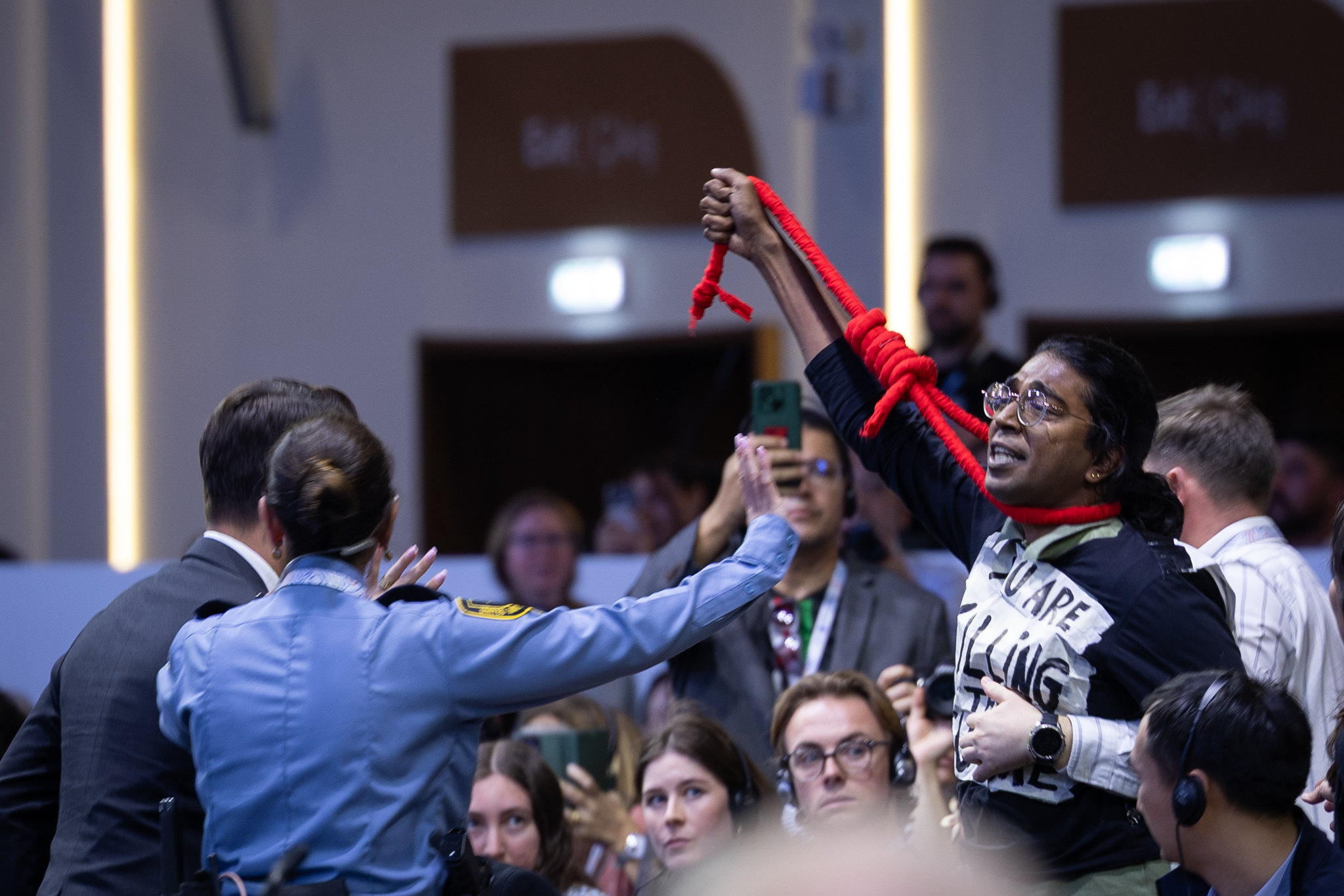
Panama’s environment minister Juan Carlos Navarro urged Kurum to ensure full respect of the rules of procedure when gavelling decisions through this weekend. Given he has led threats to object to the cover text if it is not ambitious enough, this sounded like a warning to Kurum not to ignore objections, as previous COP presidents have been accused of doing.
Another significant development on Friday night was a joint statement from Australia and China which, among other t