

The US is expected to resume its attempt to sink measures for a greener global shipping sector at closed-door talks between governments at the International Maritime Organization (IMO) in early September.
The US and oil-producing allies like Saudi Arabia want to weaken a proposed plan for cleaner fuels that aims to reduce planet-heating emissions from the industry, which relies heavily on dirty bunker fuels. Shipping currently represents 3% of global emissions.
Those that want a softer system are likely to back a Liberian proposal which expert analysis suggests would see emissions fall by only half at most by 2050, far short of the sector’s agreed climate goals.
After several years of debate, governments provisionally agreed in April 2025 on the “Net Zero Framework” (NZF), a series of emissions reduction targets for shipowners, backed up with financial rewards for meeting the targets and fees for missing them.
But in October 2025, after a high-profile intervention from US President Donald Trump and threats of sanctions and visa restrictions, the US convinced a majority of voting nations to postpone the adoption of the NZF for a year.
Ralph Regenvanu, climate minister for the Pacific nation of Vanuatu, called the delay “unacceptable” given the urgency of accelerating climate change.
After a round of low-profile talks in May, the first of three further sets of talks on how to clean up shipping will begin at the IMO’s riverside headquarters in London on Tuesday, culminating in a final public session in November.
Em Fenton, who follows the talks as senior director of climate diplomacy at Opportunity Green, an NGO focused on aviation and shipping, said governments should not be sidetracked by alternative proposals to the NZF, calling them “a distraction from a hard-fought multilateral compromise”.
“If countries want to deliver a just and fair maritime transition, there is really only one choice: back the NZF and stand together in solidarity against those who would tear it apart,” Fenton added.
Five proposals on the table
Governments will discuss five different proposals submitted in advance of next week’s meeting. The most ambitious of these is from the Pacific island nation of Tuvalu, which has proposed a levy on the entirety of a ship’s emissions rather than just those above a certain level, as the NZF envisions.
That had been the original demand of Pacific nations before the NZF was provisionally adopted in April 2025. At the time, Tuvalu’s transport minister Simon Kofe described the NZF as disappointing and not ambitious enough.
For this reason, six Pacific countries abstained in the vote on the NZF. While they supported the original plan for its adoption in October 2025, they have used the delay to push again for more ambition.
John Kautoke, advisor to a group of Pacific nations called 6PAC+, told Climate Home News that the NZF “cannot diminish its already inadequate ambition. If anything, the NZF must increase in ambition if we are going to renegotiate its parameters.”
-
New Zealand moves to protect business with law curtailing climate litigation
A new bill prevents corporations being sued for the climate damage their emissions cause, as the government says climate action should be handled at the national level not in court -
Indonesia’s nickel production cuts are not enough to create a sustainable industry
The government is restricting nickel production to push up prices but producing more sustainable nickel for a premium requires addressing the industry’s coal issue -
As marine heat breaks records, countries seek ocean roadmap at COP31
Africa and the EU are leading a push for COP31 to deliver a roadmap that lays out measures to protect fast-warming oceans


Analysis by the Institute of Marine Engineering, Science and Technology (IMarEST) suggests that, of the five proposals, only Tuvalu’s would meet the 2030 and 2040 emissions reduction targets for global shipping that were agreed by governments in 2023. Those were for cuts of 20% between 2008 and 2030, 70% by 2040 and then reaching net zero “by or around, i.e. close to 2050”.
Despite this, the UK, Australia, Canada and South Africa have formally proposed that governments adopt the NZF, which won support in a 63-13 vote among governments at the April 2025 talks. Trump’s US walked out halfway through.
According to IMarEst’s analysis, while the NZF proposal will not be enough to meet the industry’s targets, it will reduce emissions more cheaply than the Pacific proposal.
A proposal by Brazil – which fought hard for the NZF last October – suggests tweaking the framework to make meeting targets easier in the short term and harder in the long term.
While this compromise will make it more appealing to the owners of polluting ships and countries that support them, IMarEst estimates it would lead to higher cumulative emissions than either the NZF or Pacific proposals.
The NZF stipulates that fees for high-polluting shipowners should be be put into a Net Zero Fund and used to promote clean shipping fuels and a fairer transition. The Brazilian proposal would delay raising and spending these funds by two years, from 2029 to 2031.
Liberia’s proposal weakens emissions cuts
The US and Saudi Arabia are likely to swing behind a new proposal from Liberia, whose government makes millions of dollars a year selling the right for shipowners to register their vessels in the small West African nation via a US-based company.
This proposal would weaken the emissions reduction targets. IMarEst says it would cut the industry’s emissions at most by a half by 2050, falling far short of the target agreed in 2023 for international shipping to reach net zero “close to 2050”.
It would also replace the NZF’s fees for missing targets with a carbon trading system. As a result, there would be no Net Zero Fund and therefore less money available to incentivise green fuels and make the transition more equitable for poorer nations.
Pacific advisor Kautoke said that, as well as preventing shipping from reaching zero emissions by 2050, Liberia’s proposal would mean the Pacific “will not receive any support to deal with the disproportionately negative impacts created by the cost of the transition”.
“We get a double blow if we adopt the Liberian proposal,” he warned. “We get all the cost of a transition without any support, and we have an industry that continues to burn fossil fuels to an unforeseen point.”
Japanese proposal favours shipowners
Japan has submitted a late proposal to amend the NZF so that shipowners have more control over how the fees they would pay for emitting above a set threshold are spent.
University College London professor Tristan Smith has argued that this change means there will be no central mechanism to incentivise investments in clean fuels. He wrote on LinkedIn that under the system put forward by Japan, shipowners would be able to select which green projects their fees would go to. They could choose their own or those of a sister company or other shipowners, rather than funding broader just transition projects that would benefit marine workers or developing countries hit by rising shipping costs.
Despite its flaws, Smith added that Japan’s proposal “could still get taken seriously by some, given how appealing it may seem to shipowners who have consistently demanded control of revenues, and given how the US and other member states have pushed back against the IMO Net Zero Fund and [greenhouse gas] pricing.”
Tacit or explicit approval?
Next week, governments are expected to make statements saying which proposals – or which aspects of proposals – they prefer. Another set of talks will be held from November 23-27 before a potentially final round from November 30-December 4.
A new framework to tackle shipping emissions could be adopted at those talks if two-thirds of countries that are present and signed up to a regulation called Marpol Annex VI – endorsed by just over 100 states – vote in favour of it, as they did in April 2025.
The US and its allies are also trying to change the rules to make the next stage more difficult. Decisions that have been adopted at IMO meetings usually take effect automatically unless a certain number of countries object within a certain time period decided by governments, a system known as tacit approval.
But the US wants that to require explicit approval instead, so that any new emissions standard would not come into force unless enough governments – representing a certain percentage of the world’s shipping fleet – actively indicate support for it.
Critics say this change would give a small number of countries with large shipping registries the power to block implementation. Liberia has the world’s biggest shipping registry, run by an American company, followed by Panama and the Republic of the Marshall Islands.
Liberia and Panama have supported the US at the talks on the Net Zero Framework. The Marshall Islands has long been one of the most vocal supporters of climate action in shipping but, with its officials and shipping registry income vulnerable to US retaliation, did not sign on to the recent Pacific proposal vowing to strengthen the NZF if it is re-opened.
Brazilian negotiator Adriana de Medeiros Gabinio warned in April that the NZF’s opponents are trying to change the rules by which it comes into force as a “safety net to block” it.
The post Battle over cleaning up shipping set to resume at London talks appeared first on Climate Home News.
Battle over cleaning up shipping set to resume at London talks

A beacon of love
On an outer island of Fiji, two thousand nautical miles from Sydney, is a shining light of hope and resilience for our troubled world.
The island of Kioa is home to a Tuvaluan community who migrated from their atoll of Vaitupu in the late 1940s. It is a land of warm hearts, big smiles, and deep cultural roots; a place where the sound of a conch still summons the island together, where islanders paddle out to fish in carved outrigger canoes, and healthy happy children walk barefoot to school.
Here, culture is life. Kioans live sustainably through their traditional knowledge and practices. The island is alive with song, dance and the rhythms of a life tied to the tides, the winds, and the seasons.

Facing the future
Greenpeace has been lucky to have a relationship with Kioa for a number of years now, and we are continually learning from this remarkable community.
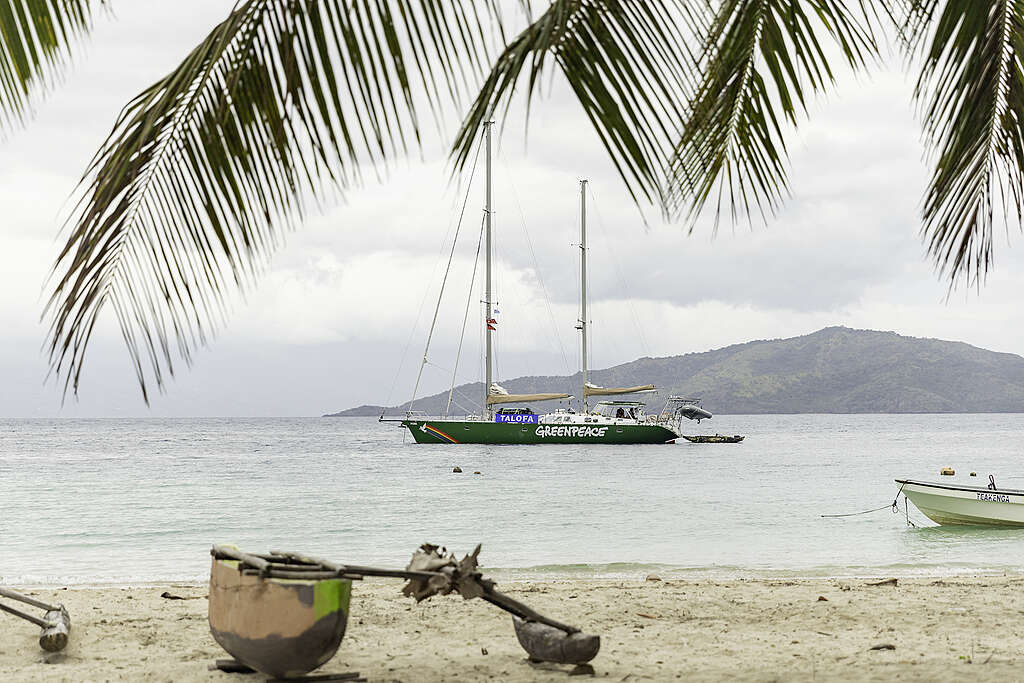
Last week, as part of our Voyaging Oceania project, we returned to the island. Our purpose was twofold —- to carry messages from the island to leaders gathering in Nadi this week for the Pacific Pre-COP, and to support the Kioa community in their efforts to improve water security for the island.
Unlike Tuvalu itself, with its eight atolls, Kioa is a mountainous, forested and richly fertile island. It will remain habitable far into the future. Kioans did not initially migrate from Vaitupu due to climate change, but the move was prophetic. They now have a lifeboat.
However, even Kioa faces challenges on our rapidly warming planet, in particular when it comes to water. Climate change is shifting once reliable rainfall patterns. On top of this, the island is already feeling the effect of this year’s intensifying El Niño event, which for Fiji means reduced rainfall and prolonged dry spells.
Right now, fresh water has to be carefully rationed, and is only available for a few hours a day. During last week’s visit aboard our campaigning ship Oceania, Greenpeace was privileged to work with the Kioa community on a new solar-powered water distribution project for the island.
Designed and led by the island, the project involves using a solar pump to move water from a reliable source to a storage tank and then using gravity to distribute the water around the village.
It was a lesson in how local knowledge and ingenuity can be the backbone of today’s climate solutions. To build a dam around the source, the local community knew the exact spot where they could gather gravel at low tide to mix with the cement. They took only what was needed, knowing that all resources must be carefully conserved. Kioa has no roads and no machinery, and it was an all-of-island effort to carry the materials up to the project site, including many heavy bags of sand and rock.
Such projects truly bring to life the vision of a resilient, locally-led, fossil fuel free Pacific.
Gallery photos taken by Raeed Ali, Pacific Community Mobiliser at Greenpeace Australia Pacific
Voices of wisdom
During our four precious days on Kioa, Greenpeace’s Pacific team sat with the island’s elders as they shared stories and experiences for us to carry with us to the Pre-COP. During a fun filled morning at the island’s school, Kioa’s children shared what they love about their life on Kioa and what they want to see nourished and protected. They wrote these messages on flags which will fly proudly from Oceania in Nadi.

It is hard to describe the warmth and generosity we experienced once again in Kioa. Meals were lovingly prepared for us, each one the product of many hours and many hands needed to fish, to grow, and to prepare. In the evenings we were entertained with traditional songs and dances, each one pulsing with an indescribable energy. For Kioans, these rituals are of course more than entertainment. This is how they have encoded and kept alive countless generations’ worth of traditional knowledge, and the wisdom that has enabled them to flourish sustainably and peacefully.
We are now sailing on to Nadi, inspired by the warmth and wisdom of Kioa, and determined to help take the voice of Pacific climate justice to the world.
A visit to Kioa is a reminder of what life can and should be. It is a reminder of what we are all fighting to protect. It is a reminder of the power of local knowledge and culture, and of listening to those on the climate front line. And it’s a reminder that tackling climate change is above all about building community, and respecting and loving each other.
Piers Forster is Professor of Physical Climate Change and Director of the Priestley Centre for Climate Futures at the University of Leeds. He has previously served as a lead author on several IPCC assessment reports.
Evidence of a rapidly changing climate and our improved scientific understanding is compelling nations to act, but not always in a good way. The science itself is facing well-organised obstruction.
The consequences of politicising the evidence are now more apparent than ever, especially in the run-up to a crucial intergovernmental climate meeting taking place in Addis Ababa this week.
On the agenda is a proposal that would prevent all governments from being able to use the most up-to-date analysis of options for combatting climate change at a critical stage in UN negotiations.
The meeting is the 65th session of the Intergovernmental Panel on Climate Change (IPCC), the body charged with providing gold-standard scientific and economic evidence on climate change to the world.