

Florida’s Miccosukee Tribe is seeking to purchase important Tribal lands to create a corridor for wildlife conservation as part of a partnership agreement with the Florida Wildlife Corridor Foundation.
The corridor will connect 18 million acres of contiguous privately owned and state wilderness that are the habitat of endangered species like Florida panthers and Key deer, reported The Guardian.
“The Miccosukee Tribe of Indians of Florida have stewarded the lands and waters of Florida since time immemorial. The entirety of this land, and her flora and fauna, have been shaped by successive generations of our people. Our collective Indigenous Knowledge offers a unique perspective informed by this deep and historic relationship to the lands and waters of the National Wildlife Refuge System that lie within our traditional lands,” said Talbert Cypress, chair of the Miccosukee Tribe, in a press release from the United States Fish and Wildlife Service (FWS).
During the Seminole Wars two centuries ago, Tribal members sought to protect the Everglades and avoid banishment by government forces to Indian territories in what is now Oklahoma.
In January, the Miccosukee Tribe entered into an agreement with FWS for co-stewardship of national wildlife refuges in South Florida. The agreement means Miccosukee citizens can once again hunt, fish, gather culturally significant and medicinal plants and conduct ceremonies in the refuges adjacent to traditional Miccosukee lands and within the Greater Everglades.
In the wake of the Trump administration’s slashing of federal funds for conservation projects, the Miccosukee Tribe has stepped in to fulfill what it feels is a “moral obligation” to protect their sacred lands and the plants and animals found there.

“We have a constitutional duty to conserve our traditional homelands, the lands and waters which protected and fed our tribe since time immemorial,” Cypress said, as The Guardian reported. “[But] we’ve seen some sort of hesitancy a lot of times to commit to projects because of the erratic nature of how the government is deciding to spend their money or allocate money.”
The agreement was announced during a corridor stakeholders’ summit last week in Orlando. It came as a Native American Fish and Wildlife Society (NAFWS) study found that 60 percent of Tribes recognized by the federal government have lost over $56 million in federal funding since President Donald Trump took office for his second term.
Though Tribes have their own independent governments, the U.S. has legal trust responsibilities to protect rights set out in Tribal treaties regarding lands, assets and resources, a press release from The Wildlife Society (TWS) said.
“These services are part of what we receive in lieu of all of the years of what we gave up — our land, our resources and sometimes, unfortunately, our culture and language,” said Executive Director of NWFWS Julie Thorstenson in the TWS press release. “These are not things that are, in our mind, something that is really negotiable.”

A Florida panther in a tree in Naples, Collier County. Tim Donovan / Florida Fish and Wildlife
As government funding has disappeared and federal land stewardship agreements face an uncertain future due to the Trump administration’s attacks on the National Park Service, Cypress said Tribal leaders had reassessed their work with other partners.
“For good reason, my predecessors had more of a standoffish approach. They went through a lot of the areas where they did deal with conservation groups, federal agencies, state agencies, pretty much not including them in conversations, or going back on their word. They just had a very different approach to this sort of thing,” Cyprus explained, as reported by The Guardian. “My administration has taken more of a collaborative approach. We’re engaging with different organizations not just to build relationships, but fix relationships that may have gone sour in the past, or were just non-existent.”
Lawmakers established the Florida Wildlife Corridor in 2021 and have preserved approximately 10 million acres thus far, with an additional eight million considered “opportunity areas” that need protection. Environmental groups have warned that there is still the potential for large areas to be lost to development.
The Florida legislature has been considering corridor funding cuts to balance state spending, and has encouraged commercial partnerships and investment.
The Tribe has already established a direct or collaborative stewardship with nearly three million acres in Biscayne and Everglades National Parks, as well as Loxahatchee National Wildlife Refuge. Cypress said the Tribe was working on identifying and prioritizing lands inside the corridor that had historical significance.
“Financially, the tribe will invest some money, but we’ll also be instrumental in finding investors, partners interested in the same thing, which is to conserve as much of our natural habitat as possible while making room for growth and development,” Cypress said. “We’ve shown we can do it in a sustainable way, and our voice can help in shaping the future of Florida as far as development goes because once a lot of the land gets developed we’re not going to get it back. We need to do it in a way where we benefit not just ourselves in the present, but for generations in the future as well.”
The post As Trump Cuts Conservation Funds, Florida’s Miccosukee Tribe Will Purchase Land for Wildlife Corridor appeared first on EcoWatch.
https://www.ecowatch.com/florida-tribe-land-purchase-wildlife-corridor.html

Doorframes decorated with fresh pine garlands are downright magical. But they sure cost a pretty penny.
Why spend all that money when you can make your own for free (or at a discount)? Not to mention, you’ll have way more fun getting creative and making it your own.

I’m all about slowing down and getting crafty during the holidays. After all, is it really the gifts we remember every year, or the memories we make with people we love?
Speaking of, it’s even better if you invite friends or family to help make a DIY garland! Put on some Christmas tunes, grab some hot cocoa, and it’s a Christmas memory you’ll be talking about for years.
Pine is also zero waste decor because it’s all compostable at the end of the season. Here’s how to make a DIY garland you’ll never forget.
materials you’ll need:
- Evergreens (you can get these while foraging, at a local nursery, or some from your own tree)
- 22-gauge floral wire (or dyed green twine)
- Heavy duty scissors
- Gloves (to protect your hands)
step 1 – measure your space
Where do you want your garland to hang? Above a doorway? A window? A fireplace? Measure the space so you know how long the garland will need to be. This will give you a better idea of how much pine you’ll need to bring your vision to life.
step 2 – find your pine
Now’s the time to decide if you want to forage or buy your pine. Faser Fir is a great option when it comes to garlands because of how sturdy the pine is, but any Fir will hold up great.
If you’re planning on foraging, try renting a book from the library that identifies the different types of native pine near you. This will help familiarize you on what to look for and what kind of effect different pines will have for your garland.
Generally, pines, firs, boxwoods and cedars make for good indoor decoration because they dry out more slowly.
Fraser fir, red pine, eastern white pine, and western red cedar are some great choices. You can use a mix of them to achieve a whimsical effect.
It’s a good idea to know how to identify different pine if foraging outdoors. Bring a reusable bag, gloves and heavy duty scissors with you while foraging. Be aware some pine trees are spikey and their needles can hurt! And never take too much off one plant.
If foraging isn’t for you, try hitting up a local nursery. They will likely have excess pine they’ll be happy to sell you for your garland. Christmas tree lots will often have a bunch of leftover greens they’ll likely part with for free too.
When in doubt, trimming some off your own tree works too (just be careful not to leave any bald spots).

step 3 – organize
Now’s the fun part – once you have all the evergreens you want, you’ll want to lay it out before you in the style of your choosing. The beauty of foraging for pine is that everything won’t be uniform – so embrace the imperfection.
You’ll want to make sure the sturdiest pieces are in the center. And make sure to pick which pine goes on the end – something with the right drip is always good. And don’t be afraid to prune them as needed.
When you have a structure you like, start layering and lining up your pieces properly. Then use the floral wire to secure them in place. You can also use dyed green twine if you’d like to compost the whole thing without hassle of removing the wire. But note that twine may be less subtle compared to wire.
Also, you’ll want to secure each end with a knot so nothing unravels. To make it easier to mount your garland, create loops with your wire or twine. Do this by simply making a loop and twisting the base until the loop is securely closed.
You can also add decorative elements if you wish, like upcycled ribbons, dried citrus, pinecone, and winter berries. It’s good to add these to any gaps you discover to help fill it in.
step 4 – hanging and display
Now you’ll want to mount your garland. You should set your hooks first (try two for single doorways, three for double, and four for triple width doorways).
Once your hooks are set in place, mount your garland using the loops you created earlier. Or, just by the wire you find – letting things shape naturally.
Don’t be afraid to add to it as needed. If you notice any gaps, this is a good time to fill them with more pine or decorative elements. And if you’d like, you can even entwine some battery operated string lights into the garland for added wow.
Have you ever made a DIY garland before? Drop your tips in the comments!
The post Easy DIY Garland: Step-By-Step Instructions appeared first on Going Zero Waste.
For 15 years, Toronto showed North America what a green roof mandate could build. Its 2009 bylaw, the first on the continent to both require green roofs and set a construction standard for them, produced more than 1,200 green roofs across the city. On November 3, 2025, the Ontario government revoked the provision of the City of Toronto Act that allowed the bylaw, with no advance notice or phase-out period.
That reversal represents the state of green roof policy in 2026. It’s a time of backlash against environment-minded construction practices. Housing-cost pressure is pushing some governments to loosen or drop requirements, while other cities keep adding them, and most of the newer laws let owners choose solar panels, vegetation, or both.
For building owners, advocates, and homeowners, the practical question now is which roof, under which local rule, delivers the most value for a specific building.
What Are Green Roofs?
A green roof, also called a living roof or ecoroof, is a roofing system that supports living plants. Sod roofs have existed since at least the Middle Ages. The modern version is engineered: Toronto’s definition calls for, at minimum, a root repellent layer, a drainage system, a filtering layer, a growing medium, and plants, all installed over a waterproof membrane.
Today’s ecoroof systems fall into two broad families. Extensive roofs use a few inches of lightweight media and hardy, drought-tolerant plants such as sedums. Intensive roofs, on the other hand, use deeper soil that can hold grasses, shrubs, and even trees. The difference is the price: the Environmental Protection Agency noted in January 2025 on a page now removed that a simple extensive roof without public access can cost one-tenth to one-third as much as an intensive roof built for public access.
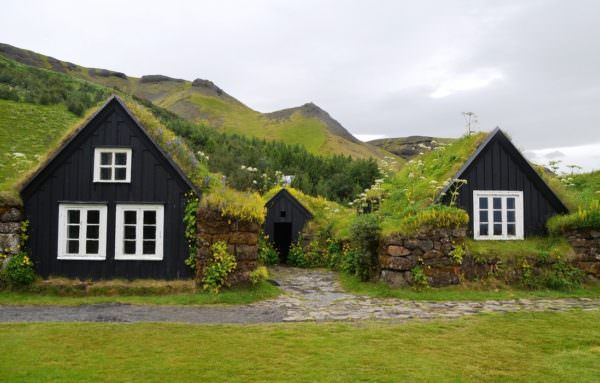
A modern green roof involves more than just plants. It needs high-quality waterproofing and protection against root damage, a drainage system, filter cloth, and a lightweight growing medium. The plants may be small, drought-tolerant ones like sedums, or larger grasses. The system can be modular or site-built, and depending on the planting medium depth, may even resemble a natural meadow or a garden with shrubs and trees.
Project Drawdown ranks green roofs and cool roofs as #73 in their list of solutions to global warming, with an anticipated 0.77 gigaton reduction in carbon dioxide by 2050. If green roofs cover 30% of roof space by 2050 and cool roofs cover 60%, approximately 407 billion square feet of efficient roofing would be in place globally.
A 2024 study published in Nature Cities reports that Seoul’s city-wide green roof implementation could reduce building energy use intensity by up to 7.7%. Another comprehensive 2024 study in Nature Urban Sustainability projected that by 2100, green and cool roofs could reduce HVAC use by up to 71.72% in six cities studied. A 2023 meta-analysis found that green roofs reduce rooftop surface temperatures by an average of 30°C during summer months.
A U.S. General Services Administration study that was removed from its website following the Trump Administration’s anti-green guidance estimated that the heating and cooling savings from green roofs on commercial and public buildings paid back the cost of installation in about 6.2 years.
Residential and Commercial Applications
Green roofs on private residences are very efficient. Despite the high cost of design and installation, which has slowed their adoption as a standard roofing option, they can provide lifetime savings.
Single-family homes accounted for less than 2 percent of green roofs in the U.S. in 2015. Multifamily homes, on the other hand, provide economies of scale that can justify the expense (and sometimes have the square footage to trigger green roof requirements), accounting for 22 percent of green roof projects. That still leaves the vast majority of green roofs to industrial and commercial buildings.
But private homeowners need not despair. Many of the incentives for green roof construction are also available for single-family residences.
Several impressive green roof installations have been completed in recent years:
Will’s Garden at Carle Foundation Hospital is a 2023 Award of Excellence winner that features a therapeutic garden in Urbana, Illinois. The immersive, wheelchair-accessible rooftop included significant technical achievements that allow the plants to grow in only six inches of media.
Construction began on the LXK Office and Residential Campus in Berlin. A designed development, it includes green rooftops and terraces.
Kö-Bogen II, in Düsseldorf, Germany, is a commercial complex features one of Europe’s largest green façades with over 30,000 hornbeam plants that provide a “green heart” and “urban mountain” in the city.
The Vancouver Convention Centre’s six-acre living roof remains the largest in Canada.
The California Academy of Sciences in San Francisco features 1.7 million plants in its living roof.
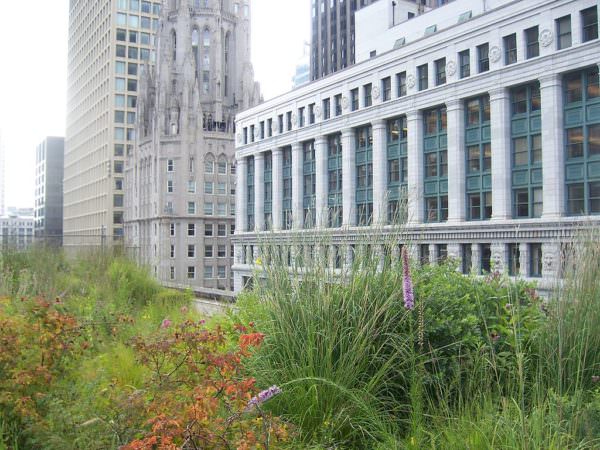
Chicago City Hall’s green roof remains one of the most studied examples, with more than 20,000 plants from 150 species.
Toronto’s Mandate Ends, Its Lessons Remain
Toronto’s bylaw applied to new commercial, institutional, and multi-unit residential developments with more than 2,000 square meters of floor area. Developers who could not fit the required coverage into a floor plan could pay $200 CAD per square meter in fees for the missing ecoroof. The city now advises building applicants that the bylaw is no longer applicable law under the Ontario Building Code.
The repeal followed Bill 17, the Protect Ontario by Building Faster and Smarter Act, which passed on June 3, 2025, after a rapid review process.
The province argued the law bars municipal requirements that go beyond the building code, including Tier 1 of the Toronto Green Standard; city staff disputed that reading, and a builders’ group was already suing the city over the standard. Green Roofs for Healthy Cities founder Steven Peck cited an analysis by local green roof companies that put the added cost at between $1 and $2.50 CAD per square foot of condominium living space, against units selling for $800 to $1,200 CAD per square foot.
Green roofs remain legal and voluntary in Toronto. The city published updated Eco-Roof Incentive Program terms in November 2025, so owners of existing buildings should check whether funding is available.
Where the Rules Stand in 2026
The most aggressive North American ecoroof requirements are concentrated in a handful of U.S. cities, and nearly all of them now treat solar as a qualifying or companion option. The summary below draws on city sources and a 2026 Roofing Brief roundup of mandates by city.
| Jurisdiction | What it requires | Applies to | Status, Nov. 2026 |
|---|---|---|---|
| New York City | Local Laws 92 and 94 (2019): a “sustainable roofing zone” of green roof, solar, or both | New buildings and full roof replacements | In effect |
| San Francisco | Better Roofs Ordinance (2017): 15% of roof as solar or 30% as living roof; SoMa needs 15% solar plus 50% living roof | Most new construction of 10 or fewer occupied floors | In effect |
| Denver | Green Buildings Ordinance (2019): cool roof plus one green option; the green-roof path means 60% vegetation (new) or 18% (existing) | New buildings, additions, and roof permits at 25,000 sq. ft. or more | In effect |
| Portland, Ore. | Central City 2035 ecoroof standard (effective July 2018) | Buildings of 20,000 net sq. ft. or more in the Central City | In effectSolar allowed as an alternative for residential projects since March 2024 |
| Cambridge, Mass. | Article 22 (2021): green roof and/or solar on 80% of available roof, or a per-square-foot payment | Most new buildings over 25,000 sq. ft. | In effect2026 payment is $64.29/sq. ft. of vegetated roof not built |
| Somerville, Mass. | Late 2023 ordinance: vegetation on 80% of available roof area | New mid-rise and high-rise buildings and major renovations, outside the Affordable Housing overlay | In effect |
| Toronto | Green Roof Bylaw (2009): 20% to 60% of available roof, scaled by building size | New buildings over 2,000 square meters | RepealedNo longer in effect since Nov. 3, 2025; Eco-Roof grants for existing buildings remain open |
| France | Climate and Resilience and APER laws: solar or vegetation on a share of the roof | Covered nonresidential new builds, extensions, and heavy renovations | 40% since July 1, 202650% from July 1, 2027; a bill that passed the Senate in Feb. 2026 and awaits National Assembly action would drop the green option |
San Francisco’s 2017 ordinance gives owners a choice between solar and a living roof rather than requiring living roofs outright. Denver’s current ordinance, adopted in 2019, replaced the voter-approved 2017 measure and pairs a cool roof requirement with a menu of compliance options. Portland’s ecoroof standard took effect in July 2018, and the plan was re-adopted in July 2020 after a court challenge.
Portland loosened, Massachusetts tightened. Portland’s Housing Regulatory Relief package, effective March 1, 2024, kept the ecoroof requirement while permitting solar panels as an alternative for buildings with residential uses. On the other side of the country, Cambridge requires green or solar coverage on 80% of available roof area for most new buildings over 25,000 square feet, and developers who build less pay a unit contribution that reaches $64.29 per square foot of vegetated roof in 2026. Neighboring Somerville went further at the end of 2023, requiring 80% vegetated coverage on new mid-rise and high-rise buildings and significant renovations.
France raised its bar, then reopened the debate. French law requires covered nonresidential buildings to put solar or vegetation on part of their roofs, and the share rose from 30% to 40% on July 1, 2026, and will reach 50% on July 1, 2027. A pending bill to align French law with EU rules would, in its Article 45, remove the vegetation option and require solar alone; legislators who object note that the EU buildings directive itself asks member states to account for green roofs.
Vancouver is still writing guidance. The city published a Rain City Green Roof Best Practices Guide in February 2026 and updated its rainwater management requirements in January 2026, but local advocates note that a mandate the council voted to explore in 2018 has not arrived.
Incentives Look Generous, but Few Owners Use Them
New York State extended New York City’s green roof property tax abatement in June 2026. The law, signed June 26, 2026, runs the program through June 30, 2031, at $10 per square foot citywide and $15 per square foot in designated community districts, capped at $200,000 per application and $4 million citywide per year. The application deadline moved to March 15, 2030.
Uptake has been the problem. A 2024 analysis of city Department of Finance records found that only two buildings had received the abatement, which helps explain why lawmakers keep raising the rate. The city’s Department of Environmental Protection runs a separate, rolling grant for green roof retrofits of at least 3,500 square feet on private property; a deputy commissioner told the City Council in 2025 that the program had funded $13 million across 32 sites, mostly green roofs.
Other programs have shrunk. Washington, D.C.’s RiverSmart Rooftops rebate, which offered $15 per square foot in target areas, now carries a notice that the program is closed. Chicago still offers developers in its downtown districts a floor area ratio bonus for green roofs, allowing more buildable space on the same lot.
Barriers to Adoption
Despite growing support, several challenges continue to limit widespread implementation.
- High Costs: Initial installation costs remain a financial barrier. A University of Michigan study found that a 21,000-square-foot green roof costs about $100,000 more to install than a conventional roof. Maintenance costs and the need for specialized expertise add to these expenses.
- Structural Concerns: Existing buildings, especially older ones, may not have been designed to bear the additional weight of saturated soil and vegetation. Assessing and potentially reinforcing structural capacity adds complexity and cost.
- Technical Challenges: The design and construction process requires coordination across multiple disciplines. Green roof components appear on architectural, structural, landscape, and plumbing drawings, while civil engineers handle exterior drainage—creating potential for coordination challenges.
- Policy and Regulatory Gaps: In municipalities without green roof policies, the permitting process for a living roof can pose barriers. Complex approval timelines often mean stormwater management plans are submitted before green roof designs are finalized.
Lack of awareness of green roofs across the public and private sectors, insufficient promotion by government entities, and limited experience with green roof systems in some regions continue to slow adoption. More research is needed to confidently price the public and environmental benefits of green roofs, including their distributed energy savings and cooling effects on surrounding buildings.
Carrots and Sticks: Policy Approaches
Toronto became the first city to require green roofs in 2009; in 2019, New York City became one of the latest major cities to pass mandatory legislation.