

UK governments have fallen so far short of their tree-planting targets since 2020 that they have failed to plant an area of forest nearly equivalent to the size of Birmingham, Carbon Brief analysis shows.
During the 2019 election campaign, the Conservatives committed to a UK-wide goal of creating 30,000 hectares of new woodland a year by 2025.
This pledge became part of the government’s net-zero strategy, which relies on “significant” tree-planting to make up for emissions from polluting sectors, such as aviation and farming.
Authorities in England, Scotland, Wales and Northern Ireland have all set out their own tree-planting ambitions, including annual goals between 2020 and 2025.
Every nation in the UK has repeatedly failed to meet these goals. This means that, despite the latest figures showing an increase in woodland creation over the past year, thousands of hectares of trees have gone unplanted across the UK since the original target was set.
By 2050, the unplanted trees would have removed some 8.5m tonnes of carbon dioxide (MtCO2) from the atmosphere, Carbon Brief analysis shows – roughly 2% of the UK’s annual emissions in 2023. This will need to be made up for with stronger efforts elsewhere, if the UK’s net-zero by 2050 target is to be met.
‘Abandoned’ target
Centuries of deforestation have left the UK one of the least forested nations in Europe.
Tree-planting can help the country meet its climate targets by removing CO2, as well as improving biodiversity and providing protection from flooding.
In this context, tree-planting enjoyed cross-party support in the run up to the 2019 general election, with parties vying to release the most ambitious targets.
Ultimately, the Conservatives emerged victorious from the election and pledged to raise tree-planting levels from around 13,000 hectares per year in 2018-19 to 30,000 hectares by the end of parliament, which was pegged for 2024-25. (Annual tree-planting figures are reported for the period between 1 April in one year and 31 March in the following year.)
This goal was roughly in line with guidance from government advisers the Climate Change Committee (CCC). The committee concluded that achieving 30,000 hectares a year by 2025 and then gradually raising it to 50,000 hectares a year by 2035, could increase forest cover from 13% to 18% by 2050, while removing more than 10MtCO2 from the atmosphere each year by 2050.
However, tree-planting is a devolved matter in the UK. England and the governments of Scotland, Wales and Northern Ireland each had to develop their own policies to drive afforestation following the 2019 election.
It soon became clear that the 2025 UK-wide target was slipping out of reach. Each year, data released by government body Forest Research showed nationwide tree-planting rates flatlining, rather than rising to meet the 30,000 hectares target.
The most recent dataset, released on 20 June – two weeks before another general election – shows that only 20,660 hectares of new woodlands were planted in 2023-24.
While this is a significant jump from the previous three years, it is still far short of the 30,000 hectares target for 2025, as the chart below shows.

As early as 2021, a report by the Institute for Government thinktank declared that the government’s overall tree-planting target had been “abandoned”.
A highly critical report released by MPs on the Environmental Audit Committee in 2023 concluded that it was “extremely unlikely” the goal would be met. It stated:
“We are extremely concerned by the consistently poor progress made in increasing tree-planting rates across all four of the nations in the UK.”
None of the major parties have included significant tree-planting targets in their manifestos for the upcoming election. Labour includes a vague pledge to plant “millions of trees” and “create new woodlands”, while the Conservatives say they will deliver existing commitments.
Birmingham-sized forest
The Conservatives’ ultimate goal of 30,000 hectares is only part of the story. Each nation has its own interim targets for scaling up tree-planting and each annual target missed means areas of forest that have not been planted.
The gaps between the nations’ combined annual targets and the actual area of trees planted across the UK can be seen in the chart below.
According to Carbon Brief calculations, these missed targets amount to 22,129 hectares of forest that has not been planted between 2020-21 and 2023-24. This is an area nearly the size of Birmingham, the nation’s second most populous city.

Scotland, which is home to around half the UK’s forests and most of its timber industry, set out its tree-planting goals in a 2020 update to its 2018-2032 climate change plan. This included a target of planting 12,000 hectares of woodland in 2020/21, rising gradually to 18,000 hectares in 2024-25.
England also set out a “planned trajectory” for tree-planting under its Nature for Climate Fund tree programme, which is also meant to contribute to the government’s legally binding goal of reaching 16.5% tree cover in England by 2050.
This trajectory covered government schemes pushing up English tree-planting from 673 hectares in 2020-21 to 7,500 hectares in 2024/25. (The 2020-21 target appears to be a significant underestimate, considering that in 2019-20 the rate was 2,340 hectares.)
In Wales and Northern Ireland, the devolved governments both committed to planting rates roughly in line with CCC recommendations.
For Wales, that meant “at least” 2,000 hectares a year from 2020, with a non-specific pledge that this would increase “over time”, as set out in its Woodlands for Wales strategy.
Northern Ireland set out plans to plant 9,000 hectares of new forest between 2020 and 2030, under the Forests for Future scheme. Annual goals up to 2023-24 are set out in the country’s forest service business plans, and a spokesperson from the Northern Ireland Executive says future plans will appear in an upcoming climate action plan.
(Together, the devolved administration targets add up to just 27,500 hectares in 2024-25. However, the flexibility in future targets for Wales and Northern Ireland could make up the remaining 2,500 hectares.)
The charts below show how afforestation in UK nations has compared to their targets since 2020-21.

Tree-planting rates have increased in England – boosted by schemes such as the Woodland Creation Offer, which pays farmers and landowners to plant forests on their land. Nevertheless, the government did not achieve its targets for the country.
In Scotland, tree-planting rates had been falling until last year – a trend that was attributed to cuts in its woodland creation budget, as well as labour and skills shortages. Scotland’s repeated failure to hit its afforestation targets was cited by the CCC in March as one of the reasons the Scottish National Party-led government’s climate plan was “no longer credible”.
A failure to allocate enough funds to tree-planting, expand the nation’s tree nurseries and drive demand for domestic timber have all been highlighted as barriers to the UK’s afforestation programme by MPs on the Environment, Food and Rural Affairs Committee.
A spokesperson for the Scottish government tells Carbon Brief that Scotland has “consistently created the lion’s share of UK new planting and this year is no exception”. They say that changes to the country’s forestry grant scheme and a sped-up applications process helped them to reach the highest level of planting in 34 years in 2023-24.
A Welsh government spokesperson tells Carbon Brief that while they see last year’s tree-planting as “a significant achievement, we recognise we need to continue building on this success”.
The UK Department for Environment, Food and Rural Affairs (Defra) declined to comment on the figures.
Stuart Goodall, the chief executive at the Confederation of Forest Industries (Confor), tells Carbon Brief the trade association is “extremely disappointed” that all four nations failed to meet what he calls “achievable planting targets”. He adds:
“Tree-planting is heavily regulated and grant-aided…It is vital that adequate public funds are made available and that the process of approving applications to plant is improved, especially for larger woodland creation projects.”
The UK government’s carbon budget delivery plan, published in 2023 to flesh out the strategy for achieving its upcoming climate targets, includes some pessimistic estimates for tree-planting. It sees UK-wide afforestation falling between 2021 and 2025 and continuing to remain relatively low out to 2035.
Despite these estimates, Carbon Brief understands that, on paper at least, 30,000 hectares per year by 2025 has remained the official target within government.
Extra carbon
A nationwide shortfall in tree-planting has implications for the UK’s climate targets. The government’s net-zero strategy relies on “significant afforestation” to “balance” the UK’s so-called “residual emissions” in 2050.
These are emissions for which affordable or scalable low-carbon alternatives are not expected to be available by mid-century, meaning CO2 has to be removed from the atmosphere in order to achieve “net-zero”. Examples include some of the emissions from aviation, livestock farming and the waste sector.
Trees absorb more CO2 as they grow larger. This means that while the short-term emissions saving from newly planted trees is small, it increases as the years pass.
In the CCC’s “balanced pathway” to net-zero, it estimates that afforestation over the next few decades would be removing more than 10m tonnes of CO2 (MtCO2) per year by 2050.
However, the CO2 savings from the trees planted over the past four years alone are not expected to be large.
If the devolved governments had met their tree-planting targets in full up to 2023-24, 32MtCO2 would have been removed cumulatively by 2050, according to Carbon Brief analysis. Trees planted in line with these goals would remove around 1.2MtCO2 per year by 2050.
Due to the tree-planting shortfall, some 8.5MtCO2 of removals have been lost over this period – equivalent to around 2% of the UK’s economy-wide emissions in 2023. These trees would have removed 0.23MtCO2 per year by 2050.

The shortfall in tree-planting could leave the UK more reliant on CO2 removal technologies, which are still in the early stages of deployment. (The net-zero strategy already assumes that 75-81MtCO2 will need to be removed using these technologies in 2050.)
Alternatively, the UK could make up for the shortfall by making deeper emissions cuts elsewhere – for example, by reducing demand for flights or meat-based diets.
Lydia Collas, a senior policy analyst at Green Alliance, tells Carbon Brief that a new land-use framework in England would help to link up landowners and farmers prime tree-planting areas with money and resources:
“The UK must start to take its commitments to restore nature seriously, including targets to create woodlands. To avoid missing our 2030 target to cut emissions under the Paris Agreement, we need to get back on track.”


The post Analysis: UK misses tree-planting targets by forest the ‘size of Birmingham’ appeared first on Carbon Brief.
Analysis: UK misses tree-planting targets by forest the ‘size of Birmingham’

Simon Kofe is Tuvalu’s Minister for Transport, Energy, Communication and Innovation
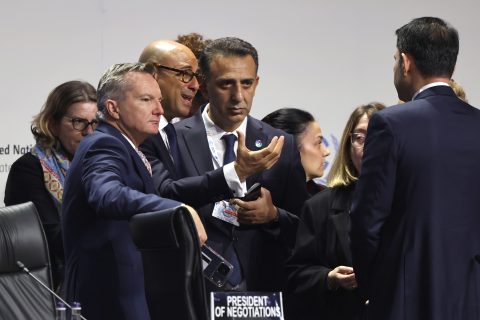
The just-wrapped COP31 has been called “the worst COP in history” for good reason.
What was billed as the “implementation summit”, translating previous climate promises into concrete progress for countries and people, collapsed without a deal. The meeting did not live up to the collective resolve to tackle the root cause of climate change: fossil fuels.
The fight is now moving to our next best opportunity to implement real action: at the UN’s International Maritime Organisation (IMO) decision summit starting on 30 November in London. The IMO’s 176 member states will debate the adoption of the world’s first global carbon pricing on any polluter, the Net-Zero Framework (NZF) for global shipping.
The IMO is different from the UNFCCC process in four key ways, which means it is much closer to actual implementation than any COP would ever be.
First, the talks focus on the climate impacts of international shipping, aiming to phase out around one gigatonne of greenhouse gas emissions a year. This is about the emissions share of major economies like Germany or Japan, a non-negligible chunk when science tells us every tonne of carbon and every degree of heating prevented matters.
Two, the IMO can set legally binding targets and enforceable measures to bring down shipping emissions. In other words, the IMO can regulate the entire global industry. This makes the outcomes of these negotiations far more consequential than big promises during COP announcements.
-
London talks raise hopes for green shipping deal
Despite fears of US wrecking tactics, the IMO says there have been “constructive discussions” over how to meet the industry’s green targets -
Ugandan oil official welcomes transition roadmap as nation gears up for exports
A senior Petroleum Authority official described the global roadmap as “fundamental” to Uganda’s transition planning as it prepares to become the world’s newest oil exporter


Three, the IMO member states have already approved the NZF. In April 2025, an overwhelming majority of countries in Africa, Europe, South America and Asia voted in favour of the agreement, against the opposition from the same blockers who sank the COP last week: Saudi Arabia, Russia and other largely Middle Eastern petrostates. Our coalition of Pacific Island states abstained in the vote, because we believed more ambition is necessary than the NZF compromise.
Four, while the IMO aims to find agreement by consensus, this is not strictly necessary. Failure to find consensus can lead to a vote. This stops climate blockers from delaying and derailing negotiations. Indeed, the NZF was “agreed” upon in a vote without their support.
Adopting the NZF next week will require a majority of countries to show up and stand firm. Our opponents will attempt to either water down the agreement to sheer meaninglessness or outright kill it completely. The latter is something they have been desperately trying to do since the agreement was reached.
But Antalya showed us 130 countries who are dead serious about climate action and who are united in their shared understanding that this unequivocally means phasing out fossil fuels. It’s on them now to show the same resolve and understanding in London.
Panama’s Environment Minister, Juan Carlos Navarro, made impassioned speeches demanding a transition away from oil, gas, and coal. Our hope is that the Panamaninian delegation will echo this message at the IMO and support adoption.
Germany’s Minister Carsten Schneider refused to accept the weak outcome text when it failed to mention fossil duels. Germany and the entire EU block need to maintain its climate leadership and not fall for weak compromises at the IMO.
-
COP31 Bulletin Day 13: Talks fail as many countries reject main deal
The EU, the AILAC group of Latin American states and the Least Developed Countries (LDCs) said they could not accept the draft “Antalya Pact” -
COP31 Bulletin Day 12: Divisions on fossil fuels, adaptation finance and trade set to delay deal until Sunday
A COP31 cover decision is not likely to be adopted before 9am on Sunday, with many negotiators complaining they had not yet seen the full text -
COP31 Bulletin Day 11: Countries decry cover text for omitting fossil fuels
Small island states and a group of Global North and South nations say the draft decision is too weak on issues ranging from the transition away from fossil fuels to finance provision

Tuvalu insisted that we need to keep the 1.5°C limit alive, despite recent warnings that we are certainly overshooting. We will continue to support the highest possible climate ambition across international fora to ensure a livable planet for everyone, including our citizens.
It’s easy to get on the stage at COP and ask for a phase out of fossil fuels. Luckily, next week, it’s equally easy to push for a concrete action that helps deliver just that. All the hard work at the IMO has been done over the past five years of negotiations, and the agreement is ripe for adoption.
To the industry, the NZF provides the certainty it is asking for to invest faster in green technology. To developing and most vulnerable countries, it generates up to $15 billion a year in revenues to help fund a just transition to clean energy in maritime and beyond. And it gives people hope that nations can still work together on the international stage to deliver meaningful progress against the climate crisis that threatens to overwhelm us all.
The coming fortnight at the IMO offers a unique chance to deliver a concrete first step to truly start moving away from fossil fuels. While we can expect petrostates to bring the same playbook to London as they did to Antalya, it’s up to us to seize the opportunity and show the laggards the tide is turning.
The post After COP31, our chance to save climate diplomacy lies in global shipping appeared first on Climate Home News.
https://www.climatechangenews.com/2026/11/23/after-cop31-our-chance-to-save-climate-diplomacy-lies-in-global-shipping/
Climate Change
‘COP-out’: COP31 fails to deliver the ambition needed to phase out fossil fuels and address climate breakdown
Antalya, Türkiye, Sunday 22 November 2026 — The COP31 climate summit in Antalya has ended in disappointment and anger, as the final COP31 outcome failed to deliver on critical issues like overshooting the 1.5°C limit, fossil fuel phase out and climate finance. Greenpeace Australia Pacific says that Australia did not deliver the deal that the world needed in a time of escalating climate breakdown.
In Antalya, Dr Susie Byers, Head of Advocacy at Greenpeace Australia Pacific, said: “We need to call this COP outcome what it is: a COP-out that has failed to deliver what the world urgently needs given the scale of the crisis we’re facing. It’s a colossal lost opportunity, and one that the world won’t easily forget.
“Coming out of Belém there was momentum to phase out fossil fuels, but COP31 wasn’t able to harness that energy and drive the world forward. The failure to adopt the Cover Decision means there’s now no acknowledgement of, let alone response to, 1.5°C overshoot — the survival line for Pacific nations. Electrification, defence of science, protection for the oceans, and advances on climate finance were all casualties of cynical attempts to derail climate action with dangerous distractions like CCUS.
“Australia knew how hard this task would be and put their hand up anyway. In the end, they didn’t get it done. This outcome validates exactly why so many countries are looking towards parallel tracks like the International Court of Justice Advisory Opinion and national transition roadmaps, where we’ve seen microdiplomacy and Pacific leadership again lead the way. This spirit of multilateralism and collaboration is how we will move beyond rhetoric to concrete actions, and end the fossil fuel chokehold.”
Also in Antalya, Shiva Gounden, Head of Pacific at Greenpeace Australia Pacific, said: “They called this an ‘implementation’ COP, but implementation means nothing when the