

Indigenous youth are fighting against climate change and advocating for Mother Earth through collaborative projects across the globe. Their leadership and collective engagement inform a resurgence of Indigenous traditions and an incorporation of new technologies to address persistent problems caused by climate change.
For example, In the Tata Province of Morocco, the hot summers and cold winters, and threatening extremes in rainfall have led young people to restore and maintain the khettara system, an ancient system of water irrigation – “a network of wells and sloped underground canals that delivers drinking and irrigation water from aquifers to fields, relying only on gravity.” And while the “over-extraction of groundwater” continues to be an issue, especially during severe drought and heatwaves, the presence of solar-powered pumps has enabled collective access to water. The khettara system had fallen into disrepair and neglect, and youth are calling for a return to a collective community-based approach to maintaining the khettara system, including the removal of detritus after floods.
Rapid changes in climate have an impact on hunting in the Canadian Arctic. The Igliniit Project involves a collaboration between Inuit hunters in Canada and geomatic engineering students. Together, they use digital technologies, including GPS, to collect and map data about climate change (including weather conditions and changes in sea ice) and the movements of animals. The project started in 2006 and it continues in 2023. Igliniit is an Inuktitut word for “trails routinely travelled.”
In the Yukon, Indigenous youth have been recruited to assist in implementing a vision to address climate change and uphold the self-determination of First Nations. Over a two-year period, the Council of Yukon First Nations partnered with the Assembly of First Nations Yukon Region and called upon people under thirty years old to determine, for all 14 Yukon First Nations, how to take climate action over the long term. The resulting youth-driven climate plan called Reconnection Vision, was released on June 30, 2023. The Reconnection Vision is not a rigid document, rather it draws in readers and implicates them to consider their “role and responsibility to the children, land, and life of tomorrow.” The Reconnection Vision draws from the intentions that were planted in the “Together Today for Our Children Tomorrow” document from 1973 that led “the federal government to begin a negotiation process a modern-day treaty, the first in Canada.”
To mark the International Day of the World’s Indigenous People, on August 9th, Indigenous youth shared their experiences and initiatives online at the Global Indigenous Youth Summit on Climate Change. The event was designed by youth for youth, to offer them a virtual platform over a twenty-four-hour period, to hold space for one another, and discuss their climate change adaptation and mitigation efforts.
As stewards of Mother Earth, Indigenous youth are leading the way, inviting collaboration with Indigenous governments and diverse knowledge keepers, to tackle the impact of climate change on the livelihood, culture, and well-being of their communities.
By Leela Viswanathan
(Image Credit: Kalen Emsley, Unsplash)
The post Indigenous Youth: Leaders and Collaborators in the Fight Against Climate Change appeared first on Indigenous Climate Hub.
Indigenous Youth: Leaders and Collaborators in the Fight Against Climate Change

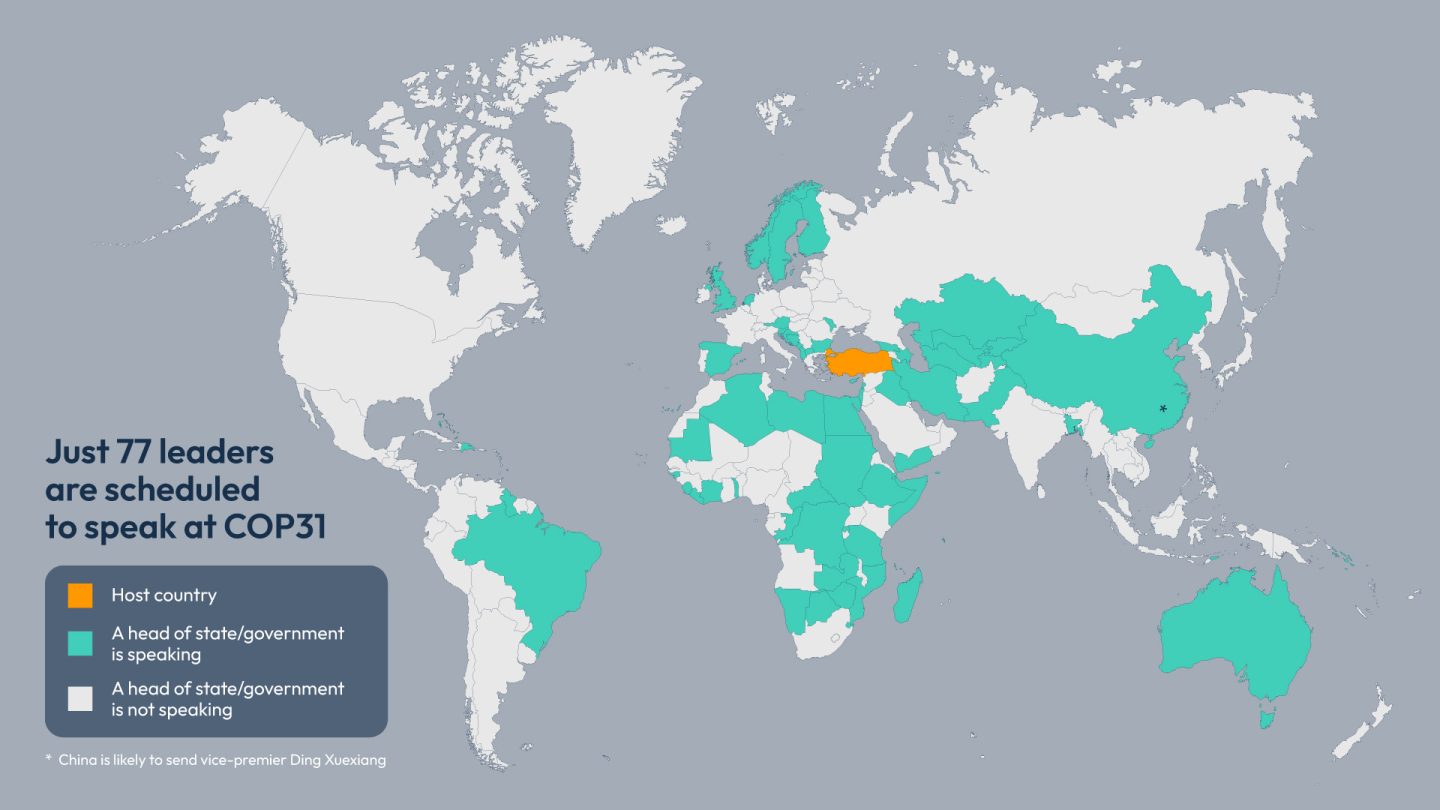
Other than the Australian and Turkish co-hosts, the only G20 nations to address the COP31 leaders’ summit with speakers at the “head of state or government” level will be the UK, Brazil and China, according to a provisional list released on Wednesday.
The list, which is published by the United Nations and subject to change, includes only 77 countries whose leaders are listed to speak at the summit in Antalya on November 11-12. That would be nearly a third fewer than the 116 who spoke at COP28 in Dubai three years ago.
Yvo de Boer, a former head of the UN’s climate secretariat, told Climate Home News that the low turnout and “the absence of many nations that should be showing leadership on climate action and support for developing nations” sends “the wrong signal at a difficult time”.
Amid geopolitical conflicts, a struggling global economy and an inevitable overshoot of the 1.5C global warming limit, de Boer said that “climate action needs a strong show of support, not empty seats at a leaders’ summit”.
-
UN sets steep emission cuts to reverse 1.5C overshoot by end of century
Emissions must by reduced by nearly 6% a year for the world to have a good chance of bringing global warming back down to the Paris Agreement limit, the Emissions Gap Report says -
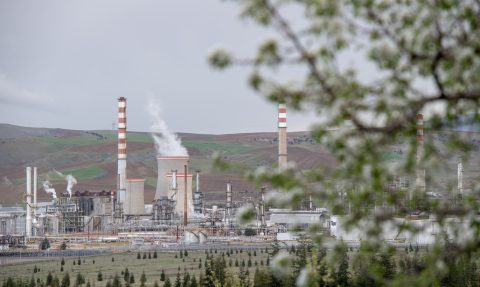
Turkish giant sponsoring COP31 cut climate goals then cashed in on oil boom
COP31 sponsors should be screened for “climate integrity”. Yet Koç Holding has become a top partner while its oil refiner runs flat out and its climate targets slip

Earlier this week, UN Secretary-General Antonio Guterres said G20 countries should lead on climate action, adding that while they have varying responsibilities in tackling global warming, “all countries, especially the big emitters, must do more”. As major economies spanning developed and developing nations, G20 countries account for more than three-quarters of annual global emissions.
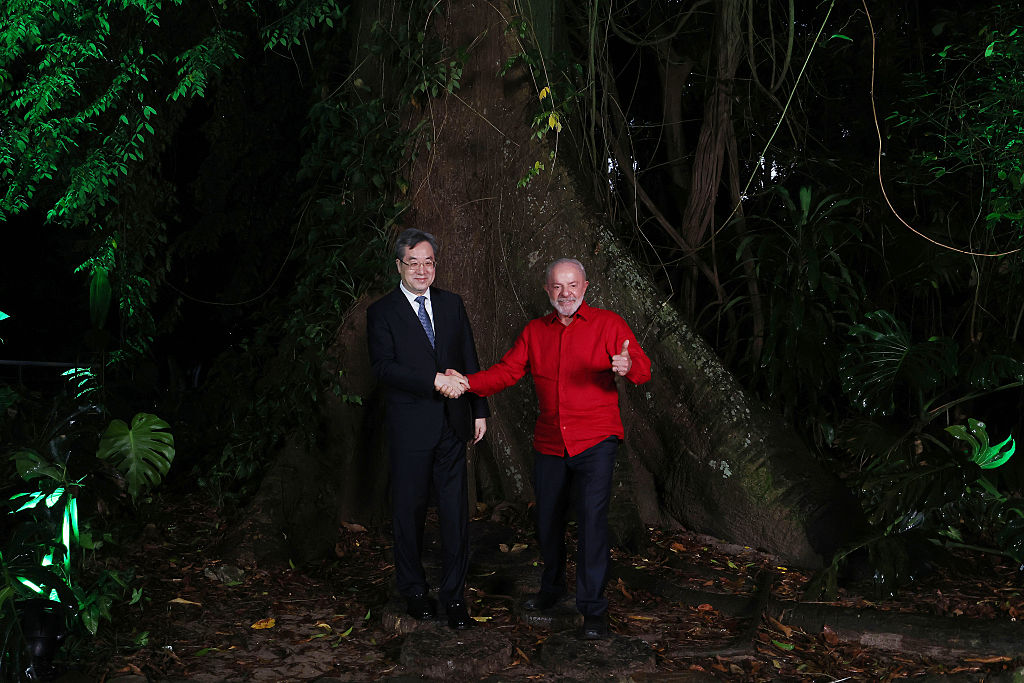
China is likely to be represented at COP31 by Vice-Premier Ding Xuexiang, as in the past three years, rather than President Xi Jinping, who has rarely left China since the COVID-19 pandemic and has not attended a climate COP since Paris in 2015.
British Prime Minister Andy Burnham is scheduled to speak, after telling parliament in September he would do so as part of his efforts to “meet the climate challenge” following a series of deadly heatwaves.
UK approves gas drilling despite admitting blow to “climate leadership” status
Brazil’s President Lula has also said he will attend. Depending on the result of Sunday’s election against his far-right rival Flávio Bolsonaro, he will speak at COP31 as either a recently re-elected or outgoing president.
While the COP31 summit is being hosted by Türkiye in Antalya, Australia has the formal role of President of Negotiations and its prime minister, Anthony Albanese, will speak at the summit. Türkiye’s President Recep Tayyip Erdogan is not on the UN’s speaker list but is likely to give an opening speech.
Many of the countries whose leaders are due to attend COP31 are those suffering the worst effects of climate change. About a third are African countries and a quarter are small island developing nations. Türkiye’s Central Asian and Balkan neighbours are also well-represented.
COP31 no-shows
Among the major emitters not on the list are French President Emmanuel Macron, German leader Friedrich Merz, Italy’s Giorgia Meloni, India’s Narendra Modi, Russia’s Vladimir Putin, Canada’s Mark Carney and Japan’s Sanae Takaichi.
Macron, who is struggling to deal with rising social unrest across France, will reportedly attend commemorations marking the end of the First World War and a European Political Community summit instead. It is not known whether the others will eventually decide to attend COP31, or what they will do instead.
Climate change-sceptic US President Donald Trump has never attended a COP and is withdrawing the US from the UN climate convention (UNFCCC), under which COP meetings are held, after quitting the Paris Agreement for a second time.
Argentina’s Javier Milei has considered exiting the Paris Agreement but has so far not done so, although his government is one of around 30 countries yet to submit an updated national climate plan to the UN.
The post Early speakers’ list suggests few powerful leaders will attend COP31 appeared first on Climate Home News.
Early speakers’ list suggests few powerful leaders will attend COP31
Muhammad Zulfikar Rakhmat is director of the China-Indonesia Desk at the Center of Economic and Law Studies (CELIOS). Bhima Yudhistira Adhinegara is executive director of CELIOS.
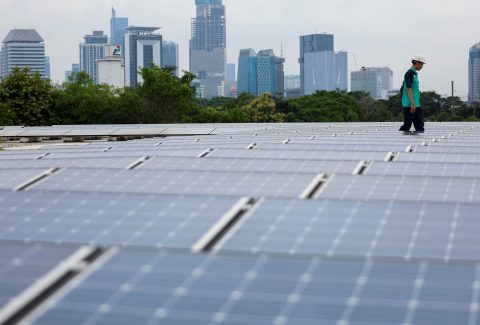
Indonesia bills its plans to mix wood with coal at dozens of power plants as a way to cut electricity generation emissions as the country transitions towards clean energy. But look closer, and the biomass co-firing plan could do far more harm than good.
Biomass co-firing involves mixing a small amount of wood or other plant matter, usually wood chips or wood pellets, into the coal that a power plant burns.
State electricity company PLN wants to use it at 52 coal-fired plants across the Southeast Asian nation – a target set out in its national electricity supply business plan and tied to Indonesia’s pledge, under its Nationally Determined Contribution to the Paris Agreement, to raise renewables to 23% of the energy mix. PLN originally aimed to secure 10.2 million tonnes of biomass a year by 2025; that target has already slipped to 2031, as the country struggles to line up enough supply.
Most plants only mix in a small amount of wood, often between 1% and 5% of the fuel load, meaning they do not even have to change machinery. In truth, it lets coal plants keep doing what they have always done, just with a little wood added to the mix.
That presents two big problems.
-
SE Asia speeds up plan for connected clean power grid after oil shock
Countries are redoubling efforts to link their grids to bolster energy security and reduce their dependence on fossil fuels – but many challenges remain -
China keeps Indonesia’s battery dream afloat but future less certain
Chinese capital and technology turned Indonesia into the world’s top nickel supplier, but its dependence on China and the rise of nickel-free batteries could upset its battery ecosystem plans -
Southeast Asia’s fragile grids threaten billions in clean energy investment
Renewables developers need reliable electricity infrastructure and stable policies to help the region meet climate goals and surging demand for power


Firstly, creating additional demand for wood would put further deforestation pressure on the country’s thick and biodiverse tropical forests, already at risk from mining and palm oil plantations.
Secondly, by making old coal plants look a little greener on paper, the plan could hand them a reason to keep operating well beyond when they would otherwise be retired, meaning the fleet keeps emitting for longer than a genuine phase-out would allow.
This is not a real climate solution. It is coal wearing a green mask.
A threat to forests
To meet its co-firing mandate, Indonesia would need more than 10 million tonnes of wood pellets every year, an area of forest equivalent to 3.27 million football fields, according to a 2024 assessment by a group of NGOs.
The same report warned this could push deforestation as high as 2.1 million hectares a year, and found that a 10% cut in coal use through co-firing could threaten 10 million hectares of untouched forest in the areas where wood is collected. At Indonesia’s biggest power plants alone, switching just 10% of coal to wood could clear an area of forest roughly 35 times the size of Jakarta.
PLN and the forestry companies that supply it insist the wood comes from dedicated “energy plantation forests” – land set aside to grow fast-growing trees for fuel, not from clearing natural forest. But the same assessment found that of the 1.2 million hectares already designated for these plantations, more than 400,000 hectares still contain undisturbed tropical forest, which will come under growing pressure as demand rises. The claim that this wood comes from already-degraded land does not hold up to scrutiny.
Advocates of co-firing say wood is a clean fuel because trees can grow back. But when old natural forests are cleared to make way for fast-growing forestry plantations to grow trees for fuel, they release carbon that took decades or centuries to build up.
One study, by the Centre for Research on Energy and Clean Air (CREA), estimated that co-firing with just 10% wood across 52 power plants could create up to 26.5 million tonnes of carbon dioxide-equivalent emissions each year, once the clearing of land and the production of wood pellets are counted.
Wood pellets for export
Government rules have made this easier, not harder. Companies that already hold industrial timber plantation permits can convert them into energy plantations, giving them a ready-made legal route into the wood pellet business without applying for new forest land.
Indroyono Soesilo, chairman of the Indonesian Forestry Entrepreneurs Association (APHI), has publicly called on the government for tax breaks and relief from state forestry levies in exchange for making that switch.
Research by Trend Asia found that the push into energy plantations for biomass is dominated not by small or informal loggers but by large companies already notorious for deforestation, including APP Group, Korindo Group, Barito Pacific and Wilmar International. In short, some of the same companies long associated with clearing forests are being given an easier path and a green label to keep doing it.
-
COP30 roadmap to end deforestation will invite countries to draft domestic plans
After promising at COP30 to produce a voluntary global roadmap to stop forest loss by 2030, Brazil provided an update on the consultations this week -
Big banks’ lending to coal backers undermines Indonesia’s green plans
Foreign banks involved in Indonesia’s $20-billion Just Energy Transition Partnership have also funded companies working on coal power expansion, a TBIJ and Climate Home News investigation reveals -
Indonesia and Vietnam set for surge in coal use this decade despite transition deals
Rising demand in Southeast Asia and India is expected to prevent coal use from falling significantly this decade, the International Energy Agency predicts


Much of this wood does not even stay in Indonesia. Japan and South Korea have bought more than 99% of Indonesia’s wood pellet exports since 2021, using them to meet their own clean energy targets.
Perhaps the biggest risk in Indonesia’s co-firing plan is what it could do to the coal fleet itself. Mixing in a small amount of wood does not require a plant to shut down or upgrade. It simply gives the plant a reason to keep running, dressed up as progress. Every year a coal plant stays open because of a paper-thin green label is a year that real clean energy, such as solar and wind, is pushed further down the road.
None of this means biomass is always bad. Using leftover farm waste or city waste to make power can make sense.
But the scale of Indonesia’s co-firing plan cannot be met by leftovers alone, which is exactly why forests are being pulled into the supply chain. The countries and banks funding Indonesia’s energy transition, along with Japan and South Korea, should stop counting co-firing as a climate win.
Real progress means closing coal plants, not feeding them wood.
The post Coal in a green mask: Indonesia’s co-firing plan will harm, not help, the climate appeared first on Climate Home News.
Coal in a green mask: Indonesia’s co-firing plan will harm, not help, the climate
Climate Change
Loss and damage fund agrees $20m for Nepal but rich nations warn it should not set precedent
The board of the UN’s Fund for Responding to Loss and Damage agreed on Thursday to set aside $20 million to help Nepal recover from the devastating climate-driven flood it suffered in August.
At an extraordinary online meeting, board members unanimously invited Nepal’s government to submit a proposal for how to use the money, which will be considered at a future board meeting.
The board’s co-chair Camila Minerva Rodriguez described the decision as “truly historic” as it is the first time the new fund has allocated any money since it was set up three years ago. It is expected to approve its first set of projects at its next board meeting in December.
Maheshwar Dhakal, a senior official at Nepal’s climate ministry, told the meeting the decision was “a powerful expression of humanity, compassion, solidarity and hope” and, for the flood victims, a ̶