Welcome to Carbon Brief’s DeBriefed.
An essential guide to the week’s key developments relating to climate change.
This week
Africa energy summit
CLOSING THE GAP: More than 1,000 people, including heads of state, gathered at the Mission 300 Africa Energy Summit in Dar es Salaam, Tanzania to agree on a road map for providing electricity to 300 million people in Africa by 2030, Nigeria’s Guardian reported. The Mission 300 initiative was launched by the World Bank and the African Development Bank last year, the newspaper said. About 600 million people in Africa “still lack access to reliable and affordable energy”, the Conversation noted.
SETTLING FINANCE: Reuters reported that the initiative aimed to “unlock” at least $90bn from multilateral development banks, development agencies, finance institutions, private businesses and philanthropies. According to Climate Home News, development banks have committed to collectively deliver $40bn under the initiative – a target that was raised this week to more than $50bn by contributions from other financial institutions.
Trump’s climate rollbacks
CONFUSION: Donald Trump’s administration introduced a widespread spending freeze this week, sparking “widespread confusion and frustration”, Politico reported. On Monday, the White House budget office ordered a pause to all grants and loans disbursed by the federal government, with climate mitigation and adaptation programmes likely affected, the outlet said. It added that a federal judge temporarily blocked the freeze on Tuesday, but this has done little to assuage concerns.
ENDANGERMENT: Trump is also making moves to call into question the “legality and applicability” of the “endangerment finding”, a rule that instructs the federal Environmental Protection Agency to regulate greenhouse gas emissions because they pose a danger to human life, the New York Times reported. The New York Times also reported that Trump wants to deploy a rarely used “god-squad” panel to carve out exemptions in the Endangered Species Act.
ALIGNMENT: Meanwhile, La Nación reported that Argentina’s far-right president Javier Milei is still “mulling over” emulating Trump by removing his country from the Paris Agreement. Rumours that Argentina could be the first country to follow the US in leaving the Paris Agreement first began at COP29 in Azerbaijan after Milei withdrew his delegation from the talks. However, the newspaper noted, Argentina is still subject to agreements, such as the EU-Mercosur deal, that mandate it to meet environmental clauses.
UK’s climate plans
CLIMATE PLEDGE: The UK government has formally submitted its international climate pledge, known as a “nationally determined contribution” (NDC), to the United Nations Framework Convention on Climate Change (UNFCCC), BusinessGreen reported. The UK is one of a handful of countries to have submitted ahead of the 10 February deadline and is pledging to cut greenhouse gas emissions by 81% compared to 1990 levels by 2035, the publication said.
ROSEBANK RULING: The decision by the UK’s previous Conservative government to greenlight two new oilfields in the North Sea has been ruled unlawful by a court in Edinburgh, the Guardian reported, as it does not take into account emissions caused by burning the oil and gas produced. BusinessGreen reported that burning all the oil from the larger project, Rosebank, would emit as much CO2 as running 56 coal-fired power stations for a year.
LAY OF THE LAND: The Guardian reported that UK environment secretary Steve Reed is to announce a consultation for a long-awaited land-use framework for England. As part of the framework, the government hopes to map the areas of England with the best quality farmland and most potential for nature recovery, with ministers “discouraged from planning developments on the areas marked as best for farming and nature”, the Guardian said.
Around the world
- LA ATTRIBUTION: Human-caused climate change increased the likelihood of the wildfires in Los Angeles by 35% and the intensity by 6%, according to a rapid attribution study from World Weather Attribution.
- HACKING RING RULING: ExxonMobil has been linked to a legal case involving hacking attempts aimed at climate activists, after the man charged alleged that the oil giant was involved, E&E News reported. ExxonMobil denied involvement.
- AI DEMANDS LESS: The surprise breakthrough of Chinese start-up DeepSeek suggests that artificial intelligence may require less energy than previously thought, exposing the “guesswork” on AI power demand, the Financial Times reported.
- CHINA’S RECORD: Record amounts of wind and solar were added in China in 2024, the Associated Press reported. It cited new Carbon Brief analysis showing the clean energy surge halted the rise of China’s emissions in the last 10 months of the year.
46%
The share of Australia’s power supply derived from renewables in the final quarter of 2024 – a new record, according to the Guardian.
Latest climate research
- A Science study, covered by Carbon Brief, showed that climate change played a key role in the “catastrophic” 2023 floods in Sikkim in India, when a “glacial lake outburst flood” led to cascading floods that killed 55 people.
- A study in Nature Medicine found that there could be an extra 2.3 million deaths from extreme temperatures in Europe’s main cities by 2099, in a scenario with little action to curb climate change and adapt to its effects.
- The survival rates of certain bird species dropped during “increasingly severe” dry seasons seen in the Amazon rainforest over the past three decades, according to a new study in Science Advances, “challenging the notion that pristine rainforests can fully protect their biodiversity under increasingly severe climate conditions”.
(For more, see Carbon Brief’s in-depth daily summaries of the top climate news stories on Monday, Tuesday, Wednesday, Thursday and Friday.)
Captured
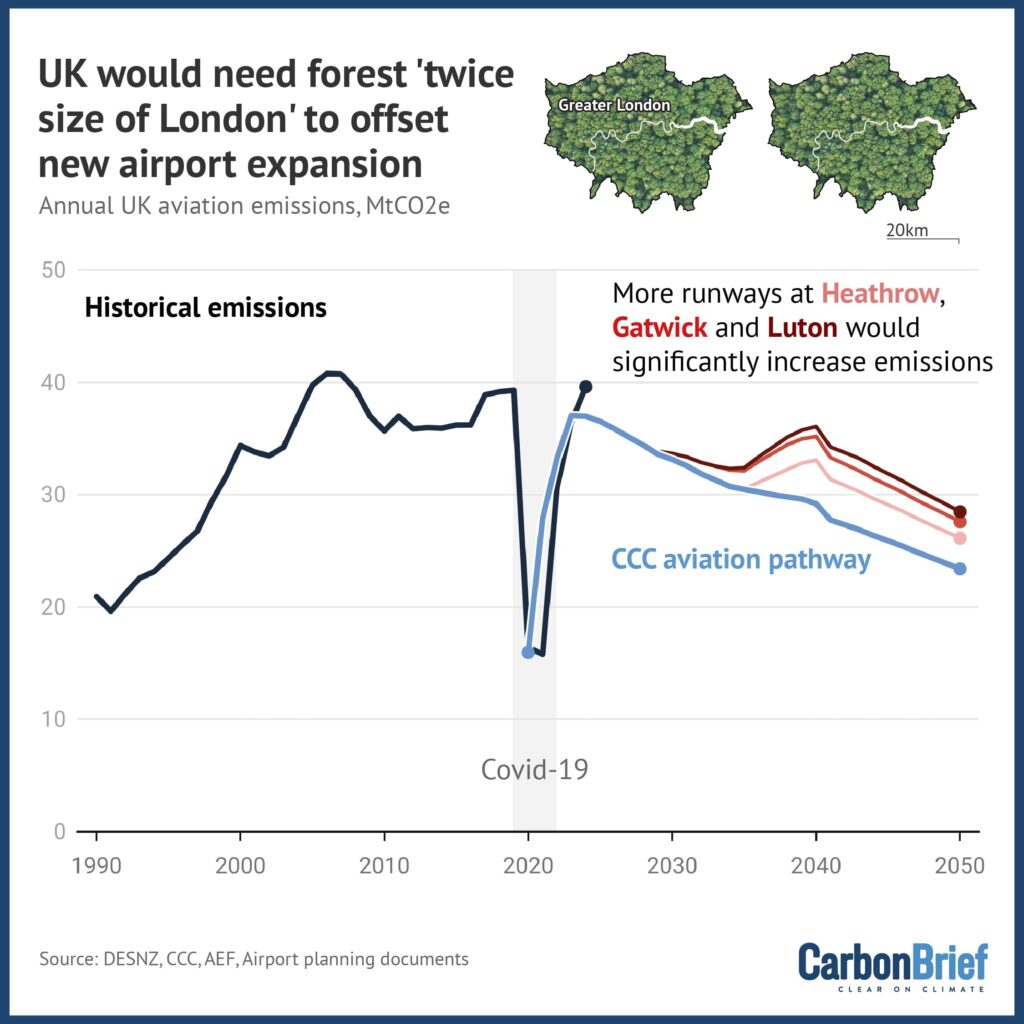
Analysis by Carbon Brief has found that a forest twice the size of Greater London would need to be planted to offset the additional CO2 emissions from the planned expansion of Heathrow, Gatwick and Luton airports announced by UK chancellor Rachel Reeves this week. Reeves confirmed the government’s support for a third runway at Heathrow airport in order to “unlock further growth” in a speech on Wednesday. Earlier in the week, UK energy security and net-zero secretary Ed Miliband said that any expansion “must be justified within carbon budgets and, if it can’t be justified, it won’t go ahead”. The analysis was twice cited in parliament by MPs and covered by a range of media outlets.
Spotlight
East Africa’s climate refugees
This week, Carbon Brief speaks to a young female journalist from Kenya’s Dadaab refugee complex who is documenting how more people are arriving in her community because of climate change-fuelled drought and famine.
Hosting more than 300,000 people and stretching over 50 square kilometres, Dadaab in eastern Kenya is one of the largest refugee camps in the world.
More than 96% of its residents arrived or are descended from neighbouring Somalia. It has make-shift shops, hospitals and schools, but permanent structures are banned by the Kenyan government.
Fardowsa Sirat Gele is a young female journalist who was born and raised in Dadaab. Her mother – like most of the first wave of residents to arrive in Dadaab – fled to the camp in 1991 due to Somalia’s civil war.
Like many in the camp, Fardowsa is stateless and unable to leave the complex. She explained:
“I can say I’m Somali because of my appearance, my language. But I don’t have the courage to say I have a country, because I’ve never lived there. And I can’t say I’m Kenyan, because Kenya will not allow me a birth certificate. So, that hurts me.”
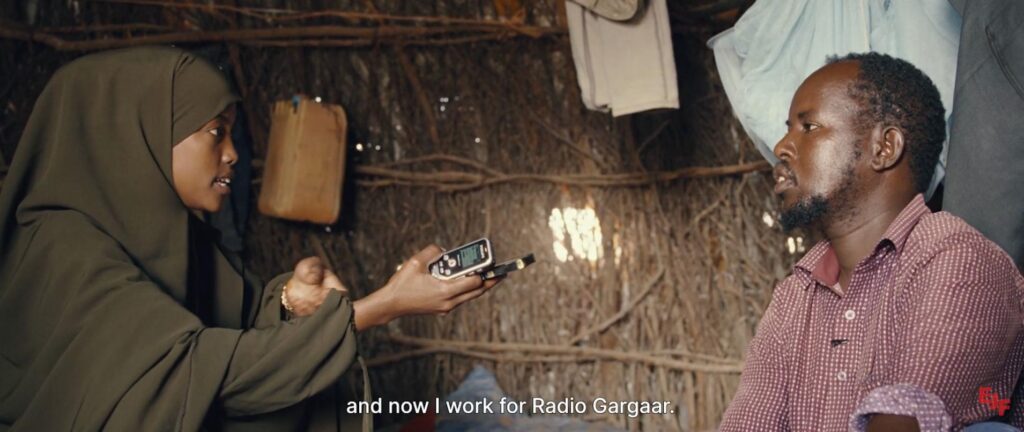
With an interest in sharing the stories of her fellow refugees, Fardowsa works as a journalist at Radio Gargaar, the camp’s radio station.
“Radio Dadaab”, a new film produced by the Environmental Justice Foundation (EJF), followed Fardowsa as she put together a radio programme exploring a new force driving growing numbers of people to arrive at the camp: climate change.
Drought injustice
In recent years, countries in the Horn of Africa have faced their driest conditions in four decades, with several consecutive rainy seasons failing. Then, when rain finally fell, it brought deadly floods that swept away homes and croplands.
In Radio Dadaab, Fardowsa travels to the outskirts of the Dadaab refugee camp to interview new arrivals, who tell her stories of their entire livestock being wiped out, their crops failing and ensuing starvation due to the drought.
A rapid “attribution” analysis found that this deadly drought was made at least 100 times more likely by human-caused climate change.
Despite facing steep climate impacts, East Africa is responsible for just 1.4% of global greenhouse gas emissions.
Fardowsa found that, despite fleeing starvation and the impacts of climate change, when people arrived at Dadaab they continued to suffer, with no access to toilets, medical care or houses.
Political tensions have caused issues with new arrivals being able to register at the camp, which, in turn, has caused difficulty accessing resources and help, according to Fardowsa’s reporting.
This has resulted in “refugees that were already in the camps and the new arrivals [having to share] the little aid [available],” she told Carbon Brief.
The future
Fardowsa expressed concern about how global politics will affect Dadaab.
When asked about her hopes for her future, Fardowsa said “there is no hope because Trump has come back and the US was the main country helping with aid”.
The US provides more foreign aid globally than any other country and, last week, following several climate policy rollbacks, the Trump administration ordered a “sweeping freeze” on new funding for almost all US foreign assistance.
Yet, Fardowsa is committed to uplifting the voices of refugees for whom climate change is a threat multiplier.
“The main aim [of the film] was to show the world that there are human beings suffering because of environmental problems, like drought and displacement. To show empathy for refugees was the main focus.”
Radio Dadaab is available to watch on YouTube.
Watch, read, listen
RENEWABLE REVEAL: The Financial Times looked at how, despite abundant fossil-fuel reserves, several Middle East countries have huge plans for renewable energy, making the area the fastest growing renewables market outside China.
STORY TIME: Three climate change “storytellers” featured in this week’s BBC Sounds’ Start the Week podcast, discussing writing the new climate talks-themed play Kyoto, Shetland’s windfarms and the art of agreeing.
NET-ZERO DADS: The Economist published a tongue-in-cheek look at how middle-aged men in the UK are becoming the unlikely early adopters of net-zero solutions.
Coming up
- 3-8 February: 78th meeting of the CITES standing committee, Geneva, Switzerland
- 7 February:Turks and Caicos Islands general election
Pick of the jobs
- Green Climate Fund, project officer, private sector facility | Salary: $87,000-$96,200. Location: Incheon, South Korea
- Nattergal, rewilding ecologist | Salary: £30,000-£35,000. Location: Remote with UK travel
- Greenpeace Africa, pan-African political strategist and responsive campaigner | Salary: Unknown. Location: South Africa, Cameroon, Senegal, Kenya or remote in Africa
- City, University of London, research fellow, centre for food policy | Salary: £42,632-£60,321. Location: London
DeBriefed is edited by Daisy Dunne. Please send any tips or feedback to debriefed@carbonbrief.org.
This is an online version of Carbon Brief’s weekly DeBriefed email newsletter. Subscribe for free here.

The post DeBriefed 31 January 2025: Closing Africa’s power gap; UK needs forest ‘twice size of London’ to offset airport plans; Kenya’s climate refugees appeared first on Carbon Brief.
Greenhouse Gases
Cropped 25 February 2026: Food inflation strikes | El Niño looms | Biodiversity talks stagnate
We handpick and explain the most important stories at the intersection of climate, land, food and nature over the past fortnight.
This is an online version of Carbon Brief’s fortnightly Cropped email newsletter.
Subscribe for free here.
Key developments
Food inflation on the rise
DELUGE STRIKES FOOD: Extreme rainfall and flooding across the Mediterranean and north Africa has “battered the winter growing regions that feed Europe…threatening food price rises”, reported the Financial Times. Western France has “endured more than 36 days of continuous rain”, while farmers’ associations in Spain’s Andalusia estimate that “20% of all production has been lost”, it added. Policy expert David Barmes told the paper that the “latest storms were part of a wider pattern of climate shocks feeding into food price inflation”.
-
Sign up to Carbon Brief’s free “Cropped” email newsletter. A fortnightly digest of food, land and nature news and views. Sent to your inbox every other Wednesday.
NO BEEF: The UK’s beef farmers, meanwhile, “face a double blow” from climate change as “relentless rain forces them to keep cows indoors”, while last summer’s drought hit hay supplies, said another Financial Times article. At the same time, indoor growers in south England described a 60% increase in electricity standing charges as a “ticking timebomb” that could “force them to raise their prices or stop production, which will further fuel food price inflation”, wrote the Guardian.
‘TINDERBOX’ AND TARIFFS: A study, covered by the Guardian, warned that major extreme weather and other “shocks” could “spark social unrest and even food riots in the UK”. Experts cited “chronic” vulnerabilities, including climate change, low incomes, poor farming policy and “fragile” supply chains that have made the UK’s food system a “tinderbox”. A New York Times explainer noted that while trade could once guard against food supply shocks, barriers such as tariffs and export controls – which are being “increasingly” used by politicians – “can shut off that safety valve”.
El Niño looms
NEW ENSO INDEX: Researchers have developed a new index for calculating El Niño, the large-scale climate pattern that influences global weather and causes “billions in damages by bringing floods to some regions and drought to others”, reported CNN. It added that climate change is making it more difficult for scientists to observe El Niño patterns by warming up the entire ocean. The outlet said that with the new metric, “scientists can now see it earlier and our long-range weather forecasts will be improved for it.”
WARMING WARNING: Meanwhile, the US Climate Prediction Center announced that there is a 60% chance of the current La Niña conditions shifting towards a neutral state over the next few months, with an El Niño likely to follow in late spring, according to Reuters. The Vibes, a Malaysian news outlet, quoted a climate scientist saying: “If the El Niño does materialise, it could possibly push 2026 or 2027 as the warmest year on record, replacing 2024.”
CROP IMPACTS: Reuters noted that neutral conditions lead to “more stable weather and potentially better crop yields”. However, the newswire added, an El Niño state would mean “worsening drought conditions and issues for the next growing season” to Australia. El Niño also “typically brings a poor south-west monsoon to India, including droughts”, reported the Hindu’s Business Line. A 2024 guest post for Carbon Brief explained that El Niño is linked to crop failure in south-eastern Africa and south-east Asia.
News and views
- DAM-AG-ES: Several South Korean farmers filed a lawsuit against the country’s state-owned utility company, “seek[ing] financial compensation for climate-related agricultural damages”, reported United Press International. Meanwhile, a national climate change assessment for the Philippines found that the country “lost up to $219bn in agricultural damages from typhoons, floods and droughts” over 2000-10, according to Eco-Business.
- SCORCHED GRASS: South Africa’s Western Cape province is experiencing “one of the worst droughts in living memory”, which is “scorching grass and killing livestock”, said Reuters. The newswire wrote: “In 2015, a drought almost dried up the taps in the city; farmers say this one has been even more brutal than a decade ago.”
- NOUVELLE VEG: New guidelines published under France’s national food, nutrition and climate strategy “urged” citizens to “limit” their meat consumption, reported Euronews. The delayed strategy comes a month after the US government “upended decades of recommendations by touting consumption of red meat and full-fat dairy”, it noted.
- COURTING DISASTER: India’s top green court accepted the findings of a committee that “found no flaws” in greenlighting the Great Nicobar project that “will lead to the felling of a million trees” and translocating corals, reported Mongabay. The court found “no good ground to interfere”, despite “threats to a globally unique biodiversity hotspot” and Indigenous tribes at risk of displacement by the project, wrote Frontline.
- FISH FALLING: A new study found that fish biomass is “falling by 7.2% from as little as 0.1C of warming per decade”, noted the Guardian. While experts also pointed to the role of overfishing in marine life loss, marine ecologist and study lead author Dr Shahar Chaikin told the outlet: “Our research proves exactly what that biological cost [of warming] looks like underwater.”
- TOO HOT FOR COFFEE: According to new analysis by Climate Central, countries where coffee beans are grown “are becoming too hot to cultivate them”, reported the Guardian. The world’s top five coffee-growing countries faced “57 additional days of coffee-harming heat” annually because of climate change, it added.
Spotlight
Nature talks inch forward
This week, Carbon Brief covers the latest round of negotiations under the UN Convention on Biological Diversity (CBD), which occurred in Rome over 16-19 February.
The penultimate set of biodiversity negotiations before October’s Conference of the Parties ended in Rome last week, leaving plenty of unfinished business.
The CBD’s subsidiary body on implementation (SBI) met in the Italian capital for four days to discuss a range of issues, including biodiversity finance and reviewing progress towards the nature targets agreed under the Kunming-Montreal Global Biodiversity Framework (GBF).
However, many of the major sticking points – particularly around finance – will have to wait until later this summer, leaving some observers worried about the capacity for delegates to get through a packed agenda at COP17.
The SBI, along with the subsidiary body on scientific, technical and technological advice (SBSTTA) will both meet in Nairobi, Kenya, later this summer for a final round of talks before COP17 kicks off in Yerevan, Armenia, on 19 October.
Money talks
Finance for nature has long been a sticking point at negotiations under the CBD.
Discussions on a new fund for biodiversity derailed biodiversity talks in Cali, Colombia, in autumn 2024, requiring resumed talks a few months later.
Despite this, finance was barely on the agenda at the SBI meetings in Rome. Delegates discussed three studies on the relationship between debt sustainability and implementation of nature plans, but the more substantive talks are set to take place at the next SBI meeting in Nairobi.
Several parties “highlighted concerns with the imbalance of work” on finance between these SBI talks and the next ones, reported Earth Negotiations Bulletin (ENB).
Lim Li Ching, senior researcher at Third World Network, noted that tensions around finance permeated every aspect of the talks. She told Carbon Brief:
“If you’re talking about the gender plan of action – if there’s little or no financial resources provided to actually put it into practice and implement it, then it’s [just] paper, right? Same with the reporting requirements and obligations.”
Monitoring and reporting
Closely linked to the issue of finance is the obligations of parties to report on their progress towards the goals and targets of the GBF.
Parties do so through the submission of national reports.
Several parties at the talks pointed to a lack of timely funding for driving delays in their reporting, according to ENB.
A note released by the CBD Secretariat in December said that no parties had submitted their national reports yet; by the time of the SBI meetings, only the EU had. It further noted that just 58 parties had submitted their national biodiversity plans, which were initially meant to be published by COP16, in October 2024.
Linda Krueger, director of biodiversity and infrastructure policy at the environmental not-for-profit Nature Conservancy, told Carbon Brief that despite the sparse submissions, parties are “very focused on the national report preparation”. She added:
“Everybody wants to be able to show that we’re on the path and that there still is a pathway to getting to 2030 that’s positive and largely in the right direction.”
Watch, read, listen
NET LOSS: Nigeria’s marine life is being “threatened” by “ghost gear” – nets and other fishing equipment discarded in the ocean – said Dialogue Earth.
COMEBACK CAUSALITY: A Vox long-read looked at whether Costa Rica’s “payments for ecosystem services” programme helped the country turn a corner on deforestation.
HOMEGROWN GOALS: A Straits Times podcast discussed whether import-dependent Singapore can afford to shelve its goal to produce 30% of its food locally by 2030.
‘RUSTING’ RIVERS: The Financial Times took a closer look at a “strange new force blighting the [Arctic] landscape”: rivers turning rust-orange due to global warming.
New science
- Lakes in the Congo Basin’s peatlands are releasing carbon that is thousands of years old | Nature Geoscience
- Natural non-forest ecosystems – such as grasslands and marshlands – were converted for agriculture at four times the rate of land with tree cover between 2005 and 2020 | Proceedings of the National Academy of Sciences
- Around one-quarter of global tree-cover loss over 2001-22 was driven by cropland expansion, pastures and forest plantations for commodity production | Nature Food
In the diary
- 2-6 March: UN Food and Agriculture Organization regional conference for Latin America and Caribbean | Brasília
- 5 March: Nepal general elections
- 9-20 March: First part of the thirty-first session of the International Seabed Authority (ISA) | Kingston, Jamaica
Cropped is researched and written by Dr Giuliana Viglione, Aruna Chandrasekhar, Daisy Dunne, Orla Dwyer and Yanine Quiroz.
Please send tips and feedback to cropped@carbonbrief.org
The post Cropped 25 February 2026: Food inflation strikes | El Niño looms | Biodiversity talks stagnate appeared first on Carbon Brief.
Cropped 25 February 2026: Food inflation strikes | El Niño looms | Biodiversity talks stagnate
Greenhouse Gases
Dangerous heat for Tour de France riders only a ‘question of time’
Rising temperatures across France since the mid-1970s is putting Tour de France competitors at “high risk”, according to new research.
The study, published in Scientific Reports, uses 50 years of climate data to calculate the potential heat stress that athletes have been exposed to across a dozen different locations during the world-famous cycling race.
The researchers find that both the severity and frequency of high-heat-stress events have increased across France over recent decades.
But, despite record-setting heatwaves in France, the heat-stress threshold for safe competition has rarely been breached in any particular city on the day the Tour passed through.
(This threshold was set out by cycling’s international governing body in 2024.)
However, the researchers add it is “only a question of time” until this occurs as average temperatures in France continue to rise.
The lead author of the study tells Carbon Brief that, while the race organisers have been fortunate to avoid major heat stress on race days so far, it will be “harder and harder to be lucky” as extreme heat becomes more common.
‘Iconic’
The Tour de France is one of the world’s most storied cycling races and the oldest of Europe’s three major multi-week cycling competitions, or Grand Tours.
Riders cover around 3,500 kilometres (km) of distance and gain up to nearly 55km of altitude over 21 stages, with only two or three rest days throughout the gruelling race.
The researchers selected the Tour de France because it is the “iconic bike race. It is the bike race of bike races,” says Dr Ivana Cvijanovic, a climate scientist at the French National Research Institute for Sustainable Development, who led the new work.
Heat has become a growing problem for the competition in recent years.
In 2022, Alexis Vuillermoz, a French competitor, collapsed at the finish line of the Tour’s ninth stage, leaving in an ambulance and subsequently pulling out of the race entirely.
Two years later, British cyclist Sir Mark Cavendish vomited on his bike during the first stage of the race after struggling with the 36C heat.
The Tour also makes a good case study because it is almost entirely held during the month of July and, while the route itself changes, there are many cities and stages that are repeated from year to year, Cvijanovic adds.
‘Have to be lucky’
The study focuses on the 50-year span between 1974 and 2023.
The researchers select six locations across the country that have commonly hosted the Tour, from the mountain pass of Col du Tourmalet, in the French Pyrenees, to the city of Paris – where the race finishes, along the Champs-Élysées.
These sites represent a broad range of climatic zones: Alpe d’ Huez, Bourdeaux, Col du Tourmalet, Nîmes, Paris and Toulouse.
For each location, they use meteorological reanalysis data from ERA5 and radiant temperature data from ERA5-HEAT to calculate the “wet-bulb globe temperature” (WBGT) for multiple times of day across the month of July each year.
WBGT is a heat-stress index that takes into account temperature, humidity, wind speed and direct sunlight.
Although there is “no exact scientific consensus” on the best heat-stress index to use, WBGT is “one of the rare indicators that has been originally developed based on the actual human response to heat”, Cvijanovic explains.
It is also the one that the International Cycling Union (UCI) – the world governing body for sport cycling – uses to assess risk. A WBGT of 28C or higher is classified as “high risk” by the group.
WBGT is the “gold standard” for assessing heat stress, says Dr Jessica Murfree, director of the ACCESS Research Laboratory and assistant professor at the University of North Carolina at Chapel Hill.
Murfree, who was not involved in the new study, adds that the researchers are “doing the right things by conducting their science in alignment with the business practices that are already happening”.
The researchers find that across the 50-year time period, WBGT has been increasing across the entire country – albeit, at different rates. In the north-west of the country, WBGT has increased at an average rate of 0.1C per decade, while in the southern and eastern parts of the country, it has increased by more than 0.5C per decade.
The maps below show the maximum July WBGT for each decade of the analysis (rows) and for hourly increments of the late afternoon (columns). Lower temperatures are shown in lighter greens and yellows, while higher temperatures are shown in darker reds and purples.
Six Tour de France locations analysed in the study are shown as triangles on the maps (clockwise from top): Paris, Alpe d’ Huez, Nîmes, Toulouse, Col du Tourmalet and Bordeaux.
The maps show that the maximum WBGT temperature in the afternoon has surpassed 28C over almost the entire country in the last decade. The notable exceptions to this are the mountainous regions of the Alps and the Pyrenees.
The researchers also find that most of the country has crossed the 28C WBGT threshold – which they describe as “dangerous heat levels” – on at least one July day over the past decade. However, by looking at the WBGT on the day the Tour passed through any of these six locations, they find that the threshold has rarely been breached during the race itself.
For example, the research notes that, since 1974, Paris has seen a WBGT of 28C five times at 3pm in July – but that these events have “so far” not coincided with the cycling race.
The study states that it is “fortunate” that the Tour has so far avoided the worst of the heat-stress.
Cvijanovic says the organisers and competitors have been “lucky” to date. She adds:
“It has worked really well for them so far. But as the frequency of these [extreme heat] events is increasing, it will be harder and harder to be lucky.”
Dr Madeleine Orr, an assistant professor of sport ecology at the University of Toronto who was not involved in the study, tells Carbon Brief that the paper was “really well done”, noting that its “methods are good [and its] approach was sound”. She adds:
“[The Tour has] had athletes complain about [the heat]. They’ve had athletes collapse – and still those aren’t the worst conditions. I think that that says a lot about what we consider safe. They’ve still been lucky to not see what unsafe looks like, despite [the heat] having already had impacts.”
Heat safety protocols
In 2024, the UCI set out its first-ever high temperature protocol – a set of guidelines for race organisers to assess athletes’ risk of heat stress.
The assessment places the potential risk into one of five categories based on the WBGT, ranging from very low to high risk.
The protocol then sets out suggested actions to take in the event of extreme heat, ranging from having athletes complete their warm-ups using ice vests and cold towels to increasing the number of support vehicles providing water and ice.
If the WBGT climbs above the 28C mark, the protocol suggests that organisers modify the start time of the stage, adapt the course to remove particularly hazardous sections – or even cancel the race entirely.
However, Orr notes that many other parts of the race, such as spectator comfort and equipment functioning, may have lower temperatures thresholds that are not accounted for in the protocol, but should also be considered.
Murfree points out that the study’s findings – and the heat protocol itself – are “really focused on adaptation, rather than mitigation”. While this is “to be expected”, she tells Carbon Brief:
“Moving to earlier start times or adjusting the route specifically to avoid these locations that score higher in heat stress doesn’t stop the heat stress. These aren’t climate preventative measures. That, I think, would be a much more difficult conversation to have in the research because of the Tour de France’s intimate relationship with fossil-fuel companies.”
The post Dangerous heat for Tour de France riders only a ‘question of time’ appeared first on Carbon Brief.
Dangerous heat for Tour de France riders only a ‘question of time’
Greenhouse Gases
DeBriefed 20 February 2026: EU’s ‘3C’ warning | Endangerment repeal’s impact on US emissions | ‘Tree invasion’ fuelled South America’s fires
Welcome to Carbon Brief’s DeBriefed.
An essential guide to the week’s key developments relating to climate change.
This week
Preparing for 3C
NEW ALERT: The EU’s climate advisory board urged countries to prepare for 3C of global warming, reported the Guardian. The outlet quoted Maarten van Aalst, a member of the advisory board, saying that adapting to this future is a “daunting task, but, at the same time, quite a doable task”. The board recommended the creation of “climate risk assessments and investments in protective measures”.
‘INSUFFICIENT’ ACTION: EFE Verde added that the advisory board said that the EU’s adaptation efforts were so far “insufficient, fragmented and reactive” and “belated”. Climate impacts are expected to weaken the bloc’s productivity, put pressure on public budgets and increase security risks, it added.
UNDERWATER: Meanwhile, France faced “unprecedented” flooding this week, reported Le Monde. The flooding has inundated houses, streets and fields and forced the evacuation of around 2,000 people, according to the outlet. The Guardian quoted Monique Barbut, minister for the ecological transition, saying: “People who follow climate issues have been warning us for a long time that events like this will happen more often…In fact, tomorrow has arrived.”
IEA ‘erases’ climate
MISSING PRIORITY: The US has “succeeded” in removing climate change from the main priorities of the International Energy Agency (IEA) during a “tense ministerial meeting” in Paris, reported Politico. It noted that climate change is not listed among the agency’s priorities in the “chair’s summary” released at the end of the two-day summit.
US INTERVENTION: Bloomberg said the meeting marked the first time in nine years the IEA failed to release a communique setting out a unified position on issues – opting instead for the chair’s summary. This came after US energy secretary Chris Wright gave the organisation a one-year deadline to “scrap its support of goals to reduce energy emissions to net-zero” – or risk losing the US as a member, according to Reuters.
Around the world
- ISLAND OBJECTION: The US is pressuring Vanuatu to withdraw a draft resolution supporting an International Court of Justice ruling on climate change, according to Al Jazeera.
- GREENLAND HEAT: The Associated Press reported that Greenland’s capital Nuuk had its hottest January since records began 109 years ago.
- CHINA PRIORITIES: China’s Energy Administration set out its five energy priorities for 2026-2030, including developing a renewable energy plan, said International Energy Net.
- AMAZON REPRIEVE: Deforestation in the Brazilian Amazon has continued to fall into early 2026, extending a downward trend, according to the latest satellite data covered by Mongabay.
- GEZANI DESTRUCTION: Reuters reported the aftermath of the Gezani cyclone, which ripped through Madagascar last week, leaving 59 dead and more than 16,000 displaced people.
20cm
The average rise in global sea levels since 1901, according to a Carbon Brief guest post on the challenges in projecting future rises.
Latest climate research
- Wildfire smoke poses negative impacts on organisms and ecosystems, such as health impacts on air-breathing animals, changes in forests’ carbon storage and coral mortality | Global Ecology and Conservation
- As climate change warms Antarctica throughout the century, the Weddell Sea could see the growth of species such as krill and fish and remain habitable for Emperor penguins | Nature Climate Change
- About 97% of South American lakes have recorded “significant warming” over the past four decades and are expected to experience rising temperatures and more frequent heatwaves | Climatic Change
(For more, see Carbon Brief’s in-depth daily summaries of the top climate news stories on Monday, Tuesday, Wednesday, Thursday and Friday.)
Captured

Repealing the US’s landmark “endangerment finding”, along with actions that rely on that finding, will slow the pace of US emissions cuts, according to Rhodium Group visualised by Carbon Brief. US president Donald Trump last week formally repealed the scientific finding that underpins federal regulations on greenhouse gas emissions, although the move is likely to face legal challenges. Data from the Rhodium Group, an independent research firm, shows that US emissions will drop more slowly without climate regulations. However, even with climate regulations, emissions are expected to drop much slower under Trump than under the previous Joe Biden administration, according to the analysis.
Spotlight
How a ‘tree invasion’ helped to fuel South America’s fires
This week, Carbon Brief explores how the “invasion” of non-native tree species helped to fan the flames of forest fires in Argentina and Chile earlier this year.
Since early January, Chile and Argentina have faced large-scale and deadly wildfires, including in Patagonia, which spans both countries.
These fires have been described as “some of the most significant and damaging in the region”, according to a World Weather Attribution (WWA) analysis covered by Carbon Brief.
In both countries, the fires destroyed vast areas of native forests and grasslands, displacing thousands of people. In Chile, the fires resulted in 23 deaths.

Multiple drivers contributed to the spread of the fires, including extended periods of high temperatures, low rainfall and abundant dry vegetation.
The WWA analysis concluded that human-caused climate change made these weather conditions at least three times more likely.
According to the researchers, another contributing factor was the invasion of non-native trees in the regions where the fires occurred.
The risk of non-native forests
In Argentina, the wildfires began on 6 January and persisted until the first week of February. They hit the city of Puerto Patriada and the Los Alerces and Lago Puelo national parks, in the Chubut province, as well as nearby regions.
In these areas, more than 45,000 hectares of native forests – such as Patagonian alerce tree, myrtle, coigüe and ñire – along with scrubland and grasslands, were consumed by the flames, according to the WWA study.
In Chile, forest fires occurred from 17 to 19 January in the Biobío, Ñuble and Araucanía regions.
The fires destroyed more than 40,000 hectares of forest and more than 20,000 hectares of non-native forest plantations, including eucalyptus and Monterey pine.
Dr Javier Grosfeld, a researcher at Argentina’s National Scientific and Technical Research Council (CONICET) in northern Patagonia, told Carbon Brief that these species, introduced to Patagonia for production purposes in the late 20th century, grow quickly and are highly flammable.
Because of this, their presence played a role in helping the fires to spread more quickly and grow larger.
However, that is no reason to “demonise” them, he stressed.
Forest management
For Grosfeld, the problem in northern Patagonia, Argentina, is a significant deficit in the management of forests and forest plantations.
This management should include pruning branches from their base and controlling the spread of non-native species, he added.
A similar situation is happening in Chile, where management of pine and eucalyptus plantations is not regulated. This means there are no “firebreaks” – gaps in vegetation – in place to prevent fire spread, Dr Gabriela Azócar, a researcher at the University of Chile’s Centre for Climate and Resilience Research (CR2), told Carbon Brief.
She noted that, although Mapuche Indigenous communities in central-south Chile are knowledgeable about native species and manage their forests, their insight and participation are not recognised in the country’s fire management and prevention policies.
Grosfeld stated:
“We are seeing the transformation of the Patagonian landscape from forest to scrubland in recent years. There is a lack of preventive forestry measures, as well as prevention and evacuation plans.”
Watch, read, listen
FUTURE FURNACE: A Guardian video explored the “unbearable experience of walking in a heatwave in the future”.
THE FUN SIDE: A Channel 4 News video covered a new wave of climate comedians who are using digital platforms such as TikTok to entertain and raise awareness.
ICE SECRETS: The BBC’s Climate Question podcast explored how scientists study ice cores to understand what the climate was like in ancient times and how to use them to inform climate projections.
Coming up
- 22-27 February: Ocean Sciences Meeting, Glasgow
- 24-26 February: Methane Mitigation Europe Summit 2026, Amsterdam, Netherlands
- 25-27 February: World Sustainable Development Summit 2026, New Delhi, India
Pick of the jobs
- The Climate Reality Project, digital specialist | Salary: $60,000-$61,200. Location: Washington DC
- Intergovernmental Panel on Climate Change (IPCC), science officer in the IPCC Working Group I Technical Support Unit | Salary: Unknown. Location: Gif-sur-Yvette, France
- Energy Transition Partnership, programme management intern | Salary: Unknown. Location: Bangkok, Thailand
DeBriefed is edited by Daisy Dunne. Please send any tips or feedback to debriefed@carbonbrief.org.
This is an online version of Carbon Brief’s weekly DeBriefed email newsletter. Subscribe for free here.
The post DeBriefed 20 February 2026: EU’s ‘3C’ warning | Endangerment repeal’s impact on US emissions | ‘Tree invasion’ fuelled South America’s fires appeared first on Carbon Brief.
-
Greenhouse Gases7 months ago
Guest post: Why China is still building new coal – and when it might stop
-
Climate Change7 months ago
Guest post: Why China is still building new coal – and when it might stop
-
Greenhouse Gases2 years ago嘉宾来稿:满足中国增长的用电需求 光伏加储能“比新建煤电更实惠”
-
Climate Change2 years ago
Bill Discounting Climate Change in Florida’s Energy Policy Awaits DeSantis’ Approval
-
Climate Change2 years ago
Spanish-language misinformation on renewable energy spreads online, report shows
-
Climate Change2 years ago嘉宾来稿:满足中国增长的用电需求 光伏加储能“比新建煤电更实惠”
-
Climate Change Videos2 years ago
The toxic gas flares fuelling Nigeria’s climate change – BBC News
-
Carbon Footprint2 years agoUS SEC’s Climate Disclosure Rules Spur Renewed Interest in Carbon Credits