If the title of this blog sounds familiar, you must have read my climate story. Right now, sitting at a cafe in COP28 and harking back to the vibrant panels and palpable energy of those who surround me, I was compelled to continue writing my climate story. I went and took a look back at what I wrote about what more I wanted to accomplish and learn, and thinking about the past few months and even this growing experience here at COP, I am proud of myself.
Going into COP28, I really did not know what to expect. The days prior to travel, I was engaged in a class that talked about COP and prepared us for our trip, read Climate Generation’s digests, and even continually looked at social media accounts to see what was happening, but to each their own, everyone’s experience was going to be different, everyone’s goals at COP were individual to them, to their communities. To me, I was interested in seeing the intersection between art and climate change at a more global level and also, seeing the Philippines’ participation at COP, if there were any.
Right from the get-go, art surrounded us with all the buildings, sculptures, and multimedia installations.
This experience continued when you walked into the pavilions and noticed all the artwork showcased that brilliantly captures the urgency and significance of climate change and the imperative for immediate action. The pieces masterfully navigate the intersection of art and activism and foster a deep emotional connection that compels its viewers to take a second and contemplate the consequences of inaction.
In the heart of COP28, art becomes a mirror that reflects our challenges and a window into the world that we can shape through collective action and creativity. Seeing all the different works inspired me as an artist and made me recognize that as active contributors, we hold the potential to effect real change on a global scale.

On another note, the Philippine delegation, at this year’s COP, officially opened their first-ever Philippine Pavilion. Reminiscing my time as a Talk Climate Intern where I was able to share my father’s climate story and create a zine about Filipino climate art activists, I have been able to get a grasp of the climate change impacts on the Philippines. It is great to see and learn more about how the country is combining climate change adaptation and mitigation with resilience and sustainable pathways rooted in equity.

COP28 has become this canvas of change for me.
My passion for art and activism has been invigorated and fueled again, but by a renewed sense of urgency and purpose. Witnessing the Philippines’ unwavering commitment to climate action makes me feel a sense of pride for my identity and further amplifies my hopefulness, inspiring me to contribute tirelessly to the collective endeavor of creating a sustainable and resilient future for our planet.

Ramier Villarama (he/him) was born in the Philippines but moved to New Jersey with his family at a young age. He is a third-year student at Macalester College in St. Paul, MN. In addition to being a part of the Men’s Swimming and Diving team, he is a double major in Environmental Studies and Studio Art, with a minor in Asian Studies and a concentration in Food, Agriculture, and Society.
He was the Talk Climate Intern for Climate Generation during the summer of 2023 and has been continuously learning more about his Filipino culture and his relationship with nature, and connecting both that with his art and the work that he creates. Ramier is also passionate about how sustainable design is crucial for tackling climate change, hoping to achieve an advanced degree in Design Engineering.
Ramier is a Climate Generation Window Into COP delegate for COP28. To learn more, we encourage you to meet the full delegation and subscribe to the Window Into COP digest.
The post The C in COP 28 Stands for Change appeared first on Climate Generation.

Simon Kofe is Tuvalu’s Minister for Transport, Energy, Communication and Innovation
The just-wrapped COP31 has been called “the worst COP in history” for good reason.
What was billed as the “implementation summit”, translating previous climate promises into concrete progress for countries and people, collapsed without a deal. The meeting did not live up to the collective resolve to tackle the root cause of climate change: fossil fuels.
The fight is now moving to our next best opportunity to implement real action: at the UN’s International Maritime Organisation (IMO) decision summit starting on 30 November in London. The IMO’s 176 member states will debate the adoption of the world’s first global carbon pricing on any polluter, the Net-Zero Framework (NZF) for global shipping.
The IMO is different from the UNFCCC process in four key ways, which means it is much closer to actual implementation than any COP would ever be.
First, the talks focus on the climate impacts of international shipping, aiming to phase out around one gigatonne of greenhouse gas emissions a year. This is about the emissions share of major economies like Germany or Japan, a non-negligible chunk when science tells us every tonne of carbon and every degree of heating prevented matters.
Two, the IMO can set legally binding targets and enforceable measures to bring down shipping emissions. In other words, the IMO can regulate the entire global industry. This makes the outcomes of these negotiations far more consequential than big promises during COP announcements.
-
London talks raise hopes for green shipping deal
Despite fears of US wrecking tactics, the IMO says there have been “constructive discussions” over how to meet the industry’s green targets -
Ugandan oil official welcomes transition roadmap as nation gears up for exports
A senior Petroleum Authority official described the global roadmap as “fundamental” to Uganda’s transition planning as it prepares to become the world’s newest oil exporter


Three, the IMO member states have already approved the NZF. In April 2025, an overwhelming majority of countries in Africa, Europe, South America and Asia voted in favour of the agreement, against the opposition from the same blockers who sank the COP last week: Saudi Arabia, Russia and other largely Middle Eastern petrostates. Our coalition of Pacific Island states abstained in the vote, because we believed more ambition is necessary than the NZF compromise.
Four, while the IMO aims to find agreement by consensus, this is not strictly necessary. Failure to find consensus can lead to a vote. This stops climate blockers from delaying and derailing negotiations. Indeed, the NZF was “agreed” upon in a vote without their support.
Adopting the NZF next week will require a majority of countries to show up and stand firm. Our opponents will attempt to either water down the agreement to sheer meaninglessness or outright kill it completely. The latter is something they have been desperately trying to do since the agreement was reached.
But Antalya showed us 130 countries who are dead serious about climate action and who are united in their shared understanding that this unequivocally means phasing out fossil fuels. It’s on them now to show the same resolve and understanding in London.
Panama’s Environment Minister, Juan Carlos Navarro, made impassioned speeches demanding a transition away from oil, gas, and coal. Our hope is that the Panamaninian delegation will echo this message at the IMO and support adoption.
Germany’s Minister Carsten Schneider refused to accept the weak outcome text when it failed to mention fossil duels. Germany and the entire EU block need to maintain its climate leadership and not fall for weak compromises at the IMO.
-
COP31 Bulletin Day 13: Talks fail as many countries reject main deal
The EU, the AILAC group of Latin American states and the Least Developed Countries (LDCs) said they could not accept the draft “Antalya Pact” -
COP31 Bulletin Day 12: Divisions on fossil fuels, adaptation finance and trade set to delay deal until Sunday
A COP31 cover decision is not likely to be adopted before 9am on Sunday, with many negotiators complaining they had not yet seen the full text -
COP31 Bulletin Day 11: Countries decry cover text for omitting fossil fuels
Small island states and a group of Global North and South nations say the draft decision is too weak on issues ranging from the transition away from fossil fuels to finance provision
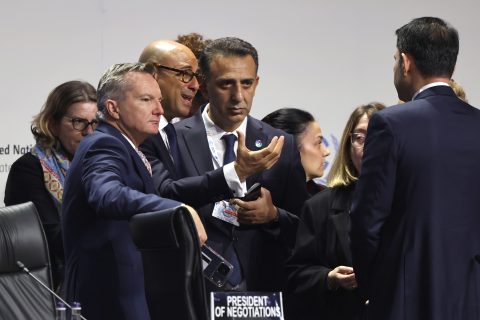
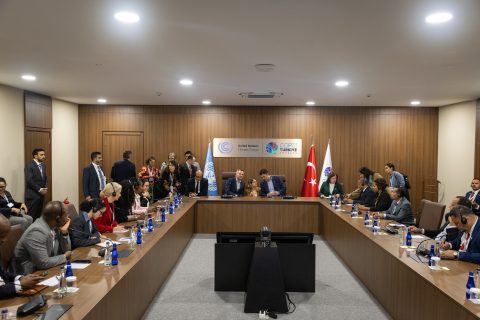
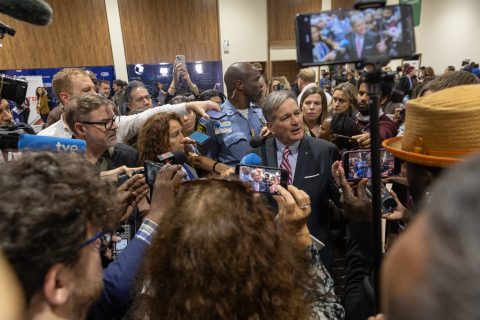
Tuvalu insisted that we need to keep the 1.5°C limit alive, despite recent warnings that we are certainly overshooting. We will continue to support the highest possible climate ambition across international fora to ensure a livable planet for everyone, including our citizens.
It’s easy to get on the stage at COP and ask for a phase out of fossil fuels. Luckily, next week, it’s equally easy to push for a concrete action that helps deliver just that. All the hard work at the IMO has been done over the past five years of negotiations, and the agreement is ripe for adoption.
To the industry, the NZF provides the certainty it is asking for to invest faster in green technology. To developing and most vulnerable countries, it generates up to $15 billion a year in revenues to help fund a just transition to clean energy in maritime and beyond. And it gives people hope that nations can still work together on the international stage to deliver meaningful progress against the climate crisis that threatens to overwhelm us all.
The coming fortnight at the IMO offers a unique chance to deliver a concrete first step to truly start moving away from fossil fuels. While we can expect petrostates to bring the same playbook to London as they did to Antalya, it’s up to us to seize the opportunity and show the laggards the tide is turning.
The post After COP31, our chance to save climate diplomacy lies in global shipping appeared first on Climate Home News.
https://www.climatechangenews.com/2026/11/23/after-cop31-our-chance-to-save-climate-diplomacy-lies-in-global-shipping/
Climate Change
‘COP-out’: COP31 fails to deliver the ambition needed to phase out fossil fuels and address climate breakdown
Antalya, Türkiye, Sunday 22 November 2026 — The COP31 climate summit in Antalya has ended in disappointment and anger, as the final COP31 outcome failed to deliver on critical issues like overshooting the 1.5°C limit, fossil fuel phase out and climate finance. Greenpeace Australia Pacific says that Australia did not deliver the deal that the world needed in a time of escalating climate breakdown.
In Antalya, Dr Susie Byers, Head of Advocacy at Greenpeace Australia Pacific, said: “We need to call this COP outcome what it is: a COP-out that has failed to deliver what the world urgently needs given the scale of the crisis we’re facing. It’s a colossal lost opportunity, and one that the world won’t easily forget.
“Coming out of Belém there was momentum to phase out fossil fuels, but COP31 wasn’t able to harness that energy and drive the world forward. The failure to adopt the Cover Decision means there’s now no acknowledgement of, let alone response to, 1.5°C overshoot — the survival line for Pacific nations. Electrification, defence of science, protection for the oceans, and advances on climate finance were all casualties of cynical attempts to derail climate action with dangerous distractions like CCUS.
“Australia knew how hard this task would be and put their hand up anyway. In the end, they didn’t get it done. This outcome validates exactly why so many countries are looking towards parallel tracks like the International Court of Justice Advisory Opinion and national transition roadmaps, where we’ve seen microdiplomacy and Pacific leadership again lead the way. This spirit of multilateralism and collaboration is how we will move beyond rhetoric to concrete actions, and end the fossil fuel chokehold.”
Also in Antalya, Shiva Gounden, Head of Pacific at Greenpeace Australia Pacific, said: “They called this an ‘implementation’ COP, but implementation means nothing when the foundation is broken. The frontline communities leading this fight came to Antalya demanding the urgent, definitive action required to confront the sickening realities of 1.5°C overshoot. Instead, developed countries turned their backs on their historical responsibilities, held climate finance hostage, and treated the debt they owe as a cheap bargaining chip.
“At the exact same time, Parties and negotiating blocs deliberately blocked the bold action the world needed on mitigation, peddled toxic distractions like CCUS, and intentionally scrubbed the words ‘fossil fuels’ from the final text. A strong Presidency that understood the urgency of the situation would not have let this happen; Australia failed to deliver what it promised the Pacific.
“Billions of people across the world are fiercely defending their lives, their homes, their cultures, and their livelihoods, and we came here with their voices demanding real action. By choking off the money and refusing to name the root cause of this collapse, polluting nations made a calculated choice to protect their own interests over our shared future. The Pacific will increasingly look towards parallel paths like the ICJ climate advisory opinion, and the Santa Marta process, to continue finding solutions because that is what our people need.”
ENDS
COP31 images and video available here in Greenpeace Media Library
Media contact: Kate O’Callaghan in Antalya (GMT+3) on +61 406 231 892 (Whatsapp/Signal)
Climate Change
COP31 Bulletin Day 13: New draft retains electrification goal but delays adaptation finance and science decisions
After an evening of tense discussions, a new version of the cover text was finally released at around 2am on Sunday morning. But, with many delegates flying home, it is unclear if – and for how long – there will be the two-thirds of governments present needed to legally adopt a decision.
The latest draft, which is – as of 9.30 – scheduled to be put to a plenary session for approval at 10am – retains a goal to boost electrification and links it more strongly with clean energy and storage. It does not, however, include language on transitioning away from fossil fuels as many countries had called for.
It ditches a specific numerical target for carbon capture, use and storage (CCUS), a controversial technology that is favoured by fossil fuel producers, which is now only an aim “to achieve gigatonne scale globally by 2035 as a collective global aspiration”. The previous version had two alternative targets, a weaker one of 0.5Gt “working towards” 1.3-2.5Gt and a stronger one of 2.5Gt.
The draft cover decision has strong language on responding to an almost certain overshoot of the 1.5C warming limit, recognising that it will increase loss and damage and result “in increasingly adverse, and in some cases irreversible, impacts and risks to human and natural systems”. As President of Negotiations Chris Bowen has repeatedly drawn attention to, this is the first COP held since the UN acknowledged that overshoot is inevitable.
In pursuing efforts to limit any overshoot, the decision recognises the need for “deep, rapid and sustained reductions in greenhouse gas emissions in line with 1.5 °C pathways” – which is a push towards greater ambition.
The text also resolves to close adaptation gaps and boost action and support to help countries and communities to better cope with adverse climate impacts. But it does not put a figure to a goal agreed at COP30 last year to triple adaptation finance by 2035.
The goal did not specify a baseline year and African nations, least-developed countries and small island states had pushed for it to be a later and higher baseline and therefore a larger target number of $120 bn a year. Instead, the text launches a “roadmap” on adaptation finance to be considered at COP32.
Loss and damage finance has been cut from the roadmap’s scope, as have references to about half the money pledged to the loss and damage fund having yet to be sent to the fund’s bank account and the gap between the $2.8 billion of loss and damage funding requested by developing countries in the fund’s start-up stage and the $0.342 billion allocated to fund these projects. “Erasing the shortfall doesn’t make it disappear for families who have lost everything”, said Harjeet Singh, global convenor of Fill the Fund.
The new text drops its invitation to the Intergovernmental Panel on Climate Change (IPCC) to publish all of its next three reports in time for the 2028 global stocktake of climate progress. Instead, it just invites them to “continue to provide policy-relevant information as input to the UNFCCC processes, including outputs from the seventh assessment cycle to the next global stocktake”. It no longer specifies that all their reports, including the third on reducing emissions, are published. The IPCC will have an online meeting in December to discuss this issue but COP31 guidance will be influential in its decision.
As Climate Home News entered the venue around 7.30am, tired-looking negotiators from Saudi Arabia and from the Alliance of Small Island Developing States were seen entering the area which houses the Presidency’s offices, as others dozed on sofas. A source close to the German delegation said that negotiations had been intense and were not necessarily resolved.
If the Presidency does not think it can get agreement on a cover text, then it can withdraw it or it can issue it a Presidency declaration, which does not have much weight. Some of its provisions could be added into other agenda items and adopted seperately. Governments could also decide to reconvene COP31 at a later date – known as a bis – as happened at COP6.
The post COP31 Bulletin Day 13: New draft retains electrification goal but delays adaptation finance and science decisions appeared first on Climate Home News.
COP31 Bulletin Day 13: Germany rejects text moments before plenary meeting