In the early hours of Friday in Dubai, a city surrounded by oil and gas plants, a draft text emerged at Cop28 that opened the possibility of phasing out all fossil fuels.
Other options are to “phase down” all fossil fuels, to focus purely on coal or to say nothing at all. The coin is in the air.
The text is in response to the global stocktake of progress to meet the Paris Agreement goals.
The draft recognises that current policies have made some progress to avoid the worst climate change scenarios, but “notes with significant concern” that we’re still not in line with the Paris Agreement goals of limiting warming to 2°C and aiming for 1.5°C.
Russia wants a “phase out” to be removed from the text, saying it would “discriminate” against their economy. The Cop28 presidency has used language suggesting preference for a “phase down” of fossil fuels.
The global stocktake text also proposes to end fossil fuel subsidies with “fairness”, as well as tripling renewable energy and doubling energy efficiency — two goals that have attracted broad support.
Some bits did not make it into the draft, observers said. While the text does have a target for cutting emissions by 2030, it does not include a medium-term target for 2035. The IPCC says the world must cut emissions by 60% by then to keep us in with a chance of meeting the 1.5°C target.
Latest headlines
Circus comes to town
More than 150 world leaders arrived in Dubai for day 2 of Cop28, where they announced modest funding pledges and bids for future Cops – but no new emissions targets.
Their presence was felt by delegates on the ground. Parts of the venue were blocked for leaders to move, forcing people to take longer routes and cutting off access to a section of the conference. Journalists were told they needed special tickets and escorts to enter the main press conference room.
The day started with a Climate Ambition Summit. UN chief Antonio Guterres took the stage to urge leaders to agree on a fossil fuel phase out. “Not reduce. Not abate. Phase out – with a clear timeframe aligned with 1.5 degrees,” he said.
Then came the usual parade of national leaders. They had been urged to keep their speeches to three minutes, but some had a lot to say. France’s Emmanuel Macron and Kenya’s William Ruto went on more than four times the limit.
Indian prime minister Narendra Modi pitched to host Cop33 in 2028. He announced a “green credits initiative” meant to go “beyond the commercial mindset of carbon credits”, without giving much detail about how.
Brazilian president Lula da Silva boasted about his wins reducing deforestation by a third in his first year. He did not mention the country’s oil and gas expansion plans for 2030 or setting the stage to join OPEC in 2024.
Some governments announced contributions to the new loss and damage fund, among them Italy ($108 million) and Canada ($8 million). World Bank CEO Ajay Banga, who will act as interim host of the fund, said the total pledged “isn’t going to get us very far” but money would start reaching people on the ground next year.

While tripling renewable energy was a common message in the leaders’ speeches, wording was less clear about phasing out fossil fuels, said E3G analyst Tom Evans.
The post Cop28 bulletin: Fossil fuel phaseout is on the table appeared first on Climate Home News.

For the first time, new-energy vehicles (NEVs) made up 67% of new car sales in China in September, according to the latest data from the China Passenger Car Association (CPCA).
The figures show that NEVs, which include battery electric cars and plug-in hybrids, captured a record share of sales, even though fewer were sold than last year.
This is because sales of combustion-engine cars are falling steeply, a trend that the CPCA has attributed to rising petrol prices following the start of the Hormuz crisis.
Indeed, sales of fuel-only cars were down 31% year-on-year in the first nine months of 2026, with plug-in hybrid sales down 26% – whereas battery EV sales were only down 4%.
One analyst tells Carbon Brief that China’s rapidly growing EV fleet has offset demand for 143m barrels of oil since the start of the Hormuz crisis.
Another says that the crisis is “reinforcing China’s electrification of road transport”.
Meanwhile, amid slowing domestic sales, Chinese carmakers’ exports of NEVs more than doubled [in 2026 to date / in September] from a year earlier.
NEV record
A record two out of every three cars sold in September in China were NEVs, according to CPCA data, as shown in the figure below.
(NEVs predominantly include battery electric vehicles – BEVs – and plug-in hybrids – PHEVs. BEVs only run on electricity, whereas PHEVs also have a combustion engine.)
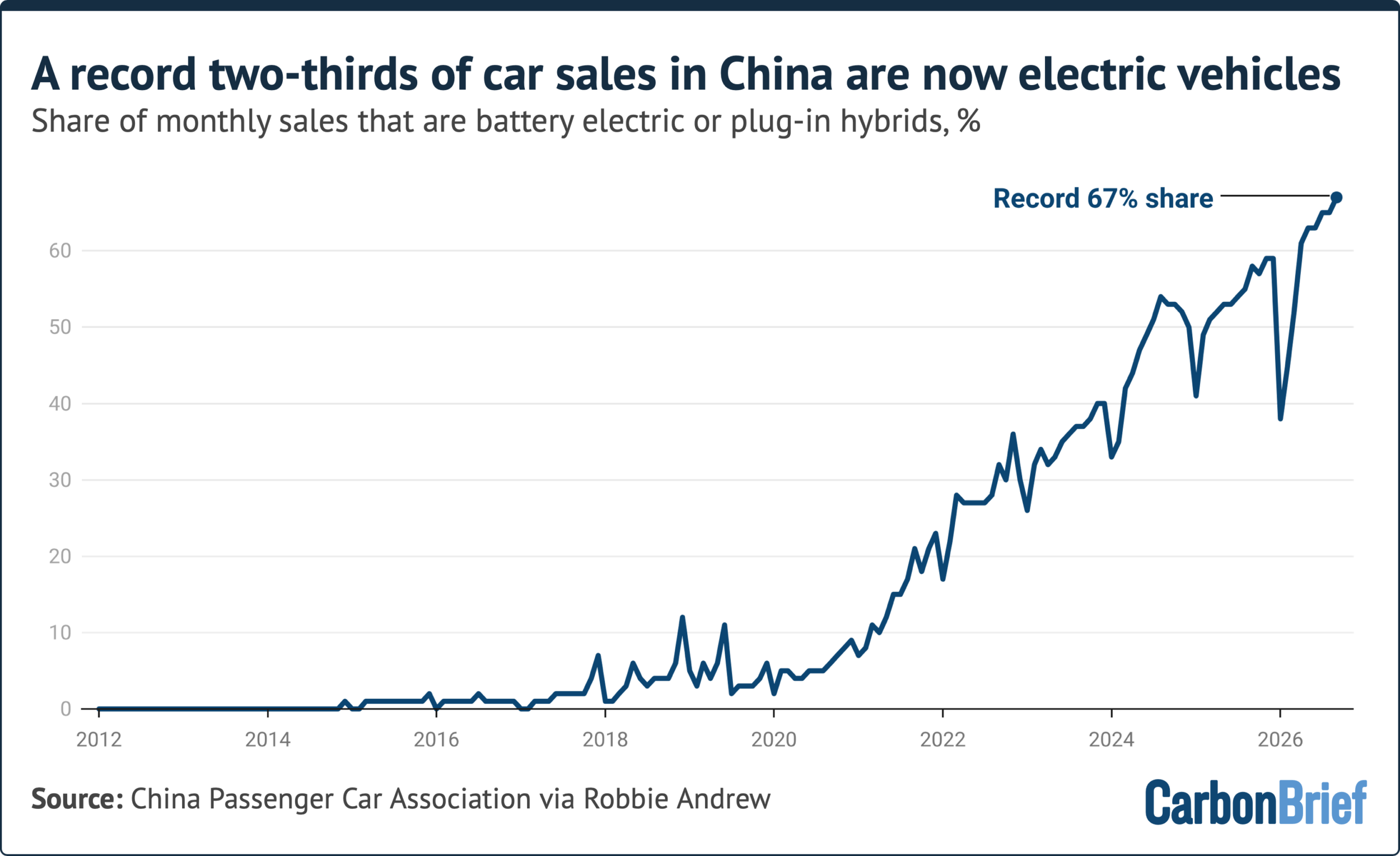
This marks a rapid rise for NEVs from just 6% of new car sales in 2020 up to 58% in 2026 to date – and a record 67% in the month of September.
This year, NEVs’ share of sales has also bounced back from a low of 39% in January, after the full purchase tax exemption that had been in place for more than a decade came to an end in December 2025.
The gain in NEV share in 2026 has come amid a slowdown across the wider domestic passenger-car market, which has hit sales of combustion-engine vehicles particularly hard.
This September, passenger-car retail sales across all categories declined, with overall sales volumes falling 28% year-on-year.
The contraction was led by combustion-engine vehicles, which saw sales fall 43% year-on-year in September and 31% in 2026 to date.
However, sales of PHEVs also fell by 36% year-on-year in September and by 26% in 2026 to date. By comparison, BEVs performed better, although sales still declined 8.5% from a year earlier in September and 4% in 2026 to date.
As a result, NEV sales overall fell by 17% in September and 13% in 2026 to date.
While the market changes in 2026 to date were particularly dramatic, they reflect a broad continuation of trends seen over the past decade.
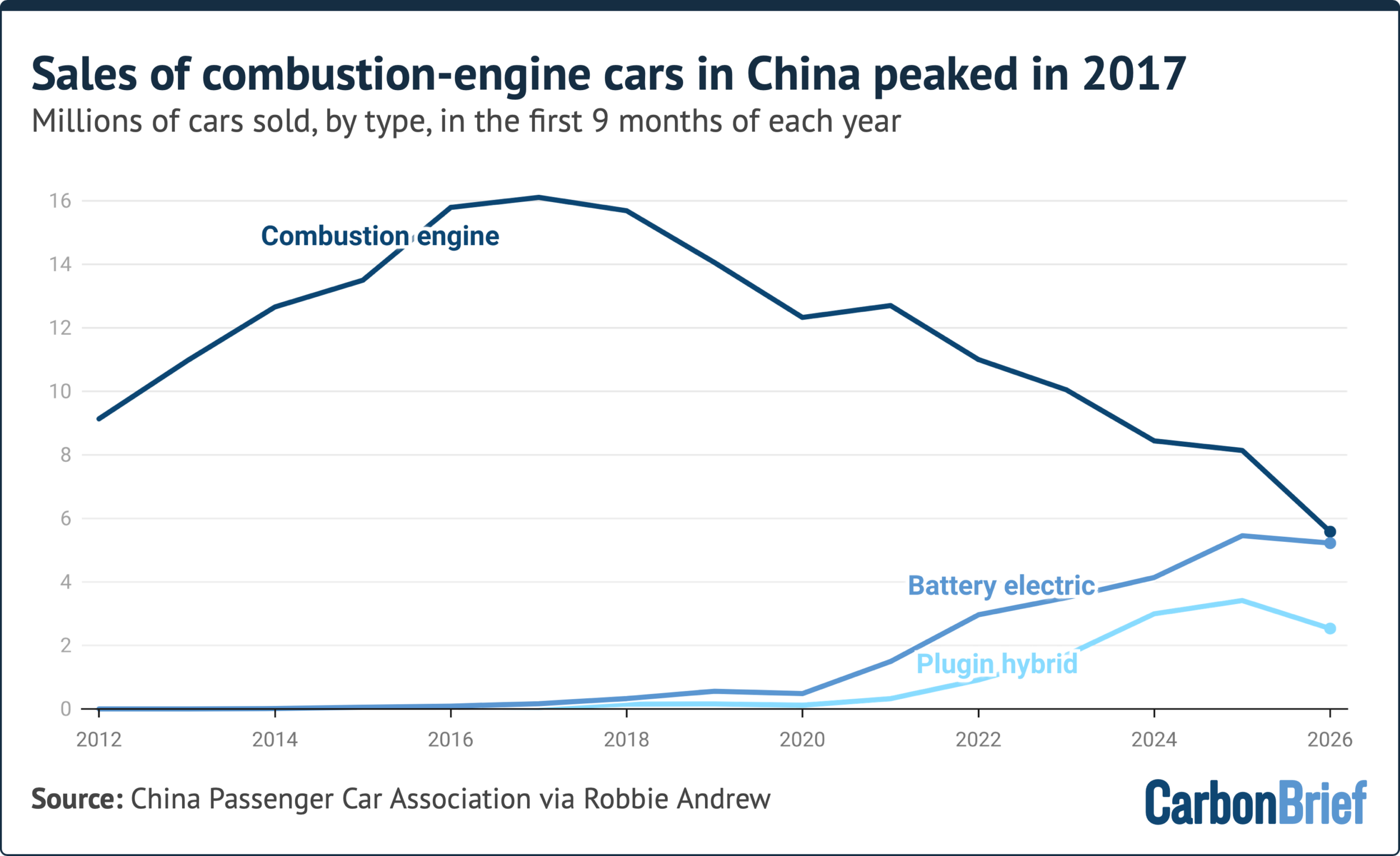
Indeed, sales of combustion-engine cars in China peaked in 2017 and they have been declining ever since, shown in the figure below.
Impact of Hormuz
Part of the reason for the advance of NEVs in 2026, said Chinese technology news outlet OFweek, was petrol cars “giving up market share” as they were outperformed by electric alternatives.
Cui Dongshu, secretary-general of the CPCA, cited higher petrol prices as an explanation for September’s weak combustion-car sales, in comments to financial news outlet National Business Daily.
Imports of oil into China in January-September have fallen 15% compared to 2025, equivalent to 470m barrels, as ongoing conflict tightened supply and drove up prices.
China’s passenger-car NEV fleet has displaced 143m barrels of oil so far during the strait of Hormuz crisis, Euan Graham, senior energy analyst at thinktank Ember, tells Carbon Brief.
EVs “accounted for 12% of the decrease in China’s oil use post-Hormuz”, according to an estimate provided to thinktank the Brookings Institute by an unnamed analyst.
Erica Downs, a senior research scholar at Columbia University’s Center on Global Energy Policy, tells Carbon Brief that the strait of Hormuz crisis and higher oil prices are “reinforcing China’s electrification of road transport”.
She says the “world’s largest oil supply disruption” vindicates China’s early bet on EVs, which was partly driven by concerns about oil-supply security.
NEV demand down
Nevertheless, NEV sales have fallen year-on-year, albeit at a slower rate than overall car sales. The growth in NEV market share has also been decelerating.
Zhang Yichao, a partner at consulting firm AlixPartners, tells Carbon Brief that NEVs benefit from government trade-in policies and a “strong pipeline” of new models, particularly those involving innovation.
He says these factors help explain why NEVs sales have fallen at a slower rate to their combustion-car counterparts.
Cui told the state-run China National Radio that the fall for NEVs and for cars overall in September 2026, is also due to a high baseline of sales from the same month in 2025, as well as changes to trade-in policies and disruptions from the holiday period.
Other factors, says consulting firm Wood Mackenzie, are the weakened demand due to “demand pull-forward” in 2025 caused by the end of subsidies, as well as “tighter financing conditions”.
Zhang tells Carbon Brief he does not “see much more room ahead” for further growth in NEVs’ market share.
He adds that, in his view, their share in China is unlikely to exceed 80%, as some premium-market segments and specific use cases will continue to require combustion-engine vehicles.
Exports surge
Meanwhile, while domestic NEV retail sales fell 17% in September 2026, exports more than doubled, increasing 164% year-on-year, according to the CPCA.
This extends the decline in domestic sales and very strong growth in exports seen across 2026 to date, as shown in the figure below.
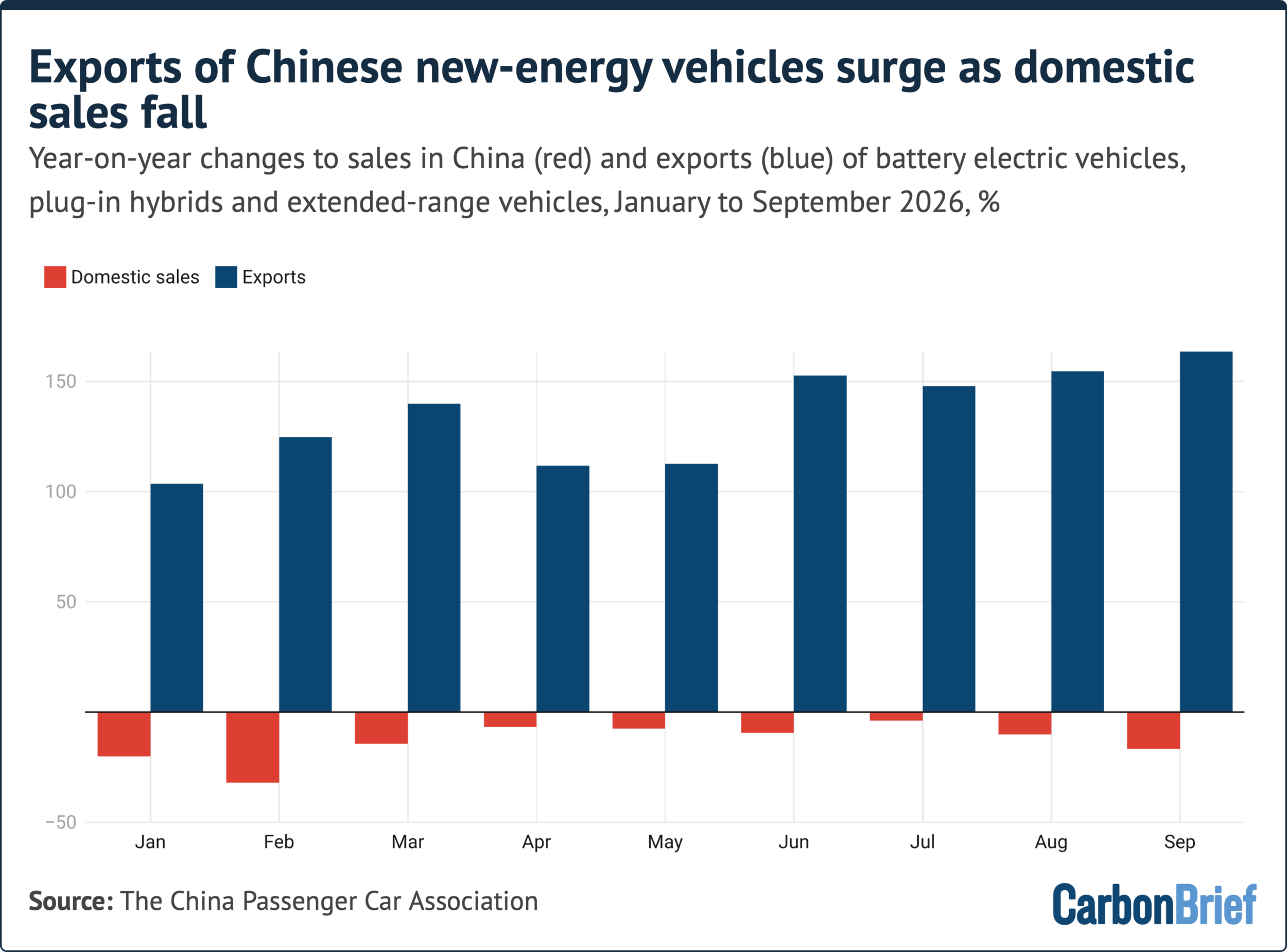
In September, 1,084,000 NEVs were sold domestically in China, while 558,000 NEVs were exported.
Exports are becoming increasingly important to Chinese carmakers, in the face of weaker domestic demand and cut-throat industrial competition.
The CPCA says exports have become “a core priority” for some carmakers.
However, the surge in exports from China has created concern in the EU, which has placed tariffs on imports of EVs from China and recently agreed plans to cut imports of hybrids.
Countries including Mexico and Turkey have also placed tariffs on Chinese EV imports.
At the same time, the Chinese government is putting policies in place that might be expected to disincentivise exports, such as cutting VAT export rebates.
Analysts differ on what impact this policy shift will have, with some saying it will be limited, while others believe it could cause the price of exported cars to rise.