

A recent ruling by the UK’s top court will make it harder for new fossil fuel production projects to get approval across Europe and beyond, with the judgment already influencing a separate court case over a new coal mine in England this week, climate campaigners and legal experts told Climate Home.
On June 20, the Supreme Court in London ruled that, in deciding whether to approve a new oil well in Horse Hill in southern England, the authorities must consider the greenhouse gas emissions from burning the oil, not just the much smaller volume of emissions from getting the oil out of the ground.
Announcing what has been called the “Finch ruling”, Judge George Leggatt said: “The emissions that will occur on combustion of the oil produced are ‘effects of the project’ because it is known with certainty that, if the project goes ahead, all the oil extracted from the ground will inevitably be burnt, thereby releasing greenhouse gases into the Earth’s atmosphere in a quantity which can readily be estimated.”
The ruling has already helped campaigners challenge a planned coal mine in Cumbria in the north of England, set to provide fuel for steel-making. The UK’s new Labour government said last week that the previous Conservative government had made an “error in law” when approving the mine and withdrew support for the mine’s developer in a separate court case being heard this week.

Campaigners against the Cumbria coal mine oppose bringing “zombie” coal back from the dead on July 16, 2024 (Photo: Friends of the Earth)
Speaking during a break in that case, Friends of the Earth lawyer Katie de Kauwe said the Finch ruling had strengthened the green group’s legal argument against the coal mine. The mine’s developer – which is still defending the case – did not assess the emissions from burning the coal and, in the wake of the Finch ruling, “it’s very clear that was unlawful”, she told Climate Home.
The ruling is likely to resonate beyond the UK, she added, because it concerns regulations that are derived from European Union (EU) law. Although the UK has left the EU, many of its laws remain similar.
Greenpeace Norway campaigner Halvard Raavand said his colleagues had “a small celebration” in their Oslo offices when the Finch ruling was handed down, popping bottles of alcohol-free champagne. “It’s highly positive,” he said. “We’re very, very relieved – it shows it’s possible to take on fossil fuels and win.”
Like the UK, Norway is not an EU member but bases much of its law on that of the bloc. Greenpeace Norway is challenging in court its government’s approval of three new oil and gas fields, arguing that they failed to properly consider the climate impact from burning the fuels – known as scope 3 emissions.
Raavand said that, while Norway and the UK’s national courts are not related, Norwegian judges are likely to consider the UK’s judgement as a precedent. “Other courts across Europe might look to each other too,” he said.

Gina Gylver, head of Natur og Ungdom (Young Friends of the Earth Norway), and Frode Pleym, head of Greenpeace in Norway in Oslo District Court on November 28, 2023 (Photo: Rasmus Berg/Greenpeace)
Over in Amsterdam, Dutch Friends of the Earth campaigner Sjoukje van Oosterhout also celebrated the Finch ruling. “This verdict sets an important precedent,” she told Climate Home. “Judges worldwide will be looking at this.” She said it could boost campaigners’ legal challenge to Dutch company One Dyas’ plans to drill oil in the Wadden Sea, part of the North Sea.
Climate law professor Harro van Asselt said the UK ruling was “important” and “may well have implications for EU member states considering licensing fossil fuel projects”. He added that judges had made similar rulings in Australia and Norway in the last few years – although the Norwegian case, which influenced the Finch ruling, is under appeal.
While its ripple effects will be strongest in the EU and countries with similar laws, van Asselt said he would not exclude the possibility of the Finch ruling influencing court judgements elsewhere, in particular in common-law countries like Australia. Common law is a legal system that evolves based on judges’ rulings, generally found in former British colonies like the US, Canada and New Zealand.
De Kauwe of Friends of the Earth added that the Finch ruling could influence environmental impact assessments across the world.

Most of the oil and gas being extracted in Europe (red) or discovered, or under development (blue), is in the North Sea (Picture: Global Energy Monitor/Screenshot)
The recent change in government in the UK is also likely to hamper new fossil fuel production projects in the country. Keir Starmer’s Labour Party was elected on a manifesto promising to ban the method of gas extraction known as fracking and not to issue new licenses to explore new oil and gas fields or grant new coal mining licenses.
Gareth Redmond-King is the international lead at the Energy and Climate Intelligence Unit advocacy group. He told Climate Home that, at last year’s COP28 climate summit, British politicians heard from Global South government negotiators that politicians in their countries had cited the UK’s decision to issue new North Sea oil and gas licences as justification for pursuing their own fossil fuel exploration. That excuse has now been taken away, he said.
“Leadership works both ways,” he added. “The precedent set by this [Labour] decision makes it harder for fossil fuel companies to justify drilling in other countries. The UK is now the first G7 country to have pledged to put a moratorium on new exploration. That’s a big step.”
(Reporting by Joe Lo; editing by Megan Rowling)
The post UK court ruling provides ammo for anti-fossil fuel lawyers worldwide appeared first on Climate Home News.
UK court ruling provides ammo for anti-fossil fuel lawyers worldwide

Following the close of COP31 in Antalya, Turkey, Carbon Brief’s journalists answered a range of questions in a CB Live panel discussion.
COP31 came to a dramatic conclusion nearly 50 hours after its scheduled close – making it the longest COP in history.
Less than 24 hours later, Carbon Brief published its 21,000-word summary, capturing everything that happened in the negotiations, the cover decision and more.
This includes the “Antalya pact”, proposed by the joint Turkish-Australian presidency, being rejected in the final hours of the summit by the EU, the UK and several climate-vulnerable nations.
There was some progress at COP31, including an agreement on the adaptation fund, as well as a raft of announcements within the “action agenda”.
Carbon Brief journalists – who followed every detail of the summit on the ground in Antalya and remotely answered a range of questions, including those sent ahead of time by CB+ members on CB Connect.
These covered climate finance, China, the “just transition mechanism”, the potential for COP reform and much more.
The discussion was moderated by Carbon Brief’s senior policy editor Dr Simon Evans and featured the following journalists:
- Daisy Dunne, associate editor
- Josh Gabbatiss, associate editor
- Aruna Chandrasekhar, policy journalist
- Molly Lempriere, policy section editor
- Anika Patel, China section editor
- Dr Giuliana Viglione, associate editor
A recording of the CB Live (below) is now available to watch on YouTube.
The post CB Live: Carbon Brief journalists discuss key COP31 outcomes appeared first on Carbon Brief.
CB Live: Carbon Brief journalists discuss key COP31 outcomes
Climate Change
COP31: Key outcomes for food, forests, oceans and nature at the UN climate talks in Antalya
The COP31 climate talks in Antalya, Turkey, failed to agree on a “pact” that – despite making no clear reference to fossil fuels or adaptation finance – had contained strong signals for oceans.
The “Antalya pact” took up much of the two weeks of negotiating time in Turkey, only to be rejected during the closing plenary by the EU, the UK and several climate-vulnerable countries.
Several countries expressed their regret during the plenary that significant work on advancing ocean-climate action would be lost.
The COP ran nearly 50 hours over time, but did not end with substantive outcomes on several key topics.
For the second year in a row, negotiations on agriculture and food security broke down and will now have to resume next year.
Food-systems advocates were, however, heartened by the explicit inclusion of “agroecology” in a decision within the “just transition work programme”.
Ocean-conservation groups noted an increased focus on ocean-climate links at this year’s COP, but said COP31 did not live up to its promise of being a “blue COP”.
There was also scant new funding for food systems and nature, with just a handful of small pledges to ocean initiatives and two newly announced contributions to the Tropical Forest Forever Facility.
Here, Carbon Brief analyses all of the key outcomes for food, forests, oceans and nature at COP31 – both inside and out of the negotiating rooms.
(See Carbon Brief’s coverage of food, forests, oceans and nature at COP30, COP29, COP28, COP27 and COP26.)
Formal negotiations
Cover decision
The final draft of a COP31 “cover decision” was rejected by at least 32 countries during a chaotic – and, at times, acrimonious – closing plenary in Antalya.
Other recent COPs have issued cover decisions, setting a firm precedent.
However, many parties remained unhappy about the existence of the cover decision, the process by which it was put together and the impact it had on time for other negotiations.
Ultimately, parties did not find consensus on the text, particularly around the removal of any reference to fossil fuels and the lack of concrete climate-finance targets.
The cover text was one of the places in the negotiations where ocean advocates were hoping to see ocean-climate linkages highlighted.
Marine Lecerf, head of international policy at Ocean & Climate Platform, told a press huddle:
“What we’re really asking for right now is to make sure we can recognise ocean-based interlinkages…We’re not asking for a new mandate. We are asking for acceleration of the work that is already undertaken.”
The first draft of the cover decision, published on 16 November, was a compilation of all the issues that parties had put forward for inclusion. It was accompanied by a short “presidency note” explaining that all elements were still in play, including whether or not they should appear in a final text.
This lengthy first draft had 21 references to the ocean, including recognising the impacts of climate change, support for ocean-observing systems, encouraging parties to strengthen ocean-climate action and a multi-year plan for the “ocean and climate change dialogue”, which occurs annually at the Bonn intersessional meetings in June.
Regarding that draft, Steven Guilbeault, former environment minister of Canada, told Carbon Brief:
“I don’t see why the elements that are in the cover decision right now on oceans should be controversial or problematic to any nations. If you’re serious about fighting climate change, there’s nothing in this text regarding oceans that should be problematic for you.”
(Earth Negotiations Bulletin reported that Russia opposed mentions of the ocean in the cover text during the ocean ministerial consultation.)
The next iteration of the text, on 19 November, retained many of the ocean elements, albeit with less detail than the first draft. The second text also removed references to post-2028 ocean work and a proposed high-level ministerial ocean dialogue.
In the end, oceans had 19 mentions in the rejected Antalya pact.
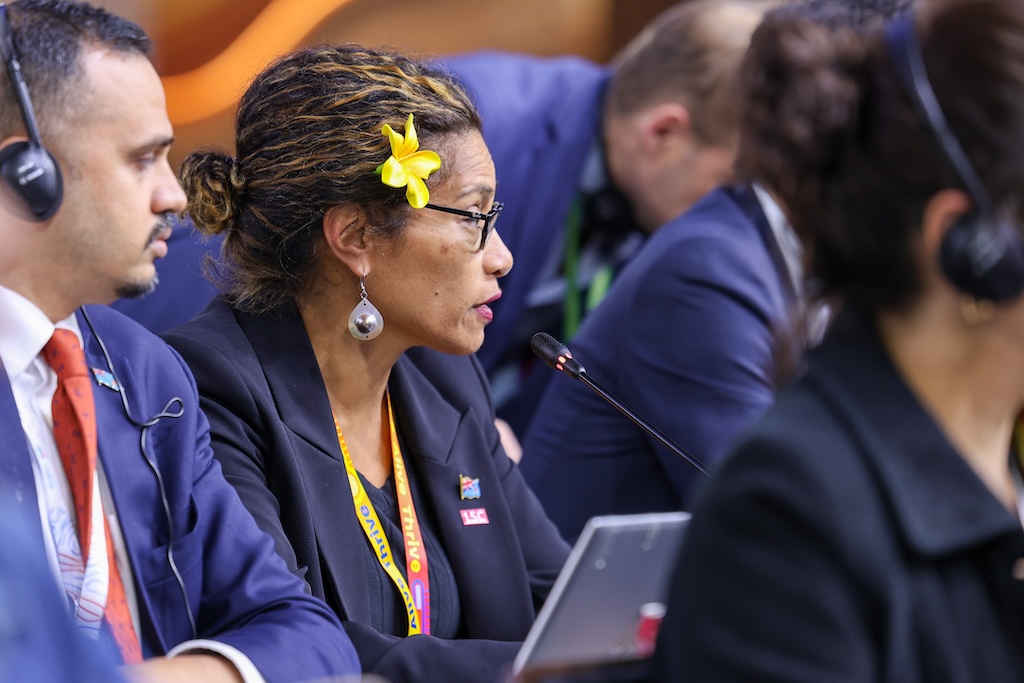
During the final plenary, Fiji’s Dr Sivendra Michael – co-chair of the ocean and climate change dialogue – appealed to the COP31 president to “humbly consolidate” the consensus on ocean as a “standalone ocean decision” and “directly submit” ten paragraphs with no objections in text as a “way to prese