

Welcome to Carbon Brief’s DeBriefed.
An essential guide to the week’s key developments relating to climate change.
This week
Record temperatures
RECORD LEVELS: The Copernicus Climate Change Service has warned that extreme weather across the globe is set to continue, following April marking the 11th month in a row where global average temperatures were at record highs, reported the Financial Times. April was 0.67C above the 1991-2020 average for the month and 1.58C above pre-industrial levels, it added.
SURGING SEA TEMPERATURES: Analysis of the Copernicus data by BBC News found that the world’s oceans have broken temperature records every single day over the past year and, on some days, this has been by a “huge margin”. In February and March 2024, sea surface temperatures reached a new global average daily high of 21.09C, according to the analysis.
Climate scientists speak out
PAST 1.5C: A survey by the Guardian has found that the majority of the world’s leading climate scientists expect global temperature to rise to at least 2.5C above pre-industrial levels by 2100, given the current level of action by countries. The survey of 380 Intergovernmental Panel on Climate Change (IPCC) scientists found that almost half anticipate 3C of warming, while only 6% thought the internationally agreed 1.5C limit will be met.
EXHAUSTED EXPERTS: In an accompanying piece in the Guardian, the experts shared their views. One scientist from Mexico told the newspaper she felt “hopeless and broken” by the pace of rising climate impacts, while another expert said thinking of the future was “infuriating, distressing, overwhelming”. A separate piece spoke to the female scientists surveyed, a fifth of whom have decided not to have children or to have fewer.
AVOIDING DESPAIR: The Guardian published an editorial alongside the above articles, urging readers not to despair. Although the “future can feel overwhelming and unfixable”, it notes, we need to “build collective awareness, a sense that change is possible and momentum for wider systemic progress”. Additionally, an opinion article by former UN climate chief Christiana Figueres similarly argues that “stubborn optimism may be our only hope”.
Around the world
- BRAZIL FLOODS: Record-breaking floods in southern Brazil have killed more than 105 people and affected more than 1.7 million, with more rain expected, reported O Globo.
- EU AND CHINA TALK TRADE: EU commissioner Ursula von der Leyen has restated readiness to launch a trade war with China over imports of clean energy technologies during a meeting with president Xi Jinping, reported the Guardian. Elsewhere, the South China Morning Post reported that the new climate envoys from China and the US have met for the first time.
- SOUTH ASIA HEATWAVES: Governments across south and south-east Asia have issued health warnings as schools shut and crops fail, as extreme heat continues to grip the region, the Guardian reported. In the Himalayan state of Uttarakhand, five people have been killed by forest fires, reported the Hindustan Times.
- AUSTRALIAN GAS: Australia’s government has announced plans to ramp up the extraction and use of gas to “2050 and beyond”, BBC News reported. The prime minister is now facing an internal revolt from his party, the Guardian added.
- KENYA DAY OF MOURNING: Kenya’s president William Ruto has declared a public day of mourning following the deaths of 238 people due to ongoing flooding, which will be marked by tree-planting, reported the Associated Press.
- LONDON MAYOR: Labour’s Sadiq Khan has pledged further “world-leading green action” after winning a historic third term as London Mayor, reported Bloomberg. Khan’s victory came despite speculation his ambitious air pollution and climate measures could turn off voters.
30%
The proportion of global electricity that came from renewables last year – a new record, according to analysis covered by Carbon Brief.
Latest climate research
- Fewer cooler days due to climate change could make existing varieties of lychee “unsuitable for cultivation in production areas in southern Taiwan”, a new study in Climate Services said.
- Tornado-producing tropical storms may increase “substantially” in the US by 2050 as climate change worsens, new research in Weather and Climate Extremes found.
- New research published in Nature Climate Change found that the transport of ocean heat through the Bering Strait has a more substantial influence on Arctic warming than previously recognised.
(For more, see Carbon Brief’s in-depth daily summaries of the top climate news stories on Tuesday, Wednesday, Thursday and Friday.)
Captured

“Residual emissions” are those that remain once a nation has gone as far as it thinks is possible to cut its emissions. These emissions tend to come from sectors that are considered hard to decarbonise, such as livestock farming and heavy industry. The concept is closely tied with net-zero targets. That is, a country must remove CO2 from the atmosphere that is equivalent in volume to its residual emissions, in order to say it has reached net-zero. A new study covered by Carbon Brief explored national strategies for managing residual emissions. Of the 71 countries examined, just 26 have long-term plans to tackle these emissions. These nations could have residual emissions of up to 2.9bn tonnes of CO2 equivalent by 2050, equal to around 5% of total global emissions. Countries include major emitters such as the US, Canada and Australia (as shown in the above chart). The chart shows residual emissions (red) as a share of each nation’s peak emissions (blue) – or its most recent annual emissions, if its emissions have not yet peaked.
Spotlight
The Thames Barrier at 40
Carbon Brief visits London’s Thames Barrier, the second-largest flood defence barrier in the world, as it turns 40-years-old.
With sea levels rising and flood risks increasing, the UK’s Environment Agency (EA) is working to develop the next era of protections for London and the wider Thames Estuary.
On 25 April, Carbon Brief visited the Thames Barrier to discuss its origins and look forward to its next 40 years.
History
In 1953, London and the east coast of England were devastated by the North Sea Flood, which killed more than 300 people and caused an estimated £50m in damage (approximately £5bn in today’s money) in the region.
While, previously, the UK government had broadly taken a reactive approach to floods, progressively raising the walls and banks of the Thames river, this flood made it clear that such an approach was not sustainable.
In response, one of the first ever “rising sector gates” was built across a 520m-long stretch of the River Thames near Woolwich.
The Thames Barrier was designed by Charles Draper of the London-based Rendel, Palmer and Tritton architectural company, who took inspiration from a gas tap on his cooker. He built a working model in 1969, ahead of construction five years later. The barrier started being used in 1982.

On 8 May 1984, the Queen Elizabeth II officially opened the £535m (£2.4bn in today’s money) Thames Barrier, which remains the second-largest flood defence barrier in the world.
Operation
Now, 40 years on, the Thames Barrier continues to protect 1.4 million people and £321bn of property from tidal flooding.
The Thames Barrier includes 10 steel gates positioned across the width of the river that can be rotated to rise out of the water. Once raised, each 3,300-tonne main gate stands as high as a five-story building and is as wide as the opening of London’s iconic Tower Bridge.
Over the past four decades, it has been closed 221 times for flood defence purposes, including a particular spike in 2013-2014 when it was closed 50 times in 13 weeks.
Andy Batchelor, Thames tidal defences operations manager, who started work at the barrier the day the Queen opened it, said in a statement:
“Having witnessed and worked on the Thames Barrier’s opening, I am immensely proud of the protection it has provided London for the past 40 years and will continue to provide for years to come.
“Its reliability and effectiveness demonstrate the sophistication of its design by a very talented group of engineers and the continued maintenance and operation carried out by the barrier team.”
The next 40 years
The Thames Barrier was only designed to last until 2030. However, the EA, which operates and maintains the site, is confident it will continue to run until 2070.
However, sea levels are predicted to rise 1.5m by the end of the century, increasing the potential for a significant tidal flood. Additionally, with England becoming increasingly wet, the barrier is expected to be called on increasingly – about half of the closures to date have been for river flood protection.
If closing the barrier 50 times in a year becomes the norm, it could fail, the EA has warned, as this does not provide the necessary time for workers to maintain it.
As such, the agency is working on preparing for the next era of flood protection.
The agency is planning to work with partners to continuously review the best available options, including building a new barrier or developing more flood storage, and decide on an end-of-century option by 2040.
Meanwhile, from 2021-27, the government is set to invest £5.6bn in creating new flood and coastal defences to protect hundreds of thousands of properties.
Watch, read, listen
THE $9TN QUESTION: A “big read” in the Financial Times explored how governments worldwide are looking to foot the “immense” bill for the green transition.
BIG BRANDS GREEN CLAIMS: BBC Panorama looked at the “green claims” made by the world’s biggest brands, exposing serious flaws and side-effects of their reliance on carbon offsetting.
ASIAN HEATWAVES: On Himal South Asian’s podcast, environmental social scientist and Carbon Brief contributing editor Dr Chandni Singh discussed why the extreme heat facing the subcontinent this summer is unlike the “heat of the past”.
Coming up
- 13 May: Fourth phase of India’s election
- 14 May: International Energy Agency (IEA) conference on clean cooking in Africa, Paris, France
- 15-17 May: UN Environment Programme: Accelerating urban nature-based solutions: A Latin American-European collaboration, Barcelona, Spain
- 15 May-1 June: IEA-COP29 high-level dialogues, Paris, France
Pick of the jobs
- Carbon Brief, journalist internship | Salary: £13.50 per hour and £100 travel expenses. Location: London
- Conservation International, director of African natural climate solutions roadmap | Salary: Unknown. Location: Nairobi, Kenya
- UK Department of Energy Security and Net Zero, environmental manager | Salary: £69,485-£76,525. Location: Aberdeen, Birmingham, Cardiff, Darlington, Edinburgh or Salford
DeBriefed is edited by Daisy Dunne. Please send any tips or feedback to debriefed@carbonbrief.org.
This is an online version of Carbon Brief’s weekly DeBriefed email newsletter. Subscribe for free here.


The post DeBriefed 10 May 2024: 11 months of record heat; Climate scientists ‘hopeless and broken’; 40 years of the Thames Barrier appeared first on Carbon Brief.

Climate Change
‘COP-out’: COP31 fails to deliver the ambition needed to phase out fossil fuels and address climate breakdown
Antalya, Türkiye, Sunday 22 November 2026 — The COP31 climate summit in Antalya has ended in disappointment and anger, as the final COP31 outcome failed to deliver on critical issues like overshooting the 1.5°C limit, fossil fuel phase out and climate finance. Greenpeace Australia Pacific says that Australia did not deliver the deal that the world needed in a time of escalating climate breakdown.
In Antalya, Dr Susie Byers, Head of Advocacy at Greenpeace Australia Pacific, said: “We need to call this COP outcome what it is: a COP-out that has failed to deliver what the world urgently needs given the scale of the crisis we’re facing. It’s a colossal lost opportunity, and one that the world won’t easily forget.
“Coming out of Belém there was momentum to phase out fossil fuels, but COP31 wasn’t able to harness that energy and drive the world forward. The failure to adopt the Cover Decision means there’s now no acknowledgement of, let alone response to, 1.5°C overshoot — the survival line for Pacific nations. Electrification, defence of science, protection for the oceans, and advances on climate finance were all casualties of cynical attempts to derail climate action with dangerous distractions like CCUS.
“Australia knew how hard this task would be and put their hand up anyway. In the end, they didn’t get it done. This outcome validates exactly why so many countries are looking towards parallel tracks like the International Court of Justice Advisory Opinion and national transition roadmaps, where we’ve seen microdiplomacy and Pacific leadership again lead the way. This spirit of multilateralism and collaboration is how we will move beyond rhetoric to concrete actions, and end the fossil fuel chokehold.”
Also in Antalya, Shiva Gounden, Head of Pacific at Greenpeace Australia Pacific, said: “They called this an ‘implementation’ COP, but implementation means nothing when the foundation is broken. The frontline communities leading this fight came to Antalya demanding the urgent, definitive action required to confront the sickening realities of 1.5°C overshoot. Instead, developed countries turned their backs on their historical responsibilities, held climate finance hostage, and treated the debt they owe as a cheap bargaining chip.
“At the exact same time, Parties and negotiating blocs deliberately blocked the bold action the world needed on mitigation, peddled toxic distractions like CCUS, and intentionally scrubbed the words ‘fossil fuels’ from the final text. A strong Presidency that understood the urgency of the situation would not have let this happen; Australia failed to deliver what it promised the Pacific.
“Billions of people across the world are fiercely defending their lives, their homes, their cultures, and their livelihoods, and we came here with their voices demanding real action. By choking off the money and refusing to name the root cause of this collapse, polluting nations made a calculated choice to protect their own interests over our shared future. The Pacific will increasingly look towards parallel paths like the ICJ climate advisory opinion, and the Santa Marta process, to continue finding solutions because that is what our people need.”
ENDS
COP31 images and video available here in Greenpeace Media Library
Media contact: Kate O’Callaghan in Antalya (GMT+3) on +61 406 231 892 (Whatsapp/Signal)
Climate Change
COP31 Bulletin Day 13: New draft retains electrification goal but delays adaptation finance and science decisions
After an evening of tense discussions, a new version of the cover text was finally released at around 2am on Sunday morning. But, with many delegates flying home, it is unclear if – and for how long – there will be the two-thirds of governments present needed to legally adopt a decision.
The latest draft, which is – as of 9.30 – scheduled to be put to a plenary session for approval at 10am – retains a goal to boost electrification and links it more strongly with clean energy and storage. It does not, however, include language on transitioning away from fossil fuels as many countries had called for.
It ditches a specific numerical target for carbon capture, use and storage (CCUS), a controversial technology that is favoured by fossil fuel producers, which is now only an aim “to achieve gigatonne scale globally by 2035 as a collective global aspiration”. The previous version had two alternative targets, a weaker one of 0.5Gt “working towards” 1.3-2.5Gt and a stronger one of 2.5Gt.
The draft cover decision has strong language on responding to an almost certain overshoot of the 1.5C warming limit, recognising that it will increase loss and damage and result “in increasingly adverse, and in some cases irreversible, impacts and risks to human and natural systems”. As President of Negotiations Chris Bowen has repeatedly drawn attention to, this is the first COP held since the UN acknowledged that overshoot is inevitable.
In pursuing efforts to limit any overshoot, the decision recognises the need for “deep, rapid and sustained reductions in greenhouse gas emissions in line with 1.5 °C pathways” – which is a push towards greater ambition.
The text also resolves to close adaptation gaps and boost action and support to help countries and communities to better cope with adverse climate impacts. But it does not put a figure to a goal agreed at COP30 last year to triple adaptation finance by 2035.
The goal did not specify a baseline year and African nations, least-developed countries and small island states had pushed for it to be a later and higher baseline and therefore a larger target number of $120 bn a year. Instead, the text launches a “roadmap” on adaptation finance to be considered at COP32.
Loss and damage finance has been cut from the roadmap’s scope, as have references to about half the money pledged to the loss and damage fund having yet to be sent to the fund’s bank account and the gap between the $2.8 billion of loss and damage funding requested by developing countries in the fund’s start-up stage and the $0.342 billion allocated to fund these projects. “Erasing the shortfall doesn’t make it disappear for families who have lost everything”, said Harjeet Singh, global convenor of Fill the Fund.
The new text drops its invitation to the Intergovernmental Panel on Climate Change (IPCC) to publish all of its next three reports in time for the 2028 global stocktake of climate progress. Instead, it just invites them to “continue to provide policy-relevant information as input to the UNFCCC processes, including outputs from the seventh assessment cycle to the next global stocktake”. It no longer specifies that all their reports, including the third on reducing emissions, are published. The IPCC will have an online meeting in December to discuss this issue but COP31 guidance will be influential in its decision.
As Climate Home News entered the venue around 7.30am, tired-looking negotiators from Saudi Arabia and from the Alliance of Small Island Developing States were seen entering the area which houses the Presidency’s offices, as others dozed on sofas. A source close to the German delegation said that negotiations had been intense and were not necessarily resolved.
If the Presidency does not think it can get agreement on a cover text, then it can withdraw it or it can issue it a Presidency declaration, which does not have much weight. Some of its provisions could be added into other agenda items and adopted seperately. Governments could also decide to reconvene COP31 at a later date – known as a bis – as happened at COP6.
The post COP31 Bulletin Day 13: New draft retains electrification goal but delays adaptation finance and science decisions appeared first on Climate Home News.
COP31 Bulletin Day 13: Germany rejects text moments before plenary meeting
On Friday night, COP31 approved a series of less controversial agenda items and then COP President Murat Kurum told governments to hang around the venue until midnight in case his team wanted to consult them on the cover text, which is still Thursday’s version.
If you don’t hear from us, Kurum said, go home and get some rest and don’t bother coming in before 9am. Governments appear to have taken his advice. Around 10am, the conference centre was ghostly and there was still no sign of a new draft cover text.
COP31 Bulletin Day 11: Countries decry cover text for omitting fossil fuels
Friday night’s plenary did offer a few moments of drama. An activist was ushered out of the room by security after holding a rope around his neck and shouting “you keep doing nothing, nothing at all” and “you are killing the future, just kill me now” to a smattering of applause.
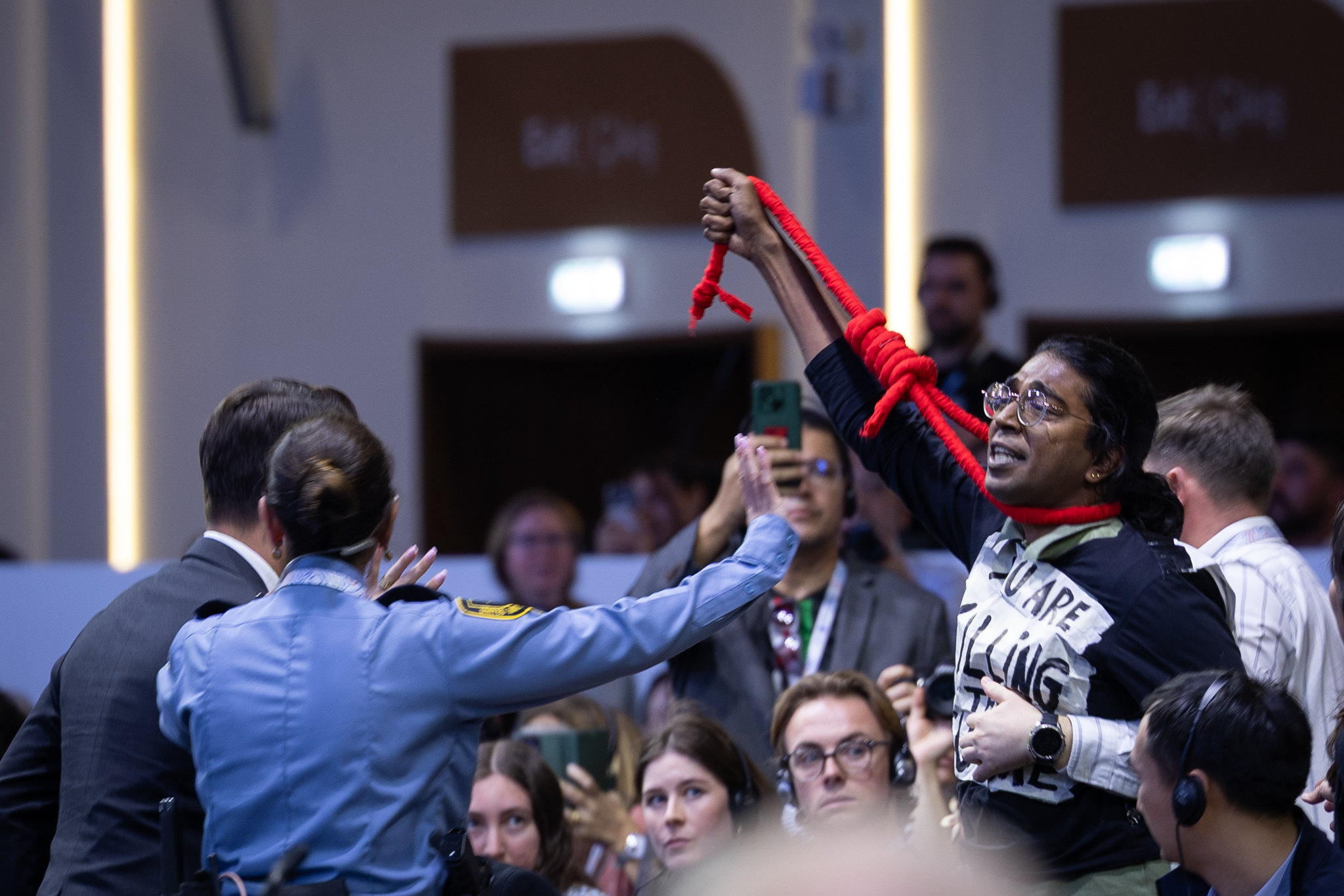
Panama’s environment minister Juan Carlos Navarro urged Kurum to ensure full respect of the rules of procedure when gavelling decisions through this weekend. Given he has led threats to object to the cover text if it is not ambitious enough, this sounded like a warning to Kurum not to ignore objections, as previous COP presidents have been accused of doing.
Another significant development on Friday night was a joint statement from Australia and China which, among other things, expressed China’s backing for the 35×35 electrification goal. More on that here.
The post COP31 Bulletin Day 12: ‘Don’t ignore us,’ Panama warns as COP31 runs into overtime appeared first on Climate Home News.
COP31 Bulletin Day 12: ‘Don’t ignore us,’ Panama warns as COP31 runs into overtime