

What a week! Our Pacific team is back from Palau and the 55th Pacific Islands Forum Leaders Meeting, and preparing for the next big moment in our campaign for Pacific climate justice — the Pacific Pre-COP.
So grab a cuppa as we take stock of what unfolded in Palau and what it means for the voyage ahead.
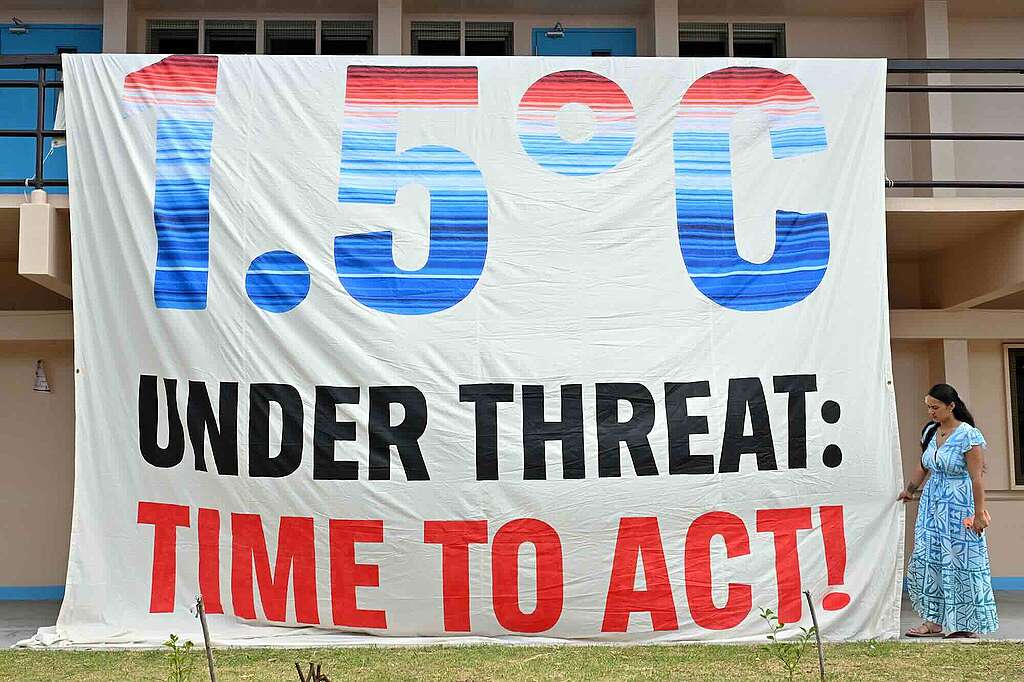
Keeping 1.5°C Alive
Immediately before leaders sat down for their negotiations, the UN Environment Program dropped a bombshell report confirming the world is set to overshoot the all-important goal of limiting warming to 1.5°C.
Limiting warming to 1.5°C is a non-negotiable survival line for Pacific communities. Every year above 1.5°C will increase irreversible harms to communities in the Pacific and around the world. The task now is to minimise the magnitude and duration of any temperature overshoot, and to return warming to 1.5°C as soon as possible.
The good news — there is a path back to 1.5°C. But it’s going to demand the very best of humanity, and all of us working together.
As a person from the Pacific, I know our communities will not quietly accept these dire warnings of climate overshoot as our fate; we are already living and fiercely resisting this reality every single day. With every increment of warming, our lands, our livelihoods, and our island homes are threatened, but the Pacific’s resolve only grows stronger.
Shiva Gounden, Head of Pacific, responds to the UNEP Limiting Overshoot report
Australia, get it together
In just two months, Australia will be chairing the world’s global climate negotiations — a role it has pledged to undertake in meaningful partnership with the Pacific. It’s a major responsibility, at a critical moment in the world’s response to the climate and energy crisis, and one that requires a focussed, all-of-government effort from Australia.
So you can imagine our shock at the start of the week, as images appeared of Australian Minister for Resources Madeleine King celebrating the first extraction of gas from the giant Beetaloo Basin, alongside Chief Minister of the Northern Territory Lia Finocchiaro. Needless to say, the image of the two leaders laughing as they turned on Australia’s largest gas tap, amid the still unfolding flood disaster in Nepal-Tibet, will not age well. Skip to Thursday, and the news came that the Australian Government had approved an expansion of one of Queensland’s largest coal mines. This was the 37th new, expanded or extended fossil fuel project approved by the Albanese Government since it was elected, and the second year in a row that Australia has approved a major fossil fuel expansion during the Pacific Islands Forum.
This is not the allyship that the Pacific has been promised from Australia, the largest member of the Forum, or the leadership the world needs. Expanding fossil fuel production is utterly incompatible with our moral, legal and scientific imperative to limit warming to 1.5°C.
Australia is not doing enough. Australia is a major producer of fossil fuels. We all know fossil fuels are the primary driver of the climate crisis. The very least a country like Australia should be doing is stopping future expansion, and it’s not doing that.
Ralph Regenvanu, Minister for Climate Change, Vanuatu
@greenpeaceap 1.5°C has never been just a number for the Pacific. It is our homes, ocean, cultures, people and our future at stake. Greenpeace is on the ground at the Pacific Islands Forum leaders’ meeting in Palau and we have a message of determination and a call for united, urgent and immediate action. Every fraction of a degree matters. This is not the moment to give up on 1.5°C. The pathway back cannot be paved with more fossil fuels. We need all hands, all heart, all minds, in this fight together


We need all hands, all heart, all minds, in this fight together
Moemoana Schwenke, Pacific Climate Campaigner
Powering up the Blue Pacific
On the bright side, the week helped bring the vision of a Fossil Fuel Free Pacific one step closer to reality.
Nowhere on Earth are the perils of fossil fuel dependence and the opportunities of renewable energy clearer than in the Pacific, where countries currently spend up to 25% of GDP on fuel imports, and renewables truly are the path to greater energy security, affordability and sovereignty.
Tuesday saw the launch of a 100% Renewable Blue Pacific Investment Prospectus, designed to attract more than $2 billion in investment to advance the vision of a Fossil Fuel Free Pacific.
Protecting our oceans
While sometimes called ‘small island states’ owing to their small land area and population, Pacific island countries are far better understood as ‘large ocean states’. If you were to divide Tuvalu’s ocean area by its population, you’d find that Tuvaluans are responsible for around 250x more ocean per person than Australians.
Pacific islanders are the world’s ocean protectors, and right now are in a fight to protect the ocean floor from deep sea mining. This year our team, led by Rae Bainteiti, hosted a moving talanoa on deep sea mining, with diverse perspectives grounded in Pacific values.
Greenpeace has been working hard to encourage more Pacific governments to join the call for a moratorium on deep sea mining, so that this destructive new industry can be stopped before it gets fully underway.

The voyage ahead
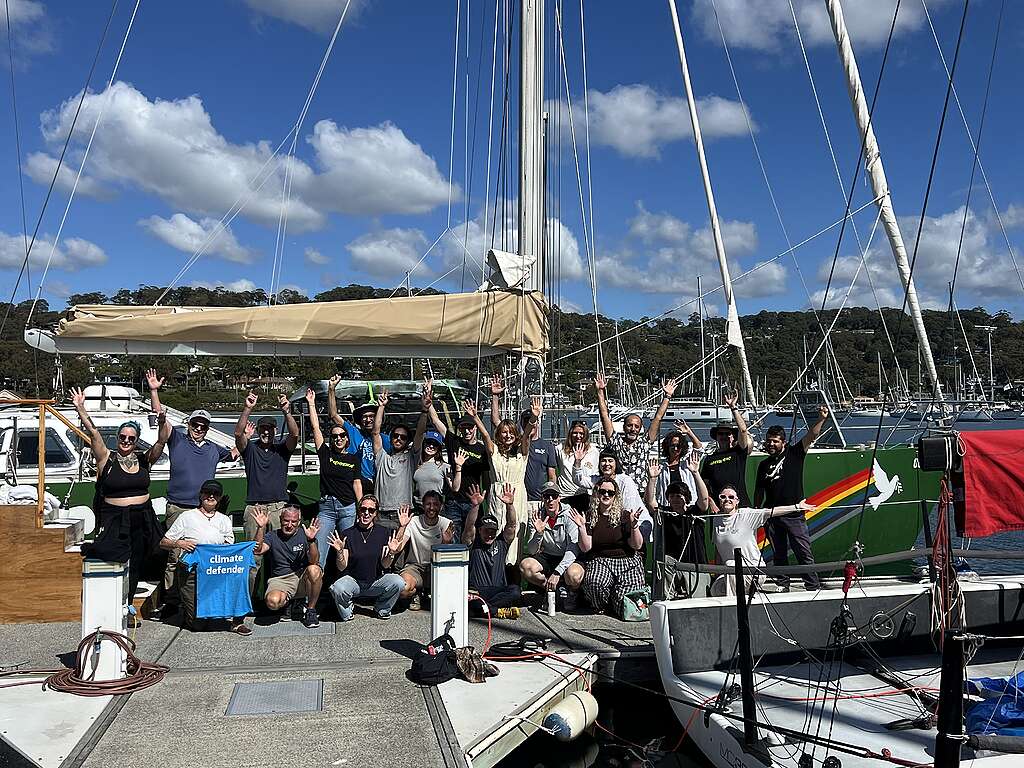
Earlier this week, a large crowd of Greenpeace staff and volunteers gathered on the dock to bid fair winds to our campaign ship Oceania as she set sail for Fiji and next month’s Pacific Pre-COP.
Hot on the heels of the Pacific Islands Forum, the Pacific Pre-COP is the next crucial moment in our voyage towards the year’s global climate negotiations (COP31) in Antalya. It is a unique opportunity to amplify Pacific leadership, and to ensure that the core priorities of keeping 1.5°C alive, accelerating the transition away from fossil fuels, and ensuring communities can access the financial support they need, are high on the agenda for COP31.
Follow our journey, and check back here for more ways to join the movement for climate justice.

Extreme heat is one of the deadliest climate hazards, but no two heatwaves are the same.
Heat extremes that happen outside of the peak summer months are often more dangerous because they can catch people off guard.
Heatwaves that hit during the spring or the first heatwave of the summer are riskier because people’s bodies are not yet accustomed to the heat and cooling strategies, such as air conditioning or public cooling centres, might not be available.
On the other hand, heatwaves that happen in the autumn, after a long summer season of heat exposure, can place further strain on bodies and local infrastructure that are already under stress.
As the climate changes and global temperatures rise, research has shown that heatwaves are becoming more frequent, intense and lengthy.
Our study, published in AGU Advances, is the first to measure whether the timing of extreme heat during the calendar year is changing around the world.
We find that, in more than half of the world, extreme heat events are spreading into the “shoulder seasons”, but doing so unevenly – in other words, they tend to creep more into autumn or spring, depending on the location.
Defining heat seasons
Meteorological summer is often assumed to be the warmest three-month period of the year. It is simplistically defined as June to August in the northern hemisphere and December to February in the southern hemisphere.
However, extreme heat seasons vary from place to place and do not always neatly map on to these defined periods.
Our study, therefore, goes beyond traditional definitions of seasons and instead focuses on “local heat seasons”. We define these as the three consecutive months when extreme heat events happened most often in the 1980s.
From this starting point, our research looks at how extreme heat is creeping into the two-month periods before and after a local heat season. We call these periods “shoulder seasons”.
This flexible definition of heat and shoulder seasons allows us to measure how the timing of extreme heat has changed over time.
Specifically, we look at the percent of annual heat days that occurred in the heat season and shoulder seasons at each location on Earth and measure how those relative shares have shifted over the last 45 years.
For our analysis, we use climate data from 1980-2024 from the MERRA2 reanalysis dataset. To ensure our results were robust, we repeated the process using ERA5 reanalysis data.
We picked the 1980s as our baseline decade as it was the start of the common time period between the two reanalysis datasets. We compared this to climate data in the decade between 2015-24.
Comparing these two time periods – the opposite ends of our datasets – allowed us to register a larger magnitude change and account for cumulative effects of climate change.
We consider measures of both dry and humid heat, as each has distinct impacts. Dry heat tends to be more dangerous to plant and ecosystem health, while humid heat is more strenuous for humans.
We use the dry-bulb temperature and wet-bulb globe temperature as our measures of dry and humid heat, respectively.
Created in the 1950s by the US military, wet-bulb globe temperature has a long history as an international standard used for outdoor sports and occupational hazard monitoring. It combines measurements of temperature, humidity, wind speed and solar radiation.
Changing heat seasons
Our research finds that, in the 1980s, extreme heat around the world was closely confined to a single heat season. For example, some 93% of the world’s land area experienced more than 80% of extreme dry-heat days during its traditional dry-heat season.
Surprisingly, this was even true in the tropics, where there is much less of a seasonal swing in temperatures.
We also show that extreme dry- and humid-heat seasons are often different from one another, typically offset by one month. This is especially true in places influenced by monsoon systems, such as north-western Mexico and central India, where the extreme dry-heat season precedes the extreme humid-heat season.
But, the edges of these extreme heat seasons are starting to blur.
Extreme heat events are spreading out significantly in the calendar year in more than half of global land areas.
This extension of the extreme dry- and humid-heat seasons means that dangerous heat has started to creep into the shoulder seasons – but not equally so.
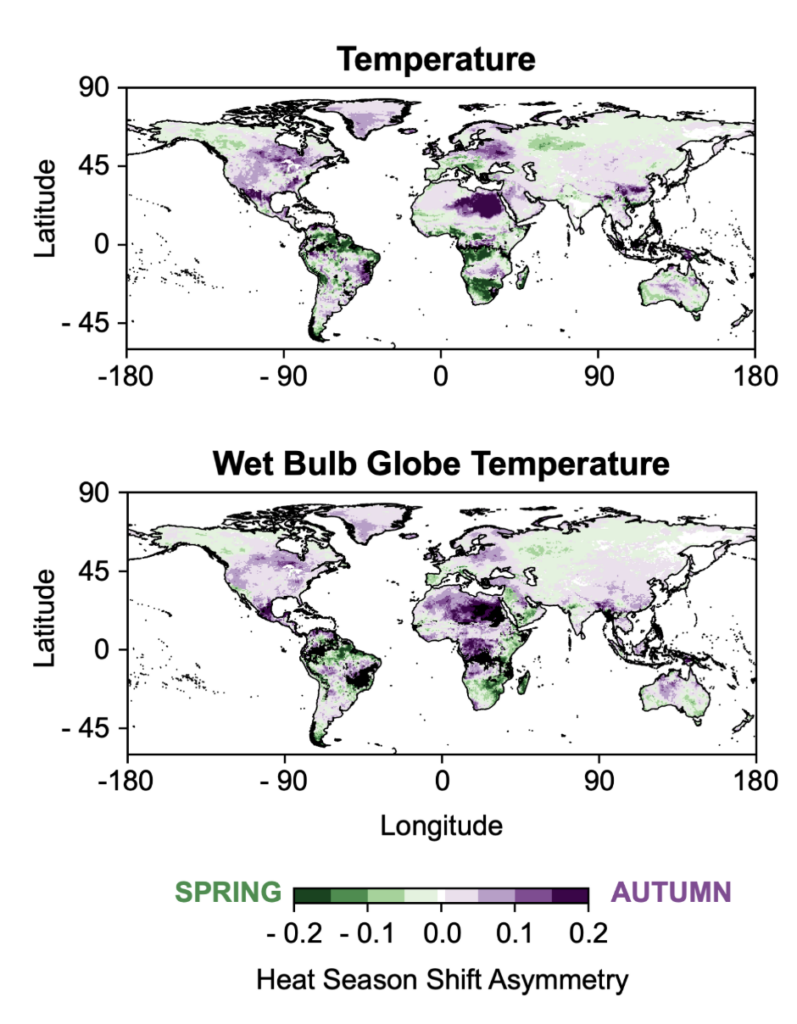
The maps below show how, in western Europe, southern Africa and north-western India, a larger fraction of each year’s extreme heat events are happening in the months before the historical dry- and humid-heat seasons. These regions are shaded in green.
On the other hand, in much of the US, eastern China, northern Africa and eastern Europe, extreme heat events are increasing in frequency in the months after the traditional heat seasons. These regions are shaded in purple.
Boosting existing seasons
It is possible that these observed changes have a straightforward – and somewhat simple – explanation.
In many regions, one shoulder season – spring or autumn – is warmer than the other. One hypothesis we explored was whether a simple step up in daily heat across the calendar year makes it more likely for extreme heat days to occur in one shoulder season over the other.
Our research shows that things are not so simple.
To investigate, we created a new, “synthetic” timeseries in order to identify the impact of annual average warming. To do this, we took the baseline 1980s timeseries and “shifted up” the data by the average change in local dry or humid heat between the first and last 10 years of our dataset (1980-89 compared to 2015-24).
We find that, in most locations, intensifying the baseline seasonality in a given location by warming evenly over the course of the year explains the changes in extreme heat timing within the traditional heat season.
However, annual average warming alone cannot explain the uneven changes in how extreme heat is occurring in the shoulder seasons.
As such, we conclude there must be other factors at play.
Long-term changes in seasonal precipitation and soil moisture – whether drying or moistening – could be contributing.
There could also be potential links to land-use changes, such as agricultural intensification or increased irrigation. Natural fluctuations in regional climates, caused by phenomena such as the Pacific Decadal Oscillation and Atlantic Multidecadal Oscillation, could also be playing an important role.
To tease out the contributions of each of these drivers, scientists will need to conduct more regionally-focused studies.
Managing hazards
The expansion of extreme heat events into the shoulder seasons indicates that key protections, such as heat early warning systems and the establishment of cooling centres, may be needed outside the traditional summer months.
Further research is also required to look into whether the overlap of extreme heat with other seasonal hazards is increasing.
For example, we find that, throughout much of the US, there is a larger expansion of the heat season into the autumn than the spring. In the western US, extreme heat which stretches later into the year could increase the overlap between the extreme heat and wildfire seasons.
Meanwhile, a similar extension of the heat season into the autumn in the eastern US could increase the overlap between the extreme heat and Atlantic hurricane seasons.
Understanding how the intersection of these seasonal hazards is changing is essential for developing targeted climate adaptation strategies, given that multiple hazards happening at once or in quick succession are much more dangerous than when they happen in isolation.
Ivanovich, C. et al. (2026) Extreme dry- and humid-heat seasons are changing asymmetrically, AGU Advances, doi:10.1029/2026AV002516
related
Guest post: Why tough methane cuts are crucial for keeping warming ‘well-below’ 2C

Guest post: France’s June heatwave caused more than 2,700 heat-related deaths
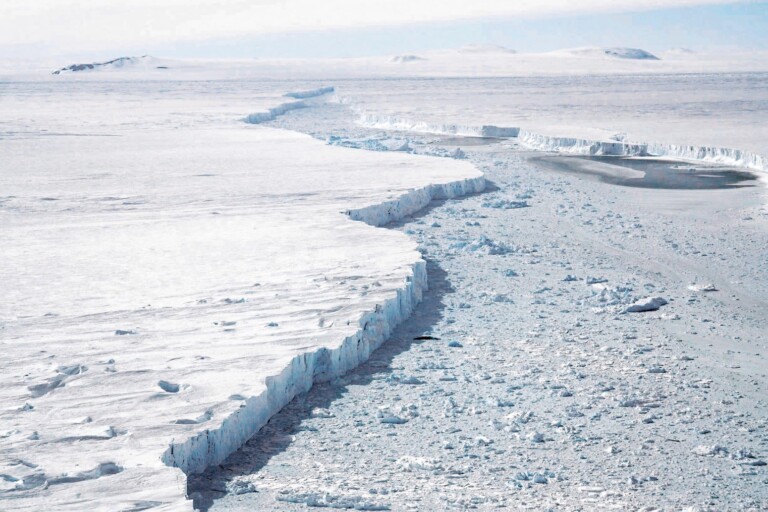
Guest post: Climate change has caused one-fifth of Pine Island glacier retreat

Q&A: What change of power in Colombia could mean for world’s fossil-fuel transition
The post Guest post: How extreme heat is ‘creeping’ from summer into autumn and spring appeared first on Carbon Brief.
Guest post: How extreme heat is ‘creeping’ from summer into autumn and spring
The UK government has slashed its hopes for electric planes and “sustainable aviation fuels” (SAFs), ahead of giving the green light to a third runway at Heathrow.
An “ambitious” rollout of new technologies and efficiency upgrades will only cut flight emissions by a quarter over the next two decades, according to forecasts quietly released in June.
This would leave aviation emissions in 2050 nearly 50% higher than expected under the “jet-zero” strategy, launched by the previous Conservative government in 2022.
The Labour government has signalled its support for a contentious third runway at Heathrow airport, with a final planning decision expected by 2029.
Ministers have justified this expansion by citing the rollout of clean-aviation technologies.
Yet, the updated forecasts suggest that rising flight numbers and a reduced role for “techno-fixes” will leave aviation emissions stubbornly high in 2050 – the UK’s legal target for net-zero.
If this is to be compatible with UK climate goals, then these higher emissions from flights in 2050 would need to be taken out of the atmosphere using costly and largely unproven “carbon dioxide removal” technologies – or by planting gigantic new forests.
Emissions up
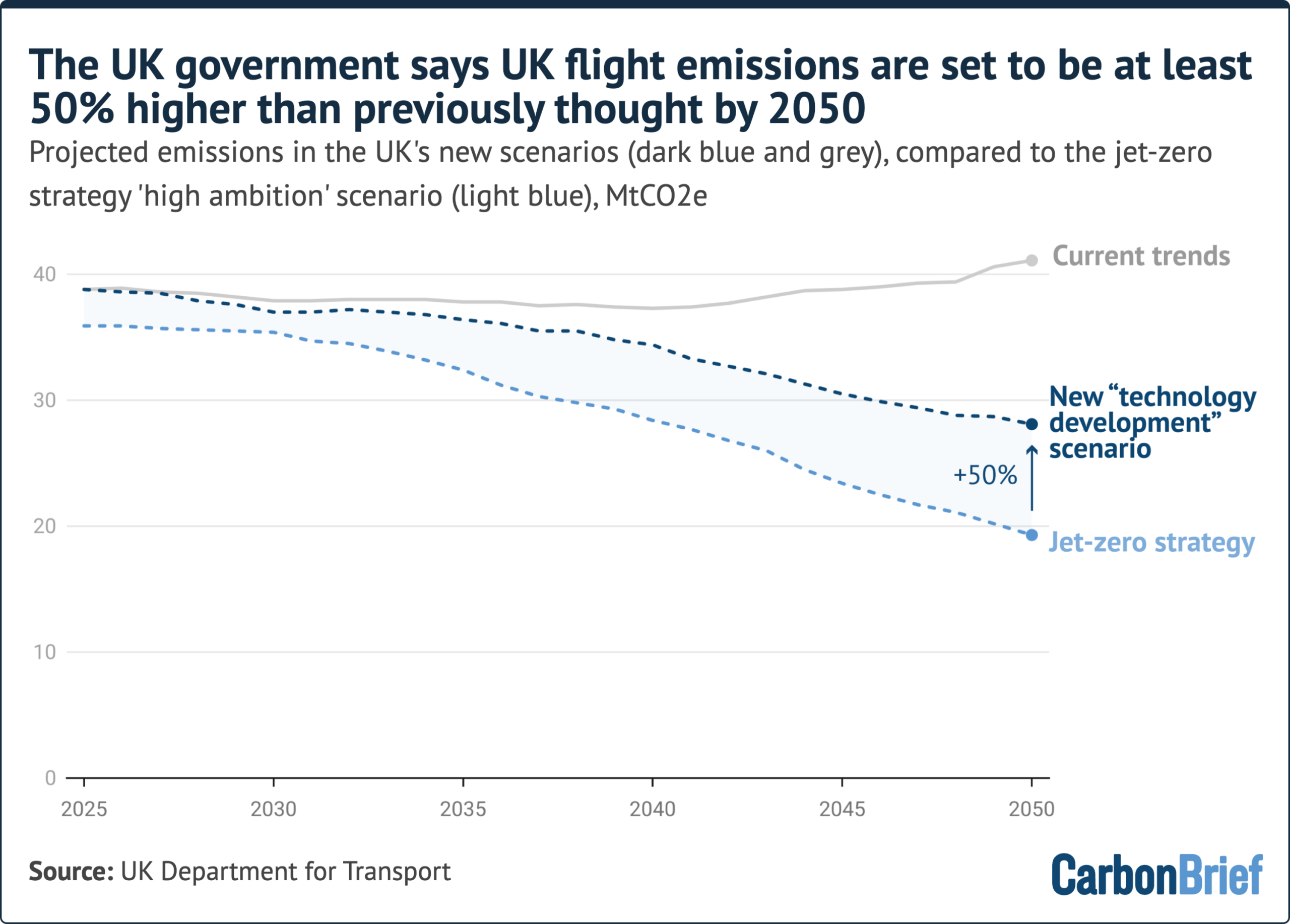
The previous government’s “jet-zero” strategy committed the UK to a “high ambition” pathway that would have seen aviation emissions peak at 38.2m tonnes of carbon dioxide equivalent (MtCO2e) in 2019 and drop to 19.3MtCO2e in 2050.
At the time, the Conservative government said this “clear goal” was achievable, alongside airport expansion and rising flight numbers.
Its strategy relied heavily on the extensive use of early-stage technologies, such as SAFs and battery-powered planes, as well as wider fuel-efficiency improvements.
In public statements, Labour has broadly continued this approach, backing new airport runways while supporting SAFs as a way to curb aviation emissions.
However, the government’s latest forecast, quietly published ahead of the formal approval of a new runway at Heathrow, sets far lower expectations for these technologies.
Its “technology development” pathway, with “ambitious carbon abatement measures”, only sees emissions drop to 28.1MtCO2e in 2050. As the chart below shows, this is around 9MtCO2e higher than the jet-zero strategy’s stated goal – a roughly 50% increase.
The shift is down to much lower expectations for SAF uptake, fuel-efficiency improvements and the roll-out of battery-powered planes, as well as lower international carbon prices.
The government now expects SAFs to make up 30% of aviation fuel by 2050, rather than 50%. It also concedes that SAFs will save less carbon over their lifecycle than previously thought.
SAFs have faced considerable criticism, due to limited supplies and uncertainty around the extent to which they cut emissions. Even meeting the UK’s relatively modest goal of 22% SAF uptake by 2040 would require enormous – potentially unattainable – volumes of waste products, which are currently the main source of the fuel.
For its new forecasts, the government commissioned a separate analysis of likely aircraft fuel-efficiency improvements over the next few decades. This analysis, from the Aviation Impact Accelerator, yielded “less optimistic” projections than earlier work.
Fuel-efficiency improvements have therefore been revised downward from 2% per year in the “jet-zero” strategy to 1.3% in the new “technology development” scenario.
There is also a reduced role for battery-powered planes, with only some of the smallest zero-emissions aircraft expected to be in use by 2035.
Crucially, even making the more limited emissions cuts in the new “technology development” pathway would require greater efforts to decarbonise the aviation sector.
If the UK fails to implement new policies or innovations, while flight numbers continue to rise, then aviation emissions would be even higher in 2050 than they are today.
This is illustrated by the pink “current trends” pathway in the chart above, in which emissions increase to 41.1MtCO2e by 2050.
This is roughly double the amount targeted by the jet-zero strategy and recommended by government climate advisors, the Climate Change Committee (CCC).
Budget ‘busting’
The new forecasts all account for the growth of several UK airports, including “planned Heathrow expansion”. Overall, passenger numbers would be at least 50% higher by 2050.
In contrast, the CCC and other experts have advised that the rise in passenger numbers may need to be limited, in order to keep emissions down.
In order to meet the UK’s net-zero target, any aviation emissions that remain in 2050 would need to be offset by planting many thousands of hectares of new forest, or by relying on costly and largely unproven CO2 removal technologies.
Tim Johnson, director at the Aviation Environment Federation (AEF), says the new forecasts present “a more honest and realistic vision of what’s possible in the next 24 years”. However, he tells Carbon Brief:
“Less reliance on cleaner technology and fuels reopens the debate about the role and scale of greenhouse gas removals and ways to tackle the projected 50% growth in demand for air travel.”
AEF calculations, based on government data and shared with Carbon Brief, suggest that emissions from the third runway at Heathrow would initially be relatively modest, reaching 3.5MtCO2e per year in 2050. Its emissions would then be expected to rise significantly beyond the legal 2050 net-zero deadline.
Previously, the Labour government has explicitly cited SAFs and other new technologies as part of its justification for expanding Heathrow airport.
Dr Lois Pennington, a research associate at the University of Manchester who has analysed Heathrow’s emissions impact, says the government’s new forecast shows “we are projected to be well over aviation’s share of the carbon budget even before a third runway is considered”.
She tells Carbon Brief:
“For Heathrow, it means expansion can no longer be waved through on the promise of technology, and any approvals will be in the full knowledge that it will bust our legally binding carbon budgets.”
The post UK aviation emissions to be 50% higher than thought by 2050, government admits appeared first on Carbon Brief.
UK aviation emissions to be 50% higher than thought by 2050, government admits
PERTH, Thursday 10 September 2026 — In response to the announcement of draft federal domestic gas reservation legislation, the following comments can be attributed to WA Campaign Lead at Greenpeace Australia Pacific, Geoff Bice:
“The gas industry has been getting away with daylight robbery in WA for years, and if the federal domestic reservation requirements are not made to apply here it is a major missed opportunity to rein them in.
“In WA, Woodside has supplied just 3.4% of the gas extracted from Australian waters and processed at its Pluto facility, flouting the expected 15% and pocketing the profits.
“If the Federal Government is not going to keep Woodside and the WA gas industry accountable, it is incumbent on the WA Government to tighten its rules.
“The WA Government needs to get a fair deal for West Australians and rule out risking pristine environments like Scott Reef and the Kimberley for unnecessary gas expansion.
“71% of Perth voters, including a majority of One Nation and Labor supporters, do not support drilling for gas at Scott Reef or fracking the Kimberley.
“Most Perth voters want a renewable energy target and a strong domestic gas reservation policy, not a run-away fossil fuel extraction and export industry.”
-ENDS-
Notes:
Greenpeace commissioned polling of voters in the Perth metropolitan area in July 2026.
Media contact
Emma Sangalli on 0431 513 465 or emma.sangalli@greenpeace.org
High res images and footage of Scott Reef can be found here



-
Climate Change1 year ago
Guest post: Why China is still building new coal – and when it might stop
-

 Greenhouse Gases2 years ago
嘉宾来稿:满足中国增长的用电需求 光伏加储能“比新建煤电更实惠”
-
Greenhouse Gases1 year ago
Guest post: Why China is still building new coal – and when it might stop
-

 Climate Change2 years ago
嘉宾来稿:满足中国增长的用电需求 光伏加储能“比新建煤电更实惠”
-

 Renewable Energy11 months ago
Sending Progressive Philanthropist George Soros to Prison?
-
Climate Change2 years ago
Bill Discounting Climate Change in Florida’s Energy Policy Awaits DeSantis’ Approval
-
Greenhouse Gases1 year ago
嘉宾来稿:探究火山喷发如何影响气候预测
-

 Carbon Footprint2 years ago
US SEC’s Climate Disclosure Rules Spur Renewed Interest in Carbon Credits