

The UK government has slashed its hopes for electric planes and “sustainable aviation fuels” (SAFs), ahead of giving the green light to a third runway at Heathrow.
An “ambitious” rollout of new technologies and efficiency upgrades will only cut flight emissions by a quarter over the next two decades, according to forecasts quietly released in June.
This would leave aviation emissions in 2050 nearly 50% higher than expected under the “jet-zero” strategy, launched by the previous Conservative government in 2022.
The Labour government has signalled its support for a contentious third runway at Heathrow airport, with a final planning decision expected by 2029.
Ministers have justified this expansion by citing the rollout of clean-aviation technologies.
Yet, the updated forecasts suggest that rising flight numbers and a reduced role for “techno-fixes” will leave aviation emissions stubbornly high in 2050 – the UK’s legal target for net-zero.
If this is to be compatible with UK climate goals, then these higher emissions from flights in 2050 would need to be taken out of the atmosphere using costly and largely unproven “carbon dioxide removal” technologies – or by planting gigantic new forests.
Emissions up
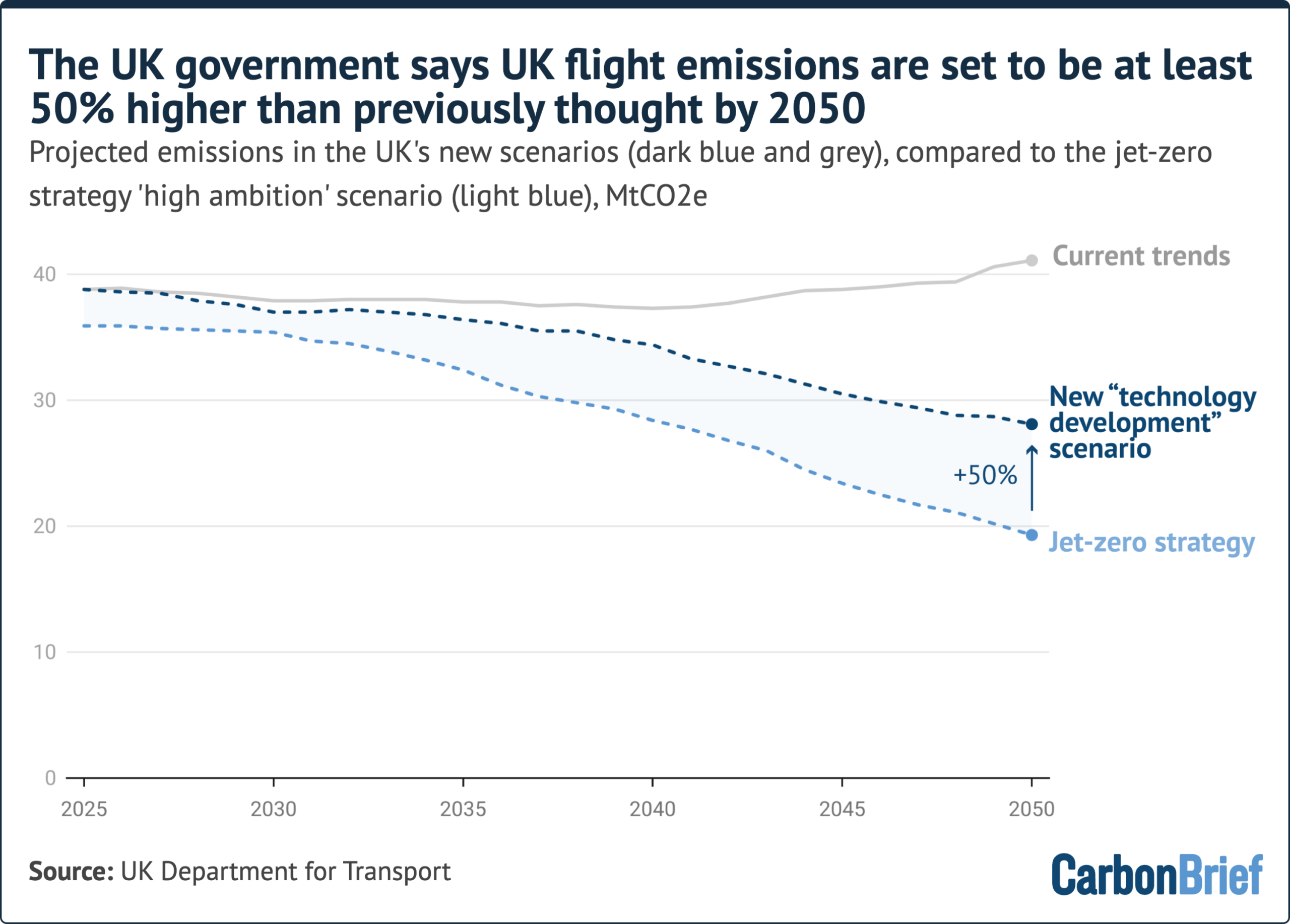
The previous government’s “jet-zero” strategy committed the UK to a “high ambition” pathway that would have seen aviation emissions peak at 38.2m tonnes of carbon dioxide equivalent (MtCO2e) in 2019 and drop to 19.3MtCO2e in 2050.
At the time, the Conservative government said this “clear goal” was achievable, alongside airport expansion and rising flight numbers.
Its strategy relied heavily on the extensive use of early-stage technologies, such as SAFs and battery-powered planes, as well as wider fuel-efficiency improvements.
In public statements, Labour has broadly continued this approach, backing new airport runways while supporting SAFs as a way to curb aviation emissions.
However, the government’s latest forecast, quietly published ahead of the formal approval of a new runway at Heathrow, sets far lower expectations for these technologies.
Its “technology development” pathway, with “ambitious carbon abatement measures”, only sees emissions drop to 28.1MtCO2e in 2050. As the chart below shows, this is around 9MtCO2e higher than the jet-zero strategy’s stated goal – a roughly 50% increase.
The shift is down to much lower expectations for SAF uptake, fuel-efficiency improvements and the roll-out of battery-powered planes, as well as lower international carbon prices.
The government now expects SAFs to make up 30% of aviation fuel by 2050, rather than 50%. It also concedes that SAFs will save less carbon over their lifecycle than previously thought.
SAFs have faced considerable criticism, due to limited supplies and uncertainty around the extent to which they cut emissions. Even meeting the UK’s relatively modest goal of 22% SAF uptake by 2040 would require enormous – potentially unattainable – volumes of waste products, which are currently the main source of the fuel.
For its new forecasts, the government commissioned a separate analysis of likely aircraft fuel-efficiency improvements over the next few decades. This analysis, from the Aviation Impact Accelerator, yielded “less optimistic” projections than earlier work.
Fuel-efficiency improvements have therefore been revised downward from 2% per year in the “jet-zero” strategy to 1.3% in the new “technology development” scenario.
There is also a reduced role for battery-powered planes, with only some of the smallest zero-emissions aircraft expected to be in use by 2035.
Crucially, even making the more limited emissions cuts in the new “technology development” pathway would require greater efforts to decarbonise the aviation sector.
If the UK fails to implement new policies or innovations, while flight numbers continue to rise, then aviation emissions would be even higher in 2050 than they are today.
This is illustrated by the pink “current trends” pathway in the chart above, in which emissions increase to 41.1MtCO2e by 2050.
This is roughly double the amount targeted by the jet-zero strategy and recommended by government climate advisors, the Climate Change Committee (CCC).
Budget ‘busting’
The new forecasts all account for the growth of several UK airports, including “planned Heathrow expansion”. Overall, passenger numbers would be at least 50% higher by 2050.
In contrast, the CCC and other experts have advised that the rise in passenger numbers may need to be limited, in order to keep emissions down.
In order to meet the UK’s net-zero target, any aviation emissions that remain in 2050 would need to be offset by planting many thousands of hectares of new forest, or by relying on costly and largely unproven CO2 removal technologies.
Tim Johnson, director at the Aviation Environment Federation (AEF), says the new forecasts present “a more honest and realistic vision of what’s possible in the next 24 years”. However, he tells Carbon Brief:
“Less reliance on cleaner technology and fuels reopens the debate about the role and scale of greenhouse gas removals and ways to tackle the projected 50% growth in demand for air travel.”
AEF calculations, based on government data and shared with Carbon Brief, suggest that emissions from the third runway at Heathrow would initially be relatively modest, reaching 3.5MtCO2e per year in 2050. Its emissions would then be expected to rise significantly beyond the legal 2050 net-zero deadline.
Previously, the Labour government has explicitly cited SAFs and other new technologies as part of its justification for expanding Heathrow airport.
Dr Lois Pennington, a research associate at the University of Manchester who has analysed Heathrow’s emissions impact, says the government’s new forecast shows “we are projected to be well over aviation’s share of the carbon budget even before a third runway is considered”.
She tells Carbon Brief:
“For Heathrow, it means expansion can no longer be waved through on the promise of technology, and any approvals will be in the full knowledge that it will bust our legally binding carbon budgets.”
The post UK aviation emissions to be 50% higher than thought by 2050, government admits appeared first on Carbon Brief.
UK aviation emissions to be 50% higher than thought by 2050, government admits

PERTH, Thursday 10 September 2026 — In response to the announcement of draft federal domestic gas reservation legislation, the following comments can be attributed to WA Campaign Lead at Greenpeace Australia Pacific, Geoff Bice:
“The gas industry has been getting away with daylight robbery in WA for years, and if the federal domestic reservation requirements are not made to apply here it is a major missed opportunity to rein them in.
“In WA, Woodside has supplied just 3.4% of the gas extracted from Australian waters and processed at its Pluto facility, flouting the expected 15% and pocketing the profits.
“If the Federal Government is not going to keep Woodside and the WA gas industry accountable, it is incumbent on the WA Government to tighten its rules.
“The WA Government needs to get a fair deal for West Australians and rule out risking pristine environments like Scott Reef and the Kimberley for unnecessary gas expansion.
“71% of Perth voters, including a majority of One Nation and Labor supporters, do not support drilling for gas at Scott Reef or fracking the Kimberley.
“Most Perth voters want a renewable energy target and a strong domestic gas reservation policy, not a run-away fossil fuel extraction and export industry.”
-ENDS-
Notes:
Greenpeace commissioned polling of voters in the Perth metropolitan area in July 2026.
Media contact
Emma Sangalli on 0431 513 465 or emma.sangalli@greenpeace.org
High res images and footage of Scott Reef can be found here
Climate Change
Foreign minister: Nepal needs “meaningful” international support to face climate threats
In the wake of the recent flash flood that swept down from the Himalayas, Nepal is seeking immediate aid from a UN fund for climate loss and damage to help vulnerable families displaced by the disaster and rebuild destroyed schools and hospitals, the country’s foreign minister told Climate Home News.
“This is exactly the kind of climate-driven catastrophe the Fund was created to address,” Shisir Khanal said in an interview. He added that “stronger global solidarity and meaningful international support” are needed for countries like Nepal, which are facing increasingly severe climate-related disasters.
The floods were caused by a glacier collapsing and triggering a landslide that forced a torrent of water and debris to rush down the Bhote Koshi River valley, causing catastrophic impacts downstream. More than 1,300 people died and over 5,300 are still missing in the area.
Khanal described the disaster as a “Himalayan tsunami”, telling Climate Home News that early assessments suggest the roads, bridges, hydropower stations, highways and settlements it wiped out could require billions of dollars to rebuild. Reconstruction estimates by the government range between $2.5 billion and $5 billion.
The minister of foreign affairs said Nepal would not be asking the UN’s new Fund for Responding to Loss and Damage (FRLD) “to write a single check for this total amount”, explaining that the government is finalising a post-disaster assessment “to guide our broader international donor appeals”.
Nepal disaster seen as test case for fledgling fund
In reality, if Nepal does receive rapid support from the FRLD, it is likely to be a fraction of the total bill because the fund has a cap of $20 million per project and has little more than $350 million available to hand out in its initial phase.
So far its board has not approved any projects as it is still working out how to allocate its scarce resources, nor does it have a process in place to respond to sudden climate disasters such as glacial lake outburst floods or powerful storms.
On August 31, Nepal’s government sent a direct appeal for emergency grant funding to the FRLD, emphasising that “a prompt response would… demonstrate that the fund can translate international solidarity into timely support for vulnerable countries and communities when it is most urgently needed”.
A couple of days later, eight developing-country board members – later joined by those from small island states – signed a letter, seen by Climate Home News, asking the fund’s board to hold an extraordinary meeting to respond to Nepal’s request.
The FRLD said in a statement that the devastating impacts on the ground “underscore both the urgency and scale of need and reaffirm the fundamental purpose for which the FRLD was established”.
It added that it is “committed to approaching Nepal’s request with the urgency, compassion, and careful consideration that these difficult circumstances require, while respecting the Fund’s governing instrument and established decision-making processes”. As of Wednesday, Climate Home News understands that discussions were still ongoing.
Designing infrastructure for extreme shocks
Khanal pointed to “the unprecedented scale” of the huge flood which occurred within a matter of minutes and swept away river gauges meant to provide early warning in Rasuwa and Nuwakot, near the border with Tibet.
“You cannot easily ‘plan’ against a mountain collapsing,” he said. But the lesson, he added in written responses in English, is that “our historical baseline for infrastructure engineering is no longer sufficient”.
Building resilient infrastructure means that “hydropower projects, roads and early warning systems must be designed for extreme, unpredictable climate shocks”, he said. Another key element will be plans to better understand and protect ecosystems, he added.
-
As science comes under attack at UN talks, climate movement splits over how to respond
A rift over how IPCC messages are produced and turned into policy is creating tensions in the world’s most influential coalition of climate NGOs -
At regional summit, Pacific islands ask for COP31 support for clean energy and finance
Pacific nations want the annual climate conference to deliver funding for renewables and ocean protection, as the UN warns of devastating sea level rise

The minister noted that Nepal, India and China share a common, interconnected Himalayan ecosystem and all three countries are affected by the impacts of climate change in the Himalayan mountain chain.
“Therefore, our call is for the three countries to work together to strengthen preparedness, resilience and regional cooperation,” he said.
New research from consultancy Systemiq, released on Wednesday, finds that Himalayan glaciers are losing mass 65% faster than a decade ago, and that only around 20 of the Himalaya’s estimated 40,000 glaciers are currently monitored. India alone has 56 glacial lakes rated very high risk, it warns.

Early cross-border efforts on information-sharing
Since the same region of Nepal was hit by smaller-scale but still highly destructive flooding in 2024 and 2025, China and Nepal have stepped up efforts to cooperate in tackling glacier-related risks in the region.
In August 2025, Climate Home News reported that authorities in both countries had agreed to share cross-border information about the risks of glacial lake outburst floods across the Tibetan region, in a first step that could be expanded to the national level in an effort to reduce deaths and damage.
This May, a delegation from China’s Ministry of Water Resources and the Water Resources Department of the Xinjiang Autonomous Region held talks with Nepalese officials in charge of water and disaster management about establishing a joint disaster information mechanism.
Then in August, a team from the Institute of Mountain Hazards and Environment under the Chinese Academy of Sciences also visited Nepal for scientific research and exchange, sharing China’s experience in monitoring glacial lakes.
Nepal and China agree to cooperate on glacial lake flooding, as warming hikes threat
However, experts told Climate Home News that progress on putting in place concrete measures has been slow. Narendra Khanal, a professor in the department of geography at Tribhuvan University, blamed that partly on Nepal’s traditional administrative system and bureaucratic delays.
“We have to share information with them, and they have to share information with us,” he said. “In my understanding, the Chinese side is also facing difficulties in making this cooperation work.”
Mohan Bahadur Chand, a Himalayan glaciologist and assistant professor at Kathmandu University, said China has the technology and human resources to provide significant information to its neighbour downstream.
But, to make that work, “we have to build trust between the two countries”, which is currently lacking but could be developed, he said. “As scientists, we are already working with them personally. If we create a trusted environment, cooperation should not be difficult.”
Nepal lacks monitoring and warning technology
Experts said Nepal – one of the world’s least-developed countries – does not have the technology or resources to install the sophisticated monitoring and warning systems needed to protect its population from growing threats linked to accelerating glacier melt in the Himalayas.
A senior meteorologist at the Department of Hydrology and Meteorology, who did not want to be named, told Climate Home News that the government had not invested enough in rainfall and weather monitoring stations, especially above 3,500 metres, and therefore lacks reliable data about what is happening at high altitudes.
“The stations we have are operated by different organisations, but many of them are not functioning properly,” the official added.
Comment: The loss and damage fund needs far more finance to deliver climate justice
This year, the UN’s Green Climate Fund released initial funding for a $50-million project to address the risks from four glacial lakes in other parts of Nepal, but has come under criticism for taking seven years to approve the proposal. The fund said this was due to efforts needed to strengthen and consult on the project, as well as administrative, institutional and COVID-related delays.
Foreign minister Khanal said Nepal was calling on the international community for support to tackle global warming impacts into the future.
“This disaster should not be viewed simply as a one-time event requiring one-time assistance,” he emphasised. “We need to recognise the longer-term consequences of rising temperatures and climate change, particularly for vulnerable communities and developing countries.”
The post Foreign minister: Nepal needs “meaningful” international support to face climate threats appeared first on Climate Home News.
Foreign minister: Nepal needs “meaningful” international support to face climate threats
Amy Youngman is a legal and policy specialist at the campaigning group Environmental Investigation Agency (EIA).
The chair’s August Aid to Negotiations is being sold as a pragmatic way to rescue the global plastics treaty. However, the text is starting to resemble the architecture of a Paris Agreement-style framework: a patchwork of vague commitments, nationally determined action and reporting, with the hardest substantive decisions left to a future that, my experience following these negotiations tells me, would never arrive.
In March 2022, governments adopted UNEA Resolution 5/14 by consensus, launching negotiations for a legally binding international instrument to end plastic pollution. I joined the global plastics treaty process in Paris in 2023, where hopes of drafting a treaty capable of confronting one of the defining environmental and human health threats of our time were first derailed by procedural warfare.
-
“We’ve gone backwards” – new plastics treaty text dims hopes for production curbs
During troubled talks, fossil fuel-producing nations have pushed for a global pact to tackle only plastic waste rather than reducing the size of the problem -
Why we couldn’t agree on a plastics treaty in Geneva – and what might happen next
Switzerland’s lead negotiator at INC-5.2 reflects on why the talks didn’t succeed – and the options now for getting an effective agreement

Five months later, in Nairobi, I watched the chair close a meeting while delegates still negotiated -allegedly to catch a flight. In 2024 and 2025, in Ottawa, Busan and Geneva, the same small group of blocking states grew bolder, cloaking opposition in language about defending the vulnerable while subsidising a system that fuels the pollution crisis. Offended by ambition, ashamed of nothing.
A year after the last formal attempt to negotiate a treaty, we are tasked with protecting a fragile process. And despite long-standing support, including legal, policy and technical expertise from my own Environmental Investigation Agency, the chair has excluded observers from the rooms where the treaty’s fate is being decided.
In that orchestrated quiet, the loudest proposal emerged: the suggestion that the instrument be a “framework convention.” The new Aid, intended to shape the late-September Heads of Delegation meeting, never uses the word “framework”. It does not need to. It strips back substantive obligations and presupposes future action.
A framework is no match for this crisis
Framework conventions outline broad principles and leave each country to develop its own plan, often delaying tough decisions to future negotiations that may never happen. This tactic is a political shell game: persuading states that want action now to give up meaningful, binding measures to reach agreement.
The Chair’s Aid arrives at a framework by subtraction rather than by proposal, which makes it harder to name and potentially easier to accept. Using the Aid, effectively the rejected text from Geneva, as a basis for the next informal meeting in Bangkok will be sold as a way to preserve a distressed UN system and reach consensus in a fractured geopolitical environment.
This is diplomacy drowning in wishful thinking that the countries fighting binding rules today will approve tougher ones tomorrow. Four years of negotiations and decades of climate diplomacy taught us that this is not a bridge to ambition – this is how ambition dies.

Production is driven by global oil, gas and chemical markets, while products and waste travel across borders. No singular government can regulate its way out of a problem created and amplified by a globalised system.
Countries have tried, and production kept rising. Now there is plastic everywhere we look, and the cost falls hardest on the people least responsible.
That failure is why there was consensus to negotiate a treaty, because this crisis requires global action. The purpose was never to list national efforts and call that progress but to create common global rules to address pollution.
The most politically sensitive issues cannot simply be postponed. How much plastic is produced, which toxic chemicals are allowed in it, which throwaway products are banned, and how future decisions are made are precisely the issues that require global answers. An instrument that refuses to negotiate them will be easier to adopt but useless on arrival.
Learn from climate governance
Supporters of a framework approach may point to the ozone treaty as proof that it can work. But the Vienna Convention succeeded for one reason: governments quickly adopted binding upstream controls on ozone-depleting substances.
Climate offers the opposite warning: a framework followed by contested, delayed and insufficient measures, while emissions keep rising.
The new chair not only deleted a direct reference to “production and consumption” and bracketed similar preambular language copied from the original mandate. The article on reporting borrows language from the Paris Agreement. Another summer of record heat, fires and floods offers a glimpse of how well that model is working.
Nothing suggests that the states blocking binding rules today will suddenly accept them tomorrow, and the exponential rise in unchecked plastic production will not pause while governments wait for courage. Blockage is not being resolved, but just pushed forward.
A framework would lock in the wrong response: unlimited upstream growth with waste management attempting to handle it downstream. No waste system can keep pace with a material engineered for endless growth.
Keeping to 1.5C of warming is no longer possible – but we must still limit the overshoot
After four years of INC negotiations, governments know this. States must reject the false choice that the only path to agreement is an instrument too weak to solve the problem it was created to address. Compromise is part of diplomacy. Surrender is not.
And if the UN keeps pushing that choice, the countries prepared to act must be willing to pursue alternative pathways. Groups of willing governments have built effective agreements before, and existing environmental regimes can deliver new rules without inventing a new empty instrument.
This process was never meant to find a lowest common denominator. It was to create the rules necessary to change our direction. Bangkok in September will be where the second iteration of this text is shaped. If ambitious countries do not push back, the argument about a framework convention will already be lost by default.
Negotiations cannot end with governments accepting the crisis rather than solving it. The science is clear and the damage is accelerating. The world does not need another promise to act later. It needs the treaty governments promised to deliver in 2022.
The post The world doesn’t need a Paris Agreement for plastics appeared first on Climate Home News.



-
Climate Change1 year ago
Guest post: Why China is still building new coal – and when it might stop
-

 Greenhouse Gases2 years ago
嘉宾来稿:满足中国增长的用电需求 光伏加储能“比新建煤电更实惠”
-
Greenhouse Gases1 year ago
Guest post: Why China is still building new coal – and when it might stop
-

 Climate Change2 years ago
嘉宾来稿:满足中国增长的用电需求 光伏加储能“比新建煤电更实惠”
-

 Renewable Energy11 months ago
Sending Progressive Philanthropist George Soros to Prison?
-
Climate Change2 years ago
Bill Discounting Climate Change in Florida’s Energy Policy Awaits DeSantis’ Approval
-
Greenhouse Gases1 year ago
嘉宾来稿:探究火山喷发如何影响气候预测
-

 Carbon Footprint2 years ago
US SEC’s Climate Disclosure Rules Spur Renewed Interest in Carbon Credits