

Two weeks of tense UN climate talks in Bonn, Germany, have produced few tangible outcomes as diplomats faced “gridlock”.
Negotiators failed to find agreement in numerous areas, such as scaling up global emissions cuts and funding for climate adaptation.
In the closing plenary, many diplomats lamented weakened trust in the UN climate process, as it struggled to find its footing in a new geopolitical landscape.
As ever, climate finance was one of the greatest sources of tension between developed and developing countries, influencing the debate around adaptation and trade in the Bonn talks.
Many countries criticised “coordinated attacks” on science by those with “fossil-fuel interests”.
Some delegates saw progress on a “just transition mechanism” to support communities through decarbonisation as a positive outcome, with a package of texts agreed for the COP31 climate summit in Antalya, Turkey.
Reporting from the talks in Bonn, Carbon Brief covers the key outcomes and disputes at the 64th biannual sessions of the UN Framework Convention on Climate Change (UNFCCC) subsidiary bodies (SB64).
- Adaptation
- Just transition
- Climate finance
- Global stocktake
- Mitigation work programme
- Action agenda and new initiatives
- Climate science
- Fossil fuels
- Trade dialogues
- COP reform
- Ocean dialogue
- Road to COP31
Adaptation
Climate adaptation proved one of the most contentious areas of negotiation in Bonn. In particular, parties were unable to agree on text relating to the “global goal on adaptation” (GGA).
Across the two weeks, progress was “stuck, stalled or deferred”, even in the rooms of technical adaptation items, Jeffrey Qi, policy advisor with International Institute for Sustainable Development’s (IISD) resilience program, told Carbon Brief.
In many of the rooms, this was due to a “fault line” over finance, Ana Mulio Alvarez, policy advisor at thinktank E3G told Carbon Brief, as developing countries sought support to help protect themselves from escalating climate hazards.
Last year at COP30, parties had agreed on a new adaptation finance target within the “global mutirão”.
The text “calls for efforts to at least triple adaptation finance” for developing countries by 2035. This is largely expected to come from developed countries, which are obliged to provide climate finance under the Paris Agreement.
While this tripling target agreed in Brazil was broadly welcomed by developing countries, it lacked key details. For example, it did not specify the baseline for tripling, the parties which have to contribute or the types of finance that will be counted under the goal.
(Earlier drafts of the text in Belém had included reference to 2025 as the baseline, the deadline for a $40bn adaptation finance goal set at COP26. This led some parties and civil society organisations to state that the 2035 level ought to be $120bn.)
In Bonn, various parties said that the tripling target should also be included within the text on the GGA. This included the African group, small-island states (AOSIS), least developed countries (LDCs), some Latin American countries (AILAC), as well as the G77 and China.
They said that they would need finance to implement the GGA, especially as adaptation projects often rely on public, grant-based funding rather than private investment.
Canada, Norway and Japan were among those opposing a reference to the tripling target.
A first draft text on the GGA did not include a reference to the finance goal. Many parties again expressed their concern over this omission.
A second draft only included a reference to the tripling of adaptation finance within a bracketed opening paragraph. (Passages of text that are not yet agreed are shown in square brackets.)
A reference to tripling finance remained in the final draft, shown below. The entire text is surrounded by square brackets and is subject to negotiation and agreement at COP31.
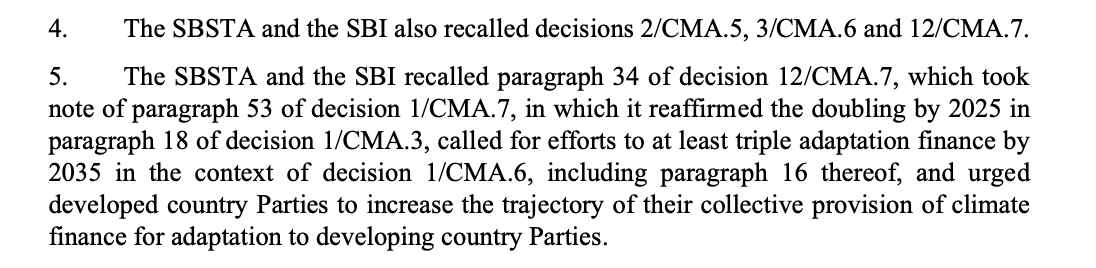
Speaking to Carbon Brief, Teresa Anderson, global lead on climate justice for ActionAid International, said:
“It’s been a huge fight to even get a soft acknowledgement of the Belém promise to triple adaptation finance, let alone a proper plan to meet that promise. It seems rich countries want to be able to quietly forget they ever said anything at all.”
Beyond the question of finance, a number of other GGA elements were discussed in Bonn. This included work on the “indicators”, a set of 59 ways to measure progress towards the GGA, which were agreed by parties at COP30.
The adoption of these indicators in Belém had proven difficult, despite experts having worked on them for two years. They were pushed through at the close of COP30 to mixed reactions.
Parties entered negotiations in Bonn amid the uncertainty this created. Alongside the indicators, the final text last year contained plans for a two-year “Belém-Addis vision” to further refine the indicator process.
As part of this, at SB64 parties worked towards creating a taskforce that would establish underlying data and methodologies for the indicators. However, the make-up of this taskforce became fraught, as parties disagreed on whether it should be technical or political.
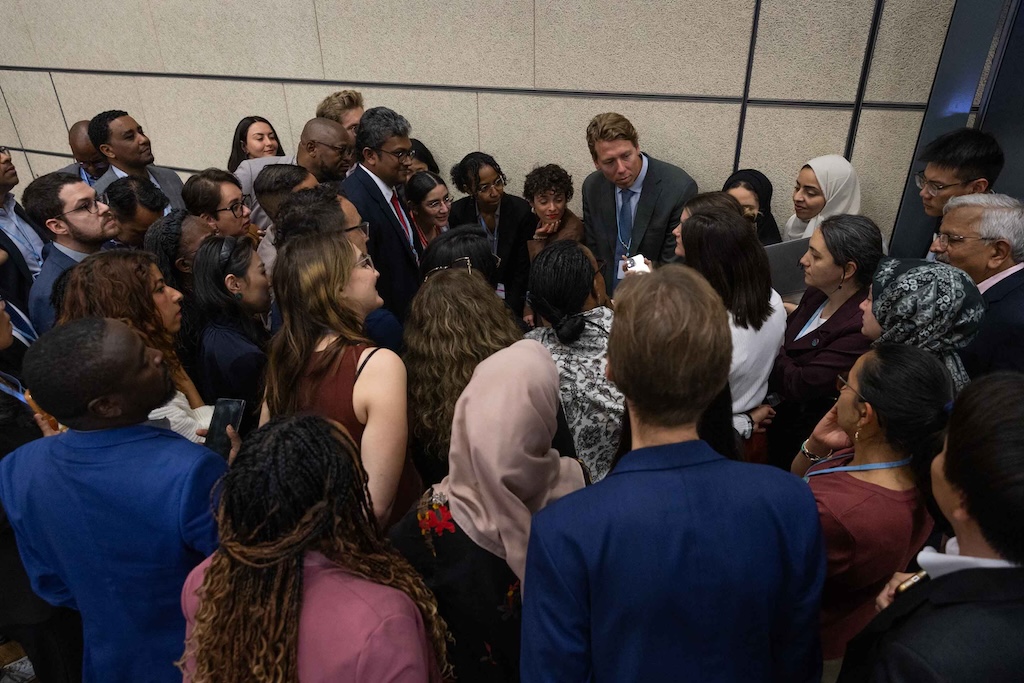
Speaking to Carbon Brief, Bethan Laughlin, senior policy specialist at the Zoological Society of London, said the negotiators were in “a very Groundhog Day’ situation”, where they were once again looking to experts to refine the indicator package, while struggling with the idea of ceding control of the process.
During negotiations in the second week, Brazil and the EU called for the taskforce to be expert-driven, while Grupo Sur, the like-minded developing countries (LMDCs) and the Arab group supported a party-driven taskforce.
As the talks moved into the final days of negotiations in Bonn, this remained a sticking point.
A final element of the GGA is the Baku adaptation roadmap (BAR), which was launched at COP29 in Azerbaijan. It is designed to help bring coherence across the multiple different adaptation efforts and advance progress towards the GGA.
At workshops during the first week in Bonn, parties focused on how the current adaptation framework supports the GGA and climate finance for adaptation.
In negotiations, the G77 and China called for the BAR to ensure access to finance in accordance with Article 9.1. This is the part of the Paris Agreement that refers to developed countries “providing” climate finance. (See: Climate finance.)
Canada, Japan, the UK and the EU all disagreed with this inclusion, arguing that finance should be addressed under other agenda items.
Ultimately, no agreement could be reached on the GGA. The issue was therefore subject to “rule 16” and passed to COP31 without any agreed text.
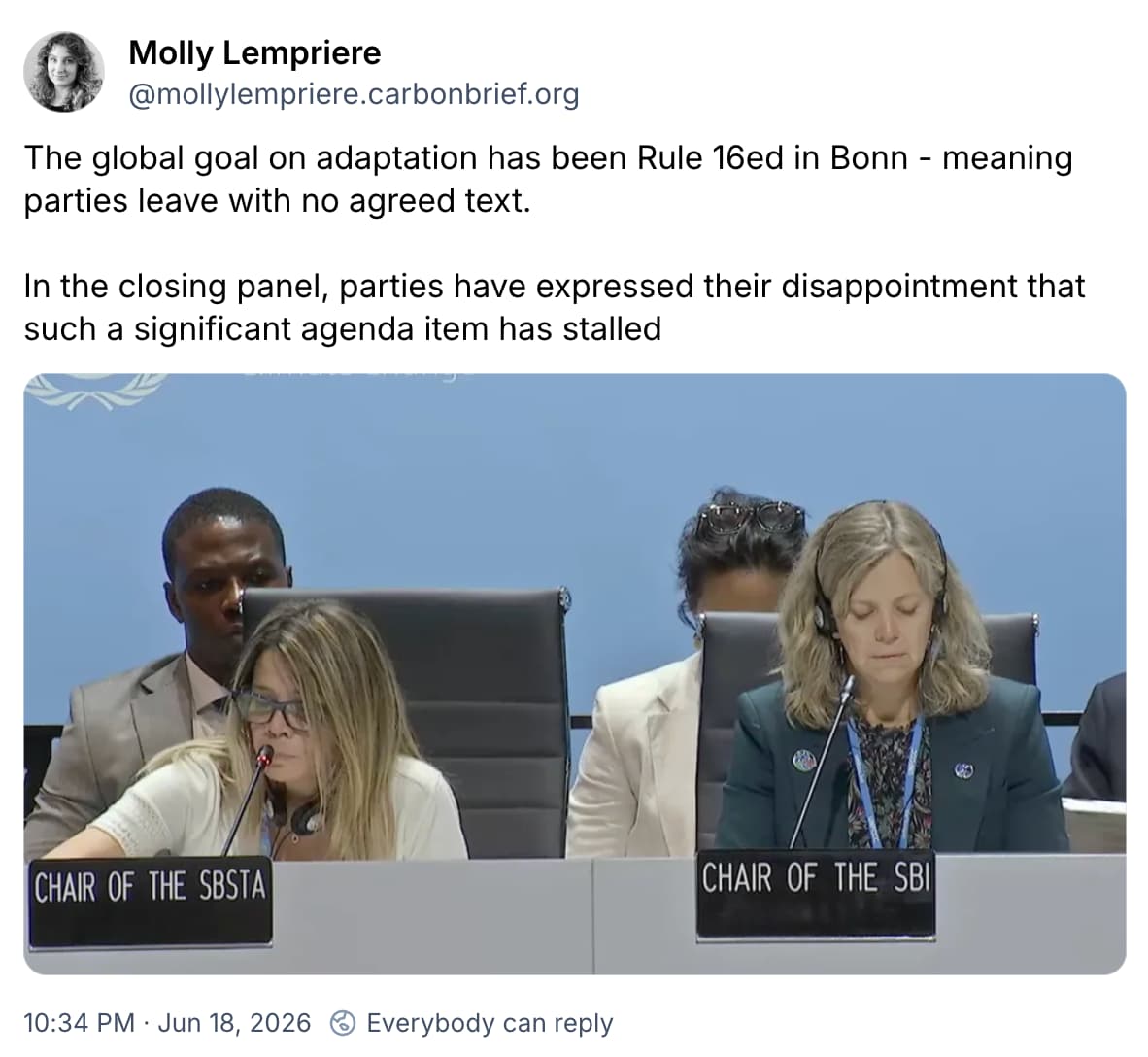
In the closing plenary, parties expressed their disappointment with the situation, with AOSIS noting the outcome was “completely unacceptable”.
In a statement, E3G’s Mulio Alvarez said that amid worsening climate impacts, the “rule 16 is more than a procedural outcome: it is a warning sign”.
Beyond the GGA, the adaptation space also includes numerous other negotiations.
Those around the adaptation fund drew particular focus this year, as it is in the process of transitioning to exclusively serve the Paris Agreement. This will allow it to access 5% of the revenues generated by the agreement’s new carbon market under Article 6.4.
A key challenge was the makeup of the fund’s board, which currently includes members from “Annex I” and “non-Annex I” countries. This refers to the division of countries based on their development status in 1992, when the UNFCCC was established.
The Paris Agreement refers instead simply to “developed” and “developing” countries. The concern, observers told Carbon Brief, is that this could open the door for wealthier developing countries to be defined as “developed” – something that some parties oppose.
Speaking to Carbon Brief, Qi said that the issue would require a head of delegation or higher to push through an agreement. He added:
“This is such a politically charged issue that concerns the fundamental question of the relationship between the convention and the Paris Agreement.”
Parties failed to come to an agreement on this point, instead deciding to continue discussions at COP31.
Just transition
The agreement to create a “just transition mechanism” was one of the most substantial outcomes of COP30. In Bonn, it took a further step forward.
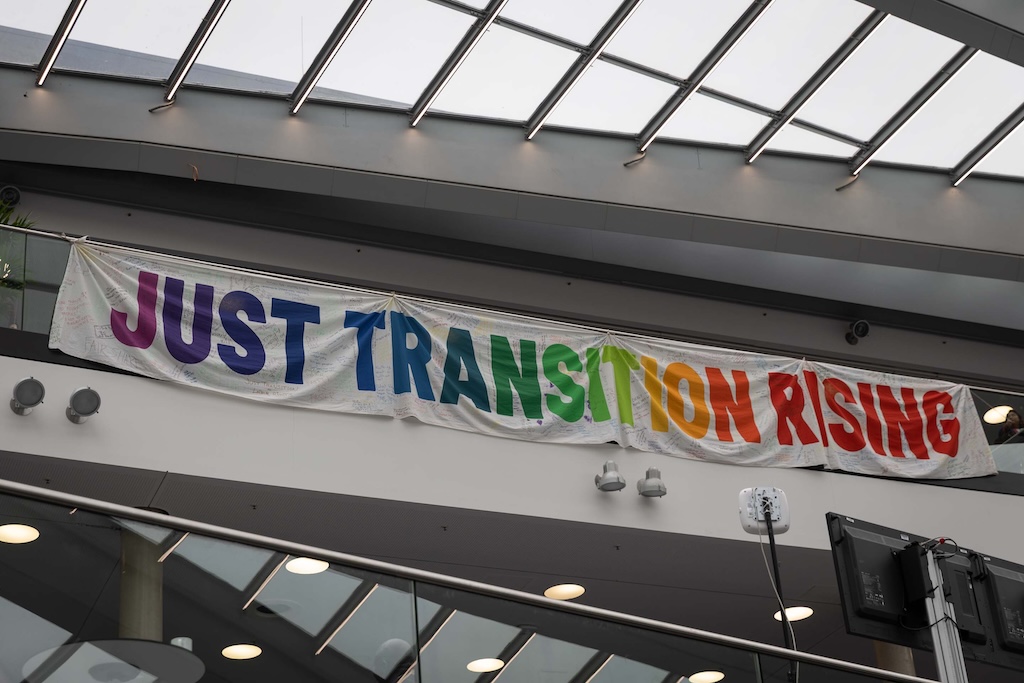
Dubbed the “Belém-Antalya mechanism for global just transitions” (BAM) by civil society, it is intended to provide a centralised hub to support “just transitions” for workers and communities around the world.
Speaking during a press conference in the second week of SB64, COP30 president André Corrêa do Lago pointed to the mechanism as a key “legacy” of the conference.
However, as work got underway on the just transition work programme (JTWP), where the BAM sits, the focus of negotiations was instead on the “terms of reference” for an upcoming review.
Speaking to Carbon Brief, Anabella Rosemberg, senior advisor on just transition at NGO umbrella group Climate Action Network (CAN) International, said that while negotiations got off to a good start, negotiators got “distracted very fast”. She added:
“Basically, over the 10 days of negotiations, a week was just [spent] on an extremely procedural and technical discussion, instead of a conversation on the mechanism.”
Over the first week, parties diverged on the review’s mandate, objective and scope. This latter point includes how the JTWP relates to processes under the UN Framework Convention on Climate Change (UNFCCC), the Paris Agreement and UN entities.
Observers told Carbon Brief that they did not think the delay in the discussion of the mechanism had been orchestrated by parties to hamper progress, although they did suggest the BAM was not a priority for certain groups.
Going into the second week, with so much time focused on the terms of reference, Chadli Sadorra, senior program staff at the Asian Peoples’ Movement on Debt and Development, told Carbon Brief that whether or not there was enough time to come up with meaningful outcomes on the mechanism was a concern.
However, on 16 June, the co-chairs introduced a draft text with a “non-exhaustive” list on how to take the mechanism forward.
This was divided into sections on context, purpose, functions integration, coordination and coherence, barriers and opportunities, international cooperation, modalities and governance, timelines and links to the JTWP.
Parties, including Latin American countries under AILAC, Brazil, Norway, AOSIS, the African group and others, welcomed the note as the basis of further negotiations. The Arab group pushed back, saying the text did not reflect its priorities.
There were further discussions on key elements, such as AILAC suggesting a review of the timelines. Brazil and others said that the way the BAM operates and is governed should be considered separately, while the African group urged a strengthened focus on international cooperation.
Ultimately, talks were able to move forward substantially.
Civil society representatives also broadly welcomed the draft text. Rosemberg told Carbon Brief that “there’s a whole chunk that is really good”, adding:
“It points to functions that make sense; it’s not rehashing stuff that we have seen forever in the UNFCCC. It’s new, it’s fresh, it’s crisp, it has potential.”
On the penultimate day of the SB64 negotiations, the co-facilitators asked parties to agree on a package of outcomes, including a summary of the fifth JTWP “dialogue”, a placeholder for its next meeting and the terms of reference for the review of the process. It also included a list of items that would need to be agreed as part of developing the BAM.
Several parties said they could agree to the package in the spirit of compromise. This included an invitation to the chairs of the process to continue working on the matter before COP31, in order to try to find agreement on the BAM.
Speaking to Carbon Brief, Dr Leon Sealey-Huggins, a senior campaigner at the charity War on Want, said that lots of important elements remained in the text, albeit in “skeleton form”, including links to financial architecture.
But key questions remain around the details of the BAM, including on the role of non-party stakeholder participants, Huggins added. As such, civil society groups see further meetings on the mechanism, ahead of COP31, as key to allowing it to be adopted in November.
Ultimately, this package of texts was agreed without intervention in the closing plenary of SB64 on 18 June.
Speaking during a press conference that day, attended by Carbon Brief, Rosemberg concluded:
“Watch out, the BAM is coming”.
Climate finance
Delegates spent much of the first week in Bonn debating climate finance outside of formal negotiations, in a series of “workshops” and “dialogues”. Much of their focus was on how to fulfil financial commitments made during previous climate negotiations.
Finance is a core issue at UN climate talks and one that has frequently led to “agenda fights” and delays in recent years.
The major divide is between developing countries that receive climate finance and developed countries that are obliged, under the Paris Agreement, to provide or “mobilise” it.
There was no agenda fight as SB64 kicked off in Bonn. However, finance remained a source of friction across many workstreams, against a difficult global backdrop.
Recent official figures show that climate finance from developed countries reached a record $136.7bn in 2024. Developed countries, therefore, argue that they are raising climate finance in line with their obligations, despite other fiscal strains.
Since 2024, however, aid cuts by major donors – particularly the US – mean public climate spending by developed countries is likely to have fallen substantially. There have also been drops in support for UN climate funds, such as the Green Climate Fund.
Moreover, hardly any developed countries have pledged new finance for 2026 and beyond.
This is in spite of parties agreeing in 2024 on a “new collective quantified goal” (NCQG) of $300bn a year for developing countries by 2035 – largely from developed countries.
Given this, developing countries argue that developed countries are, in fact, shirking their responsibility to scale up their public-finance provision. They say this is vital, especially considering the $300bn goal is already far below the scale needed to tackle climate change.
Isatou Camara, lead climate finance coordinator for the Least Developed Countries (LDCs), told Carbon Brief that their adaptation needs depended on securing such funding:
“[Public finance is] oxygen for us, because when we talk about what we need as vulnerable countries, it’s basically enhancing resilience and adaptation.”
At COP30, parties agreed to launch a new two-year “work programme” for countries to discuss these concerns, among others.
This came after a concerted effort, led by the LMDCs and the Arab group, to start a work programme focused exclusively on Article 9.1 of the Paris Agreement. This is the part that says developed countries “shall provide” finance – generally taken to mean public spending.
However, developed countries note that the NCQG goal covers a “wide variety of sources”, including the private sector and wealthier developing countries, such as China.
In the end, parties at COP30 compromised on a programme to address Article 9.1 “in the context of Article 9…as a whole” – meaning it could cover all types of finance.
Nevertheless, in submissions ahead of SB64, many developing countries were clear that they wanted the programme to be a “dedicated space” to discuss Article 9.1.
The LMDCs and Arab group even erroneously referred to it simply as the “work programme on Article 9.1” and made it clear that they “do not see [it] as a way of consolidating other agenda items on finance”.
(Some developing-country groups, such as AOSIS, place a lot of emphasis on other aspects of finance, such as quality and accessibility, as well as the need for provision by developed countries.)
In contrast, developed countries, such as the EU, Norway and Canada, said they wanted a broad approach that focuses on “streamlining” the existing climate-finance agenda and “mobilising” finance from various sources.
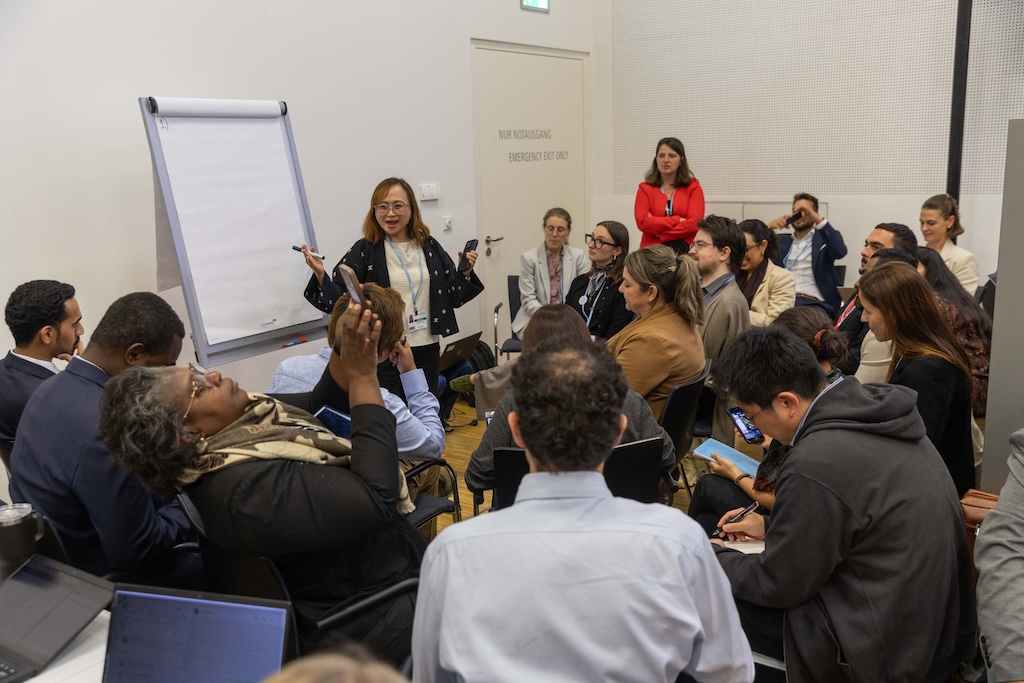
There were three “engagement workshops” to discuss this new climate-finance work programme at SB64.
Parties remained entrenched in long-held positions, with developed countries happy to keep the focus on climate finance of all kinds, as opposed to public funding.
The G77 and China rejected the “work plan” prepared by the co-chairs and said its focus should be squarely on Article 9.1. Some developing countries argued for “burden sharing agreements” and an “action plan” to compel developed countries to provide more finance.
In order to elevate these issues into formal negotiations, developing countries and civil-society organisations stressed throughout SB64 that the Article 9 work programme should be placed on the agenda at COP31. (A draft version of the agenda for November’s summit did not include it.)
This argument was given more weight when COP30 president Corrêa do Lago used his “authority” to request such an item, in a letter published towards the end of SB64 week one.
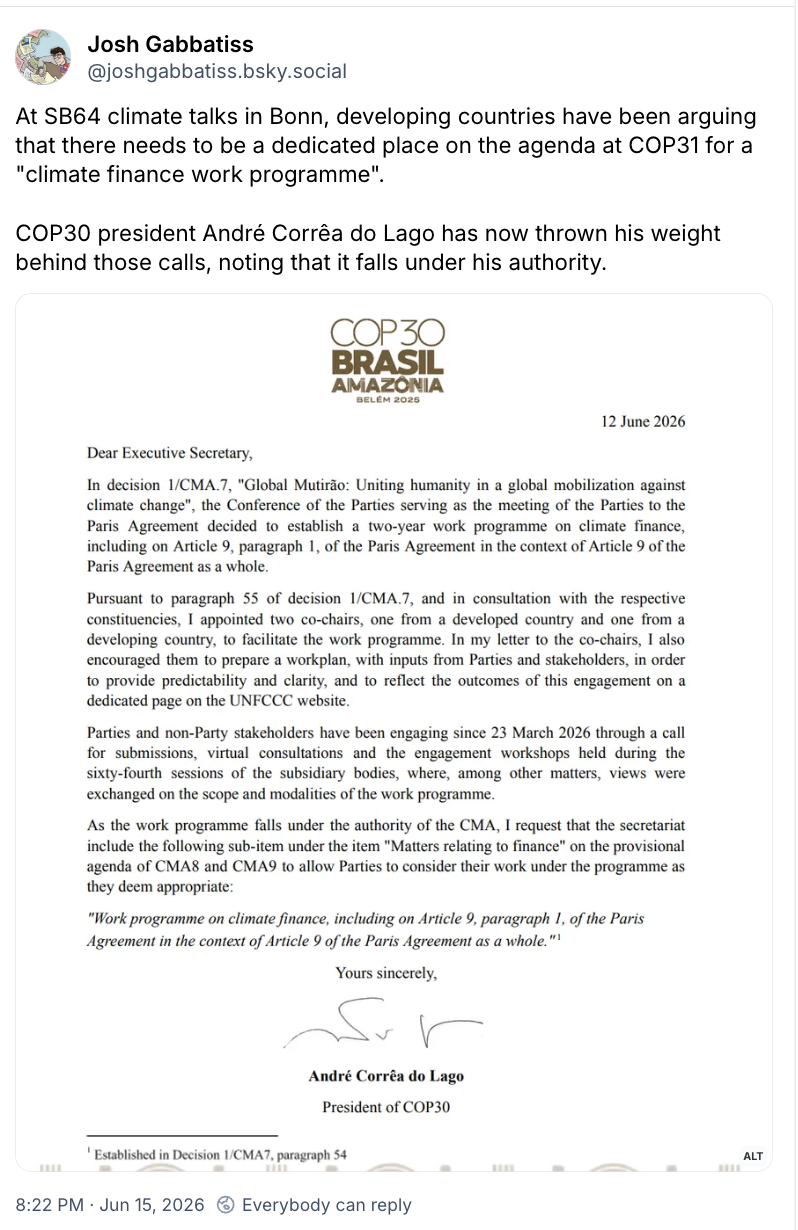
When asked why he made this unconventional intervention, Corrêa do Lago told Carbon Brief that it reflected his understanding of what was agreed last year:
“If I believe that we agreed in Belém that this would happen, I think it is normal that, as president of the COP, I request that to the secretariat.”
Nevertheless, his action is not binding and will not, in itself, avert conflict over whether to include the issue on the COP31 agenda. Despite this, the move was celebrated by civil society, with Sehr Raheja, a climate change programme office at the Centre for Science and Environment (CSE) telling Carbon Brief:
“Developed countries have been resistant to it from the beginning…Drama is going to be there [at COP31], whether we like it or not.”
The SB64 talks also saw the first two-day meeting of the “Veredas dialogue”, another new finance-related process agreed at COP30.
This is a space for parties to discuss Article 2.1c of the Paris Agreement, which concerns making all global financial flows “consistent” with climate goals. Some developing countries, such as the Arab group, have resisted this aspect of negotiations, preferring to keep the focus exclusively on finance from developed countries.
The Veredas dialogue is essentially a continuation of the “Sharm el-Sheikh dialogue” – which ended last year – except with greater focus on real-world implementation.
These discussions saw presentations on various topics, including how Rwanda is aligning its public finance with climate resilience and Norway’s experience with carbon pricing. As part of the dialogue, high-level “Xingu finance talks” will take place later this year.
Finally, the COP30 presidency hosted sessions to discuss the implementation of the “Baku to Belém roadmap”.
As well as the $300bn goal, the NCQG contains a more aspirational target of reaching $1.3tn in annual climate finance by 2035, which parties at COP30 agreed to “urgently advance”. The roadmap is a presidency-led attempt to add substance to the $1.3tn pledge.
In Bonn, parties and experts discussed activities to “focus collective energies” and “gain quick wins”, as well as how to follow up on the roadmap in “mandated workstreams and through the action agenda”.
A summary of the discussion will be produced and used to inform the continued follow-up on the roadmap, over the coming year.
Global stocktake
Years of discussions culminated in the first “global stocktake” (GST) of the Paris Agreement in 2023, which assessed progress towards climate goals and what more needed to be done.
Since then, countries have been engaging in a process known as the United Arab Emirates (UAE) dialogue, which focuses on implementing the GST outcomes.
There were two sessions at SB64 for parties to share experiences and information about how to implement the GST – and barriers they faced – as agreed at COP30.
Interventions from parties such as the EU, Switzerland and Colombia focused on the GST’s “energy package”, contained in paragraph 28 of the text, including “transitioning away from fossil fuels” and “phasing out inefficient fossil-fuel subsidies”.
AOSIS highlighted the recent conference on transitioning away from fossil fuels in Santa Marta, Colombia, as a good example of cooperation to deliver on these outcomes.
Many developing-country parties stressed that they needed more climate finance and other forms of support to carry out GST outcomes. The Philippines, speaking on behalf of the G77 and China, highlighted:
“The persistent gap between the scale of action required to implement GST outcomes…and the scale, quality, accessibility and predictability of support provided.”
Among the groups preferring to keep the focus on finance were those representing major fossil-fuel producers. Saudi Arabia, speaking for the LMDCs, described the dialogue as a “non-prescriptive space with a focus on finance”.
The co-facilitators are now expected to prepare a report that summarises the discussions, without providing guidance.
As the talks came to a close and an overview was presented to attendees by the diplomats leading the discussions, Colombia noted that “transitioning away from fossil fuels” was missing:
“This topic featured prominently in several interventions and was identified by many parties as a key element of the GST outcomes that requires [finance].”
Following this, Saudi Arabia said “cherry-picking” of paragraphs from the GST should be avoided, given it was a “carefully negotiated” package:
“While some parties may choose specific pathways, roadmaps, initiatives, approaches, others are contributing through other alternative approaches – all of which are valid and contribute to the goal of the Paris Agreement.”
(The stocktake calls on all parties to contribute to the entire energy package, including the fossil-fuel transition. Yet Saudi Arabia has consistently argued the package is a menu of options, from which parties can pick and choose.)
Across various rooms in Bonn, talk also turned to the next GST, a two-year process that will begin at COP31 later this year and end in 2028.
The most contentious issue regarding the second GST was whether or not the next Intergovernmental Panel on Climate Change (IPCC) report will feed directly into it. See: Climate science.
Mitigation work programme
Bonn closed with the mitigation work programme (MWP) – the only formal agenda item specifically about cutting greenhouse gas emissions – failing to reach an agreement. As a result, it was subject to “rule 16”, meaning it was simply pushed to COP31.
The main challenge within negotiations was a divergence between parties wanting the MWP to actively drive more urgent emissions cuts and those who want it to be merely a space for communication.
Speaking to Carbon Brief, Kaveh Guilanpour, vice president for international strategies at the Center for Climate and Energy Solutions (C2ES), explained:
“Tensions in the MWP go back to when it was adopted at COP27, where some parties wanted it to be a non-negotiated space to exchange ideas and views on how to accelerate mitigation action, while others hope the space could be used for more normative signals on what needs to be done going forward.
“At the heart of this is the fact that NDCs are nationally determined, while the goals of the Paris Agreement are collective in nature.”
One of the main areas of focus in Bonn was the future of the MWP, including its duration, its relationship with other UNFCCC processes and how it should be carried out.
For example, during discussions in the first week, parties disagreed on whether the mandate for the MWP’s work – which refers to “this critical decade” – meant it should continue operation until 2030, or whether this simply related to the urgency of action.
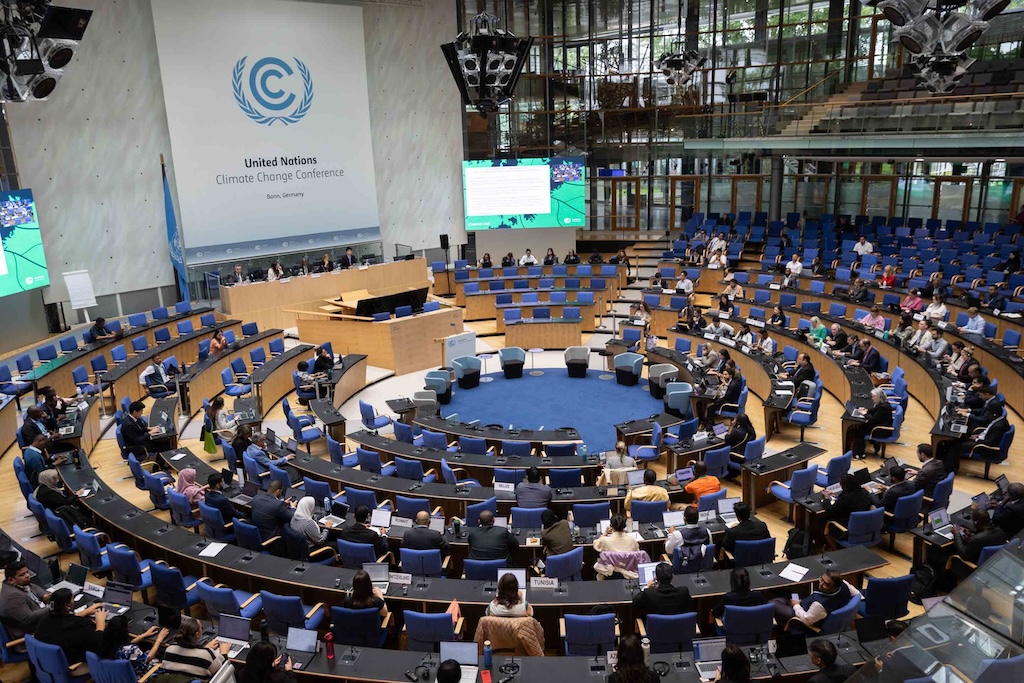
Speaking during a press conference in the second week attended by Carbon Brief, Anne Rasmussen, lead climate negotiator for AOSIS, said that on mitigation:
“We need to move beyond simply exchanging views and focus on how the work programme can support the implementation of GST outcomes, particularly those related to mitigation. These [include] accelerating renewable energy deployment and strengthening dedicated mitigation space beyond 2027.”
Questions of finance also became contentious, as they had across a range of negotiating rooms in Bonn.
During negotiations, some parties highlighted the need to engage with financiers, investors or other avenues, in order to turn MWP discussions into action.
In the second week, the diplomats leading negotiations put together three separate documents to represent the divided discussions: a draft legal text; a note capturing the key parts of the debate; and a “non-exhaustive reflection of the exchange of views”.
Further documents released the day after, with few substantial changes, faced a similar response.
In the afternoon of the final day in Bonn, brief draft conclusions were published. This contained just five points, predominantly focused on the need for continued work on the MWP.
Ultimately, however, parties could not even agree on this minimal document and the MWP was pushed to COP31.
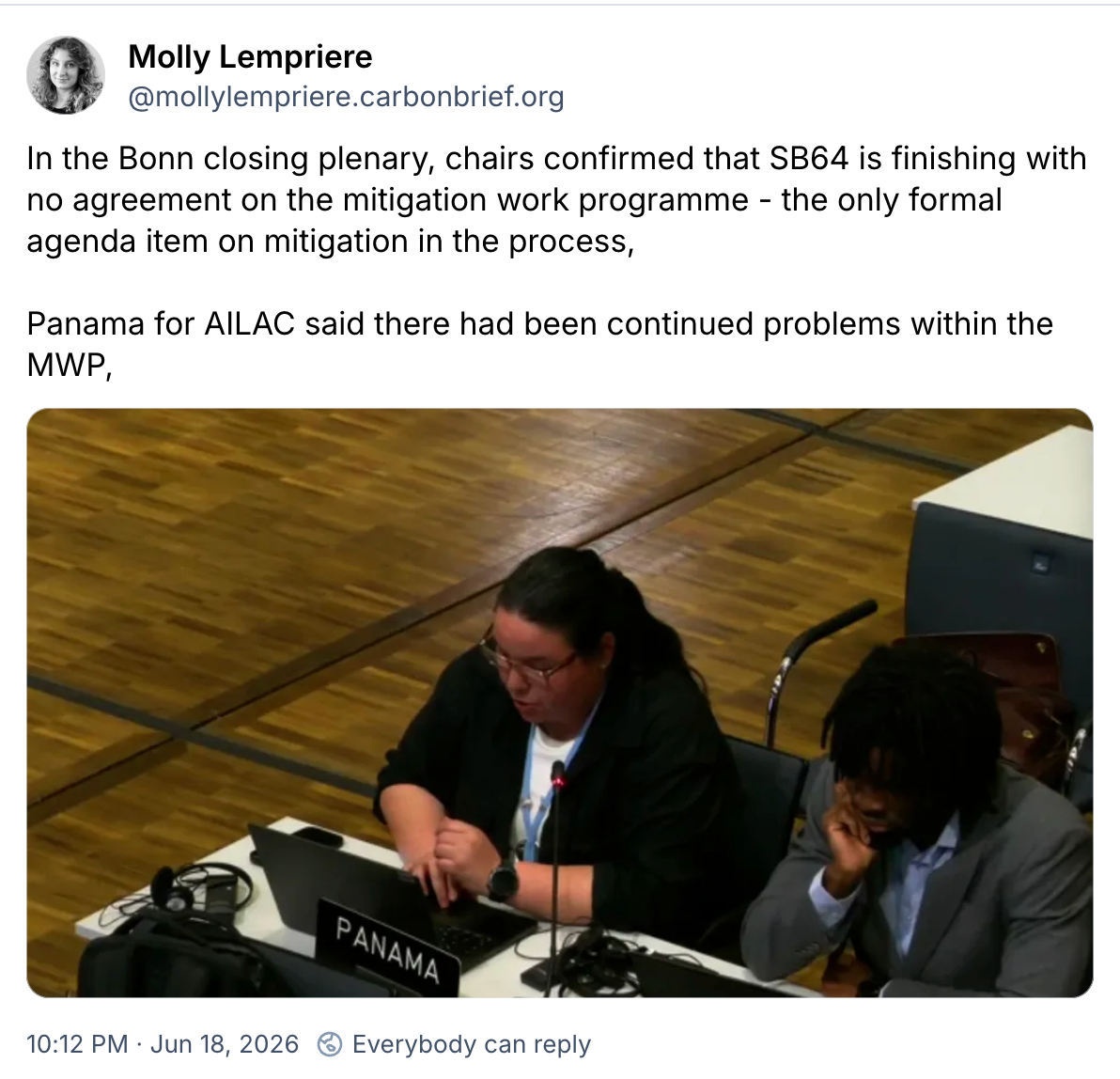
In the closing plenary, a range of parties expressed their “profound disappointment” and reaffirmed their commitment to the MWP process.
Action agenda and new initiatives
COP30 saw an effort by the Brazilian presidency to raise the profile of the “action agenda” – a long-running initiative to mobilise climate action outside the formal UN process.
Hundreds of voluntary climate initiatives have been launched by businesses, local governments and many other actors over the years at COP summits and other international events.
In a bid to turn this into real-world action, the COP30 presidency marshalled these initiatives into six broad themes and compiled them into a five-year plan for “accelerating implementation”.
These plans were intentionally aligned with the goals of the global stocktake, negotiated in 2023, which includes everything from “transitioning away from fossil fuels” to “halting and reversing deforestation”. (See: Global stocktake.)
This work continued at SB64, with UN Climate Change executive secretary Simon Stiell telling participants in his opening speech:
“We hear calls from many to elevate the global climate action agenda – complementing negotiations, bringing together governments, companies, innovators, investors, cities and regions and civil society.”
The Turkish COP31 presidency launched its own “priorities” for the action agenda during the first week of SB64. The most high-profile of these was a goal – yet to be endorsed by national governments – to increase the global share of final energy demand met by electricity from just over 20% today to 35% by 2035.
(Amid soaring fuel prices linked to the Iran war, some governments have already identified electrification as a way to curb their reliance on expensive fossil-fuel imports.)
The Turkish presidency also announced targets to halve the growth in global waste, reduce “energy consumption intensity in the building sector” by 25%, increase the global use of “circular materials” by 15% and “build awareness of the climate crisis” among young people and farmers, all by 2035.
Alongside these goals, the presidency has also announced a “climate implementation bridge”. This was described as an initiative to help developing countries access support and capacity building – but it is not a new climate fund.
(The COP31 action agenda is set to be formally launched at London Climate Action Week, the week after SB64.)
In a press conference announcing these new goals, the Australian “president of negotiations” for COP31, Chris Bowen, made it clear that the negotiations and the action agenda are “separate things” and that the latter could proceed without universal buy-in from every country. He said:
“The action agenda is set by the presidency, the negotiations are steered but are a party-driven process and require consensus.”
COP30 also had also seen the launch of more new presidency-led initiatives that were intended to drive climate action beyond the UN negotiating halls. SB64 provided an opportunity to flesh these out and for parties to provide their views.
One of these initiatives was the “global implementation accelerator”, which was the focus of an event in the first week of the conference.
COP30 and COP31 presidency representatives explained that this would involve providing additional support to three or four “high-impact” climate “solutions” from the action agenda. The goal would be to help parties – on a voluntary basis – as they implement nationally determined contributions (NDCs) and national adaptation plans (NAPs).
Another new presidency initiative was the “Belém mission to 1.5C”, which held a consultation event in Bonn. This has similar objectives to the global implementation accelerator – namely, driving ambition, implementation and investment in nations’ NDCs and NAPs.
The “mission” is gathering inputs from various actors and will use these, alongside various meetings and consultations, to produce a report ahead of COP31.
Some parties used these sessions to make their priorities clear. For example, Saudi Arabia, on behalf of the Arab Group, made statements during both consultations about the importance of carbon-capture technologies. They told the “mission to 1.5C” session:
“International cooperation currently disproportionately emphasises particular solutions, while technologies such as CCUS [carbon capture, utilisation and storage] and CDR [carbon dioxide removal], despite their critical role in IPCC-assess