

The planet is heating up more quickly than ever before.
For decades, greenhouse gas emissions caused by human activity have been building up in the atmosphere and trapping ever-higher levels of heat.
The resulting asymmetry between incoming solar energy and energy radiated back out into space – known as “Earth’s energy imbalance” – provides a direct measure of the extent to which humans are disrupting the Earth’s climate system.
This imbalance is growing and in 2025 its 10-year average reached a record high, indicating that global temperatures could increase at even higher rates in the future.
This is among the headline findings of the latest “indicators of global climate change” (IGCC) report, published in the journal Earth System Science Data, which tracks changes in the climate system on an annual basis.
The report, now in its fourth iteration, has been produced by dozens of scientists from around the world.
Its findings are designed to fill the gap between Intergovernmental Panel on Climate Change (IPCC) science reports, which are published every 5-7 years.
In this article, we unpack the IGCC report, which explores how human activity is driving a growing energy imbalance and why monitoring systems to track global climate are so crucial.
(For more on previous IGCC reports, see Carbon Brief’s coverage in 2023, 2024 and 2025.)
Greenhouse gas emissions remain at an all-time high
Global greenhouse gas emissions are continuing to increase, mostly as a result of the use of fossil fuels. However, deforestation, agriculture and industrial processes also play an important role.

Over the most recent decade (2015-24), emissions stood at the equivalent of 54.6bn tonnes of carbon dioxide equivalent (GtCO2e) per year. In 2024, the most recent year for which we have complete data, emissions reached 56.8GtCO2e.
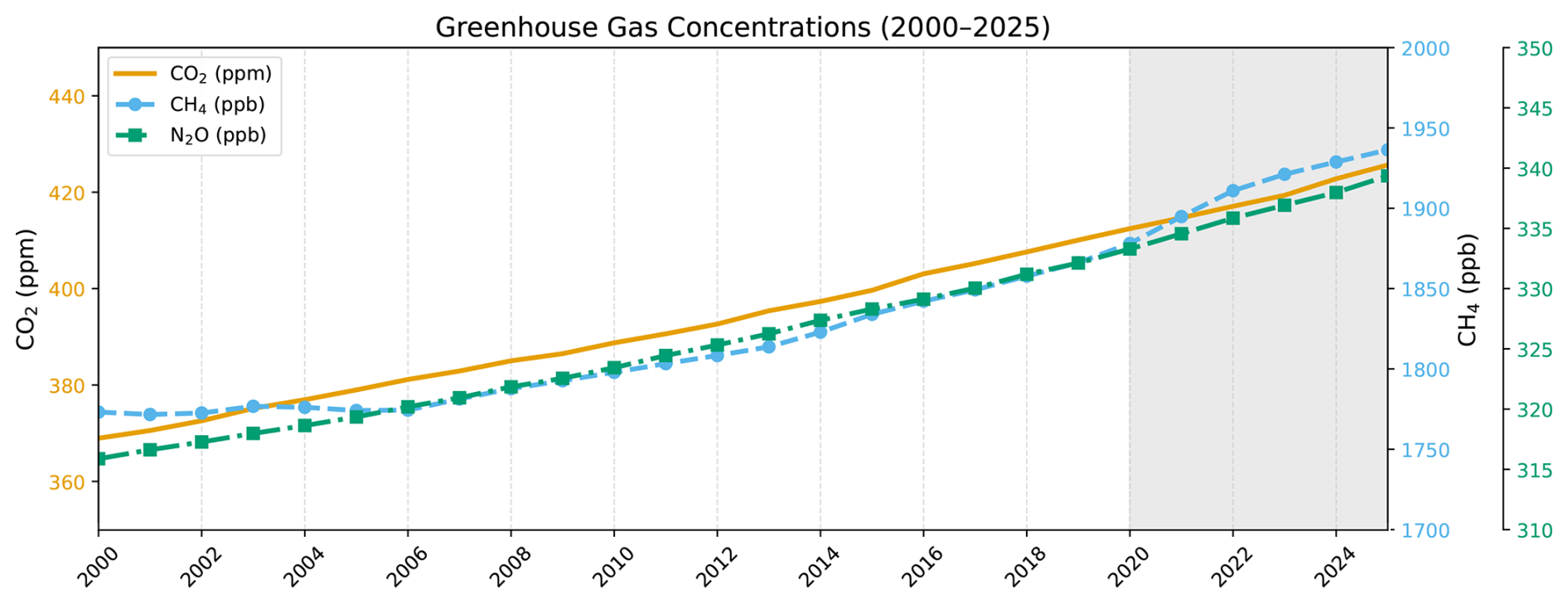
As the chart below shows, these emissions have pushed up atmospheric levels of CO2, methane and nitrous oxide. In 2025, concentrations of these gases reached 425.6 parts per million (ppm), 1936.3 parts per billion (ppb) and 339.4ppb, respectively.
This represents a rise of 3.8%, 3.8% and 2.2%, respectively, since the 2019 levels reported in the IPCC’s sixth assessment report (AR6).
At the same time, declines in emissions of aerosols such as sulphur dioxide, partly as a result of efforts to tackle air pollution, are increasing the Earth’s energy imbalance. This is because aerosols have a cooling effect on the Earth’s climate, counteracting warming from CO2 and other greenhouse gas emissions.
(Tackling sulphur dioxide, alongside other particulate emissions, remains critical because the immediate health and environmental damage they cause far outweighs their short-term cooling effect on the climate.)
The Earth’s energy imbalance is rising rapidly
The Earth’s energy imbalance has long been recognised as a key indicator of how the climate is being affected by human activities.
However, it is only in the last few decades that scientists have been able to record temperature changes deep enough in the ocean to accurately quantify it.
Earth’s energy imbalance measures how quickly excess heat is accumulating in every part of the Earth system, primarily in the ocean, but also in land, ice and atmosphere.
Through this accumulation of heat, the energy imbalance influences the rate of sea level rise and ice melt across the world, as well as increasing the frequency and intensity of extreme weather events, such as storms, floods and droughts.
Without human influence, the Earth’s energy imbalance would be close to zero.
But, as greenhouse gas emissions have built up in the atmosphere, the imbalance has been growing since the 1970s. Recent increases to Earth’s energy imbalance have outpaced those projections made by climate models — indicating the planet could see more warming than expected in the future.
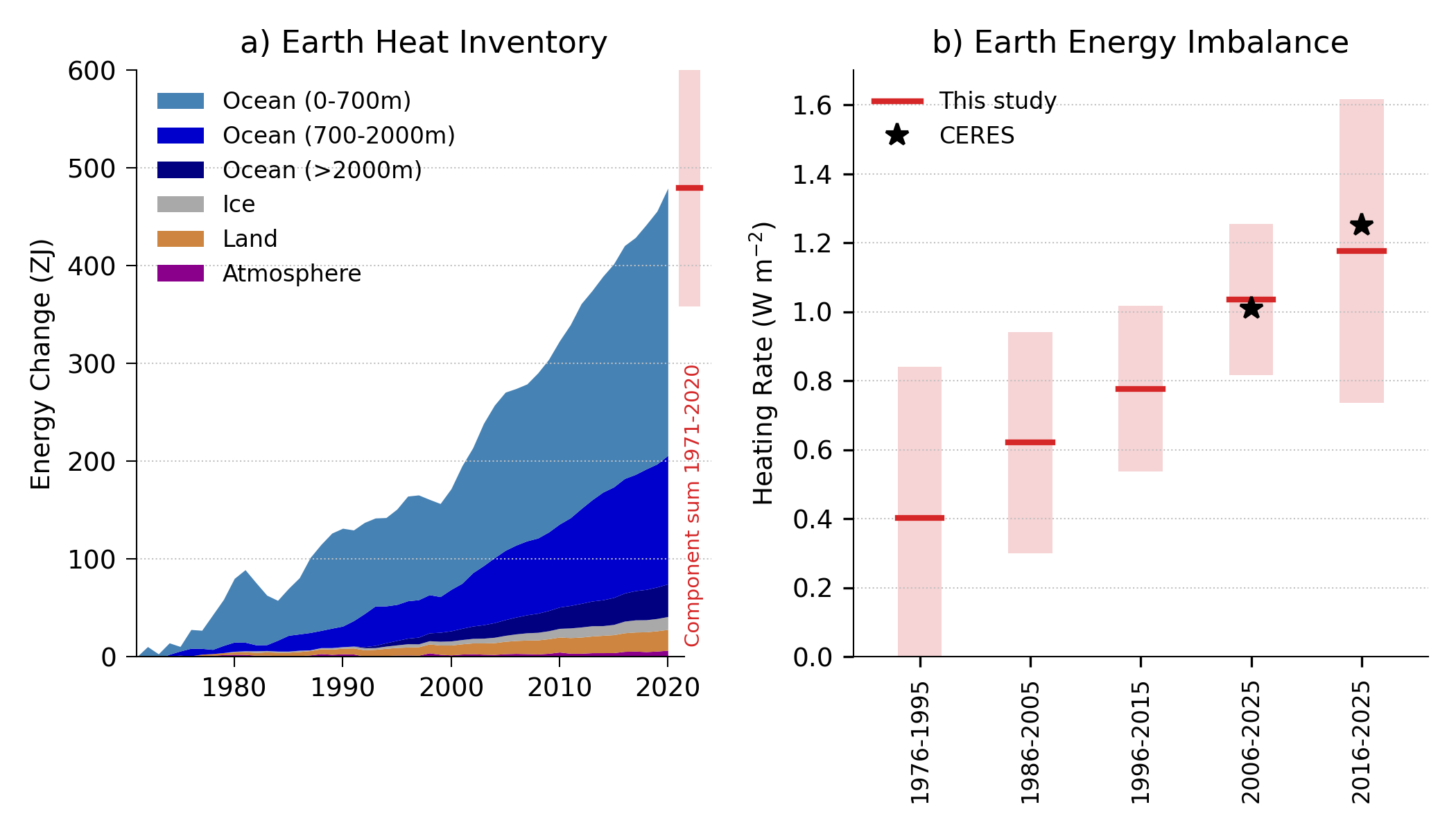
As the right-hand chart below shows, the imbalance is now at a record high, having more than doubled over the past two decades.
It has increased by around 40% since 2019, from an average 0.79 watts per square metre (Wm2) over 2006-18, according to IPCC AR6, to 1.12Wm2 over 2013-25.
The left-hand chart shows how heat is accumulating in the ocean (blues), ice (grey), land (orange) and atmosphere (purple).
Global temperature rise
The excess heat building up in the climate system from the energy imbalance is pushing up global temperatures at a record rate of 0.27C per decade.
We estimate that human-induced warming – the amount of observed global surface
temperature increase attributable to both the direct and indirect effects of human activities – reached 1.37C in 2025. This has risen from 1.0C in 2017, as reported in IPCC AR6.
While natural variability in the climate system – such as El Niño or La Niña events – can also influence temperatures year-to-year, the upward temperature trend we are seeing is being driven by the persistent imbalance in energy.
We now expect global temperatures to exceed the Paris Agreement limit of 1.5C above pre-industrial levels around the year 2030.
This is significant because 1.5C has been identified as the critical dividing line between manageable climate risks and catastrophic, potentially irreversible damage to global ecosystems and human societies.
Heat accumulating throughout the Earth system
While heat is accumulating throughout the Earth system, it is not being distributed evenly around the globe.
Since the 1970s, around 90% of this heat has been taken up by the ocean, affecting marine ecosystems, ocean circulation patterns, sea level rise and climate extremes.
For example, the number of marine heatwave days – periods of unusually high sea surface temperatures – has more than tripled globally since the early 1990s. The year 2025 alone saw 65 days of marine heatwaves – meaning they occurred, on average, more than one day a week.
Meanwhile, the cryosphere – the portion of the Earth made up of frozen water, including glaciers, ice sheets and permafrost – is experiencing widespread ice loss and thawing in response to the growing energy imbalance. This affects ecosystems, sea level rise and infrastructure in polar and high-latitude regions.
Rapid warming has also resulted in record extreme temperatures over land, with average maximum temperatures for any single day over 2016-25 around 1.92C above pre-industrial levels). This is an increase of almost half a degree compared to the previous decade (2006-15).
Sea level rise and the energy imbalance
Sea level rise provides one of the clearest long-term signals of a changing planet.
It is closely linked to Earth’s energy imbalance. As heat accumulates in the ocean, water expands, raising sea levels. Meanwhile, a warming land and atmosphere means addition of water to the oceans through melting of glaciers and ice sheets, also adding to sea level rise.
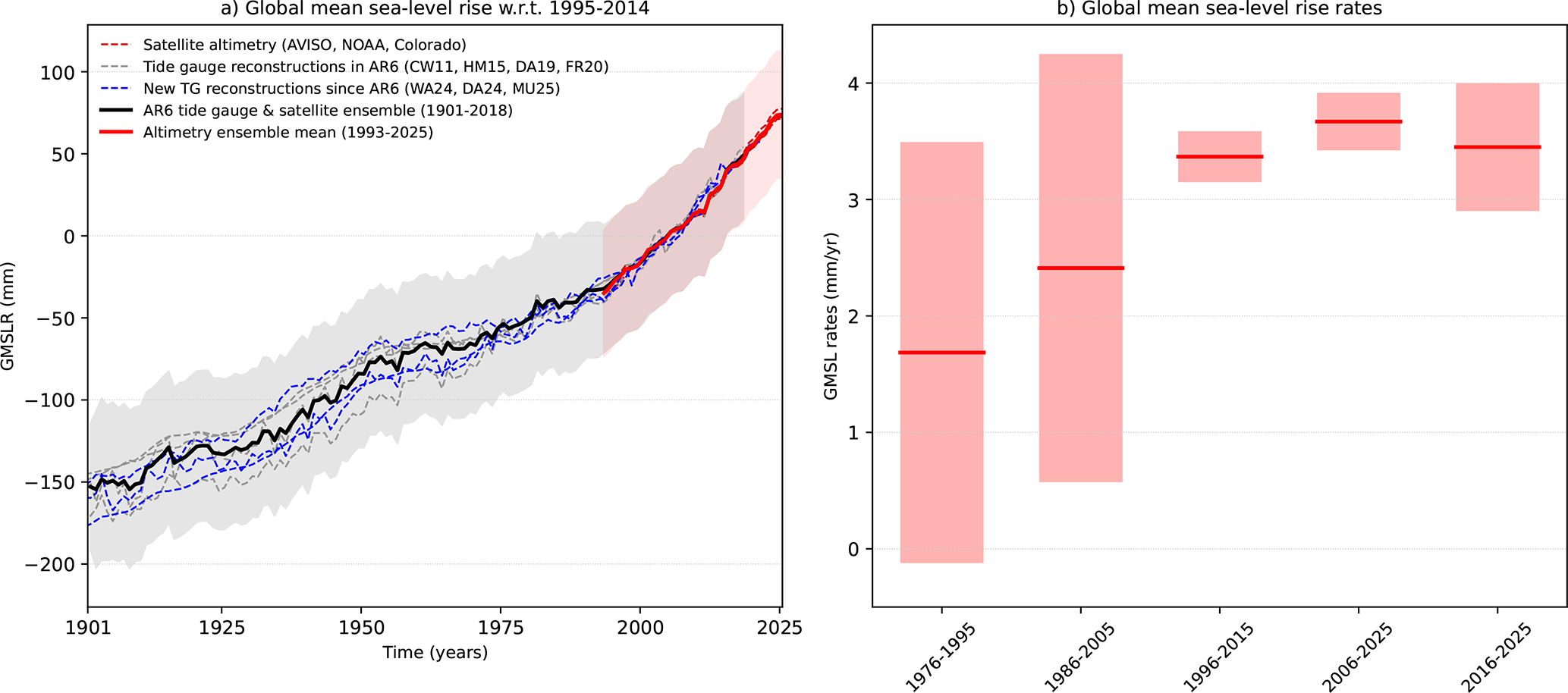
Over the long-term, sea levels have been rising, on average, at a rate of around 1.8mm per year since 1901, totalling a record 23cm in 2025. This is increasing the risk of coastal flooding, erosion and habitat loss in many low-lying areas around the world.
This rise can be seen in the left-hand chart below, which shows observed global sea level changes from tide gauges (grey and blue dashed lines) and satellites (red dashed lines) since 1901. The solid lines indicate the average across multiple datasets.
Sea level rise is accelerating consistent with the observed increase in Earth’s energy imbalance. Over 2006-25, sea levels have risen at a rate of 3.67mm per year – more than double the rate of 1.69mm per year seen over 1976-95.
This increasing rate is shown in the right-hand figure below, which shows four successive overlapping 20-year periods and the most-recent decade.
(Last year’s transition from El Niño to weak La Niña conditions affected global rainfall patterns and led to a small and temporary fall in global average sea level in 2025. This explains the slight decrease in rate of sea level rise for the most recent decade, which is affected more than the 20-year period 2006-25.)
The bigger picture
Despite greenhouse gas emissions not increasing as rapidly as in the 2000s, this year’s IGCC findings continue to show how far and how fast the climate is changing due to human activity.
A significant increase in decarbonisation efforts in the second half of this decade is required to slow down the rate of human-caused warming and limit the escalation of climate risks and impacts.
These findings, like many others produced by scientists across the globe, rely on international expertise, partnership and the maintenance and availability of global climate datasets and the global observing programmes that underpin them.
This year’s edition of IGCC used more than 40 global datasets produced by research teams around the world, including the NASA satellite record of the Earth’s energy imbalance and the ARGO deep ocean float network.
However, a number of long-term monitoring programmes could be threatened by funding decisions made by governments around the world, most notably the Trump administration in the US.
Local meteorological data and weather balloon measurement programmes in many countries have declined in recent years, especially in Africa, the west Pacific and South America. This reduces scientists’ ability to monitor and understand key indicators of climate change.
This is not just an issue for climate science. Many of these observations are key to weather forecasts and systems that provide early warning for extreme weather. For example, media reports have suggested that recent reductions in weather balloon measurements in Alaska led to a lack of warnings for a recent winter storm.
The continuity and integrity of the climate observations that scientists use to understand how the climate is changing depends on effective and sustained coordination by international organisations, such as the Global Climate Observing System, the World Meteorological Organization and World Climate Research Programme.
Without this data and its coordination, future assessments will be much more difficult at a time when urgent climate action is needed.



The post Guest post: How a record-high ‘energy imbalance’ is driving global warming appeared first on Carbon Brief.
Guest post: How a record-high ‘energy imbalance’ is driving global warming

Elisa Morgera is the UN Special Rapporteur on Climate Change and Human Rights.
For years, governments and international financial institutions have justified the mining boom by arguing that the energy transition cannot happen without critical minerals.
Increasingly, however, they are securing those minerals for something else: weapons and artificial intelligence (AI).
At COP31, governments must make clear what a sustainable and fair energy transition requires and reject demand for minerals that fuels war and other climate-harming uses.
Independent research shows that mineral demand is increasingly driven by AI and militarisation. Yet, both undermine climate action.
Major armed conflicts are linked to fossil fuel expansion, generate emissions that are unaccounted for under the Paris Agreement, and deliver record profits to fossil fuel and petrochemical companies through price spikes and disrupted access to fuel and food.
Meanwhile, AI infrastructure risks undoing the progress of the renewable energy transition by driving fossil fuel expansion to meet data centres’ vast new energy demand.
-
We need no-go mining zones for the energy transition to be just: Here’s how it could work
As rising demand for critical minerals is compounding threats to fragile ecosystems, NGOs have mapped out areas that should be off-limits to mining -
Rush for critical minerals tests Europe’s resolve to protect nature
A Climate Home News investigation found that more than half of the EU’s “strategic” mineral projects lie on, or within a kilometre, of protected Natura 2000 sites -
Major financiers neglect energy transition risks from mining as demand booms
Financial institutions are lacking safeguards to prevent harms caused by mining the resources needed for the energy transition, analysis of the sector’s financing finds



UN Secretary-General António Guterres and the head of UN Climate Change Simon Stiell have both warned of the climate harm of unchecked, fossil fuel-powered AI and data centre growth.
In addition, AI equipment and infrastructure require huge amounts of copper – one of the minerals most in demand for the energy transition. A recent academic study found that copper makes up roughly 82-83% of the mineral mass in data centres.
None of this demand serves the energy transition. Instead, the climate case for mining is being used to legitimise uses that undermine a sustainable future.
Mining still relies heavily on fossil fuels and often harms the environment, so it must be limited to extracting the resources strictly necessary for the energy transition. Otherwise, states breach their binding obligations to protect the environment and human rights, as the International Court of Justice (ICJ) has made clear.
National security is the new mining fast track
Campaigners have long warned that when minerals become a matter of national security, governments are more tempted to deregulate and fast-track mining projects. Communities pay the price.
Extraction without adequate consultation is a global pattern linked to killings of land and environmental defenders. More than half of transition mineral projects are located on or near Indigenous lands, and allegations of abuses linked to mining transition minerals surged 73% in 2025 alone.
Security and climate are not separate problems. Both are rooted in the fossil fuel-based global economy, now joined by the unchecked growth of AI and data centres.
Who should benefit from minerals?
Not every demand for minerals can or should be met. Minerals are finite and must be used to address the worsening climate crisis as a priority.
The COP31 presidency’s push for electrification will have significant implications for mineral demand. At the same time, electrification doesn’t necessarily help to phase out fossil fuels. Governments must be clear about how minerals are being used and prioritise uses that genuinely advance the energy transition.
- Climate action comes first: Mineral demand for the wind and solar projects that power communities and essential public services such as local food systems should be met first. Priority uses should include community-led wind and solar projects and renewable power for public transport.
- No support for climate-harming activities: Mineral demand projections for the energy transition should exclude the military-industrial complex and data centres, and governments should reconsider public spending on militarisation. Mineral demand for electrification should also be scrutinised to avoid deepening fossil fuel dependence.
- Cut demand before expanding supply: High-consuming countries should use less primary material through efficiency, longer-lasting products and by reducing car dependence, rather than exporting waste and harm to the Global South.
- Prioritise energy needs: Those without access to energy must be served first. Overproduction and overconsumption must be curbed, otherwise the transition will neither mitigate climate change nor reduce poverty.
- No mining without consent: No project should receive financing or permits without the Free, Prior and Informed Consent of Indigenous Peoples and genuine consultations with affected communities.
- No-go zones: States should establish no-go mining zones in ecologically sensitive areas, on land and at sea, and ensure that mining does not cause significant harm to biodiversity.
What can COP31 do?
Last year, governments agreed to develop a Just Transition Mechanism, but explicit provisions on transition mineral governance were dropped. At COP31, negotiators are reconsidering the issue. I urge negotiators in Antalya to:
- Reflect states’ obligations underpinning the ICJ Advisory Opinion and the UN Secretary-General’s Critical Energy Transition Minerals Panel principles in the Just Transition Work Programme.
- Keep mineral demand for the military and digital infrastructure separate from demand that serves climate protection.
- Require traceability and end-use disclosure, so it is publicly known whether a mineral ends up in a battery, a missile or a data centre.
- Respect the human rights of Indigenous Peoples, peasants and environmental human rights defenders, including the right to say no, protection from reprisals and access to remedy.
At COP31, transition minerals should be unequivocally linked to everyone’s human right to a safe climate and a healthy environment.
The post Minerals for the planet or for war and AI? COP31 must make clear what we prioritise appeared first on Climate Home News.
Minerals for the planet or for war and AI? COP31 must make clear what we prioritise
Dozens of countries – from big emerging economies to the world’s poorest nations – are calling for the UN’s new carbon market to reassess climate integrity rules, in a push that campaigners and researchers have blamed on industry lobbying.
At COP31 talks on the Paris Agreement Crediting Mechanism (PACM) this weekend, the Like-Minded Developing Countries – a group that includes Saudi Arabia, India and China – the Least Developed Countries (LDCs) and landlocked developing countries raised concerns about the requirements project developers must meet, according to sources familiar with the closed-door discussions.
They warned about the cumulative weight of those requirements developed under Article 6 of the Paris Agreement as barriers to implementation. Several countries, including Singapore and some Latin American states, said rules must keep projects financially viable, while South Korea asked for proportionate requirements, the sources said.
Their demands closely track arguments from carbon market industry groups, which claim PACM’s conservative approach to counting emission reductions is so strict that few projects will ever come to fruition.
Industry and NGOs lobby to weaken UN carbon credit rules in “coordinated” push
In a letter published ahead of COP31, the lobby groups asked governments to “raise implementation concerns” and to request that the Supervisory Body – the UN body that oversees the market – assess the “combined impact” of its rules on the feasibility of projects.
The letter was signed by the International Emissions Trading Association (IETA), a business group whose members include fossil fuel giants Shell, BP, Saudi Aramco and Chevron, along with the Project Developer Forum and the Wildlife Conservation Society, which develops forest conservation programmes.
Draft text reflects industry demands
Those demands are reflected in the first draft of the COP31 decision on the mechanism, published late on Saturday. To guard against over-crediting, PACM’s rules deliberately err on the side of issuing fewer credits when emissions cuts from projects are uncertain.
The document asks the Supervisory Body to look at how these cautious assumptions add up across its rules and what that means for the number of credits, project costs and prices. The aim, it says, is to avoid “excessive compounding of conservative adjustments”.
Other parts of the draft tell the body not to make its rules too cautious or too rigid. That includes efforts to guard against the risk that carbon captured by a project is later released. Most of these passages add that environmental inte