When the land no longer answers the stars the way it once did, Indigenous peoples are among the first to notice — and the first to ask why.
A Sky Full of Knowledge
Look up on a clear night on Turtle Island and you’re seeing a sky that has guided human life for thousands of years. Across Indigenous nations in Canada, detailed systems of celestial knowledge developed not as abstract science but as living, practical guides —telling people when to plant, when to harvest, when herds would move, and when ice would come. This astronomical knowledge was woven into language, ceremony, and everyday life, passed down through generations with remarkable precision.
The Mi’kmaq and the Celestial Bear
Among the Mi’kmaq of Atlantic Canada, star stories are ecological calendars, precise and functional. The story of Muin and the Seven Bird Hunters connects the annual movement of what Western astronomy calls Ursa Major to the seasonal cycle of hunting and harvest: the bear rises in spring, is hunted through summer, and falls to earth in autumn. This knowledge was brought to broader public attention in 2009 during the International Year of Astronomy, when Mi’kmaq Elders Lillian Marshall of Potlotek First Nation and Murdena Marshall of Eskasoni First Nation shared the story through an animated film produced at Cape Breton University narrated in English, French, and Mi’kmaq.¹ The story encodes specific observations about when and where to hunt, and which species to expect at which time of year. It is science in narrative form.
The Anishinaabe and the Seasonal Star Map
Among the Anishinaabe peoples of the Great Lakes and northern Ontario, celestial knowledge forms part of a comprehensive seasonal understanding. Knowledge keepers like Michael Wassegijig Price of Wikwemikong First Nation have described how Anishinaabe constellations quite different from those of Western astronomy connect the movement of the heavens to naming ceremonies, seasonal gatherings, and land practices.² The Royal Astronomical Society of Canada now offers planispheres featuring Indigenous constellations from Cree, Ojibwe, and Dakota sky traditions, recognizing their value as both cultural heritage and ecological knowledge systems.³
When the Stars and the Land Fall Out of Rhythm
Here’s the challenge that climate change has introduced: the stars still move on their ancient, reliable schedule. But the land no longer always responds as expected. Migratory birds that once arrived when certain constellations appeared are now showing up earlier or later. Ice that once formed in predictable windows is forming weeks late, or not at all. Berry harvests, fish runs, animal migrations, all once timed by celestial cues accumulated over millennia are shifting. Indigenous knowledge holders across Canada describe this as a kind of dissonance: the sky remains faithful, but the land has changed.⁴
Long-Baseline Ecological Records
Far from being historical curiosity, Indigenous celestial knowledge systems are now being recognized by researchers as long-baseline ecological calendars —records of how nature behaved over centuries, encoded in story and ceremony. When an Elder observes that a particular star rising no longer predicts the arrival of certain geese, that observation represents a departure from a pattern that may have held true for hundreds of years. The Climate Atlas of Canada integrates Indigenous knowledge observations alongside western climate data, recognizing that both contribute meaningfully to understanding ecological change.⁵
Keeping the Knowledge Alive
Language revitalization and land-based education programs are helping ensure this knowledge reaches the future. From youth astronomy nights on-reserve to the integration of Indigenous sky stories in school curricula, there is growing recognition that these knowledge systems belong to what comes next, not only what came before. As Canada grapples with accelerating ecological change, the quiet precision of thousands of years of skyward observation offers something no satellite can fully replicate: a continuous record of the relationship between the cosmos and a living land.
Blog by Rye Karonhiowanen Barberstock
Image Credit: Dustin Bowdige, Unsplash
References
[1] Marshall, L., Marshall, M., Harris, P., & Bartlett, C. (2010). Muin and the Seven Bird Hunters: A Mi’kmaw Night Sky Story. Cape Breton University Press. See also: Integrative Science, CBU. (2009). Background on the Making of the Muin Video for IYA2009. http://www.integrativescience.ca/uploads/activities/BACKGROUND-making-video-Muin-Seven-Bird-Hunters-IYA-binder.pdf
[2] Price, M.W. (Various). Anishinaabe celestial knowledge. Wikwemikong First Nation. Referenced in: Royal Astronomical Society of Canada Indigenous Astronomy resources.
[3] Royal Astronomical Society of Canada. (2020). Indigenous Skies planisphere series. RASC. https://www.rasc.ca/indigenous-skies
[4] Neilson, H. (2022, December 11). The night sky over Mi’kmaki: A Q&A with astronomer Hilding Neilson. CBC News. https://www.cbc.ca/news/canada/newfoundland-labrador/hilding-neilson-indigenizing-astronomy-1.6679072
[5] Climate Atlas of Canada. (2024). Prairie Climate Centre, University of Winnipeg. https://climateatlas.ca/
The post Night Skies and Shifting Stars: How Indigenous Celestial Knowledge Tracks a Changing Climate appeared first on Indigenous Climate Hub.
https://indigenousclimatehub.ca/2026/04/night-skies-and-shifting-stars-how-indigenous-celestial-knowledge-tracks-a-changing-climate/

For the first time, new-energy vehicles (NEVs) made up 67% of new car sales in China in September, according to the latest data from the China Passenger Car Association (CPCA).
The figures show that NEVs, which include battery electric cars and plug-in hybrids, captured a record share of sales, even though fewer were sold than last year.
This is because sales of combustion-engine cars are falling steeply, a trend that the CPCA has attributed to rising petrol prices following the start of the Hormuz crisis.
Indeed, sales of fuel-only cars were down 31% year-on-year in the first nine months of 2026, with plug-in hybrid sales down 26% – whereas battery EV sales were only down 4%.
One analyst tells Carbon Brief that China’s rapidly growing EV fleet has offset demand for 143m barrels of oil since the start of the Hormuz crisis.
Another says that the crisis is “reinforcing China’s electrification of road transport”.
Meanwhile, amid slowing domestic sales, Chinese carmakers’ exports of NEVs more than doubled [in 2026 to date / in September] from a year earlier.
NEV record
A record two out of every three cars sold in September in China were NEVs, according to CPCA data, as shown in the figure below.
(NEVs predominantly include battery electric vehicles – BEVs – and plug-in hybrids – PHEVs. BEVs only run on electricity, whereas PHEVs also have a combustion engine.)
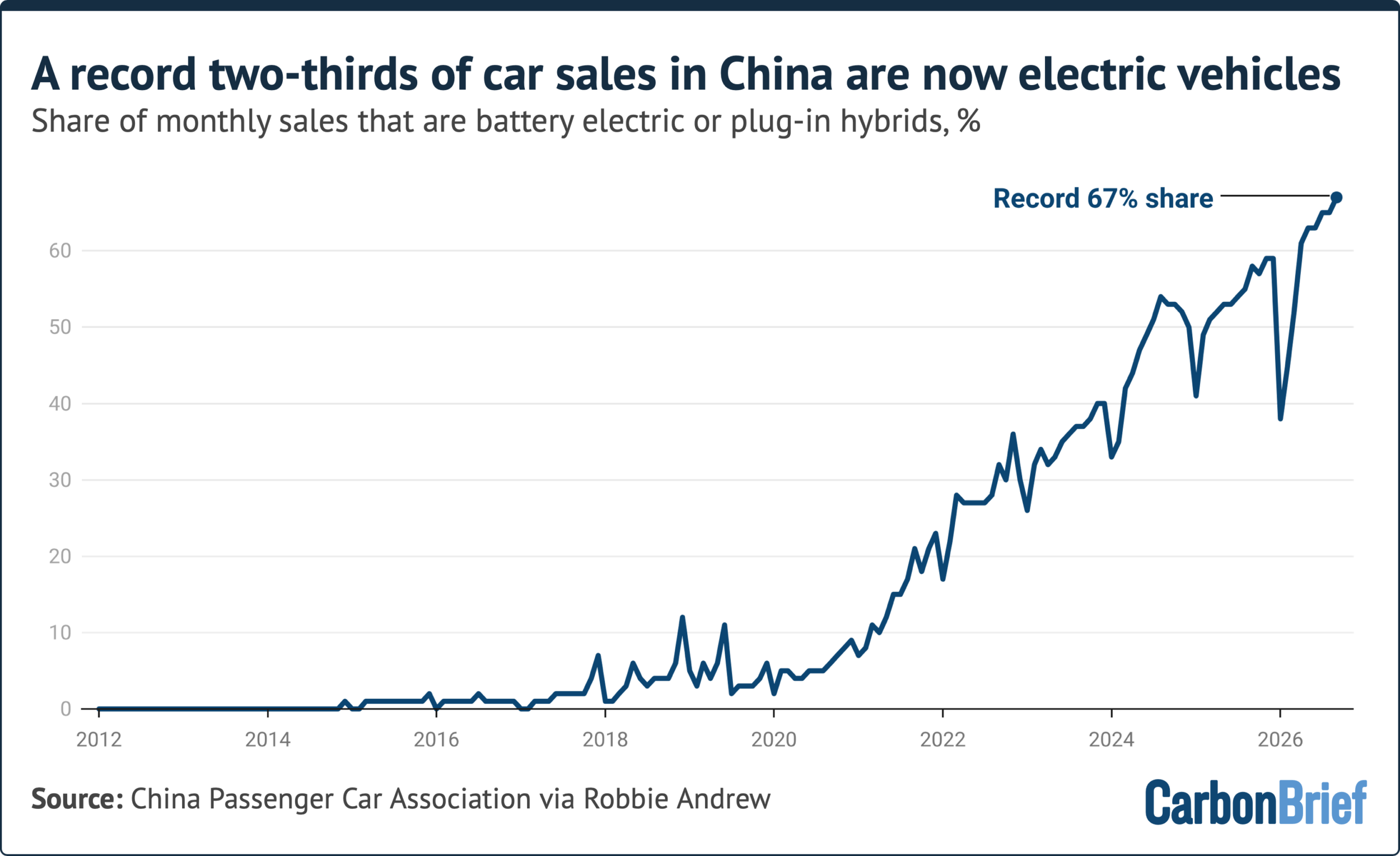
This marks a rapid rise for NEVs from just 6% of new car sales in 2020 up to 58% in 2026 to date – and a record 67% in the month of September.
This year, NEVs’ share of sales has also bounced back from a low of 39% in January, after the full purchase tax exemption that had been in place for more than a decade came to an end in December 2025.
The gain in NEV share in 2026 has come amid a slowdown across the wider domestic passenger-car market, which has hit sales of combustion-engine vehicles particularly hard.
This September, passenger-car retail sales across all categories declined, with overall sales volumes falling 28% year-on-year.
The contraction was led by combustion-engine vehicles, which saw sales fall 43% year-on-year in September and 31% in 2026 to date.
However, sales of PHEVs also fell by 36% year-on-year in September and by 26% in 2026 to date. By comparison, BEVs performed better, although sales still declined 8.5% from a year earlier in September and 4% in 2026 to date.
As a result, NEV sales overall fell by 17% in September and 13% in 2026 to date.
While the market changes in 2026 to date were particularly dramatic, they reflect a broad continuation of trends seen over the past decade.
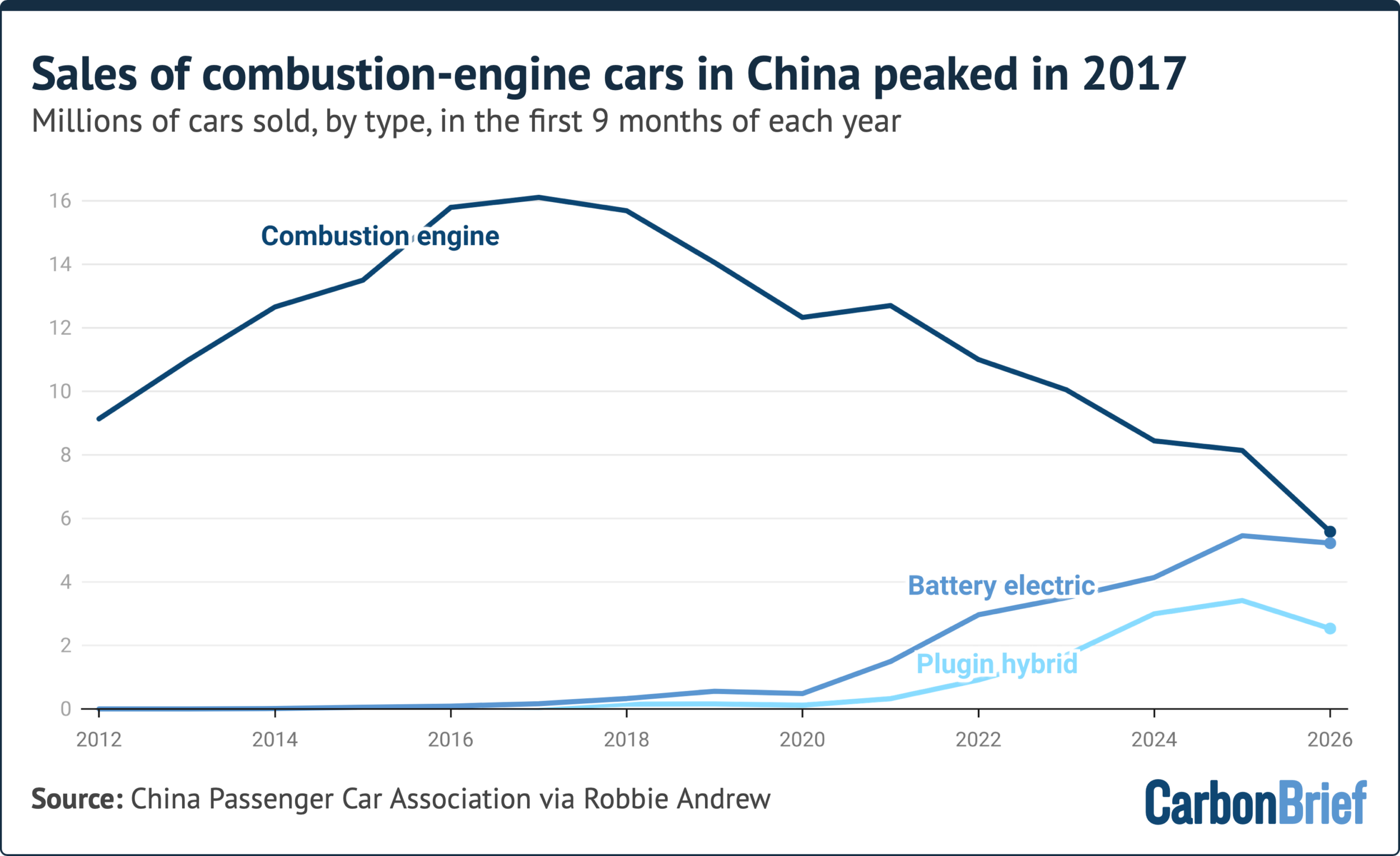
Indeed, sales of combustion-engine cars in China peaked in 2017 and they have been declining ever since, shown in the figure below.
Impact of Hormuz
Part of the reason for the advance of NEVs in 2026, said Chinese technology news outlet OFweek, was petrol cars “giving up market share” as they were outperformed by electric alternatives.
Cui Dongshu, secretary-general of the CPCA, cited higher petrol prices as an explanation for September’s weak combustion-car sales, in comments to financial news outlet National Business Daily.
Imports of oil into China in January-September have fallen 15% compared to 2025, equivalent to 470m barrels, as ongoing conflict tightened supply and drove up prices.
China’s passenger-car NEV fleet has displaced 143m barrels of oil so far during the strait of Hormuz crisis, Euan Graham, senior energy analyst at thinktank Ember, tells Carbon Brief.
EVs “accounted for 12% of the decrease in China’s oil use post-Hormuz”, according to an estimate provided to thinktank the Brookings Institute by an unnamed analyst.
Erica Downs, a senior research scholar at Columbia University’s Center on Global Energy Policy, tells Carbon Brief that the strait of Hormuz crisis and higher oil prices are “reinforcing China’s electrification of road transport”.
She says the “world’s largest oil supply disruption” vindicates China’s early bet on EVs, which was partly driven by concerns about oil-supply security.
NEV demand down
Nevertheless, NEV sales have fallen year-on-year, albeit at a slower rate than overall car sales. The growth in NEV market share has also been decelerating.
Zhang Yichao, a partner at consulting firm AlixPartners, tells Carbon Brief that NEVs benefit from government trade-in policies and a “strong pipeline” of new models, particularly those involving innovation.
He says these factors help explain why NEVs sales have fallen at a slower rate to their combustion-car counterparts.
Cui told the state-run China National Radio that the fall for NEVs and for cars overall in September 2026, is also due to a high baseline of sales from the same month in 2025, as well as changes to trade-in policies and disruptions from the holiday period.
Other factors, says consulting firm Wood Mackenzie, are the weakened demand due to “demand pull-forward” in 2025 caused by the end of subsidies, as well as “tighter financing conditions”.
Zhang tells Carbon Brief he does not “see much more room ahead” for further growth in NEVs’ market share.
He adds that, in his view, their share in China is unlikely to exceed 80%, as some premium-market segments and specific use cases will continue to require combustion-engine vehicles.
Exports surge
Meanwhile, while domestic NEV retail sales fell 17% in September 2026, exports more than doubled, increasing 164% year-on-year, according to the CPCA.
This extends the decline in domestic sales and very strong growth in exports seen across 2026 to date, as shown in the figure below.
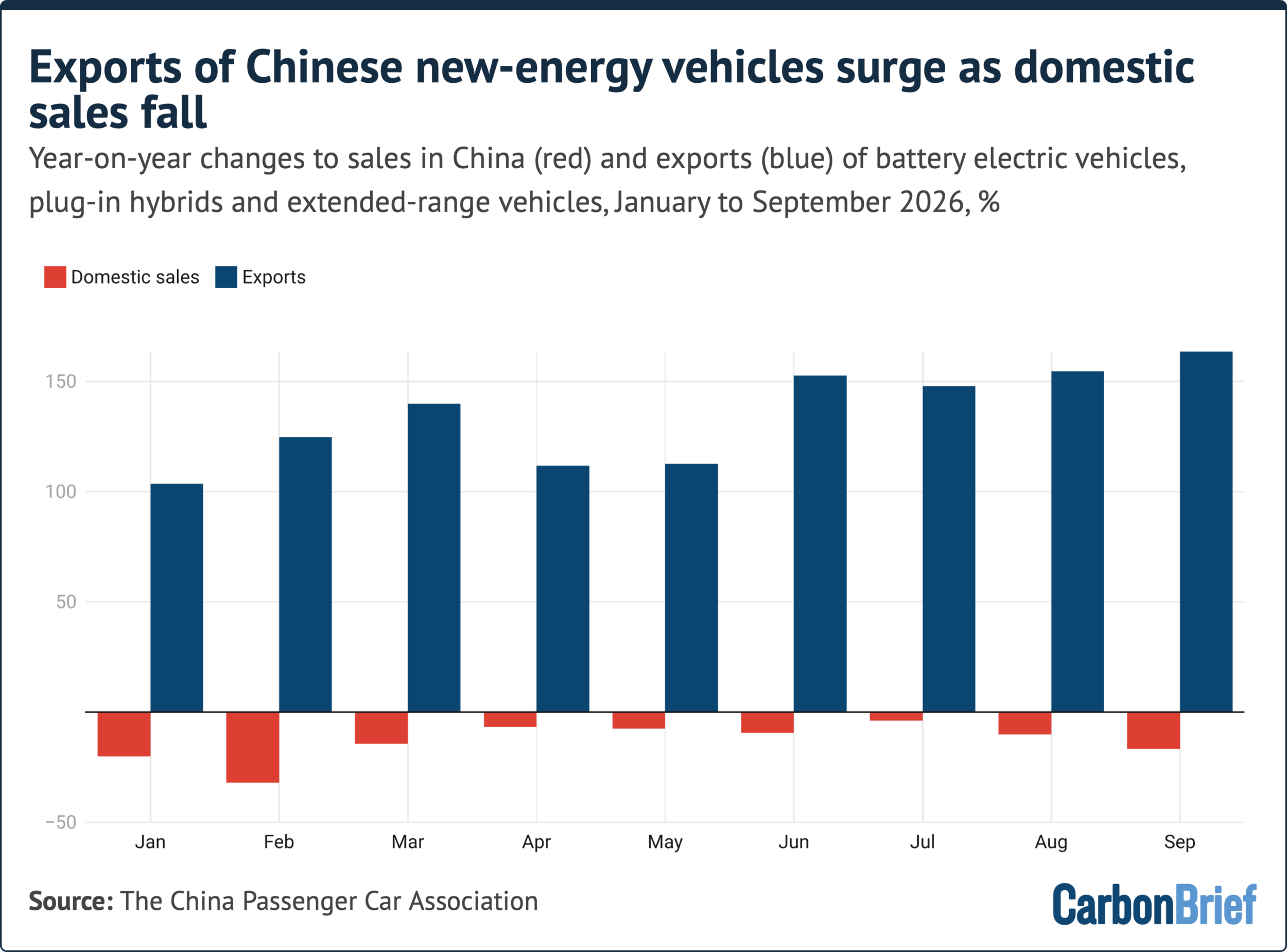
In September, 1,084,000 NEVs were sold domestically in China, while 558,000 NEVs were exported.
Exports are becoming increasingly important to Chinese carmakers, in the face of weaker domestic demand and cut-throat industrial competition.
The CPCA says exports have become “a core priority” for some carmakers.
However, the surge in exports from China has created concern in the EU, which has placed tariffs on imports of EVs from China and recently agreed plans to cut imports of hybrids.
Countries including Mexico and Turkey have also placed tariffs on Chinese EV imports.
At the same time, the Chinese government is putting policies in place that might be expected to disincentivise exports, such as cutting VAT export rebates.
Analysts differ on what impact this policy shift will have, with some saying it will be limited, while others believe it could cause the price of exported cars to rise.