

Republican allies of the oil and gas industry question the objectivity of an independent report from the nation’s top science advisers on the harms of human-caused climate change.
Soon after the U.S. Environmental Protection Agency released a plan to revoke its legal authority to regulate climate pollutants last summer, the nation’s most respected scientific organization fast-tracked a review of the latest evidence on whether greenhouse gas emissions endanger public health and welfare.


African negotiators have asked the UN to open a formal space at COP31 for contentious talks on adaptation finance and trade, lining up a potential fight over the agenda when the climate summit opens in Antalya on November 9.
In a letter sent to UN climate chief Simon Stiell last Sunday, Ghana, which is chairing the African Group of Negotiators (AGN) this year, requested three additional agenda items on tripling adaptation finance, trade and climate change, and the financing arrangements of the Green Climate Fund.
Governments agreed at last year’s COP30 on a new target to “at least triple” finance for climate adaptation in developing countries by 2035, following a push led by the least-developed countries which are highly vulnerable to growing climate impacts. But the last-minute deal left out key details, including the baseline year for tripling, a headline amount, who should pay and how it will be delivered.
AGN chair Antwi-Boasiako Amoah wrote in the letter that “a dedicated item is needed”, pointing to worrying trends in adaptation finance. He added that the mid-year climate talks in Bonn had “made clear” that countries could not agree how or where to take the goal forward.
During June’s session, developing countries tried to anchor the target in the negotiations on the Global Goal on Adaptation, which lays out technical indicators to measure and boost global efforts to cope with climate change. But wealthy nations – led primarily by the EU, the UK and Japan – opposed that push, arguing adaptation finance should be discussed elsewhere. Unable to break the deadlock, diplomats left Bonn without an agreement on adaptation.
‘Homeless’ issue
No other developing-country group has officially backed the AGN’s proposal so far. That may change next week, when negotiating blocs hold their pre-COP coordination meetings in Antalya.
Raju Pandit Chhetri, lead climate finance negotiator for the least-developed countries (LDCs), told Climate Home News it would be difficult to secure an agenda item on adaptation finance alone, but it is “a homeless issue” that needs to be discussed somewhere within the formal talks at COP31.
-
National climate plans now promise half the emission cuts expected by UN
The US exit from the Paris Agreement and weak new pledges leave 2035 emissions just 6% below 2019 levels, against 12% projected last year -
Early speakers’ list suggests few powerful leaders will attend COP31
Just 77 heads of state or government are scheduled to address the COP31 climate summit in Antalya, a third less than the COP28 peak

Developed countries are likely to resist. In their agreed COP31 negotiating position, EU governments reaffirmed the tripling call but framed it within the New Collective Quantified Goal (NCQG), the broader post-2025 finance goal agreed at COP29 in Baku. The EU and its member states are the largest provider of international climate finance to developing countries, but some nations, including Germany and France, have cut their aid budgets in recent years.
The LDCs want the goal to be defined as $120 billion a year by 2030 (five years before the agreed timeline), which would triple a previous target of around $40 billion. That was meant to be reached in 2025 but is likely to have been missed.
Mattias Söderberg, global climate lead for the Danish development NGO DanChurchAid, said tripling adaptation finance is not just “catchy wording”, but something that will save lives and help countries and communities cope with climate change on the ground.
He added that the AGN’s proposal will “for sure” spark a debate and “may lead to an agenda fight”, but it will ensure that the goal will not be forgotten.

GCF’s needs assessment
The second request in Ghana’s letter aims to revive a provision dating back to COP19 in 2013. Countries agreed then that the COP conferences should periodically assess how much money developing countries need to implement the UN climate convention, with the goal of helping inform fundraising by the Green Climate Fund (GCF).
Amoah said the COP has not made that assessment since 2013, so the fund’s replenishments have gone ahead without it. The GCF’s next fundraising round, covering 2028 to 2031, officially began in July. Its board is meeting in South Korea this week to agree rules for donor contributions, and a pledging conference is expected by the end of 2027.
The letter points to “declining” aid and “pressure on multilateral climate funds”. In May, the UK told the GCF it would deliver only half of the £1.62bn it had pledged for the current period, as it spends more on national security.
Trade tensions return
The third African request, for a “Trade and Climate Change Dialogue” item, is likely to be just as contentious. Disputes over what some countries call unilateral trade measures, such as the EU’s carbon border tax, have flared at recent COPs.
To keep this hot issue out of the official negotiations, in Belém last year, the Brazilian presidency set up three trade dialogues to take place at the Bonn mid-year sessions from 2026 to 2028. The first, in June, stayed stuck at “principled debate”, E3G’s Ellie Belton told Climate Home News. There, the African Group and Russia floated a formal negotiating track, which developed countries are reluctant to open.
Tensions set to flare over trade at COP31 as China makes it a priority
The AGN letter argues that the Belém decision already gives sufficient basis for an agenda item. “Respecting previous decisions of the [UNFCCC] governing bodies is an inalienable basis for trust in the process,” it says.
China, which previously asked for an agenda item on trade, signalled last week that it wants COP31 to tackle trade “protectionism” and the free flow of green technology, after US and EU curbs on its cleantech exports.
The UN climate secretariat can add the requested items to a provisional agenda that would need to be formally adopted at the start of the COP. Any government can object to the inclusion of additional issues, and disputed items are often moved into consultations led by the presidency to broker a deal.
The post Africa wants adaptation finance on COP31 agenda, raising risk of a fight appeared first on Climate Home News.
Africa wants adaptation finance on COP31 agenda, raising risk of a fight
Negotiations on finance at a key UN summit where governments are expected to ramp up “insufficient” nature conservation policies have reached a stalemate, as countries struggle to agree on where new sources of funding for biodiversity will come from.
Ahead of the COP17 nature summit taking place in Yerevan, Armenia, a UN assessment report showed that governments are off track to meet nearly all the 2030 targets in the Global Biodiversity Framework (GBF), often referred to as the ‘Paris Agreement for nature’.
In Yerevan, talks on increasing financial resources for biodiversity have remained gridlocked by an EU proposal to expand the list of potential government donors, so that emerging economies like China or Gulf states would also be able to contribute funding and have it counted towards a collective goal.
But some developing nations have fiercely opposed proposal. The group of Arab countries said at the summit’s opening plenary that it “rejects any attempt” to expand the list of donors or “reclassify” the development status of countries.
-
Tensions set to flare over trade at COP31 as China makes it a priority
After difficult talks in Belém last year, trade is likely to remain a sticking point at COP31 despite Brazil’s efforts to contain the issue to a series of dialogues -
Lula’s election win in Brazil raises hopes for zero deforestation drive
Lula’s re-election makes it more likely Brazil can meet a key goal to end forest loss in the Amazon and builds confidence in a new fund to protect the world’s rainforests, experts say -
National climate plans now promise half the emission cuts expected by UN
The US exit from the Paris Agreement and weak new pledges leave 2035 emissions just 6% below 2019 levels, against 12% projected last year


Ireland’s nature minister Christopher O’Sullivan, whose country holds the EU presidency, told journalists in Yerevan that EU member states “do feel very strongly about this”, adding “it is a position we will be holding”. “There are a lot of countries considered developing countries that obviously need to play their part,” he said.
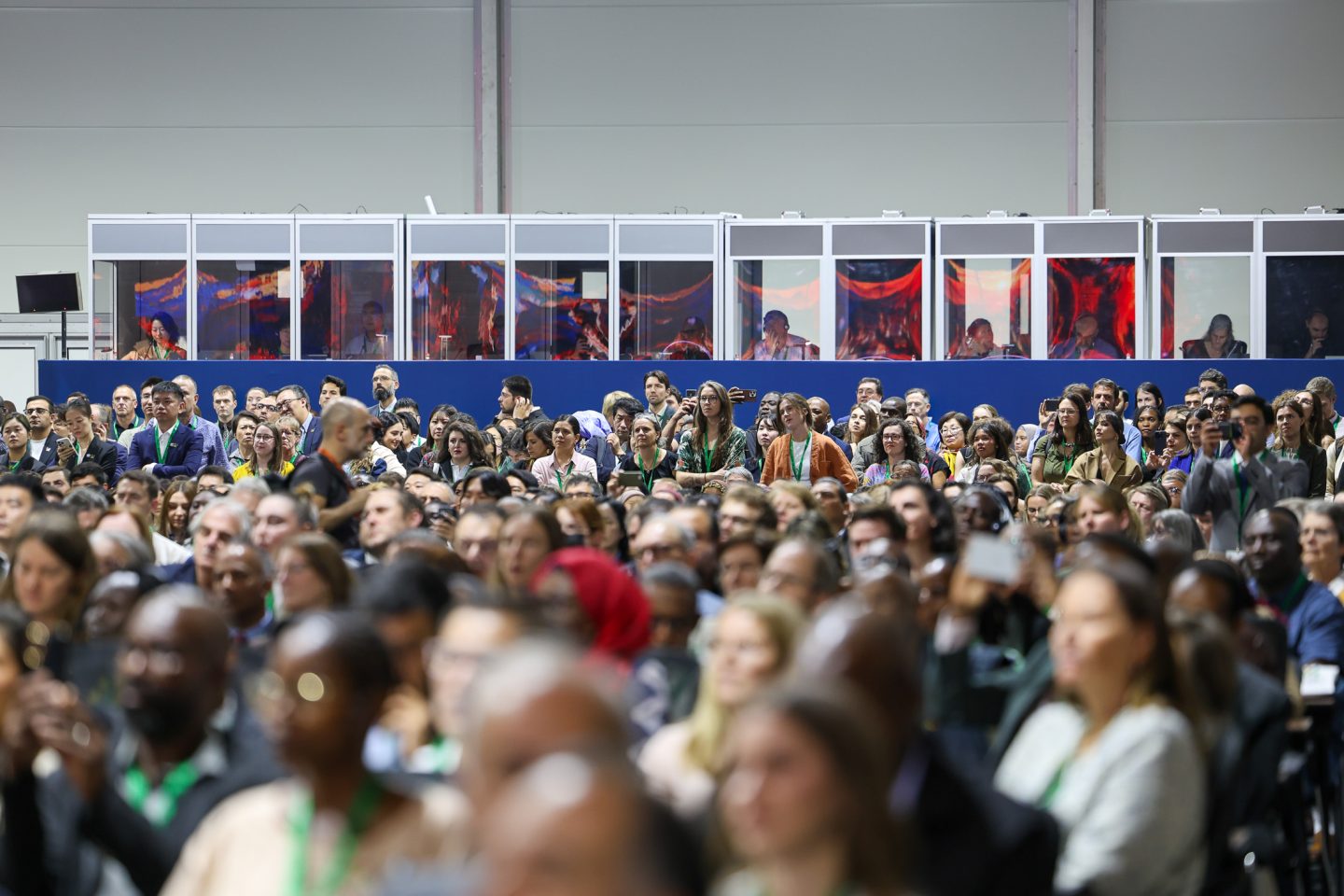
Countries are meeting in Armenia for the first Global Review of Collective Progress – a similar process to the climate Global Stocktake – under which they are expected to adopt a “Yerevan Pathway” outlining ways to ramp up nature conservation policies and get on course to meet global nature goals.
Biodiversity finance falling short
The UN report on progress shows developed countries most likely failed to meet an interim target to channel $20 billion for nature protection by 2025, which developing countries say is necessary to implement a global target to protect 30% of the world’s land and ocean by 2030.
The group of African countries said in a statement at the COP17 opening plenary that the findings of the global review “serve as a serious warning” and “underscore the urgent need to strengthen” the delivery of public finance.
Brian O’Donnell from the non-profit Campaign for Nature told a Climate Home News webinar that public funding is key for developing countries – which are home to most of the world’s biodiversity – so that they can develop tools like spatial planning, incentives for local communities, institutional capacity and even simply signage within a protected area. “We’re asking a lot from those countries,” he added.
The GBF target also states that public biodiversity finance should be increased to $30bn by 2030, and that in total countries should mobilise $200bn from all possible sources – which includes the private sector and philanthropic funds – by the same date. In 2025, global biodiversity finance is estimated to have reached between $74.9 and $92.4 billion per year.

Speaking at the webinar, Steven Guilbeault, a former minister of environment for Canada and one of the architects of the GBF, said he has been hearing the idea of expanding the base of donors to increase available finance since the biodiversity COP1 in 1995, but added it’s not an “easy conversation” that will be solved in Yerevan.
“I wouldn’t want the progress that we’re seeing here, the progress that we can still make in the coming days, to be jeopardised by the entrenched position on this issue,” he said.
In a letter issued to governments, the Armenian presidency said it aimed to adopt the Global Review text this Wednesday, with two days of negotiations still to go. Observers told Climate Home News that this would be a way of detaching it from the thorniest negotiations on finance.
Reducing harmful subsidies as an alternative
Linda Krueger, director of biodiversity and infrastructure policy at The Nature Conservancy (TNC), said it is “no surprise” that the finance decisions will require guidance from ministers, but argued that the “heavy lift” to increase financial commitments will need to come from reforming subsidies.
When the GBF was adopted, countries identified a finance gap of $700bn a year by 2030. They agreed to address it by mobilising $200bn from all sources, but the bulk of this is due to come by redirecting $500bn in subsidies for activities that harm nature. This goal – contained in Target 18 of the GBF – is where governments have made the least amount of progress, according to the UN progress report.
The UN currently estimates that for every dollar invested in nature conservation and restoration, $30 are currently invested in its destruction. A report by Conservation International puts the cost of harmful subsidies at $11 trillion-$24.7 trillion a year, when also accounting for the nature loss they leave behind.
In Yerevan, the COP17 presidency has aimed to raise the profile of the target on subsidies by launching several voluntary initiatives, including the “Friends of Target 18”, a new platform led by Colombia and Finland which will help countries identify and find ways to redirect damaging subsidies.
Early speakers’ list suggests few powerful leaders will attend COP31
A group of over 130 business and financial institutions – among them French bank BNP Paribas, fashion retailer H&M, food giant Nestle and household products multinational Unilever – also issued an open letter calling on countries to accelerate incentive reform.
Speaking to the media on Monday, Kumi Kitamori, environment director at the Organisation for Economic Co-operation and Development (OECD), said much of the discussion focuses on winding down nature-negative incentives, but noted “it’s also equally about scaling up incentives that are positive”.
In the formal negotiations, countries are talking about whether to include a specific mention of this in the Global Review. The COP17 presidency has proposed to include a line encouraging countries “to accelerate the identification, and the elimination, phase out or reform of negative incentives”, as well as scaling up positive ones.
Jill Hepp, Conservation International’s managing director of nature policy and incentives, said this sends a “powerful signal” that the presidency is prioritising subsidy and incentive reform. She said the new suggested text “well reflects the discussions over the last two weeks and the reality that action towards Target 18 in its entirety must be accelerated to keep 2030 goals within reach”.
Private contributions awaiting rules
Developed countries have pointed to the need for more private-sector contributions that can offset shrinking government aid budgets. At the COP16 biodiversity summit in Cali, countries created a new fund to channel voluntary private-sector contributions based on their use of genetic material to support biodiversity protection.
A large part of the fund’s potential relies on the participation of pharmaceutical companies. According to a report by think-tank Zero Carbon Analytics, the top 15 pharma companies could have paid $756 million into the fund in 2025, when taking into account its guidelines suggesting contributions of 1% of profits or 0.1% of revenue.
Yet two years since its creation, the Cali Fund has received little more than $10,000 in corporate contributions. In Yerevan, negotiations have focused on how to operationalise the fund and how to distribute the money among developing countries.
Guilbeault argued that once the rules are finalised, it will open the door to further contributions, noting that companies “need a little bit more security” about what they’re investing in. “Like we saw on climate, when the rules became clearer, more money started flowing through the type of activities we want,” he said.
On the sidelines of COP17, the EU also launched an initiative for “Friends of Credits for Nature and Biodiversity”, which provides a platform to support biodiversity credits. Much like carbon markets, these are credits that companies can buy and sell representing “nature-positive” actions that protect biodiversity, but they are a controversial measure disputed by some Indigenous and environmental groups.
Campaign for Nature’s O’Donnell argued that, even if private-sector flows increase, public funds will still be required, given that the “business case” for some nature-conservation or restoration projects could be harder to make than for climate measures like renewable energy.
Nonetheless, the TNC’s Krueger noted there is a lot of interest among businesses in investing in nature and said the UN biodiversity talks could help ensure they play their part.
“A lot of businesses have taken it up voluntarily, which is fantastic to see. And so, I think a process of making that a little bit more mandatory, a little bit more implemented, could go a long way to help business and nature be aligned,” she said.
The post Stalemate on finance at COP17 nature talks exposes need for new sources appeared first on Climate Home News.
Stalemate on finance at COP17 nature talks exposes need for new sources