

Mae Buenaventura is the manager of the debt justice programme of the Asian Peoples’ Movement on Debt and Development, a regional alliance of peoples’ movements, community organizations, coalitions, NGOs and networks
A potentially historic shift in public debt governance is set to unfold in Washington DC this week as Global South governments take a collective stand to stop a “silent killer” of development financing.
The first-ever UN-hosted borrowers’ forum will officially be launched on April 15 on the sidelines of the 2026 Spring Meetings of the International Monetary Fund (IMF) and the World Bank. Led by five convening countries – Zambia, Egypt, Nepal, the Maldives and Pakistan – the initiative is one of the key wins of last year’s 4th Financing for Development Conference (FFD4) in Sevilla, Spain.
The forum’s mandate is to establish a platform for borrower countries, supported by a UN secretariat, “to discuss technical issues, share information and experiences in addressing debt challenges, increase access to technical assistance and capacity-building in debt management, coordinate approaches and strengthen borrower countries’ voices in the global debt architecture”.
Instead of facing lenders alone, these countries will now use a UN-backed platform to share technical expertise and coordinate their approach to a global debt system that is fundamentally broken.
Debt grips climate-vulnerable nations
The human cost of the current debt architecture is staggering. According to the UN trade and development agency, UNCTAD, more than 40% of the global population – roughly 3.4 billion people – live in countries where the government is forced to spend more on debt payments than on the health, education and social protection of its citizens.
In so-called low-income countries, governments spend an average of 7.5% of their total budgets on debt service, with interest payments consuming up to 20% of total government revenue in these regions.
The Philippines is a case study in this financial stranglehold. It is part of a global majority forced to watch its public services crumble and infrastructure lag while its wealth is siphoned off to satisfy foreign lenders.
The policy of automatic appropriations – a legacy of the rule of late former President Ferdinand Marcos Sr. – mandates that debt servicing takes precedence over any other public expenditure, effectively placing the demands of lenders above the needs of the Filipino people. Even as it faces a $1.5 trillion regional financing gap to achieve the Sustainable Development Goals (SDGs) by 2030, its hands remain tied by a legal framework that values credit ratings over human lives.
-
GEF raises $3.9bn ahead of funding deadline, $1bn below previous budget
Amid aid cuts, donor governments pledge less nature and climate funding to the Global Environment Facility (GEF), with the four-year package to be finalised in late May -
Charging worries, high prices put brakes on EV growth in Bangladesh
Sales of e-bikes and rickshaws are up amid queues at fuel stations, but a lack of charging infrastructure and high prices still deter many Bangladeshis from going electric


As a “middle-income country” (MIC), the Philippines is stuck in a frustrating purgatory. It is often deemed “too wealthy” for the G20’s debt-relief framework, yet too poor to absorb global economic shocks. Last year, Finance Undersecretary Joven Balbosa hit the nail on the head when he called for support that goes “beyond the simplistic income categorization” that ignores a country’s actual vulnerabilities.
Without an inclusive and equitable global debt architecture, nations including the Philippines are left to navigate catastrophic climate risks and economic shocks with zero fiscal breathing space.
No respite during climate disasters
The regional evidence of this systemic failure is everywhere. Take Pakistan, which in 2022 was hit by catastrophic flooding that submerged a third of the country and caused billions in losses. Despite this climate-driven disaster, World Bank data shows that Pakistan made payments in 2023 of $11.8 billion for public and publicly guaranteed (PPG) external debt, while its PPG external debt reached $93 billion that same year, surpassing pre-pandemic debt of $87 billion (2020).
Sri Lanka followed IMF prescriptions throughout 16 lending programs since 1991, only to become the first Asian country this century to default. Its MIC status prevents application for debt relief and restructuring measures. Today, the Sri Lankan people bear the brunt of harsh conditionalities, including raising VAT from 8% to 15%, slashing food and fuel subsidies, and the erosion of hard-earned worker pensions.

Currently, the global rules of lending and borrowing are set by a “creditors’ club” composed of the IMF, the World Bank and the Global Sovereign Debt Roundtable it set up, and the Paris Club.
These institutions measure “debt sustainability” through a narrow lens of a country’s capacity to make timely repayments. They largely ignore internal economic inequalities, gender disparities and the existential threat of climate change.
Crises should trigger debt service cancellation
By organising the new borrowers’ forum, the Global South is signalling that the era of passive “standard-setting” by lenders is over.
The ultimate goal for global civil society and debt justice movements is the establishment of a UN Debt Convention; a democratic, binding and inclusive framework that governs both lenders and borrowers. This mechanism would ensure that debt restructuring and cancellation are sufficient to allow countries to fulfill their international human rights obligations and implement necessary climate actions.
Green Climate Fund picks locations for five developing country hubs
To be truly transformative, debt sustainability analyses must align with human rights and sustainable development needs. This means conducting impact assessments – both before and after loans are issued – to identify “illegitimate” debts that do not benefit the public.
Crucially, we need an automatic debt service cancellation mechanism that triggers during extreme climatic, environmental or health shocks. We also need a binding global debt registry to ensure that every loan is transparent and subject to public scrutiny.
Whether the borrowers’ forum becomes a true milestone depends on its courage to challenge the status quo. We can no longer allow debt to act as a “silent killer” of our future. It is time to demand a financial system that serves humanity, not just the balance sheets of the powerful.
The post Broken debt system must be fixed to confront future climate shocks appeared first on Climate Home News.
Broken debt system must be fixed to confront future climate shocks

Countries’ climate plans would cut global emissions only half as much by 2035 as the UN projected a year ago, its annual assessment showed, after the US exit from the Paris Agreement and weaker new pledges worsened the outlook.
Taking into account the nationally determined contributions (NDCs) of 154 countries, which cover about 71% of global emissions, and current policies in the rest of the world, global emissions would fall to about 6% below 2019 levels by 2035. Last year’s update, based on 113 countries, put the figure at 12%.
According to the Intergovernmental Panel on Climate Change, emissions need to go down by 60% over the same period to limit global warming to 1.5C – a threshold that is now inevitably going to be breached, at least temporarily.
The latest NDCs put the world on course for between 2.1C and 3.2C of warming by the end of the century, depending on what countries do beyond 2035. That is slightly higher than the 1.9C–3.0C range that the UN climate body estimated in last year’s update, published during COP30.
-
Early speakers’ list suggests few powerful leaders will attend COP31
Just 77 heads of state or government are scheduled to address the COP31 climate summit in Antalya, a third less than the COP28 peak -
Paris Agreement committee names three countries snubbing it over NDCs
More than 30 countries have failed to submit an NDC, but only three have repeatedly ignored the committee’s efforts to engage with them


US exit worsens picture
A major factor is the US, the world’s second-largest emitter. Last year’s UN assessment included the pledge to cut emissions by between 61% and 66% by 2035, made under the administration of former President Joe Biden.
But, since the US has officially left the Paris Agreement, its NDC has been excluded from the tally and its emissions projections have now been derived from current policies, which point to far higher levels of pollution.
US emissions grew significantly last year as a result of growing electricity demand and the policies of President Donald Trump’s administration, which has rolled back support for clean energy and backed the burning of fossil fuels.
Weak new NDCs
Another reason for weaker emission reduction projections is that the approximately 40 new NDCs submitted since last year’s update have been less ambitious than the earlier UN modelling had hoped for.
India, the world’s third-largest emitter, submitted its NDC in April. Its plan would let emissions climb to 6.3 billion tonnes by 2035, almost 64% above 2023 levels, according to analysis by Climate Action Tracker (CAT). Its targets are weaker than India’s current policies and it could meet them as early as 2030.
-
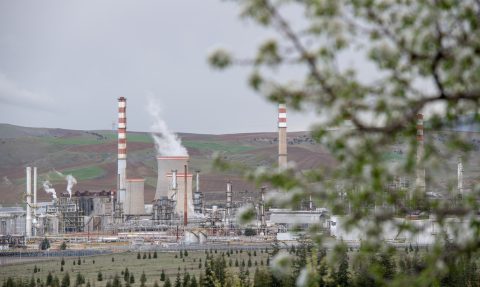
Turkish giant sponsoring COP31 cut climate goals then cashed in on oil boom
COP31 sponsors should be screened for “climate integrity”. Yet Koç Holding has become a top partner while its oil refiner runs flat out and its climate targets slip -
Early speakers’ list suggests few powerful leaders will attend COP31
Just 77 heads of state or government are scheduled to address the COP31 climate summit in Antalya, a third less than the COP28 peak -
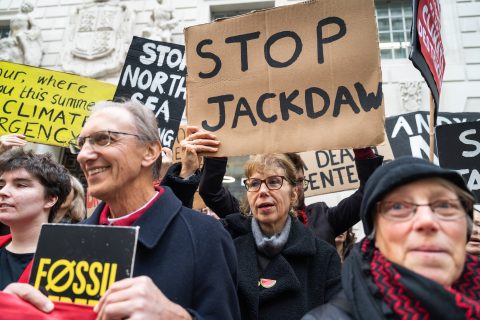
UK approves gas drilling despite admitting blow to “climate leadership” status
The government accepts that approving the Jackdaw field will weaken its climate reputation and downplays the legal weight of the International Court of Justice opinion
Saudi Arabia’s plan, submitted at the end of last year, sets no 2035 target, but has only a 2040 goal to reduce, avoid or remove 335 million tonnes a year against an undisclosed baseline. CAT rates it “critically insufficient”, estimating 2035 emissions at between 13% below and 18% above 2019 levels.
About 30 countries, including Egypt, Vietnam and Argentina, have still not produced an updated NDC, which all governments should have submitted more than a year and a half ago.
UN climate chief Simon Stiell said this year’s assessment report demonstrates again that collective progress remains insufficient, that global transitions are very uneven and that many countries face substantial barriers to delivering their targets and pledges.
He added that COP31 in Türkiye can help address some of the key gaps highlighted in this year’s reports, through ambitious outcomes on emission-cutting efforts, adaptation, climate finance and just transitions, as well as presidency-led initiatives on electrification, curbing methane emissions and progressing towards zero waste.
The post National climate plans now promise half the emission cuts expected by UN appeared first on Climate Home News.
National climate plans now promise half the emission cuts expected by UN
Climate Change
‘A strong start’: WA’s transition to renewable energy powerhouse aided by Premier’s announcement
PERTH, Tuesday 27 October 2026 — In response to WA Premier Roger Cook’s announcement of a doubled renewable energy target for WA’s main energy system, reported today, the following comments can be attributed to WA Campaign Lead at Greenpeace Australia Pacific, Geoff Bice:
“A Western Australian renewable energy target of 75% by 2030-31 is a welcome step in the right direction following sustained calls from across the WA community including unions, industry and advocacy groups.
“This common sense policy is a vital roadmap for WA’s shift to affordable and reliable solar and wind backed by batteries, and gives certainty to business and investors in a volatile global environment.
“Clear policy on renewable energy for WA’s main electricity grid will allow the phase out of polluting coal-fired power from the system and begin to remedy our reliance on expensive and polluting gas.
“This commitment is a positive first step for WA’s clean energy future, but the Cook Government must also address the state’s rising climate pollution driven by the gas industry and industrial processing.
“A natural step towards tackling rising emissions is rejecting any new fossil fuel projects, including Woodside’s proposal to drill for gas at Scott Reef.
“Expert advice and analysis compiled by Greenpeace and Springmount Advisory clearly lays out a viable pathway for WA to follow a staged transition away from fossil fuels and unlock almost $1 trillion of economic value by 2060 by replacing gas exports with green exports.
“The renewable energy target is a strong start — it must now be paired with emissions reduction targets to ensure climate pollution from WA starts falling urgently, and a plan for WA to become a renewable energy powerhouse must be prioritised.”
-ENDS-
Media contact
Emma Sangalli at emma.sangalli@greenpeace.org or 0431 513 465
‘A strong start’: WA’s transition to renewable energy powerhouse aided by Premier’s announcement
Climate Change
WA EPA warned Woodside of ‘serious, significant and irreversible’ harms to Scott Reef from gas plans, new documents reveal