

The Global Environment Facility (GEF), a multilateral fund that provides climate and nature finance to developing countries, has raised $3.9 billion from donor governments in its last pledging session ahead of a key fundraising deadline at the end of May.
The amount, which is meant to cover the fund’s activities for the next four years (July 2026-June 2030), falls significantly short of the previous four-year cycle for which the GEF managed to raise $5.3bn from governments. Since then, military and other political priorities have squeezed rich nations’ budgets for climate and development aid.
The facility said in a statement that it expects more pledges ahead of the final replenishment package, which is set for approval at the next GEF Council meeting from May 31 to June 3.
Claude Gascon, interim CEO of the GEF, said that “donor countries have risen to the challenge and made bold commitments towards a more positive future for the planet”. He added that the pledges send a message that “the world is not giving up on nature even in a time of competing priorities”.
-
UK imports of “green” jet fuel linked to Amazon deforestation
A Texas refinery shipping sustainable aviation fuel to Europe has sourced beef tallow with links to a meatpacking firm fined over illegal cattle purchases -
Italy pushes coal exit back after gas prices rise
Analysts say the move sends a negative signal, but its impact will be limited given coal’s marginal role in Italy’s energy mix


Donors under pressure
But Brian O’Donnell, director of the environmental non-profit Campaign for Nature, said the announcement shows “an alarming trend” of donor governments cutting public finance for climate and nature.
“Wealthy nations pledged to increase international nature finance, and yet we are seeing cuts and lower contributions. Investing in nature prevents extinctions and supports livelihoods, security, health, food, clean water and climate,” he said. “Failing to safeguard nature now will result in much larger costs later.”
At COP29 in Baku, developed countries pledged to mobilise $300bn a year in public climate finance by 2035, while at UN biodiversity talks they have also pledged to raise $30bn per year by 2030. Yet several wealthy governments have announced cuts to green finance to increase defense spending, among them most recently the UK.
As for the US, despite Trump’s cuts to international climate finance, Congress approved a $150 million increase in its contribution to the GEF after what was described as the organisation’s “refocus on non-climate priorities like biodiversity, plastics and ocean ecosystems, per US Treasury guidance”.
The facility will only reveal how much each country has pledged when its assembly of 186 member countries meets in early June. The last period’s largest donors were Germany ($575 million), Japan ($451 million), and the US ($425 million).
The GEF has also gone through a change in leadership halfway through its fundraising cycle. Last December, the GEF Council asked former CEO Carlos Manuel Rodriguez to step down effective immediately and appointed Gascon as interim CEO.
Santa Marta conference: fossil fuel transition in an unstable world
New guidelines
As part of the upcoming funding cycle, the GEF has approved a set of guidelines for spending the $3.9bn raised so far, which include allocating 35% of resources for least developed countries and small island states, as well as 20% of the money going to Indigenous people and communities.
Its programs will help countries shift five key systems – nature, food, urban, energy and health – from models that drive degradation to alternatives that protect the planet and support human well-being by integrating the value of nature into production and consumption systems.
The new priorities also include a target to allocate 25% of the GEF’s budget for mobilising private funds through blended finance. This aligns with efforts by wealthy countries to increase contributions from the private sector to international climate finance.
Niels Annen, Germany’s State Secretary for Economic Cooperation and Development, said in a statement that the country’s priorities are “very well reflected” in the GEF’s new spending guidelines, including on “innovative finance for nature and people, better cooperation with the private sector, and stable resources for the most vulnerable countries”.
Aliou Mustafa, of the GEF Indigenous Peoples Advisory Group (IPAG), also welcomed the announcement, adding that “the GEF is strengthening trust and meaningful partnerships with Indigenous Peoples and local communities” by placing them at the “centre of decision-making”.
The post GEF raises $3.9bn ahead of funding deadline, $1bn below previous budget appeared first on Climate Home News.
GEF raises $3.9bn ahead of funding deadline, $1bn below previous budget

Climate Change
COP31 Bulletin Day 13: New draft retains electrification goal but delays adaptation finance and science decisions
After an evening of tense discussions, a new version of the cover text was finally released at around 2am on Sunday morning. But, with many delegates flying home, it is unclear if – and for how long – there will be the two-thirds of governments present needed to legally adopt a decision.
The latest draft, which is – as of 9.30 – scheduled to be put to a plenary session for approval at 10am – retains a goal to boost electrification and links it more strongly with clean energy and storage. It does not, however, include language on transitioning away from fossil fuels as many countries had called for.
It ditches a specific numerical target for carbon capture, use and storage (CCUS), a controversial technology that is favoured by fossil fuel producers, which is now only an aim “to achieve gigatonne scale globally by 2035 as a collective global aspiration”. The previous version had two alternative targets, a weaker one of 0.5Gt “working towards” 1.3-2.5Gt and a stronger one of 2.5Gt.
The draft cover decision has strong language on responding to an almost certain overshoot of the 1.5C warming limit, recognising that it will increase loss and damage and result “in increasingly adverse, and in some cases irreversible, impacts and risks to human and natural systems”. As President of Negotiations Chris Bowen has repeatedly drawn attention to, this is the first COP held since the UN acknowledged that overshoot is inevitable.
In pursuing efforts to limit any overshoot, the decision recognises the need for “deep, rapid and sustained reductions in greenhouse gas emissions in line with 1.5 °C pathways” – which is a push towards greater ambition.
The text also resolves to close adaptation gaps and boost action and support to help countries and communities to better cope with adverse climate impacts. But it does not put a figure to a goal agreed at COP30 last year to triple adaptation finance by 2035.
The goal did not specify a baseline year and African nations, least-developed countries and small island states had pushed for it to be a later and higher baseline and therefore a larger target number of $120 bn a year. Instead, the text launches a “roadmap” on adaptation finance to be considered at COP32.
Loss and damage finance has been cut from the roadmap’s scope, as have references to about half the money pledged to the loss and damage fund having yet to be sent to the fund’s bank account and the gap between the $2.8 billion of loss and damage funding requested by developing countries in the fund’s start-up stage and the $0.342 billion allocated to fund these projects. “Erasing the shortfall doesn’t make it disappear for families who have lost everything”, said Harjeet Singh, global convenor of Fill the Fund.
The new text drops its invitation to the Intergovernmental Panel on Climate Change (IPCC) to publish all of its next three reports in time for the 2028 global stocktake of climate progress. Instead, it just invites them to “continue to provide policy-relevant information as input to the UNFCCC processes, including outputs from the seventh assessment cycle to the next global stocktake”. It no longer specifies that all their reports, including the third on reducing emissions, are published. The IPCC will have an online meeting in December to discuss this issue but COP31 guidance will be influential in its decision.
As Climate Home News entered the venue around 7.30am, tired-looking negotiators from Saudi Arabia and from the Alliance of Small Island Developing States were seen entering the area which houses the Presidency’s offices, as others dozed on sofas. A source close to the German delegation said that negotiations had been intense and were not necessarily resolved.
If the Presidency does not think it can get agreement on a cover text, then it can withdraw it or it can issue it a Presidency declaration, which does not have much weight. Some of its provisions could be added into other agenda items and adopted seperately. Governments could also decide to reconvene COP31 at a later date – known as a bis – as happened at COP6.
The post COP31 Bulletin Day 13: New draft retains electrification goal but delays adaptation finance and science decisions appeared first on Climate Home News.
COP31 Bulletin Day 13: Germany rejects text moments before plenary meeting
On Friday night, COP31 approved a series of less controversial agenda items and then COP President Murat Kurum told governments to hang around the venue until midnight in case his team wanted to consult them on the cover text, which is still Thursday’s version.
If you don’t hear from us, Kurum said, go home and get some rest and don’t bother coming in before 9am. Governments appear to have taken his advice. Around 10am, the conference centre was ghostly and there was still no sign of a new draft cover text.
COP31 Bulletin Day 11: Countries decry cover text for omitting fossil fuels
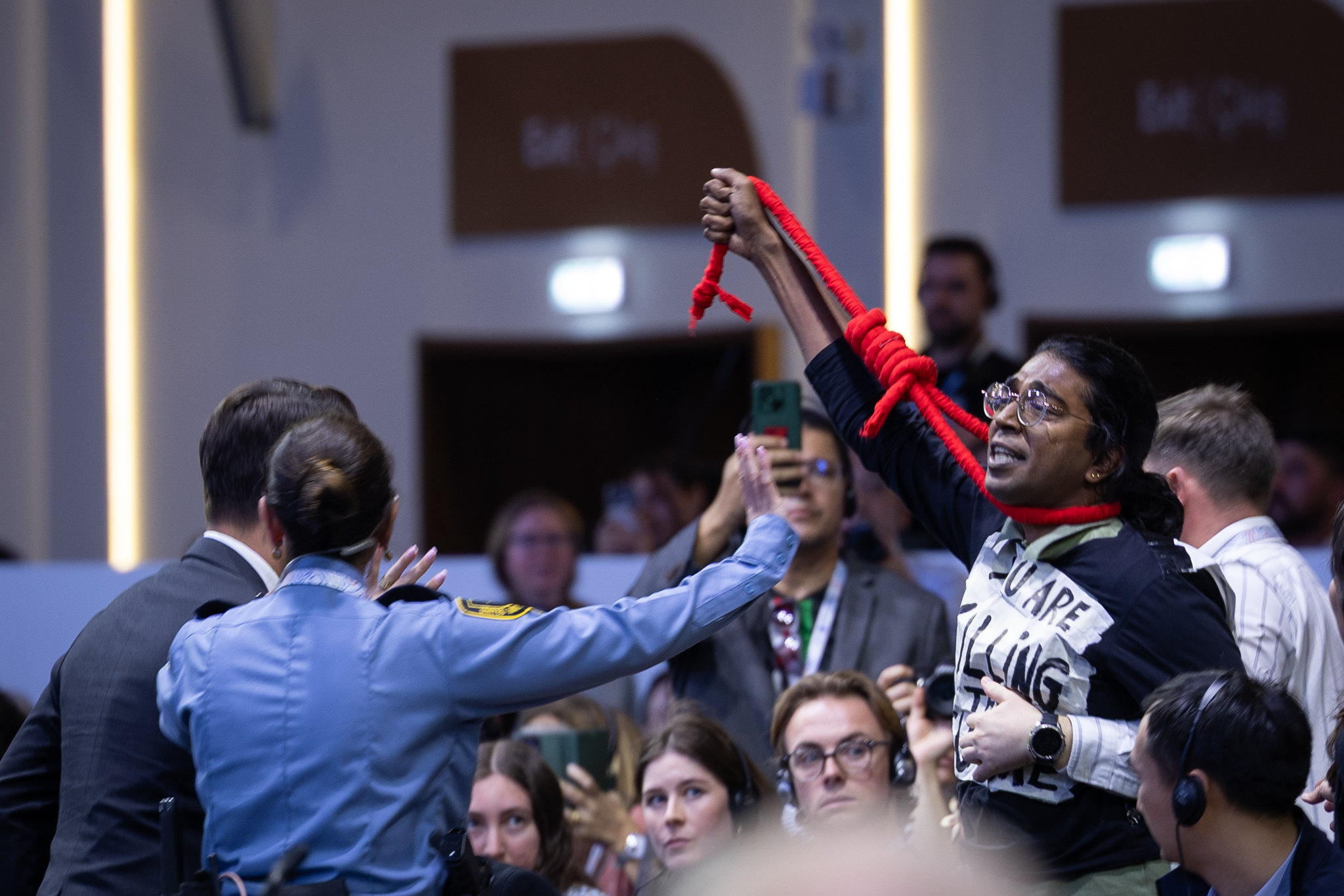
Friday night’s plenary did offer a few moments of drama. An activist was ushered out of the room by security after holding a rope around his neck and shouting “you keep doing nothing, nothing at all” and “you are killing the future, just kill me now” to a smattering of applause.
Panama’s environment minister Juan Carlos Navarro urged Kurum to ensure full respect of the rules of procedure when gavelling decisions through this weekend. Given he has led threats to object to the cover text if it is not ambitious enough, this sounded like a warning to Kurum not to ignore objections, as previous COP presidents have been accused of doing.
Another significant development on Friday night was a joint statement from Australia and China which, among other things, expressed China’s backing for the 35×35 electrification goal. More on that here.
The post COP31 Bulletin Day 12: ‘Don’t ignore us,’ Panama warns as COP31 runs into overtime appeared first on Climate Home News.
COP31 Bulletin Day 12: ‘Don’t ignore us,’ Panama warns as COP31 runs into overtime
“Fossil fuels dumped from latest draft deal at climate summit.” “Ambition goes missing as fossil fuel language drops from draft deal.” “Anger as COP31 draft climate deal removes all mentions of fossil fuels.” These are a few selected headlines about the COP31 climate negotiations as they are due to draw to a close this weekend – and they hoto: © UN Climate Change – Kiara Worth)all miss the point.
Yes, the UN climate negotiations should address fossil fuels, the primary driver of the climate crisis. But there are many other key issues at play in the negotiations.
Yes, COP31 is shaping up to be a disastrous failure for people and the planet, especially frontline communities in the Global South. But it’s because of much more than the absence of language on fossil fuel phaseout.
COP31 Bulletin Day 11: Countries decry cover text for omitting fossil fuels
The UN climate negotiations are premised on the idea that the countries of the Global North, which have built their wealth on the backs of heavily polluting fossil fuel-based economies, must do two main things: reduce their emissions and provide support for poorer countries of the Global South. Enabled by climate finance from the Global North, Global South countries should transition much faster to clean, sustainable economies than they would be able to do otherwise.
In addition, given their climate inaction of the past many decades – including ongoing and, in some cases, increasing use of fossil fuels – those Global North countries must also pay to support adaptation to future climate impacts, as well as to respond to loss and damage from climate shocks and stresses that have already happened.
Bad-faith negotiating
On August 26, catastrophic warming-driven glacial floods hit Nepal, with some 1,500 people dead and over 5,000 still missing. Almost exactly two months later, EU climate commissioner Wopke Hoekstra said that any new pledges for climate finance to support countries like Nepal were “dead in the water.”
This comment was shocking for how callous and tone-deaf it was. But it was also shocking because it was the EU openly declaring that they were coming to the COP31 negotiations with nothing to offer – that they would have no intent to negotiate in good faith. Without finance from rich developed countries, the UN climate regime simply does not, and cannot, work.
This is the real story of the failure of COP31. The actual negotiating deliverables for this year’s climate summit include a work programme on climate finance, an institution to support countries to design just transition plans, and progress on adaptation goals supported by adaptation finance. Across all of these negotiating tracks, developed countries led by the EU have done nothing but bullying and blocking.
It is deeply unfair and incoherent for developed countries to call for quicker fossil fuel phaseout in poorer countries while denying those countries the support they need to deliver.
This position becomes even more nonsensical when considering that developed countries’ claims to “leadership” on fossil fuel phaseout are built on lies. The “roadmaps” for transitioning away from fossil fuels that some of these countries have announced are nothing more than repackaged existing policies – exercises in public relations rather than serious plans for change.
Ugandan oil official welcomes transition roadmap as nation gears up for exports
Why the broader story matters
A singular focus on the lack of fossil fuel outcomes – which were not actually on the agenda for the COP31 negotiations – conveniently blurs the story of EU and Global North bad faith out of the picture. It allows the rich countries to do their usual blame game, pointing the finger at Saudi Arabia and similar countries (ignoring the fact that it is actually the United States that has, by far, the world’s largest oil and gas expansion plans).
A political signal in the COP31 text reiterating the importance of phasing out fossil fuels would be very useful (though it would be deeply undermined by language around carbon capture and storage that does exist in the text and must be removed). But that is not actually what this year’s negotiations are about.
Finance, adaptation, and just transition are among the major negotiating tracks at COP31. On each one of these tracks, rich countries have been stonewalling at every turn. Not only are they refusing to fulfill their obligations, they are undermining future obligations and pointing the finger at anyone but themselves when a weak negotiating outcome is the result.
We should be outraged at the lack of progress in phasing out fossil fuels, but we cannot lose sight of the real blockers of progress in the broader geopolitics of the UN climate talks. Saying climate finance is “dead in the water” weeks before negotiations even begin? The EU taking up the mantle of climate villain now that the Trump-led US is out of the picture? That’s the real scandal.
The post COP31 is shaping up to be a disaster – not only because it’s weak on fossil fuels appeared first on Climate Home News.
COP31 is shaping up to be a disaster – not only because it’s weak on fossil fuels

COP31 Bulletin Day 13: New draft retains electrification goal but delays adaptation finance and science decisions

How “Marie Antoinnete” Can We Get?



