

The UN’s climate body (UNFCCC) is facing “severe financial challenges” as the ability to fulfill its expanding workload is being put at risk by governments’ failure to provide enough money.
The UNFCCC executive director Simon Stiell made an urgent plea for more funding to over 40 ministers and negotiators gathered on Thursday in Helsingør, Denmark, for the first major climate summit of the year.
“Our organization, the UNFCCC, now faces severe financial challenges,” he said. “We are attempting to meet an ever-growing mandate. Our job is to make your job easier. To carry out the tasks you have all agreed we should do, but we can only do this if we have the funding support.”
Stiell highlighted that the organisation’s budget “is currently less than half funded”.
Budget headache
The UNFCCC estimated it needed around €152m ($165m) in the 2024-2025 period to carry out an ever-growing number of activities that countries ask the climate body to be in charge of.
But, in Bonn last June, countries agreed only to a core budget of €74m ($80.4m) with compulsory contributions provided by governments based on their wealth. This was a 19% increase on the previous two years’ budget, ignoring inflation.
That left the climate body with a hole of €78m ($85m) that would need to be filled with voluntary donations from governments and private entities.
This money is needed to arrange dozens of meetings across the world on key negotiating strands like the new climate finance goal – to be agreed at COP29 – the global goal on adaptation and a new carbon market under Article 6 of the Paris Agreement.

Voluntary donations missing
But, so far this year, the UNFCCC has managed to raise less than $9m in voluntary donations. The United Kingdom has given the largest sum – $2.1m – followed by the Open Society Foundations ($1.5m), the Rockefeller Foundation ($1.3m) and Germany ($0.9m).
The climate body is also scrambling to collect millions of dollars in compulsory contributions that countries failed to fork out in previous years.
African dismay at decision to host loss and damage advice hub in Geneva
The funding shortfall is fuelling a sense of angst among UNFCCC staff, who are forced to constantly find new ways to shuffle money around in emergency mode without any long-term certainty, according to a source with knowledge of the UNFCCC’s operations.
The UNFCCC has repeatedly warned governments of the risk of leaving them at the mercy of voluntary donations.
During discussions over the size of its budget last year, it wrote that “prohibitive dependence on supplementary funding” would result in “jeopardizing the sustainability of the UNFCCC secretariat and limiting support to critical recurring and long-term activities”.
Urgent pleas
At Cop28, soon after the gavel came down in Dubai, Simon Stiell urged governments to stump up more cash for unfunded operations.
But his plea went unheeded, prompting Stiell to issue a new request for funding in a letter to all countries last week. He then used his speech at the Danish climate summit to bring his argument out in the open.
“This is me once again ringing that alarm bell,” he said. “I urge you to respond as soon as possible, to ensure you get the support you need and have requested from us.”
The post UN’s climate body faces “severe financial challenges” which put work at risk appeared first on Climate Home News.
UN’s climate body faces “severe financial challenges” which put work at risk

SYDNEY, Friday 9 October 2026 — In response to the Environment Protection Order issued by the National EPA to stop deforestation at a cattle station in North Queensland, the following comments can be attributed to Adele Chasson, Nature Policy Lead at Greenpeace Australia Pacific:
“Greenpeace welcomes the Environment Protection Order to stop deforestation operations at Wombinoo Station in North Queensland. This order is good news for koalas, wildlife and the Great Barrier Reef. Without intervention, this bulldozing operation could have led to more than 1,000 tonnes of toxic sediment runoff flowing into the Great Barrier Reef every year. This is the first such order under the reformed national nature laws, and shows the potential for genuine environment protection provided strong action continues.
“But this is just one station in one state, and now we need rapid action. Rampant deforestation in Australia continues to destroy precious forests, pushing threatened animals like the koala to the brink of extinction, and poisoning the Great Barrier Reef with muddy runoff. Every minute, the equivalent of a dump truck of sediment enters the Reef, smothering coral and threatening our global icon.
“This first stop order is a great start, but the Albanese government must stop widespread deforestation threatening the Great Barrier Reef and endangered wildlife using the new nature laws. We need a no-go zone plan for the Great Barrier Reef to reign in the bulldozing of forests in the catchment area, and for the National EPA to use the full extent of its powers to catch bulldozers in real time and crack down on deforestation with strong sanctions.
-ENDS-
‘Good news for wildlife’ as EPA puts stop order on Qld cattle station deforestation
After witnessing and hearing stories of Pacific islands’ vulnerability to climate change, senior climate officials have promised to strengthen efforts to limit global warming to 1.5C, despite an expected overshoot, and to help the region adapt to rising seas and other impacts.
More than 30 world leaders, ministers, climate negotiators and international development bankers travelled to the sinking atoll nation of Tuvalu on Tuesday before attending the pre-COP31 talks in Fiji, where schoolchildren told them about the effects warming-driven droughts, heatwaves and storms are having on their education.
Australia and the Pacific nations hoped to use the pre-COP to reinforce the urgency of tackling climate change to the officials from around 50 countries who travelled to the region. Fiji’s climate minister, Lynda Tabuya, told a closing press conference on Thursday they had wanted to “bring decision-makers to the climate frontlines”.
Many of those decision-makers said they had been moved by what they had seen and heard this week, and their speeches emphasised the importance of limiting global warming to 1.5C above pre-industrial levels, a key goal of the 2015 Paris climate agreement.
-
Pacific leaders rail at climate finance failures after pre-COP trip to Tuvalu
Island nations seek invest in their own Pacific Resilience Facility, as they struggle with the red-tape of international climate funds -
New Zealand accused of breaching EU trade deal over climate rollbacks
The EU’s climate trade rules face their first major test after a green group alleged New Zealand violated binding environmental provisions under its trade deal with the bloc

In September, a UN report acknowledged that the 1.5C threshold will be breached but said temperatures could still be brought back down to that level by the end of the century with stepped-up climate action.
A month ago, Türkiye‘s COP31 President Murat Kurum told a press conference in the northern Turkish city of Trabzon that limiting global warming to 1.5C “does not really look possible”, adding that “around 1.5C, that will be a success”.
But after seeing the “anxiety” of children and mothers in Tuvalu caused by rising sea levels, Kurum told reporters in Fiji that 1.5C is a “matter of survival – the survival of cultures, history, memories, your homeland, your homes – it’s that important.”
“The 1.5C target is in jeopardy and we do not have a single minute, a single day to lose,” he added through an interpreter.
Jacobo Ocharan, head of political strategies at Climate Action Network International, warned that “words of concern will not protect anyone”. “The Pacific has shown the world what is at stake. Now governments must show they are ready to act,” he said. “[COP31 in] Antalya must deliver decisions that change people’s lives for the better.”
$1.5 billion for 1.5C
In Fiji, Kurum echoed the call of Australia and Pacific nations for contributions to the fledgling Pacific Resilience Facility (PRF), which aims to use the returns on its investments to fund community climate adaptation projects like water storage, building sea walls and protecting homes from storms. “$1.5 billion for 1.5 degrees will save the Pacific,” he said. “It’s that easy. Life will continue in Tuvalu. Children will be smiling again.”
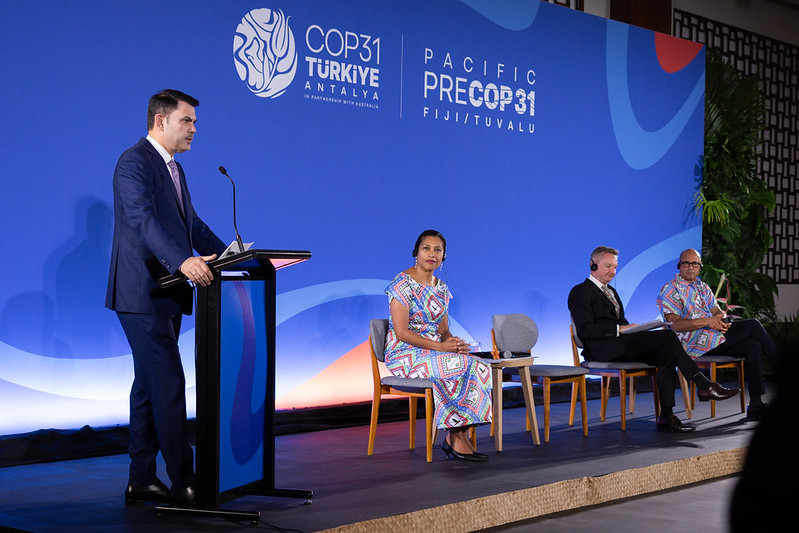
Sitting next to him, Fiji’s Tabuya said she was “encouraged” by his words. “$1.5 billion for 1.5. We will hold COP 31 to that,” she said. The PRF has been promised just under $200 million so far – including about $15 million pledged by European and Pacific governments at pre-COP – and is aiming for $500 million by COP31. It has a longer-term target of mobilising $1.5 billion in capital.
After Pacific leaders on Tuesday aired a litany of concerns about the barriers to accessing the global climate finance system, Kurum joined in at Thursday’s press conference. “Justice in climate finance is essential,” he said. “Resources must reach those in need in a timely and accessible manner, not through a lot of red-tape, and we cannot accept that the same countries should always bear the burden.”
Plan for easier access to climate finance
Australian climate and energy minister Chris Bowen, who is COP31’s president of negotiations, also lamented that “the countries that need the finance the most get it the least”. He said he would ask governments and multilateral development banks to support an access to finance plan for small island states and the world’s poorest nations, launched by Australia on Thursday.
The plan says that while there has been progress in making it easier and quicker to obtain international climate funding, “multiple persistent challenges have continued to limit access to climate finance for developing countries”.
It adds that the amounts available are insufficient to meet climate goals and stresses the need for “grant-based and highly concessional financing”, especially for adaptation and responding to loss and damage. The plan proposes an annual high-level forum on climate finance access to track implementation.
The pre-COP summit closed with an emotional plea from Fiji’s host minister Tabuya. Fighting back tears before finally succumbing, she asked delegates to “carry something of the Pacific with you”.
“Remember the people you met, the stories you heard and why we gathered. This pre-COP draws to a close tonight. Our responsibility does not,” she said to applause.
The post Pre-COP draws attention to Pacific’s climate plight and 1.5C goal appeared first on Climate Home News.
Pre-COP draws attention to Pacific’s climate plight and 1.5C goal
Climate Change
Australia’s climate credibility tested at Pacific Pre-COP talks, as High Court fossil fuel ruling puts government on notice
NADI, FIJI Thursday 8 October 2026 — As the Pacific Pre-COP talks wrap up and Australia prepares to take the reins of COP31 Negotiations in Türkiye next month, Greenpeace Australia Pacific says the government is on notice over fossil fuel expansion and exports, and must accelerate action to align with a 1.5°C pathway.
Following yesterday’s landmark High Court ruling that the climate impacts of coal and gas exports must be considered by New South Wales planning authorities, Greenpeace Australia Pacific is calling on the Albanese government to find the “courage, leadership and grit” to chart a new course away from fossil fuels.
High res images and video from yesterday’s ‘Keep 1.5C Alive’ flotilla in Nadi can be found here
Speaking from Nadi, Shiva Gounden, Head of Pacific at Greenpeace Australia Pacific, said:
“The outcomes of this week’s talks are a drop in the ocean given the scale of need, and urgency of the crisis our communities are facing. It is like taking a glass of water to a burning house if we do not urgently act to address the root cause of the existential threat facing Tuvalu, Fiji and all Pacific countries: fossil fuel expansion.
“The Electrification Pledge must end fossil fuel dependence, not be an end in itself — its ultimate success depends on ensuring electricity comes from renewable sources that displace fossil fuels and align with a 1.5°C pathway. It must be underpinned by justice and backed by finance flowing from polluters to communities.
“Limiting global warming to 1.5°C is a non-negotiable survival line for humanity and Australia must act. The landmark climate advisory ruling from the ICJ is clear — 1.5°C is the moral, the scientific and the legal limit. Continuing down the fossil fuel path, and failing to align efforts with limiting warming to 1.5°C, is a breach of our international legal obligations, and risks making Australia liable for future reparations from climate-vulnerable nations.”
Also in Nadi, Dr Simon Bradshaw, COP31 Lead and climate expert at Greenpeace Australia Pacific, said: “The Pacific was never going to be a mere backdrop for Australia in its role as incoming chair of the COP31 climate talks, but where its credibility and commitment to climate leadership would be tested.
“Here we see communities fighting for their survival and doing everything possible to hold the line on returning warming to 1.5°C. When governments profess to take their concerns seriously, only to then throw more fuel on the fire, the pain and sadness is visceral.
“This week the High Court of Australia recognised what the Federal Government refuses to — that Australia is responsible for the climate damage of our fossil fuel exports and if governments don’t act, the courts will intervene. The message is simple: this is not someone else’s problem, it is ours.
“We must now follow other countries in developing a national roadmap away from fossil fuels that ensures a managed wind-down of fossil fuel production, including exports, in line with our legal obligation to help return warming to 1.5°C.”
ENDS
Media contact: Kate O’Callaghan in Nadi on +61 406 231 892 (Whatsapp/Signal)


-
Climate Change1 year ago
Guest post: Why China is still building new coal – and when it might stop
-

 Greenhouse Gases2 years ago
嘉宾来稿:满足中国增长的用电需求 光伏加储能“比新建煤电更实惠”
-
Greenhouse Gases1 year ago
Guest post: Why China is still building new coal – and when it might stop
-

 Climate Change2 years ago
嘉宾来稿:满足中国增长的用电需求 光伏加储能“比新建煤电更实惠”
-

 Renewable Energy12 months ago
Sending Progressive Philanthropist George Soros to Prison?
-
Climate Change2 years ago
Bill Discounting Climate Change in Florida’s Energy Policy Awaits DeSantis’ Approval
-
Greenhouse Gases1 year ago
嘉宾来稿:探究火山喷发如何影响气候预测
-

 Climate Change2 years ago
Analysis: China’s CO2 falls 1% in Q2 2024 in first quarterly drop since Covid-19